
Most American startup founders spend countless hours crafting solutions without truly knowing if their target audience cares. If you are a millennial tech-savvy professional dreaming of leaving your corporate job behind, your biggest risk is building an AI product that nobody wants. With over 90 percent of startups failing because they misread market needs, learning to define your audience and validate your solution is non-negotiable. This guide offers clear, actionable strategies to help you gain real market traction quickly.
Table of Contents
- Step 1: Define Your Target Audience And Pain Point
- Step 2: Validate Your Solution With Real User Feedback
- Step 3: Build A Streamlined MVP For Rapid Launch
- Step 4: Execute Focused Marketing And Outreach Campaigns
- Step 5: Track Traction Metrics And Iterate For Growth
Quick Summary
| Main Takeaway | Explanation |
|---|---|
| 1. Define Your Target Audience | Clearly identify your audience and their pain points to tailor your solution effectively. |
| 2. Gather Real User Feedback | Utilize various methods to validate your concept and adjust based on user insights and behaviors. |
| 3. Build a Focused MVP | Develop a minimum viable product concentrating on essential features to test your core hypothesis efficiently. |
| 4. Execute Targeted Marketing Campaigns | Personalize your marketing efforts based on deep audience understanding to increase engagement and conversion. |
| 5. Track Key Traction Metrics | Monitor actionable metrics to understand your product’s performance and adapt your strategies for growth. |
Step 1: Define your target audience and pain point
Defining your target audience and understanding their core pain point is the foundational strategy for startup success. This critical step transforms your product from a generic solution to a laser focused remedy that solves real problems for specific people.
Start by identifying decision maker groups who will most urgently need your solution. Consider breaking down potential customers into specific categories like policy makers, providers, purchasers, and end users. Each group will have unique challenges and perspectives that can help you refine your startup’s value proposition.
To dig deeper, create detailed customer personas that go beyond basic demographics. Map out their professional challenges, emotional triggers, and specific scenarios where your solution becomes indispensable. Ask questions like: What keeps them up at night? What inefficiencies frustrate them most? What would make their professional life significantly easier?
Research your potential market through direct interviews, online surveys, industry reports, and conversations with professionals in your target sector. The more precisely you can articulate your audience’s pain points, the more compelling your startup’s solution will become.
Pro tip: Create a one page customer persona document that includes their professional challenges, goals, and specific scenarios where your solution becomes a game changer.
Step 2: Validate your solution with real user feedback
User feedback is the critical lifeline that transforms your startup concept from theoretical potential into a market ready solution. This step demands a strategic approach to gathering authentic insights that will either confirm your value proposition or reveal necessary pivots.
Start by implementing continuous feedback methods that allow you to capture real world user experiences. Create multiple feedback channels including direct interviews, online surveys, prototype testing sessions, and analytics tracking. The goal is to collect both qualitative and quantitative data that provides a comprehensive view of how users interact with your solution.
Your validation process should move beyond surface level responses. Dive deep into understanding not just what users say, but how they behave when using your product. Solution validation research recommends combining multiple research methods to ensure high confidence in your design decisions. This might include usability testing, behavioral analytics, user journey mapping, and comparative assessments that reveal genuine user needs and friction points.
Prioritize gathering feedback from potential customers who closely match your initial target audience persona. Look for patterns in their responses that indicate whether your solution genuinely solves a significant problem. Pay special attention to the language they use, the specific challenges they describe, and the emotional responses they have to your proposed solution.
Compare key feedback methods startups use to validate their solution:
| Method | Strengths | Limitations |
|---|---|---|
| Direct Interviews | Provides deep qualitative insights | Time-consuming, less scalable |
| Online Surveys | Offers broad quantitative data | May limit depth of understanding |
| Usability Testing | Observes real user interaction | Needs prototype and planning |
| Behavioral Analytics | Reveals unbiased user behaviors | Requires strong data infrastructure |
Pro tip: Create a systematic feedback tracking template that allows you to quantify qualitative responses and easily identify recurring themes across different user interactions.
Step 3: Build a streamlined MVP for rapid launch
Building a minimum viable product (MVP) is your startup’s critical first mission transforming your concept from abstract idea to tangible solution. Your goal is to create the leanest possible version of your product that validates your core value proposition while conserving precious resources.

Rapid MVP development requires ruthless focus on essential features that directly address your target audience’s primary pain points. Think of your MVP as a strategic prototype designed to test your most fundamental hypotheses about market need. This means stripping away everything nonessential and concentrating on the single core functionality that makes your solution unique.
Start by mapping out your product’s absolute minimum requirements. What is the smallest set of features that will demonstrate your solution’s potential? Launch strategies suggest that you can potentially develop and launch a meaningful product in as little as 20 days by maintaining laser sharp focus. Prioritize user experience and simplicity over comprehensive functionality. Your initial version should be clean, intuitive, and directly solve one specific problem for your target users.
During development, maintain an iterative approach. Build quickly, test with real users, gather feedback, and be prepared to pivot. Your first version is not about perfection but about learning and validating your core concept. Embrace imperfection and view each iteration as a step toward understanding your market more deeply.
Pro tip: Document every assumption you’re testing with your MVP and create a structured feedback collection mechanism to systematically capture user insights during initial launch.
Step 4: Execute focused marketing and outreach campaigns
Successful startup marketing demands precision targeting and strategic communication that transforms your product from an unknown entity into a compelling solution people actively seek. Your outreach campaigns are not about shouting loudest but connecting most authentically with your ideal customers.
Strategic marketing planning requires creating personalized content meticulously aligned with specific customer segments and buyer personas. This means developing a nuanced understanding of your target audience that goes far beyond basic demographics. Map out their professional challenges, communication preferences, online behaviors, and emotional triggers that will make your message resonate.
Craft your marketing approach with surgical precision. Design campaigns that speak directly to your audience’s most pressing pain points, using language that feels like a direct conversation rather than a generic pitch. Research driven outreach demonstrates that tailored communication significantly increases engagement and conversion potential. Your goal is to position your startup as the precise solution to a specific problem your audience is desperately seeking to solve.
Utilize multiple channels strategically. This might include targeted social media advertising, content marketing through industry blogs, LinkedIn networking, specialized webinars, and direct email outreach. Each channel should be selected based on where your specific audience congregates and consumes information. Track your metrics obsessively and be prepared to pivot quickly based on real world response.
Pro tip: Create a living document tracking your marketing experiments that captures not just results but the specific hypotheses you are testing with each campaign iteration.
Step 5: Track traction metrics and iterate for growth
Tracking startup traction is not about collecting endless data points but about identifying the most meaningful signals that demonstrate your product’s market potential. Your metrics should tell a clear story about your startup’s momentum and potential for sustainable growth.
Impact tracking strategies reveal the importance of combining quantitative metrics with qualitative insights. This means going beyond surface level numbers and understanding the deeper narrative behind each data point. Your goal is to develop a comprehensive dashboard that captures not just raw performance indicators but the underlying dynamics of user engagement and market response.
Focus on a core set of actionable metrics that directly reflect your startup’s unique value proposition. These might include customer acquisition cost, user retention rates, conversion percentages, and engagement depth. Create a systematic approach to measurement that allows you to quickly identify trends, recognize emerging opportunities, and swiftly adapt your strategy. Treat each metric as a living indicator that requires continuous interpretation and responsive adjustment.
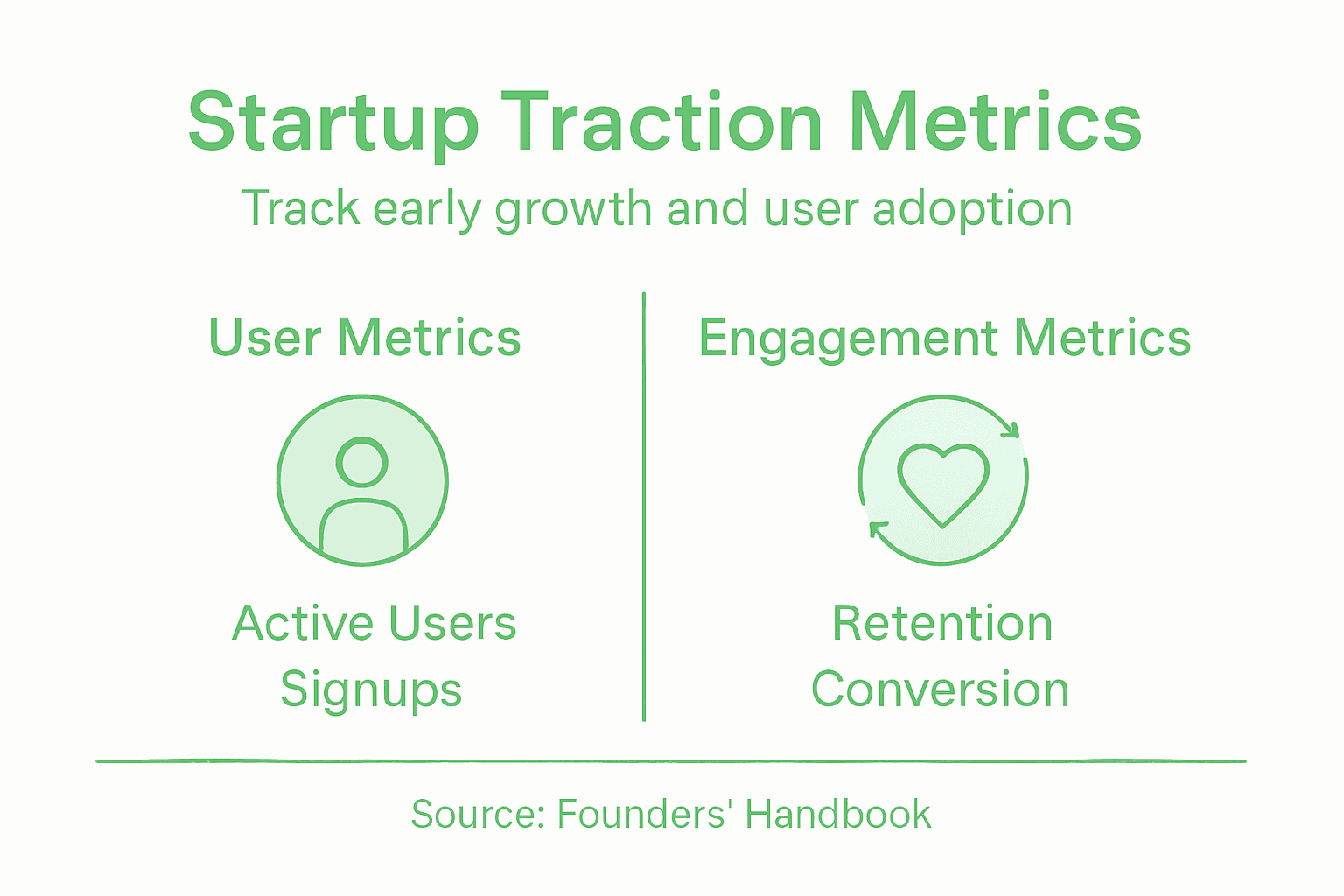
Here’s a concise summary of typical traction metrics startups monitor for growth:
| Metric Name | What It Measures | Business Impact |
|---|---|---|
| Customer Acquisition Cost | Cost to secure each new customer | Evaluates marketing efficiency |
| User Retention Rate | Percentage of users staying active | Indicates product appeal, loyalty |
| Conversion Rate | Rate converting interest to sales | Highlights sales effectiveness |
| Engagement Depth | How deeply users use key features | Reveals solution value perception |
Establish a rhythm of regular metric review and strategic reflection. Schedule weekly or biweekly deep dive sessions where you analyze your performance data, challenge your existing assumptions, and develop hypotheses for improvement. This iterative approach transforms data from a passive reporting tool into an active engine of strategic innovation.
Pro tip: Create a living dashboard that visualizes your key metrics with color coded indicators showing progress, stagnation, and areas requiring immediate strategic intervention.
Accelerate Your Startup Growth With Smart Strategy and AI Guidance
The journey to startup traction described in this article highlights the importance of defining your target audience, validating your solution, building a focused MVP, executing precise marketing, and tracking crucial growth metrics. These steps address key challenges like eliminating guesswork, avoiding bias, and rapidly turning ideas into real market impact. If you are struggling to prioritize features, gather insightful user feedback, or measure meaningful traction signals, you are not alone.
siift.ai Intelligent Business Canvas offers a modern, AI-powered platform designed to systematically guide founders through these exact stages. It helps you capture your core value proposition, validate assumptions with personalized insights, and craft prioritizations that cut through the noise. With its step-by-step approach, you can reduce blindspots and confidently make data-driven decisions to achieve fast growth. Discover how to turn your evolving idea into a viable business with clarity and speed by exploring siift.ai today. Start your strategic founder’s journey now and see how actionable feedback accelerates traction!
Frequently Asked Questions
How can I define my target audience for startup traction?
Understanding your target audience involves identifying decision maker groups such as policy makers, providers, purchasers, and end users. Create detailed customer personas that map out their professional challenges, emotional triggers, and specific scenarios where your solution is vital.
What methods can I use to gather user feedback for my startup?
Utilize multiple feedback channels like direct interviews, online surveys, and usability testing to gather insights from potential users. Aim for a mix of qualitative and quantitative data to get a comprehensive view of how users interact with your solution, and analyze feedback regularly to identify patterns or necessary pivots.
What features should I include in my minimum viable product (MVP)?
Focus on the essential features that directly address your audience’s primary pain points when building your MVP. Determine the smallest set of functionalities that demonstrate your solution’s potential, ensuring a clean and intuitive user experience so that you can launch quickly and gather feedback.
How can I create effective marketing campaigns to drive traction?
Design personalized content for specific customer segments to ensure your marketing communications resonate with your audience’s needs. Choose multiple relevant channels for outreach and tailor your messaging to speak directly to the pressing challenges your audience faces.
What key metrics should I track to measure startup traction?
Monitor actionable metrics like customer acquisition cost, user retention rates, conversion percentages, and engagement depth to gauge your startup’s growth. Create a systematic approach to reviewing these metrics regularly, allowing you to quickly identify trends and adapt your strategies accordingly.