
Launching an AI-driven startup often starts with one pressing question: how do you find the right people to champion your idea from day one. For tech-savvy founders in North America, this is not just about building a cool product, but about reaching those who genuinely crave innovation and offer real feedback. Learning to identify and connect with your ideal early adopters sets the stage for customer-driven growth, product validation, and lasting traction in a crowded market.
Table of Contents
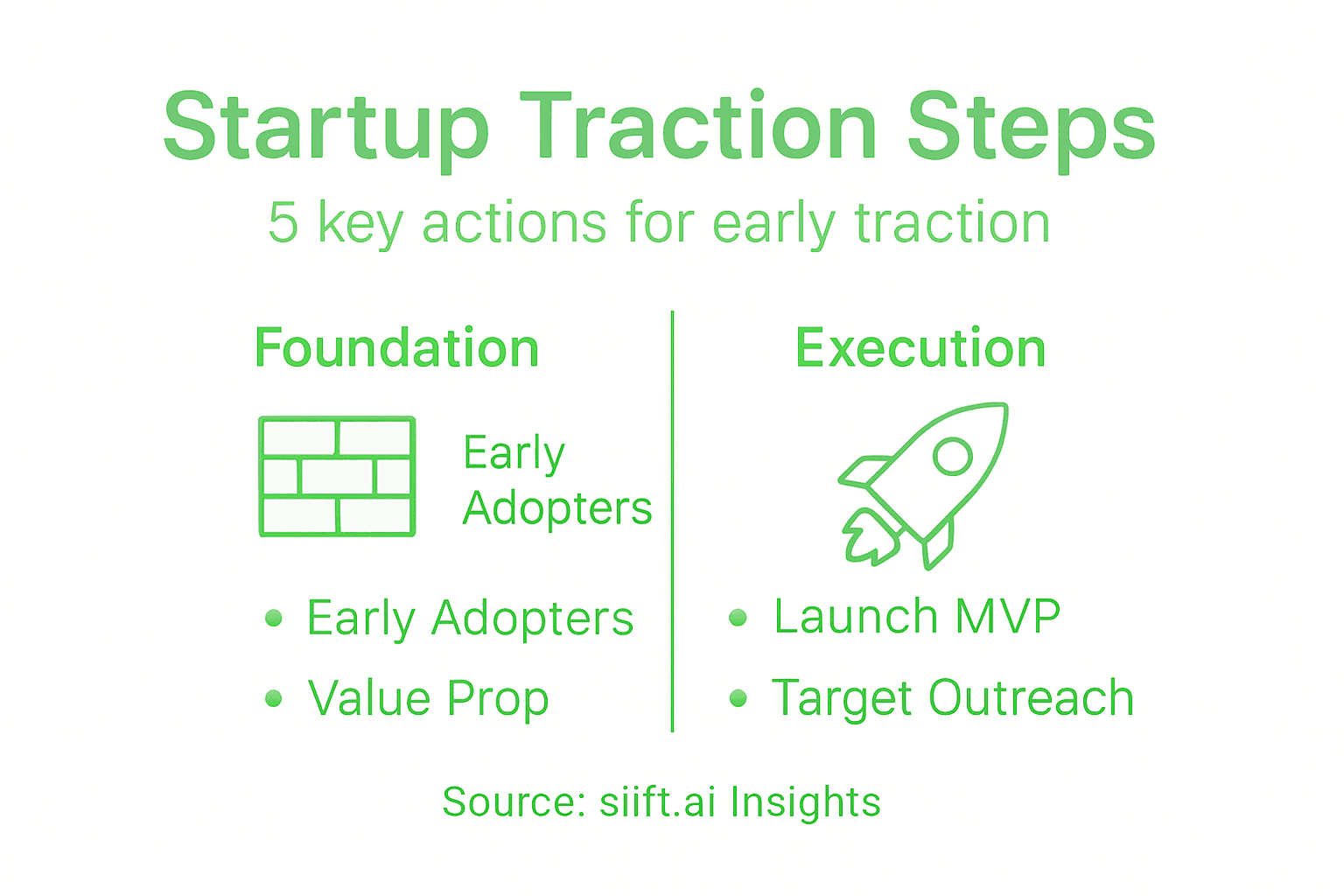
- Step 1: Define Your Ideal Early Adopters
- Step 2: Craft A Compelling Value Proposition
- Step 3: Launch And Measure A High-Impact MVP
- Step 4: Implement Targeted Outreach Campaigns
- Step 5: Validate Traction With Real User Metrics
Quick Summary
| Key Takeaway | Explanation |
|---|---|
| 1. Define Your Ideal Early Adopters | Identify customers who are willing to try new technology and provide valuable feedback. |
| 2. Craft a Compelling Value Proposition | Clearly articulate how your product solves specific customer pain points and stands out from competitors. |
| 3. Launch a Minimum Viable Product (MVP) | Test core hypotheses with minimal features to gather user feedback and iterate effectively. |
| 4. Implement Targeted Outreach Campaigns | Develop personalized strategies to build meaningful relationships with potential customers and partners. |
| 5. Validate Traction with User Metrics | Focus on metrics that reveal genuine market potential and inform future product development. |
Step 1: Define your ideal early adopters
Defining your ideal early adopters is crucial for startup success. By understanding the specific group most likely to embrace your innovative solution, you’ll accelerate product development and market penetration.
Early adopters represent a strategic subset of customers who are intrinsically motivated to try new technologies. Traits of early innovation consumers reveal they typically exhibit:
- High technological curiosity
- Willingness to experiment
- Lower price sensitivity
- Strong problem-solving mindset
- Network influence potential
To effectively pinpoint these individuals, start by creating a detailed customer persona. This means going beyond basic demographics to understand their psychographic characteristics, professional challenges, and technological engagement levels. Consider these strategic approaches:
- Research online communities related to your product domain
- Analyze social media groups where potential users discuss industry problems
- Attend specialized conferences or virtual events in your sector
- Interview professionals experiencing the pain point your startup addresses
Your goal is crafting a nuanced understanding of who would derive maximum value from your solution. This isn’t about finding everyone - it’s about identifying the right initial users who can provide meaningful feedback and become product evangelists.

Here’s a concise comparison of early adopters versus mainstream customers to clarify targeting strategies:
| Attribute | Early Adopters | Mainstream Customers |
|---|---|---|
| Technology Attitude | Embrace new trends | Prefer proven methods |
| Risk Tolerance | High | Moderate to low |
| Feedback Engagement | Actively participate | Passive or minimal |
| Influence on Network | Often leaders | Mainly followers |
Early adopters aren’t just customers - they’re your first strategic partners in product development.
By meticulously defining and targeting these innovative consumers, you’ll create a powerful foundation for startup growth and market validation.
Pro tip: Create a living document of your ideal early adopter profile that you continuously refine based on actual interaction and feedback.
Step 2: Craft a compelling value proposition
Crafting a compelling value proposition is your startup’s strategic blueprint for communicating unique market value. This critical step transforms your innovative idea into a clear, resonant message that immediately captures potential customers’ attention.
Mapping customer needs effectively requires a deep understanding of your target audience’s core challenges and desires. To develop a standout value proposition, focus on these essential components:
- Identify specific customer pain points
- Define your product’s unique solution
- Articulate quantifiable benefits
- Highlight your competitive differentiation
Start by answering three fundamental questions:
- What specific problem does your product solve?
- How is your solution different from existing alternatives?
- Why should customers choose your offering over competitors?
Your value proposition should be a concise, powerful statement that immediately communicates the unique benefits of your solution. Think of it as your startup’s elevator pitch - clear, compelling, and instantly understandable.
A great value proposition isn’t about features. It’s about transforming customer challenges into opportunities.
Remember that crafting an exceptional value proposition is an iterative process. Test your messaging with potential customers, gather feedback, and continuously refine your approach to ensure maximum resonance.
Pro tip: Draft multiple value proposition versions and conduct small-scale customer interviews to determine which resonates most powerfully with your target audience.
Step 3: Launch and measure a high-impact MVP
Launching a minimum viable product (MVP) is your strategic gateway to transforming startup ideas into market-validated solutions. This critical phase allows you to test core hypotheses, gather real-world user feedback, and iterate rapidly without exhausting your resources.
Strategically planning MVP metrics involves establishing clear, measurable success criteria aligned with your business objectives. Your MVP measurement approach should focus on these key performance indicators:
- User acquisition rate
- Activation and engagement levels
- Retention and churn metrics
- Qualitative user feedback
- Conversion rates
To maximize your MVP’s impact, follow these strategic steps:
- Define your core hypothesis
- Build the minimum feature set
- Select appropriate tracking mechanisms
- Establish baseline performance benchmarks
- Plan iterative improvement cycles
Prioritize tracking metrics that directly validate your core product assumptions. This means going beyond surface-level statistics and diving deep into user behavior and satisfaction patterns.
Use this table to match MVP metrics with their business impact for stronger measurement:
| MVP Metric | Business Impact | Recommended Tracking Tool |
|---|---|---|
| User Acquisition | Gauges initial demand | Google Analytics |
| Retention Rate | Measures long-term appeal | Mixpanel |
| Conversion Rate | Assesses revenue potential | CRM dashboard |
| Qualitative Feedback | Improves product fit | SurveyMonkey |
An MVP is not a stripped-down product. It’s a strategic learning tool that reveals your path to product-market fit.
Remember that your first MVP is a starting point, not a final destination. Each iteration brings you closer to understanding your customers’ true needs and refining your solution accordingly.
Pro tip: Create a structured feedback loop that captures both quantitative metrics and rich qualitative insights from your early user base.
Step 4: Implement targeted outreach campaigns
Targeted outreach is your strategic approach to connecting with potential customers, investors, and partners who can accelerate your startup’s growth. By crafting precise, personalized communication strategies, you’ll transform cold contacts into meaningful relationships that drive your business forward.
Strategic audience engagement techniques require a nuanced understanding of your target segment’s unique needs and communication preferences. Your outreach campaign should incorporate these critical elements:
- Precise audience segmentation
- Personalized messaging
- Multi-channel communication approach
- Data-driven performance tracking
- Continuous refinement strategy
Develop your outreach strategy through these systematic steps:
- Map your ideal customer profiles
- Research communication channels
- Craft compelling personalized messages
- Design a structured outreach sequence
- Implement robust tracking mechanisms
Successful outreach goes beyond generic mass communication. It demands authentic, value-driven interactions that demonstrate your deep understanding of potential customers’ challenges and aspirations.
Targeted outreach is not about quantity of connections, but the quality of relationships you build.
Remember that each outreach attempt is an opportunity to learn, refine, and improve your communication strategy. Treat every interaction as a valuable data point in understanding your market.
Pro tip: Create a detailed feedback and response tracking system that helps you continuously optimize your outreach approach based on real interaction data.
Step 5: Validate traction with real user metrics
Validating traction requires a strategic approach to measuring your startup’s genuine market potential through authentic, meaningful user interactions. This critical step transforms raw data into actionable insights that guide your product’s evolution and growth strategy.
Data quality screening techniques are essential for generating credible evidence about your startup’s market performance. Your traction validation should encompass these fundamental metrics:
- User acquisition rates
- Engagement depth and frequency
- Retention and churn percentages
- Customer lifetime value
- Conversion funnel performance
To systematically validate your startup’s traction, implement these strategic measurement approaches:
- Define clear, measurable success indicators
- Establish baseline performance benchmarks
- Track comprehensive user interaction data
- Analyze behavioral patterns and trends
- Correlate metrics with business objectives
Successful traction validation goes beyond surface-level numbers. It requires a holistic understanding of how users interact with your product, their motivations, and the value they derive from your solution.
Traction metrics are not just numbers - they’re a narrative of your startup’s market resonance.
Remember that metric validation is an ongoing process. Continuously refine your measurement approach, staying adaptable and responsive to emerging insights.
Pro tip: Develop a dynamic dashboard that visualizes key metrics, enabling real-time performance tracking and rapid strategic adjustments.
Accelerate Your Startup Traction with Intelligent Guidance
Getting traction for your startup means navigating complex challenges like identifying ideal early adopters, creating a compelling value proposition, launching an effective MVP, and validating real user metrics. These crucial steps demand clarity, strategic focus, and timely action to avoid common pitfalls such as misdirected outreach or unclear product-market fit.
siift.ai’s Intelligent Business Canvas understands these challenges deeply. It transforms the overwhelming process of startup validation into an intuitive, step-by-step journey. With personalized feedback and prioritized actions, the platform helps you confidently define your target users, structure your value proposition, and measure traction with real data insights. By removing biases and blindspots, siift.ai ensures you focus on what truly drives growth — turning uncertainty into informed progress.
Ready to fast-track your founder’s journey and move from ideas to viable business outcomes? Discover how siift.ai can empower you with smart tools to validate traction and drive startup success. Don’t wait to act on your vision. Visit the Intelligent Business Canvas now and start accelerating toward product-market fit today.
Frequently Asked Questions
How can I define my ideal early adopters for my startup?
Defining your ideal early adopters involves creating a detailed customer persona that captures both demographic and psychographic traits. Start by researching online communities or industry-specific social media groups to understand the challenges and motivations of potential users.
What should I include in my value proposition for my startup?
Your value proposition should clearly articulate the specific problem your product solves, how it differs from existing solutions, and the quantifiable benefits it offers to customers. Draft a concise statement and test it with potential users to ensure it resonates with their needs.
What metrics should I track when launching my minimum viable product (MVP)?
Key metrics to track include user acquisition rates, activation and engagement levels, retention rates, and qualitative user feedback. Focus on these metrics to validate your core product assumptions and adjust your strategy based on user interactions within the first 30 days of launch.
How do I implement targeted outreach campaigns effectively?
To implement effective targeted outreach campaigns, start by mapping your ideal customer profiles and researching the best communication channels. Create personalized messages and design a structured outreach sequence to engage your audience authentically.
How can I validate traction for my startup?
You can validate traction by establishing clear success indicators and tracking comprehensive user interaction data. Set baseline performance benchmarks and analyze user behavior to ensure that your product meets market needs, aiming for measurable results within the first few months after launch.
What should I do if my MVP does not perform as expected?
If your MVP does not perform as expected, analyze the feedback and metrics gathered to identify gaps or misunderstandings in your product offering. Make data-driven decisions to iterate on your product and adjust your features or marketing strategies within a short timeframe, such as 30 days, to address user concerns.