
TL;DR:
Launching on Product Hunt requires a well-prepared campaign that builds early momentum, genuine engagement, and strong relationships ahead of time. Success depends on polishing your product, creating compelling assets, and executing a coordinated plan during the critical first hours of launch. Maintaining consistent post-launch follow-up and authentic community participation ultimately drive meaningful growth beyond just ranking.
Launching on Product Hunt is the fastest way for an early-stage startup to earn visibility, community feedback, and a wave of first users — but only when you treat it as a structured campaign, not a one-day gamble. Product Hunt’s algorithm rewards early momentum, genuine engagement, and preparation that starts weeks before your listing goes live. The founders who crack the top 5 aren’t luckier than you. They’re just more prepared. This guide walks you through every phase of a Product Hunt launch strategy, from profile setup to post-launch follow-up, so you can compete with confidence.
How to launch on Product Hunt the right way
A successful Product Hunt launch is defined by three things: a polished product, a warm audience, and a coordinated execution plan. Skip any one of those and you’re leaving ranking points on the table.

Start with your product. Before you even think about your listing, your product needs to work. Visitors from Product Hunt are notoriously quick to bounce if onboarding is confusing or the core value isn’t obvious within 60 seconds. Fix your landing page copy, tighten your onboarding flow, and make sure your product does what your tagline promises.
Your maker profile matters more than most founders realize. A real photo, a credible bio, and a history of genuine community participation all signal authenticity to both the algorithm and real voters. Product Hunt discounts newly created accounts, reducing the weight of their upvotes. That means you need to build your profile and follower base months ahead of launch, not the night before.
Your listing assets are your storefront. Get these right:
Tagline: Benefit-focused, approximately 60 characters, no buzzwords
Description: 260 characters that answer what it does, who it’s for, and why it matters
Thumbnail: 240×240px, clean, recognizable at small sizes
Gallery images: 1270×760px, 5 to 8 images that walk through key features
Demo video or GIF: Under 60 seconds. Short videos increase click-through and conversion.
Pro Tip: Draft your maker comment before launch day. This comment is conversation infrastructure. It seeds discussion, signals activity to the algorithm, and sets the tone for how visitors engage with your product.
What does building a pre-launch audience actually look like?
The single strongest predictor of a top-ranking launch is the size and warmth of your audience before you go live. A warm audience of 500 to 1,000 followers pre-launch strongly predicts success and ranking on Product Hunt. That number isn’t arbitrary. It represents enough coordinated early engagement to trigger the algorithm’s momentum signals in the critical first hours.
Building that audience takes time. Plan 4 to 5 months ahead, not 4 to 5 days. Here’s what that looks like in practice:
Grow your Product Hunt following organically. Follow makers in your niche, engage with their launches, and leave thoughtful comments. Reciprocity is real on this platform.
Activate your existing network on Twitter/X, LinkedIn, and relevant Slack or Discord communities. Share behind-the-scenes content, early screenshots, and honest progress updates. People support founders they feel connected to.
Build or grow your email list now. A mailing list is your most reliable launch-day asset. Segment it so you can notify your most engaged subscribers first.
Identify 20 to 30 genuine supporters. These are people who have used your product, given you feedback, or expressed excitement. Personal outreach to this group on launch day is worth more than a mass blast to 1,000 cold contacts.
The goal isn’t to manufacture hype. It’s to find your audience before launch day so that when you go live, real people who actually care show up.
Pro Tip: Never ask for upvotes directly. Asking for feedback instead of votes encourages genuine engagement and keeps you clear of penalties. “Would love your honest thoughts” beats “Please upvote us” every time.
The launch day timeline: executing a 24-hour campaign
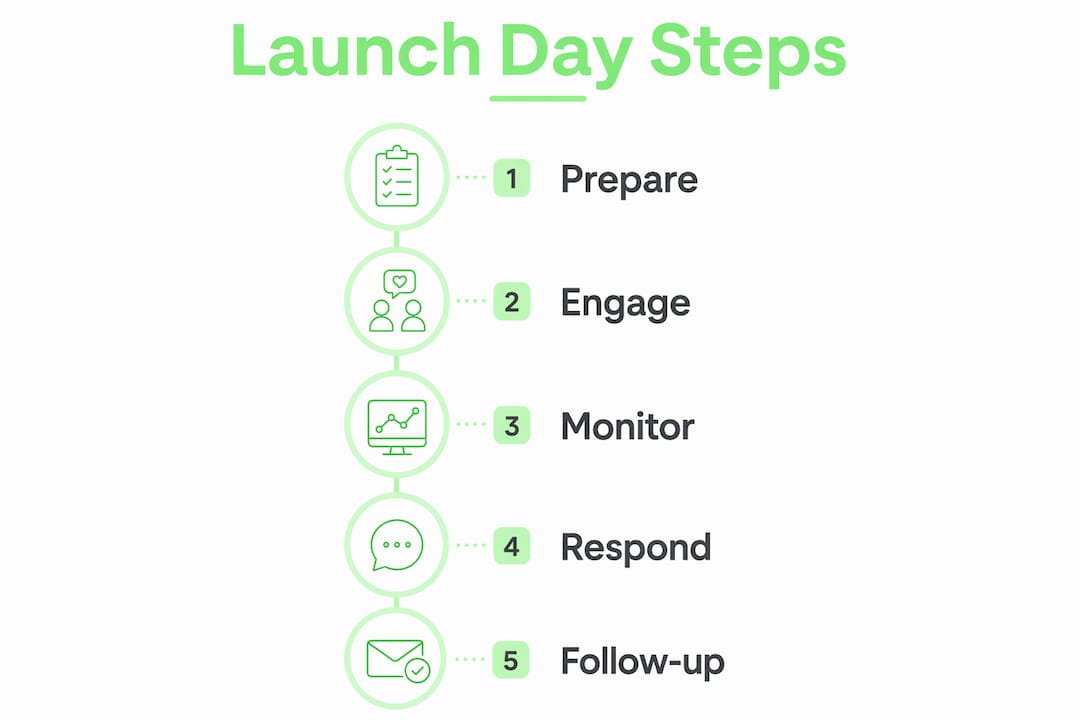
Launch day is a 12 to 16 hour marathon, and the first 6 hours are where rankings are made or lost. Early upvote velocity heavily influences ranking, with targets of 200 or more upvotes and 30 or more comments in those first hours. That means your execution needs to be tight from the very first minute.
Here’s how to structure the day:
12:01 AM Pacific Time: Go live. Launch on Tuesday, Wednesday, or Thursday for maximum engagement. Weekends and Mondays consistently underperform. Post your maker comment immediately after going live.
12:01 AM to 6:00 AM: Notify your core 20 to 30 supporters personally. Text, DM, email. Be specific and human. “Hey, we just launched on Product Hunt. I’d love your honest feedback on the listing” is the right tone.
6:00 AM to 12:00 PM: This is your mid-morning push. Share your launch on Twitter/X, LinkedIn, and relevant communities. Post progress updates. Celebrate early milestones publicly. Keep the energy visible.
All day: Reply to every comment within 5 to 15 minutes for at least the first 6 hours. Substantive replies outperform simple thank-yous. Ask follow-up questions. Turn comments into conversations.
6:00 PM to 11:59 PM: Final push. Re-engage your email list with a “last chance to weigh in” message. Share a behind-the-scenes update on social. Thank your community publicly.
A few things to have ready before midnight:
UTM-coded short links for every channel (Twitter/X, LinkedIn, email, Slack). Referrer data is often stripped by clients, so unique links per channel are the only reliable way to track where your traffic actually comes from.
Scheduled social posts for key time zones
A shared doc or Notion page for your team to log comments that need responses
Pro Tip: Set a repeating phone timer every 10 minutes during the first 6 hours. It sounds obsessive. It works. Rapid response signals activity to the algorithm and makes your listing feel alive to new visitors.
Post-launch strategies that turn momentum into growth
The 48 hours after your launch are as important as launch day itself. Most founders celebrate or collapse. The ones who win treat the post-launch window as a conversion sprint.
Start by replying to every comment you missed during the day. Late commenters are often serious users who arrived after the initial rush. A thoughtful reply 12 hours after launch still builds goodwill and keeps your listing active.
Send a follow-up thank-you to your supporters. A personal note to the people who showed up for you costs nothing and builds the kind of loyalty that compounds over time.
Share your results and lessons publicly. A Twitter/X thread or LinkedIn post about what you learned from your launch generates second-wave traffic and positions you as a transparent, trustworthy founder.
Add your Product Hunt badge to your website, landing page, and email signature. Social proof from a top-ranking launch is a credibility signal that works for months.
Use the feedback you collected. Visitors who left comments gave you free product research. Act on it. Update your roadmap. Ship a fix. Then tell your Product Hunt community you listened.
The first 30 days post-launch are critical for converting Product Hunt visitors into active users through email sequences, onboarding improvements, and roadmap updates. That window closes fast.
One underrated move: pair your Product Hunt launch with a paid waitlist or deposit-based pre-order. Upvotes don’t equal business validation. Payment-based funnels identify committed users and give you real signal about whether your product solves a problem people will actually pay to fix. You can read more about pre-launch validation methods to build that layer into your strategy.
Pro Tip: Track your Product Hunt referral traffic with UTM-coded links per channel. Product Hunt traffic frequently appears as “direct” in analytics due to stripped referrer headers. Without unique links, you won’t know which channel actually drove conversions.
Common mistakes that sink otherwise good launches
Most failed Product Hunt launches don’t fail because the product is bad. They fail because of avoidable execution errors. Here’s what to watch for:
Asking directly for upvotes. This is the fastest way to get penalized and alienate the community. Ask for feedback, opinions, or honest reactions instead.
Launching with a broken or confusing product. If your landing page is unclear or your onboarding breaks on mobile, Product Hunt traffic will bounce and your conversion rate will be embarrassing.
Going silent after posting. Leaving comment gaps longer than 30 minutes during peak hours signals low engagement to the algorithm and frustrates visitors who took the time to write something.
Rushing your preparation. A structured 30-day preparation split across building foundation, growing audience, and finalizing assets is the standard for top 5 placement. Skipping phases costs you ranking.
Treating it as a one-day event. Product Hunt is a community. Founders who engage consistently before and after their launch build reputations that pay dividends on every future launch.
Pro Tip: Schedule all your launch links and tracking short links the day before. Scrambling to create UTM links at 11:55 PM Pacific Time is a rite of passage you don’t need.
Key takeaways
A successful Product Hunt launch requires a warm audience, polished assets, precise timing, and sustained engagement before, during, and after launch day.
Point | Details |
|---|---|
Prepare 4 to 5 months ahead | Build your follower base and maker profile early; new accounts carry less algorithmic weight. |
Target 500 to 1,000 followers pre-launch | A warm audience is the strongest predictor of top-ranking placement on launch day. |
Launch at 12:01 AM PT on a weekday | Tuesday through Thursday maximize your voting window and community engagement. |
Reply within 15 minutes for 6 hours | Rapid, substantive responses signal activity to the algorithm and convert visitors into advocates. |
Pair upvotes with payment validation | Upvotes measure interest; paid waitlists and deposits measure real buying intent. |
Why most Product Hunt advice misses the point
Here’s my honest take after watching dozens of founders go through this process: the tactics matter far less than the relationships you build before launch day. Everyone talks about timing, taglines, and demo videos. Those things are table stakes. What actually separates a top 5 finish from a forgettable mid-table result is whether real people who genuinely care about your product show up in the first two hours.
That means the work happens weeks before launch. It happens in the DMs, in the Slack communities, in the honest conversations where you ask someone to try your product and they actually do. The founders who treat Product Hunt as a community they participate in, rather than a platform they extract from, consistently outperform the ones who show up with a polished listing and no relationships.
The other thing I’d push back on: don’t measure your launch purely by ranking. A #3 finish with 50 email signups and 10 genuine user conversations is worth more than a #1 finish with 500 upvotes and zero conversions. Use Product Hunt to get traction for your startup, not just a badge. The badge is nice. The users are the point.
— Samim
Ready to launch smarter with Siift?
Preparing for a Product Hunt launch is really a go-to-market challenge in disguise. You need a validated product, a defined audience, and a clear narrative before any listing goes live. That’s exactly what Siift is built to help you build. Siift’s Agentic AI platform guides founders step by step through ideation, validation, and go-to-market strategy, so you’re not guessing when it matters most. Whether you’re still shaping your minimum viable product or ready to coordinate your launch campaign, Siift gives you the structure and clarity to move faster and with less risk. Visit Siift.ai to start building your launch strategy today.
FAQ
What is the best time to launch on Product Hunt?
Launch at exactly 12:01 AM Pacific Time on a Tuesday, Wednesday, or Thursday. Mid-week launches consistently outperform weekends and Mondays due to higher community engagement and a full 24-hour voting window.
How many followers do I need before launching on Product Hunt?
A warm audience of 500 to 1,000 Product Hunt followers before launch day is the benchmark for top-ranking success. Build this base over 4 to 5 months through genuine community participation, not last-minute follow requests.
Can I ask people to upvote my Product Hunt listing?
No. Directly asking for upvotes can trigger penalties from Product Hunt’s algorithm. Ask for feedback, honest opinions, or reactions instead. Genuine engagement from real users carries more weight than solicited votes.
How do I track traffic from my Product Hunt launch?
Use UTM-coded short links for every channel, including Twitter/X, LinkedIn, email, and Slack. Product Hunt traffic frequently appears as “direct” in analytics because referrer data is stripped by many clients, making unique links per channel the only reliable attribution method.
What should I do in the 30 days after my Product Hunt launch?
Focus on converting visitors into active users through targeted email sequences, onboarding improvements, and public roadmap updates based on the feedback you collected. The post-launch window closes fast, and consistent follow-up is what turns a spike in traffic into lasting growth.