
TL;DR:
- An MVP is a functional product designed to gather validated customer learning with minimal effort.
- Unlike prototypes or PoCs, MVPs test real market demand through actual user behavior.
- Building an MVP early reduces risk, accelerates market entry, and provides credible user validation.
Most founders waste months building something nobody asked for. The confusion between a prototype and a minimum viable product, commonly called an MVP, is one of the most expensive mistakes in startup culture. It leads to over-engineered launches, drained budgets, and missed market windows. Getting this distinction right is not a semantic exercise. It shapes every decision you make in those critical early months. This article will clear up that confusion, define exactly what an MVP is, and give you a practical roadmap so you can stop building in the dark and start learning from real customers as fast as possible.
Table of Contents
- What is a minimum viable product?
- MVP vs. prototype and proof of concept
- Why startups need an MVP: Benefits and core goals
- How to build an MVP: A practical roadmap for founders
- What most founders get wrong about MVPs
- Ready to validate your startup idea?
- Frequently asked questions
Key Takeaways
| Point | Details |
|---|---|
| MVP is not a prototype | An MVP is a functional product tested by real users to validate ideas, not just a design or demo. |
| Market validation focus | The main goal of an MVP is to gather real-market feedback with minimal effort and investment. |
| Faster, smarter launches | Building an MVP first speeds up learning and reduces risk, especially when using AI tools. |
| Lean execution matters | Resist the urge to overbuild—focus only on features essential for testing your core idea. |
What is a minimum viable product?
Let’s start with the official version. The term “minimum viable product” was popularized by Eric Ries in The Lean Startup, and it has since become one of the most referenced concepts in entrepreneurship. Yet despite all the coverage it gets, the definition is still widely misapplied.
Here is the most precise framing:
“The version of a new product which allows a team to collect the maximum validated learning about customers with the least effort.”
Read that twice. The goal is not to ship the smallest possible product. The goal is to collect validated learning. That word, validated, is doing a lot of heavy lifting. Validated learning means real customers, taking real actions, in a real market context. Not surveys. Not user interviews alone. Actual behavior.
An MVP is not a prototype. It’s not a wireframe. It’s not a proof of concept that your engineering team uses to test a technical approach. According to Atlassian, an MVP is for market and customer validation, not just internal proof or a UI mock. That distinction matters enormously. Here is why.
When you stop at a prototype, you are only answering internal questions: “Can we build this?” or “Does it look right?” When you launch an MVP, you are asking the market: “Will people use this? Will they pay for it? Does this actually solve their problem?”
Those are completely different questions. And only real-world behavior gives you real answers.
Key things an MVP must have:
- A core function that solves one specific problem for a specific user segment
- A real delivery mechanism where actual users can interact with it, whether that’s an app, a landing page with a checkout, a service offer, or even a manual process
- A feedback loop built in, so you can capture what users do, not just what they say
- A hypothesis being tested, meaning you go in with a clear assumption about what value you’re delivering and to whom
The temptation to keep polishing before launch is strong. But the longer you wait to put something in front of real users, the more you are betting on assumptions that may be completely wrong. AI tools for MVP planning have made this process faster than ever, which removes the last real excuse for over-building before validating.
Early feedback is not just useful. It’s the whole point. The MVP is a learning vehicle, not a finished product.

MVP vs. prototype and proof of concept
Now that you have a solid definition, let’s compare MVPs to the two terms most often confused with them: prototypes and proofs of concept, often called PoCs.
Here is a quick breakdown:
- Prototype: A visual or functional model used to test a concept, usually with an internal team or a small group of testers. It looks like a product but does not function like one in the market. Its audience is internal stakeholders, designers, and developers. Its goal is to refine the design and check feasibility.
- Proof of concept (PoC): A technical demonstration that a specific idea or technology is feasible. Typically used in B2B or deep tech environments. Its audience is internal engineers or potential investors. Its goal is to answer “can we build this at all?”
- MVP: A functional, living product delivered to real potential customers. Its audience is the target market. Its goal is to validate a business hypothesis through observed user behavior.
| Concept | Purpose | Audience | Key outcome |
|---|---|---|---|
| Prototype | Test design and usability | Internal team, early testers | Refined interface or flow |
| Proof of concept | Test technical feasibility | Developers, investors | Build confidence in possibility |
| MVP | Validate market demand | Real target customers | Evidence of real-world traction |
That table tells the story clearly. The MVP is the only one of the three that actually tests whether your business idea holds up in the real world.
As Atlassian puts it, market and customer validation is the purpose of an MVP, not internal confidence building. That distinction is what separates founders who learn fast from founders who build long and learn late.
A critical point: MVPs measure customer actions, not customer opinions. Someone telling you they would pay for something is data. Someone actually paying for it is proof. Build for proof.
Pro Tip: The most common mistake we see founders make is stopping at prototype and calling it an MVP. If real paying customers have not interacted with it, you have not shipped an MVP. You’ve built a prototype. Go back and ask yourself: who is the first real person who could use this, and how do I get it in front of them today?
If you want to understand product iteration for market fit, the prototype to MVP transition is exactly where that iterative thinking starts. It’s a mindset shift as much as a process shift.
Why startups need an MVP: Benefits and core goals
Okay, so MVPs are about validated learning. But why does this matter so much in practice? What is actually at stake?
Let’s look at what happens when founders skip the MVP phase entirely. They build a full product based on assumptions, spend six to twelve months in development, burn through their runway, and then launch to discover that the market doesn’t want what they built, or that someone already built it better, or that their pricing model is completely wrong. This is not a hypothetical. It is the most common startup failure pattern in the world.
Building an MVP first changes the entire risk profile of your startup.
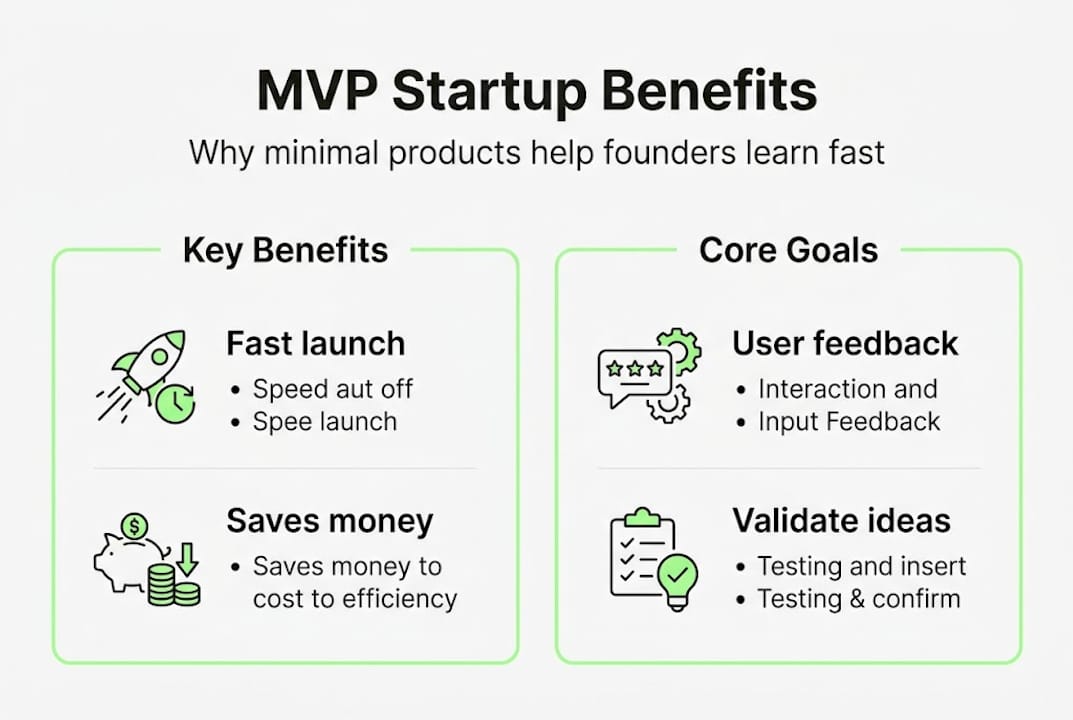
Here are the main benefits that matter most for early-stage founders:
- Faster market entry. You learn what works and what doesn’t before your competitors catch up or before the market shifts.
- Reduced waste. You spend time and money building only what users actually value, not what you assumed they would value.
- Early customer validation. You get real signal from real people, which is the most credible proof point you can bring to early investors, co-founders, or partners.
- Tighter focus. Constraints force clarity. When you can only ship one core feature, you have to know exactly what your value proposition is.
- Lower risk. Testing a hypothesis with a small build costs far less than discovering a flawed assumption after a full launch.
The numbers back this up. AI-based delivery advantages in modern software development now allow founders to cut build time significantly, making the MVP phase even more accessible for solo founders and small teams.
| MVP benefit | How it helps resource-limited founders |
|---|---|
| Faster iteration | Reduces time between idea and market signal |
| Cheaper development | Limits scope to what is essential |
| Real customer data | Removes guesswork from product roadmap |
| Investor readiness | Traction story is grounded in actual usage |
| Lean team execution | Lets small teams move fast without specialist overhead |
The role of AI in MVP building is particularly exciting right now. Tools powered by artificial intelligence let founders design, test, and even deploy functional MVPs in days rather than months. You don’t need a full engineering team. You don’t need a massive budget. What you need is a clear hypothesis and a commitment to validating product market fit through real market contact.
As Atlassian describes it, the MVP is the simplest version to validate ideas and gather feedback with minimal effort. That principle has not changed. What has changed is how accessible the tools are to execute it.
If you’re serious about knowing how to validate your startup idea, the MVP is your primary instrument. Everything else is preparation.
How to build an MVP: A practical roadmap for founders
Let’s get practical. Building an MVP is not just about “building less.” It requires strategic discipline. Here is a proven roadmap that lean founders can follow today, especially in the age of AI-powered tools.
Step 1: Identify your core assumption. Every MVP starts with a belief you need to test. Something like: “Busy freelancers will pay $20 per month for a tool that automates their invoice follow-ups.” Write it down. That is your hypothesis. Everything you build should be in service of testing it.
Step 2: Define the single most important feature. Resist the urge to build a feature list. Your MVP needs one core function that delivers the core promise. Just one. The rest can wait.
Step 3: Choose your build approach. This could be a no-code app, a landing page with a waitlist or checkout, a concierge service where you manually deliver the value, or a simple tool built with AI assistance. The delivery method matters less than whether real users can interact with it.
Step 4: Build the smallest version that works. As the simplest working product released to real users, your MVP does not need to be perfect. It needs to function well enough to test your hypothesis. Done beats polished here.
Step 5: Put it in front of real users immediately. Not friends. Not family. Real people who match your target customer profile. Give them a reason to use it. Charge them if at all possible, even a small amount. Payment is the strongest validation signal you can get.
Step 6: Track the right metrics. Instinct is not a metric. Set up simple tracking from day one.
Key validation metrics to monitor:
- Activation rate: What percentage of users complete the core action your MVP is designed for?
- Retention: Do users come back? Once is curiosity. Twice is a signal. Three times is traction.
- Purchase intent or conversion: Are users willing to pay or commit in some meaningful way?
- Qualitative feedback patterns: What language do users use to describe the problem you are solving?
- Drop-off points: Where do users abandon the experience? That is where your hypothesis may be wrong.
Step 7: Learn and iterate, or pivot. Take what you learned and decide whether to double down, adjust the value proposition, or change course entirely. This is the cycle. It’s not failure. It’s the process.
Pro Tip: One of the most common pitfalls is building a technically impressive MVP that is so polished it obscures what you’re actually learning. If users are complimenting the design instead of engaging with the core function, you may have over-invested in presentation. Keep it rough where it needs to be rough. The goal is insight, not applause.
Check out these steps to startup traction to understand what comes after a successful MVP cycle. And if you want to make sure you’re not self-sabotaging, reading about MVP mistakes to avoid will save you serious time and heartache.
What most founders get wrong about MVPs
Here is an uncomfortable truth we want to share with you, based on watching hundreds of founders go through this process. The phrase “just launch something simple” has become a dangerous oversimplification.
Most founders who think they are building an MVP are actually building a slightly smaller version of the product they originally imagined. They trim features, sure. But they still build from their own assumptions rather than designing a lean experiment around a single testable hypothesis. That is a crucial difference.
True MVP thinking is hard. It requires intellectual honesty that most people, understandably, struggle with. Because what validated learning actually demands is that you put a real offer in front of real customers who have no relationship with you, no reason to be kind, and every reason to ignore you. That is uncomfortable. And it should be.
The AI era adds a new wrinkle to this. Because AI tools make it so cheap and fast to build, founders now overbuild at record speed. The barrier to entry for shipping something has never been lower, which sounds great. But it also means the temptation to keep adding features “since it’s so easy now” has never been higher. Ease of building does not equal wisdom in building.
Avoiding common MVP mistakes means fighting your own instinct to build more, not less. The discipline of constraint is the actual skill. And the founders who master it early are the ones who reach product-market fit fastest.
Ready to validate your startup idea?
Building an MVP that actually teaches you something is one of the most powerful skills you can develop as a founder. At siift.ai, we built our Intelligent Business Canvas specifically to guide you through this process step by step. From articulating your hypothesis to mapping your go-to-market, our AI-driven platform helps you stay lean, move fast, and avoid the blind spots that derail most early-stage startups. Stop guessing. Start validating. Whether you’re still exploring your idea or ready to launch, siift’s tools and frameworks give you the structure to build smarter from day one.
Frequently asked questions
What is the difference between an MVP and a prototype?
An MVP is for market validation with real customers, while a prototype is a simulation or design model used to test concepts internally before any real-world exposure.
Why should startups launch with an MVP?
Launching with an MVP lets you generate validated learning from real users fast, saving time and money by testing your core business assumptions before committing to a full build.
Can you build an MVP without coding?
Yes, many founders build effective MVPs using no-code platforms, landing pages, manual processes, or AI-powered tools that require zero traditional development skills.
What are examples of successful MVPs?
Famous MVPs include Dropbox’s explainer video, Airbnb’s basic rental listing page, and Twitter’s internal SMS tool, each designed to test real user demand with the smallest possible investment.