

Did you know that over 90 percent of startups fail because they misjudge customer needs? Understanding exactly who you are solving a problem for and how that problem affects them is the core of building a successful business. Many founders leap to solutions too quickly, missing out on critical learning in the early stages. By breaking down the steps from defining your target problem to refining your audience profile, you can build real answers to real pain points instead of guessing in the dark.
Table of Contents
- Step 1: Define Your Ideal Problem And Target User
- Step 2: Research Where Your Audience Spends Time
- Step 3: Engage With Potential Users Directly
- Step 4: Test Your Value Proposition With Feedback
- Step 5: Refine Your Audience Profile Based On Insights
Quick Summary
| Key Point | Explanation |
|---|---|
| 1. Define a specific problem | Clearly articulate the exact problem your startup aims to solve for users. |
| 2. Identify your target user persona | Create a detailed persona of your ideal customer to guide product development effectively. |
| 3. Actively research user communities | Engage directly with your audience’s spaces to understand their needs and frustrations. |
| 4. Validate your value proposition | Test your proposed solution with potential users and adapt based on their feedback. |
| 5. Refine your audience profile | Use insights from user conversations to update and specify your audience understanding. |
Step 1: Define your ideal problem and target user
In this crucial step, you’ll map out the specific problem your startup aims to solve and identify the exact user group who will most benefit from your solution. Think of this as creating a laser focused blueprint that transforms your abstract idea into a tangible opportunity.
According to startupguide, developing a profitable business requires conducting thorough market analysis to determine both the size of the problem and the potential customer segment. This means digging deep beyond surface level observations. Start by asking yourself critical questions: What specific pain point am I solving? Who experiences this problem most intensely? How widespread is this issue?
To crystallize your target user, create what experts call a “persona” - a semi fictional representation of your ideal customer. As en explains, personas help humanize data by capturing behavioral patterns, goals, skills, and attitudes. Imagine your target user as a real person. What are their daily challenges? What solutions have they already tried? What would make their life meaningfully easier?
Warning: Avoid the common trap of believing your solution is for everyone. The most successful startups solve a specific problem for a well defined audience. Be ruthlessly precise about who you’re serving.
Once you’ve defined your problem and user, you’re ready to validate your hypothesis through targeted research and potential customer interviews.
Step 2: Research where your audience spends time
Now that you have defined your ideal problem and target user, it is time to uncover the digital and physical spaces where your potential customers congregate. Understanding your audience’s preferred platforms and communities is critical for effective outreach and validation.
According to en, knowing where your target audience spends time is crucial for developing effective marketing and advertising strategies. This means going beyond generic demographics and diving deep into specific behavioral patterns. Start by mapping out potential channels like online forums, social media groups, professional networks, industry conferences, local meetups, and niche online communities relevant to your target user.
en emphasizes the customer development methodology which requires founders to get out of the building and actively test hypotheses about their business model. This means direct observation and engagement. Spend time lurking in these spaces. Read discussions. Understand the language, pain points, and current solutions your potential users are discussing. Look for recurring themes, frustrations, and unmet needs that align with your startup concept.
Warning: Avoid passive research. Engagement is key. Create accounts, participate in discussions, ask thoughtful questions, and build genuine connections. Your goal is not just to observe but to understand the nuanced ecosystem of your target audience.

With these insights, you are now ready to move toward validating your problem hypothesis through direct customer interactions.
Step 3: Engage with potential users directly
This step transforms your research from passive observation to active validation. You will now reach out and have meaningful conversations that transform your startup hypothesis from a theory into a testable reality.
en emphasizes that startups must spend time in the field identifying potential consumers and learning how to better meet their needs. This means moving beyond digital lurking and initiating genuine conversations. Your goal is not to sell but to listen. Craft interview questions that reveal deep insights about their challenges, current solutions, and unmet needs. Ask open ended questions that invite storytelling about their experiences.
Research from en highlights the importance of analyzing user requirements at the very beginning of product development. This means treating each conversation as a precious opportunity to understand the intricate details of your potential users experience. Aim for at least 10 to 15 in depth conversations. Record key patterns. Look for consistent pain points. Pay attention to the language they use. The most valuable insights often emerge not from direct answers but from the stories and context users share.
Warning: Avoid confirmation bias. Do not ask leading questions that validate what you want to hear. Stay curious. Stay neutral. Your job is to discover truth not manufacture agreement.
With these user insights gathered, you are now prepared to refine your problem statement and begin designing an initial solution that truly addresses user needs.
Step 4: Test your value proposition with feedback
In this critical stage, you will transform your initial insights into a tangible value proposition and systematically validate whether your solution genuinely solves your target users real problems. This is where your startup concept gets its first real reality check.
According to en, achieving product market fit requires creating a product that people desperately want. This means crafting a clear and compelling statement that communicates exactly how your solution addresses a specific user pain point. Develop a concise one paragraph description of your value proposition that articulates the unique problem you solve, who you solve it for, and why your approach is different from existing solutions.
en emphasizes testing business model hypotheses by designing experiments and getting out of the building to validate your assumptions. Present your value proposition to the potential users you interviewed earlier. Watch their reactions carefully. Do their eyes light up? Do they lean in with interest? Or do they seem confused or indifferent? Pay attention to both verbal and non verbal cues. Ask probing questions like “Would you pay for this?” and “How would this solve your current challenges?”
Warning: Brutal honesty is your friend. If users do not immediately see the value, do not get defensive. Listen. Adapt. Your goal is truth not ego preservation.
With validated feedback, you are now ready to begin prototyping an initial solution that truly resonates with your target audience. Check out our guide on business idea validation for deeper insights into this process.
Step 5: Refine your audience profile based on insights
This is where your initial assumptions meet reality. You will transform your rough audience sketch into a precise, data driven persona that captures the nuanced characteristics of your potential users.
According to en, personas are representations of user groups synthesized from interview data that capture behavioral patterns, goals, skills, and attitudes. Review the conversations and feedback from your user interviews. Look for unexpected patterns. What surprised you? What assumptions did you have that were completely wrong? Pay attention to the specific language they use, their professional contexts, hidden motivations, and unspoken challenges.
en emphasizes that customer development is an iterative process of testing and refining business model hypotheses. Update your audience profile with granular details. If your initial persona was a “tech professional between 25 and 35,” now it might become “mid level software engineers at growing startups who feel overwhelmed by project management tools and are seeking simplicity.” The more specific you can be, the more powerful your understanding becomes.
Warning: Do not fall into the trap of over generalizing. Each insight is a puzzle piece. Some will fit perfectly. Some will challenge your entire concept. Embrace the complexity.
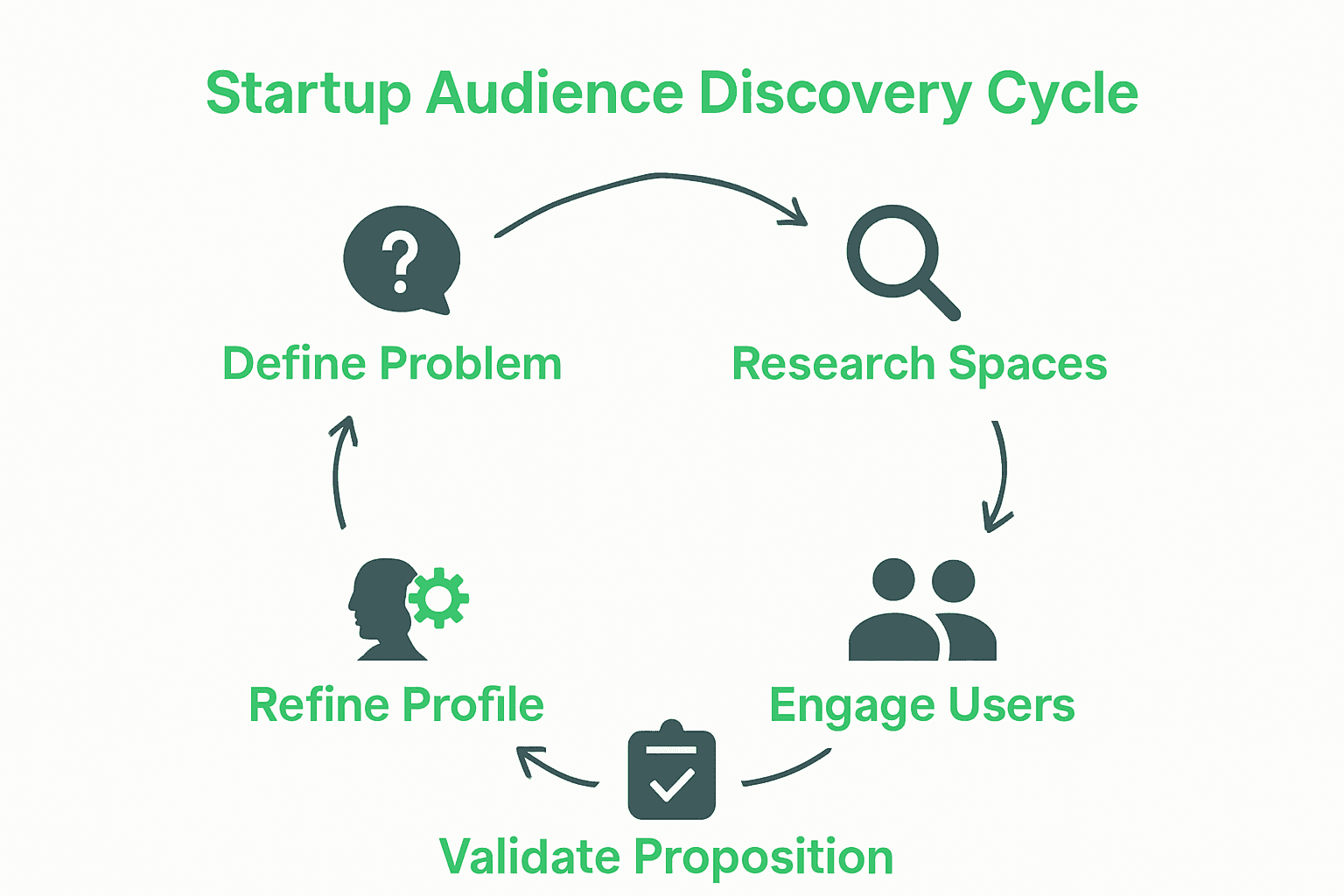
With your refined audience profile, you are now prepared to design a solution that speaks directly to your users most profound needs. Check out our guide on business idea validation to continue refining your approach.
Discover Your Target Audience with Confidence and Clarity
Finding the right audience is one of the toughest challenges every startup faces. You want to solve a real problem for real people who feel the pain deeply. This article reveals the key steps to identifying a precise target user and validating your assumptions through direct engagement and meaningful conversations. The struggle to avoid broad generalizations and confirmation bias resonates with every founder trying to sharpen their focus.
At siift.ai we understand that pinpointing your audience is just the beginning. Our founder’s intelligence platform helps you break down complex startup challenges like audience definition and problem validation into simple, clear steps. With personalized feedback and prioritized actions you can confidently navigate customer development without the usual blindspots or gatekeepers.
Ready to move beyond guesswork and truly connect with your ideal users? Start your journey now with siift.ai and gain the clarity you need to turn your idea into a viable business. Explore how our step-by-step AI guidance complements your process of finding your audience and validating your value proposition by visiting siift.ai today. Your startup deserves a smarter start.
Frequently Asked Questions
How can I define the ideal problem my startup idea solves?
To define the ideal problem, identify specific pain points your potential users face. Start by asking what challenges they encounter daily and how widespread these issues are.
What steps should I take to create a persona for my target audience?
Begin by gathering data on your ideal customers’ behaviors, goals, and frustrations. Create a semi-fictional representation of them, focusing on their daily challenges and previously attempted solutions.
How do I find where my audience spends time online and offline?
Research online forums, social media platforms, and local meetups relevant to your target audience. Engage in these spaces to understand their discussions, preferences, and pain points more thoroughly.
What types of questions should I ask during user interviews to validate my startup idea?
Craft open-ended questions that encourage users to share their experiences and challenges. For example, ask them to describe past solutions they tried and what they felt was lacking.
How can I test my value proposition with potential users?
Present your value proposition to users and observe their reactions. Ask for feedback on whether they see value in your idea and solicit any concerns or confusions they may have.
What should I do after I gather insights from my user interviews?
Analyze the feedback to refine your audience profile and persona. Look for patterns in their language and motivations, and update your audience profile to reflect these insights more accurately.