.png&w=3840&q=70)
Siift vs Claude Two Different Approaches to AI
The comparison is not simply about which AI produces better responses. The real question is: Which AI system better supports founders building and operating a company?
However, as startups grow, founders face challenges that go beyond generating answers.
They need an AI system that can:
Understand business context
Prioritize validated information
Track strategic decisions
Connect workflows
Turn discussions into measurable execution
This creates an important distinction:
Claude represents the general AI assistant approach.
Siift represents the intelligent business operating system approach.
The comparison is not simply about which AI produces better responses.
The real question is:
Which AI system better supports founders building and operating a company?
AI adoption among businesses is moving from experimentation toward real operational use. According to the U.S. Census Bureau’s Business Trends and Outlook Survey (BTOS), 17%–20% of U.S. businesses reported using AI in their operations, while 20%–23% expected to use AI within the following six months. This shows that companies are increasingly looking for AI systems that can support practical workflows, not only individual tasks.
The startup landscape is also becoming increasingly founder-driven. Solo-founded startups increased from 23.7% of new U.S. companies in 2019 to 36.3% by mid-2025, showing that more entrepreneurs are building companies with fewer resources and smaller teams.
Claude vs Siift: The Strategic Difference
The Generalist Agent vs The Intelligent Business Canvas
Claude is designed as a highly capable general-purpose AI assistant.
It helps users:
Write content
Analyze documents
Research information
Generate ideas
Support coding workflows
However, startups operate in a different environment.
Founders are not only looking for answers.
They need a system that understands:
Customer feedback
Business assumptions
Market validation
Strategic priorities
Execution progress
This is where Siift takes a different approach.
Instead of functioning as another chatbot, Siift is designed as an AI business operating system for startups that transforms scattered information into structured business intelligence.
.png)
Why Founders Look Beyond Claude Projects
1. From Document Storage to Business Understanding
Claude Projects provides founders with a useful way to organize conversations and uploaded information.
However, startup knowledge is more complex than a collection of files.
A growing startup contains:
Pitch decks
Customer interviews
Product research
Market analysis
Financial assumptions
Growth experiments
The challenge is not storing information.
The challenge is understanding:
Which information is validated?
Which assumptions are still uncertain?
Which insights should influence decisions?
For founders managing complex businesses, a static document approach can become difficult to navigate as information grows.
Modern founders are increasingly using AI tools for startup founders to validate ideas, analyze markets, automate workflows, and improve strategic decision-making.
As businesses increasingly adopt generative AI, research from McKinsey State of AI Research shows that organizations are exploring AI not only for productivity but also for workflow transformation and decision support.
2. Why Founders Need a Structured AI Workspace for Their Business
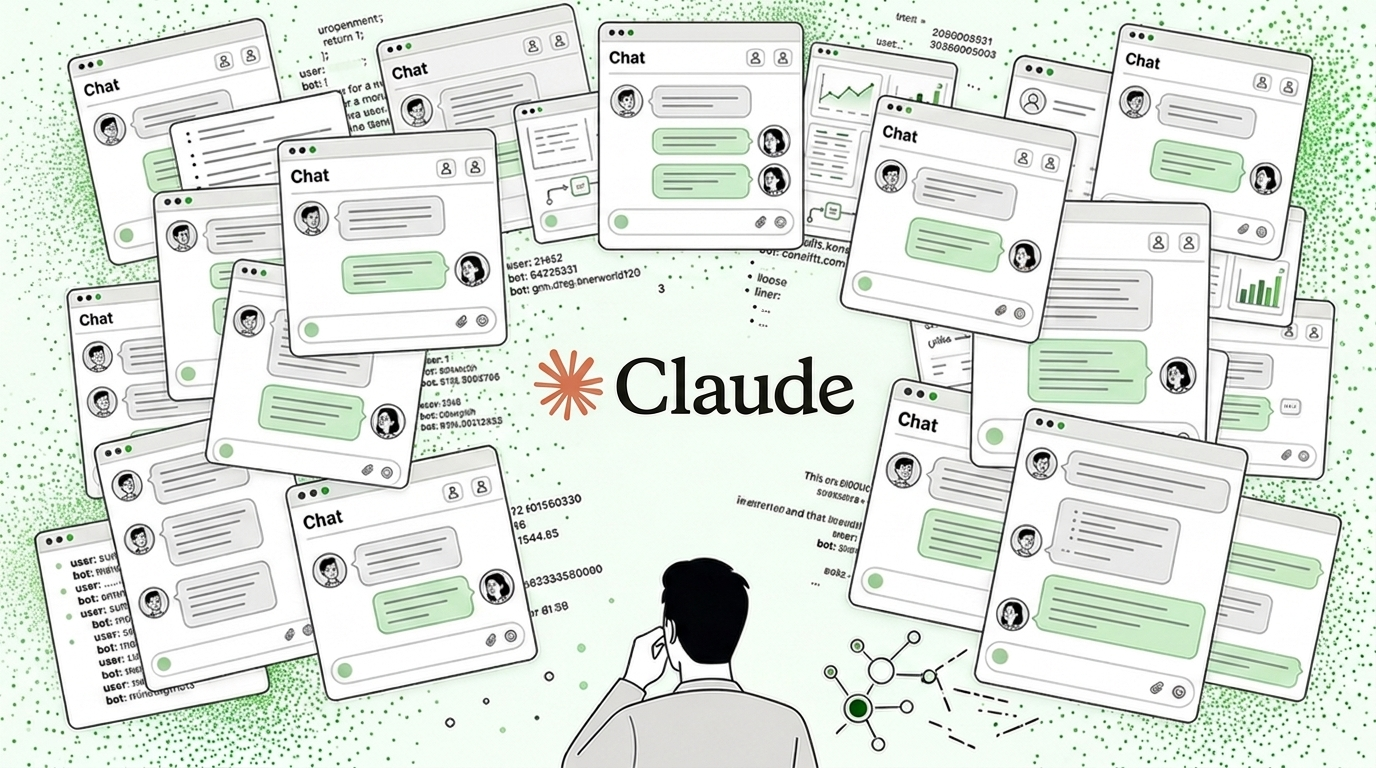
Many AI tools keep important information inside chat threads.
Over time, founders can experience:
Long conversations
Difficult information retrieval
Reduced visibility into priorities
Lack of operational overview
A startup requires more than conversation history.
It needs a structured environment where business progress can be viewed clearly.
The siift Difference: Intelligent Business Canvas
Siift introduces the Intelligent Business Canvas, which organizes business information into three practical views:
Insights
Validated learnings, customer signals, and important business knowledge.
Actions
Priorities, execution steps, and strategic milestones.
Assets
Important resources, documents, and operational materials.
Instead of searching through multiple conversations, founders receive a clearer business command center. This approach reflects the shift toward AI platforms built specifically for founders, where tools support validation, strategy, and execution rather than only content generation.
3. Beyond AI Responses: The Need for an Active Strategic Engine
Traditional AI assistants are primarily reactive.
A user asks a question.
The AI provides an answer.
However, founders need systems that help maintain strategic alignment.
Important startup questions include:
Does our go-to-market strategy match customer feedback?
Are we prioritizing the highest-impact activities?
Which assumptions require validation?
What actions should happen next?
Siift Difference: Master Context Engine
Siift uses a Master Context Engine designed to continuously process, refine, and rebalance business context.
When new validated information becomes available, such as customer feedback or traction signals, Siift helps maintain updated operational context across workflows.
This creates a more dynamic approach to business knowledge management.
Siift’s convograms create intent-defined conversations designed around specific business objectives, helping founders move from open-ended AI chats toward focused strategic discussions and measurable outcomes.
4. AI Context Management: The Missing Layer for Startup Growth
As companies collect more information, maintaining useful context becomes increasingly important.
A startup may have:
Hundreds of customer conversations
Multiple product decisions
Marketing experiments
Business strategy documents
Without prioritization, important signals can become harder to identify.
Siift Difference: Truth Hierarchy
Siift applies a Truth Hierarchy approach by prioritizing verified real-world evidence over unvalidated assumptions.
This helps founders focus on:
Customer reality
Business outcomes
Confirmed learnings
rather than treating every piece of information equally.
5. From Individual Tools to AI Orchestration
Modern startups rely on many specialized tools:
Development platforms
Marketing systems
Analytics tools
Customer platforms
A business AI system should not replace every tool.
Instead, it should connect the existing technology stack.
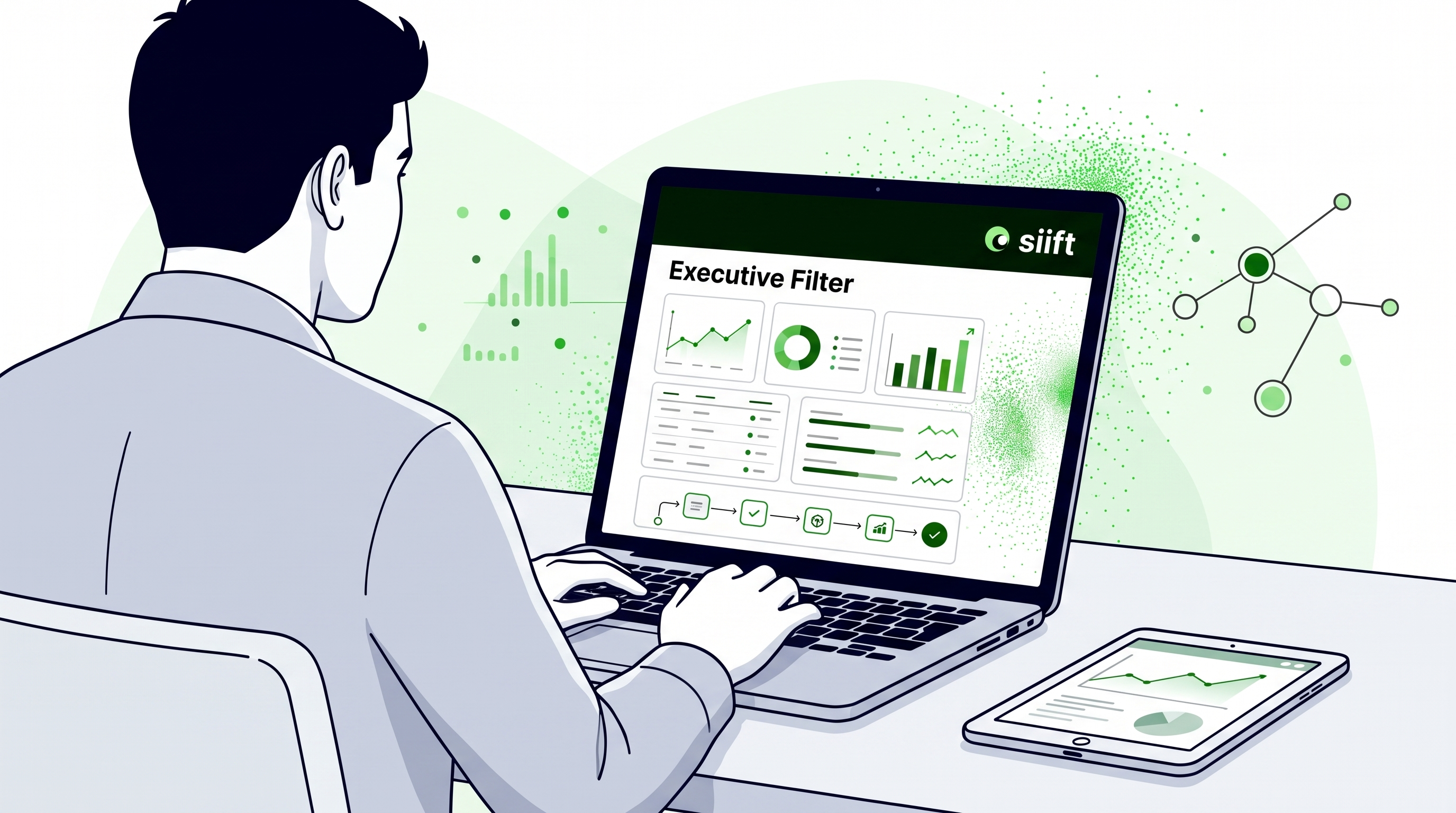
Siift Difference: Top-of-Toolchain Executive Filter
Through MCP and connectors, Siift acts as an executive filter that coordinates information across external tools and brings important context into a unified environment.
The goal is not replacing specialized software.
The goal is creating a smarter operating layer above it, similar to how modern AI tools for startup strategy help founders connect decisions, workflows, and execution.
6. AI Privacy for Startups: Protecting Business Data and IP
For startups, AI adoption involves protecting valuable company information.
This includes:
Intellectual property
Product strategies
Customer information
Internal research
Organizations adopting AI systems increasingly focus on transparency, security, and responsible AI practices. The NIST AI Risk Management Framework provides guidance for managing AI risks and building trustworthy AI systems.
Siift Difference: Private Sustainable Token Business Model
Siift is designed around a founder-aligned model:
No selling user data
No training third-party models on company IP
Enterprise-grade cloud infrastructure
This approach allows startups to use AI while maintaining control over their business knowledge.
Direct Feature Comparison: Claude vs Siift
Feature | Claude (Anthropic) | Siift (The New Business OS) |
|---|---|---|
Primary Purpose | General AI assistant | AI business operating system |
Core Strength | Writing, reasoning, research, document analysis | Startup context management and execution |
Workspace | Projects and conversations | Intelligent Business Canvas |
Context Approach | Helps organize uploaded information through Projects | Dynamic Master Context Engine |
Information Priority | General document understanding | Truth Hierarchy prioritizing validated evidence |
Interface | Chat and document workflows | Insights, Actions, Assets business view |
Strategic Support | User-driven interaction | Founder-focused execution support |
Workflow Coordination | AI assistance across tasks | MCP and connector-based orchestration |
Business Privacy | Enterprise and user-selected privacy controls | Private architecture and founder-focused model |
Claude vs Siift: Which AI Platform Should Founders Choose?
Choose Claude If You Need:
General AI assistance
Writing support
Research help
Document analysis
Coding assistance
Claude is a strong option for individual productivity and knowledge work.
Choose Siift If You Need:
An AI operating system for startups
Business context management
Strategic visibility
Execution tracking
A unified founder workspace
AI-powered business orchestration
Siift is designed for founders who need an operational intelligence layer, not only a conversational assistant. This makes Siift an option for founders searching for an AI business management platform that combines strategy, context, and execution.
How Founders Use AI Business Operating Systems
Startup founders increasingly use AI systems for:
Customer Validation
Analyzing feedback, identifying patterns, and understanding customer needs.
Go-To-Market Planning
Connecting customer insights with positioning and growth strategies.
Strategic Decision Making
Organizing business information to make better decisions.
Execution Management
Tracking priorities, milestones, and operational progress.
Autonomous Agent Platforms: The Next Evolution of Startup AI

The AI market is moving from simple chat assistants toward autonomous and connected systems.
As adoption grows, the next challenge for businesses is moving from using individual AI tools toward integrated systems that can manage information, workflows, and decisions. Census Bureau research shows AI adoption varies significantly by industry, with sectors such as Information and Finance & Insurance reporting higher usage rates than the overall business average.
Future startup AI platforms will focus on:
Understanding business goals
Managing context
Coordinating workflows
Supporting decisions
Connecting multiple tools
As more entrepreneurs adopt AI tools for entrepreneurs, the focus is moving from simple productivity assistance toward systems that support business growth and strategic decisions.
The difference between traditional AI assistants and business operating systems is moving from:
"Answer my question"
toward:
"Help me run my business better."
Frequently Asked Questions
Is Siift an alternative to Claude?
Yes. Siift can be considered a Claude alternative for startup founders who need more than AI conversations. While Claude is a powerful general AI assistant for writing, research, and analysis, Siift focuses on business context management, strategic execution, and organizing startup operations through an intelligent business workspace.
Is Claude good for startups?
Claude is useful for startups that need help with writing, research, coding, and document analysis. However, founders managing a growing company may need additional capabilities such as business context tracking, workflow coordination, and strategic visibility.
What is the best Claude alternative for startup founders?
The best Claude alternative depends on the founder’s goals. Founders looking for a general AI assistant may prefer tools focused on productivity, while those needing an AI operating system for startups may look for platforms that combine knowledge management, execution tracking, and business intelligence.
What is an AI operating system for startups?
An AI operating system for startups is a platform that helps founders organize business knowledge, manage context, connect workflows, and support strategic decisions. Unlike traditional AI chat assistants, these systems are designed around running and scaling business operations.
Can AI help startup founders make better business decisions?
Yes. AI can help founders analyze customer feedback, organize market insights, identify patterns, and support strategic planning. However, the effectiveness depends on whether the AI system can maintain accurate business context and prioritize validated information.
What AI tools do startup founders use?
Startup founders use AI tools for research, customer validation, marketing, automation, product planning, and decision support. Modern founders are increasingly moving from individual AI assistants toward connected AI systems that support complete workflows.
How is Siift different from Claude?
Claude is a general-purpose AI assistant designed for conversations, writing, reasoning, and analysis. Siift is designed as an AI business operating system with features such as the Intelligent Business Canvas, Master Context Engine, Truth Hierarchy, and workflow orchestration.
First-time founders looking for AI strategy support can explore how AI helps entrepreneurs move from ideas to execution
Conclusion
Claude is a powerful general AI assistant that helps users write, research, analyze, and create.
However, startup founders face challenges that require more than generating responses.
They need systems that understand business context, prioritize important information, connect workflows, and support execution.
Claude represents the evolution of general AI assistance.
Siift represents the evolution toward AI-powered business operations.
For founders building the next generation of companies, the future is not only asking AI questions.
The future is building businesses with AI systems that understand, organize, and accelerate execution.
Ready to build smarter? Explore how Siift can help you organize, validate, and execute your next business idea.