

AI tools are becoming increasingly useful for entrepreneurs across ideation, research, marketing, customer engagement, and business operations. But the right tool depends on the problem you are trying to solve, the stage of your business, and how much automation or decision support you actually need.
Table of Contents
Key Takeaways
Point | Details |
|---|---|
AI Tools Should Match the Business Need | Entrepreneurs should evaluate AI tools based on their specific use case, business stage, workflow, pricing, integrations, data handling, and required level of human oversight. |
Core AI Solution Categories | AI Solution Categories: Entrepreneurs can use AI for content creation, research and analysis, workflow automation, customer engagement, predictive analytics, and strategy and decision support. |
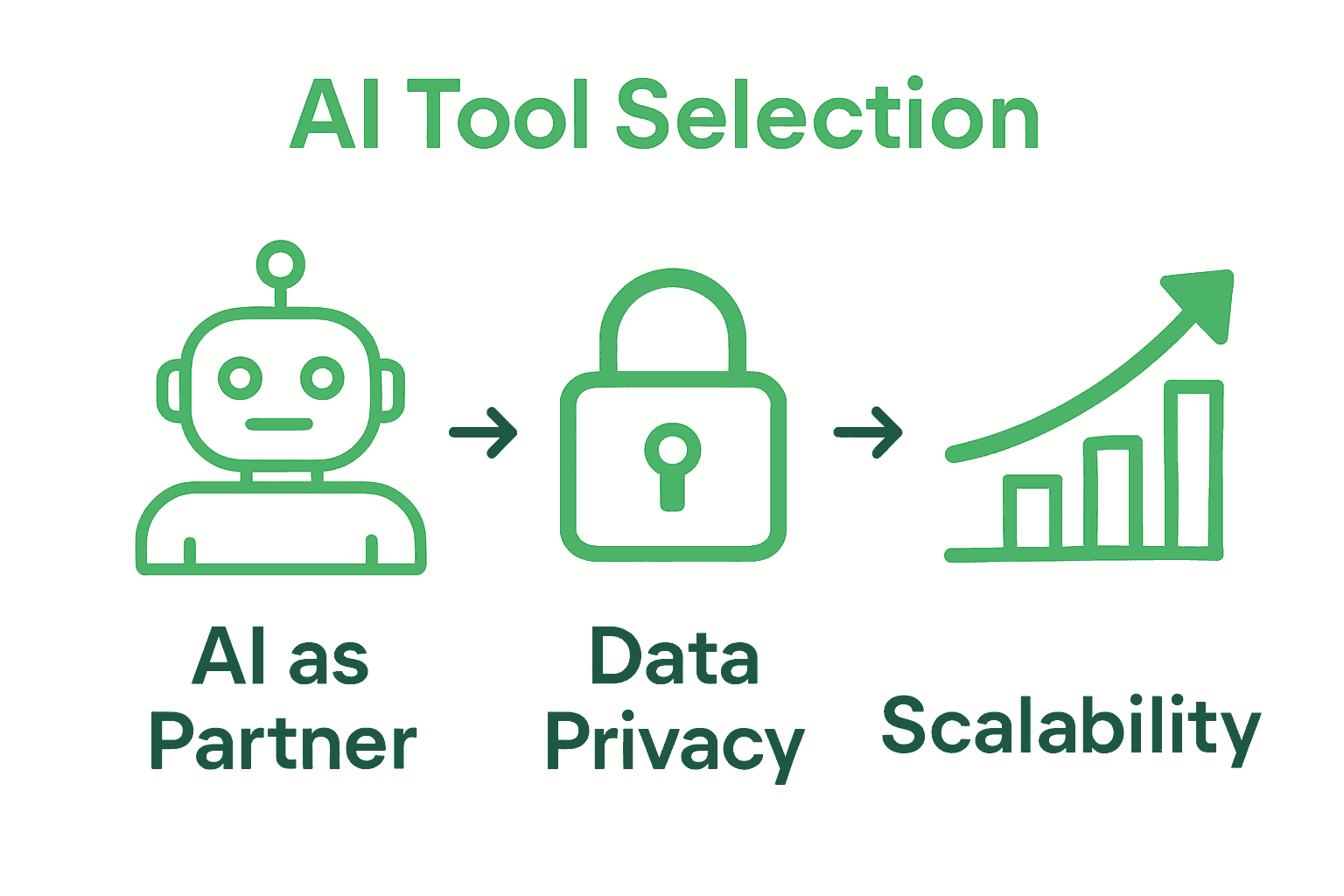
Selection Criteria for AI Tools | When selecting AI tools, focus on scalability, data privacy, integration capabilities, customization potential and pricing. |
AI platform for founders that supports business ideation, validation, planning, business context, and go-to-market work. Current plans include a free tier and paid options with different usage limits. |
Defining AI Tools for Modern Entrepreneurs
AI tools for entrepreneurs can support different parts of the business journey, from researching an idea and testing assumptions to creating content, automating workflows, analyzing information, and managing customer interactions.
The useful question is not simply whether a tool uses AI, but what business problem it solves, how it fits into your workflow, and what level of human oversight it requires.
Key characteristics of AI tools for modern entrepreneurs include:
Adaptability: Ability to handle different tasks, inputs, or workflows depending on the tool.
Automated workflow optimization
Real-time data analysis and insights generation
Personalized recommendation systems
Intelligent task prioritization
AI tools can augment human work by handling repetitive or information-heavy tasks, allowing entrepreneurs to spend more time on strategy, customer relationships, and business decisions. Their usefulness depends on the quality of the tool, the task, the information provided, and the level of human review.
Our guide on AI tools for founders provides additional information on evaluating AI tools for entrepreneurial work.
AI tools can support entrepreneurial work, but they are not substitutes for business judgment. Entrepreneurs should evaluate each tool based on the specific problem it solves, the quality of its outputs, the information it requires, and the level of human review needed.
Core Categories of AI Solutions in 2026
Entrepreneurs can use AI across several practical areas of business:
Generative AI: Creating and refining text, images, presentations, and other content.
Research and analysis: Summarizing information, comparing options, and extracting insights from large amounts of material.
Workflow automation: Handling repetitive tasks and connecting actions across business applications.
Customer engagement: Supporting customer conversations, lead qualification, and personalized communication.
Predictive and analytical tools: Helping businesses identify patterns, monitor performance, and support forecasting.
Strategy and decision support: Helping founders structure ideas, test assumptions, and work through business decisions.
The best category depends on the entrepreneur's immediate need. A founder validating a business idea may need research and decision support, while an established business may get more value from workflow automation, analytics, or customer engagement tools.
Comparing AI Tools for Entrepreneurs
When comparing AI tools, entrepreneurs should look beyond whether a product is marketed as “AI-powered.” The important differences are what each tool actually does, who it is designed for, and how it fits into the business workflow.
Consider:
Primary use case: What specific problem does the tool solve?
Business stage: Is it useful for ideation, validation, launch, growth, or ongoing operations?
Automation: Does it perform actions or mainly provide information and suggestions?
Integrations: Can it work with the applications and systems you already use?
Data and privacy: What information does the tool handle, and what controls are available?
Pricing: Is there a free tier, usage limit, subscription, or custom pricing?
Human oversight: Which decisions still require the entrepreneur's judgment?
Scalability: Can the tool remain useful as the business and workflow become more complex?
This makes the comparison more useful than simply listing features. Two AI tools can both improve productivity while serving completely different entrepreneurial needs.

Best AI Tools for Marketing and Customer Engagement
AI can support entrepreneurs with content creation, audience research, customer communication, campaign workflows, and performance analysis. However, these tools differ significantly in their intended use.
For example, a content-generation tool may help produce marketing assets, while a customer-engagement platform may focus on conversations and lead management. Entrepreneurs should therefore evaluate tools against the specific marketing bottleneck they need to solve rather than choosing a product simply because it includes AI features.
Siift.ai: AI Support for Business Strategy and Execution
Siift is a business-focused AI platform designed to help founders work through different stages of building and growing a business. Its current product includes an Intelligent Business Canvas, shareable workspaces and views, evidence-backed feedback, persistent business context, and support across ideation, validation, product development, and go-to-market planning. Learn more about Siift’s AI business solutions.
What Siift can help entrepreneurs with
Idea exploration: Work through business ideas and organize the information around them.
Idea validation: Pressure-test assumptions and evaluate a business concept using the context provided.
Business planning: Structure business information and turn it into practical actions.
Go-to-market work: Support research, positioning, customer discovery, and related planning.
Ongoing business context: Maintain project context as the business develops.
AI-assisted execution: Use AI guidance and supported actions to work through specific business tasks.
Siift is most relevant when an entrepreneur wants AI support across multiple stages of the business journey rather than a tool dedicated to only one task, such as writing content or automating email.
Pricing and availability
Siift currently offers a free Explore plan with 50 credits per user per month and no credit card requirement. Paid plans include Discover and Focus, with higher monthly credit allowances, while Enterprise pricing is customized for organizations. Pricing and included usage can change, so entrepreneurs should check the current Siift pricing before subscribing.
Who may benefit from Siift?
Siift may be useful for entrepreneurs who want one environment for exploring ideas, validating assumptions, organizing business context, planning next steps, and working through go-to-market questions.
It may be less suitable for someone looking for a narrowly focused tool, such as a dedicated accounting platform, CRM, email marketing system, or content-generation application.
Key Selection Criteria and Common Pitfalls
Critical Selection Criteria for AI Entrepreneurial Tools:
Scalability: Ability to grow with your business
Data & Privacy: Review the provider's privacy documentation and understand how business information is handled.
Integration Capabilities: Seamless workflow compatibility
Customization Potential: Flexible adaptation to unique needs
Human Oversight: Understand where the tool provides recommendations versus where the entrepreneur needs to make the final decision.
Entrepreneurs often fall into predictable traps when selecting AI tools. These include overestimating technological capabilities, neglecting human oversight, and failing to align tool functionality with specific business objectives.
Ultimately, successful AI tool selection is less about finding a perfect solution and more about finding a tool that fits the specific business problem, workflow, budget, and level of human oversight required.
Entrepreneurs should evaluate AI tools critically, focusing on measurable business needs rather than relying on feature lists or marketing claims.
Unlock Your Entrepreneurial Potential with Siift.ai
Starting and growing a business comes with the challenge of turning innovative ideas into actionable, viable plans. This article highlights how AI tools can feel overwhelming due to information overload, integration complexity, and the need for strategic validation at every step. Entrepreneurs often struggle to balance creativity with the demands of reality testing and scaling their ventures efficiently.
Siift's Intelligent Business Canvas is designed for founders who want AI-assisted support while exploring ideas, validating assumptions, planning a business, and working through go-to-market decisions. Explore Siift to see whether its workflow and current plans fit the way you want to build and operate your business.
Frequently Asked Questions
What are AI tools for entrepreneurs?
AI tools for entrepreneurs are software products that use artificial intelligence to support tasks such as research, content creation, analysis, automation, customer engagement, and business planning.
How can AI improve marketing and customer engagement for my business?
AI can support marketing and customer engagement through content creation, audience research, customer communication, lead qualification, campaign workflows, and performance analysis. The appropriate tool depends on the specific marketing task, and important customer-facing outputs should be reviewed by a person before use.
What criteria should I consider when selecting AI tools for my business?
When selecting AI tools, consider scalability, data privacy, integration capabilities, customization potential, pricing, and the level of human oversight required.
How can I integrate AI tools into my existing business strategy?
To integrate AI effectively, entrepreneurs should start with a specific business problem, test the tool on a limited workflow, measure the results, and expand its use when it provides consistent value. Human oversight remains important for strategic, financial, legal, customer-facing, and other high-impact decisions.