
More than 50 percent of American tech startups use AI tools to simplify their launch process and reduce costly mistakes. For many first-time founders, especially those without a business background, finding an intuitive way to turn ideas into successful ventures is a key challenge. This guide reveals how AI platforms can help you make smarter decisions, receive real-time feedback, and build a thriving startup from day one—no experience required.
Table of Contents
- What Is An AI Tool For Founders?
- Types Of AI Platforms For Startup Launch
- How AI Business Canvas Works Step-By-Step
- Personalized Feedback And Actionable Insights
- Real Startup Use Cases And Results
- Risks, Limitations, And Common Mistakes
Key Takeaways
| Point | Details |
|---|---|
| Leverage AI Tools | Founders should utilize AI tools to streamline processes and enhance decision-making, allowing them to focus on strategic growth. |
| Diverse Platform Selection | Selecting the right AI platform is crucial; consider customization, scalability, and integration with existing systems to maximize efficiency. |
| Dynamic Planning with AI Canvas | Use the AI Business Canvas as a flexible, evolving tool to adapt business strategies in response to market changes and insights. |
| Mitigate Risks Effectively | Understand potential risks associated with AI, such as data quality and ethical concerns, and implement strategies for ongoing governance and oversight. |
What Is an AI Tool for Founders?
AI tools for founders are specialized digital platforms designed to transform entrepreneurial workflows by automating complex business processes and generating strategic insights. These intelligent software solutions act as virtual co-founders, leveraging advanced technologies like machine learning and natural language processing to help startups overcome traditional barriers to growth and innovation.
At their core, these tools optimize research and decision-making operations by processing large datasets rapidly and generating actionable recommendations. They function across multiple domains including market research, financial modeling, competitive analysis, and strategic planning. Unlike traditional software, AI tools can learn from patterns, adapt to specific business contexts, and provide predictive intelligence that helps founders make more informed choices.
The key capabilities of AI tools for founders typically include:
- Automated data analysis and visualization
- Intelligent market research capabilities
- Predictive financial modeling
- Strategic recommendation generation
- Workflow optimization and productivity enhancement
Founders can leverage these tools to dramatically reduce manual work, minimize human error, and accelerate their startup’s progression from concept to market-ready enterprise. By integrating AI assistance, entrepreneurs can focus more energy on high-value creative and strategic tasks while the technology handles complex analytical processes.
Pro Startup Strategy Tip: Research and test multiple AI tools before committing, and prioritize platforms offering seamless integration with your existing business systems to maximize efficiency and minimize learning curve.
Types of AI Platforms for Startup Launch
AI platforms for startup launch represent a diverse ecosystem of technological solutions designed to accelerate entrepreneurial growth and innovation. These platforms range from comprehensive cloud-based services to specialized APIs and open-source frameworks, each offering unique capabilities tailored to different startup needs and technical requirements.

Startups can leverage multiple AI orchestration platforms with distinct strengths in performance and scalability, including cloud-based solutions like Google AI, Microsoft Azure, and Amazon Web Services. These platforms provide robust infrastructure for machine learning and data processing, enabling founders to build sophisticated technological capabilities without massive upfront infrastructure investments.
The primary categories of AI platforms for startup launch include:
- Cloud-Based AI Platforms: Offer scalable computing resources and pre-built AI services
- Open-Source AI Libraries: Provide customizable machine learning frameworks
- Specialized AI APIs: Enable rapid integration of specific intelligent functionalities
- Hybrid AI Orchestration Solutions: Combine multiple platform approaches for maximum flexibility
Successful startup founders typically blend different AI platform approaches, selecting tools that align with their specific technological requirements, budget constraints, and development goals. Cloud-based services offer turnkey scalability, while open-source solutions provide deeper customization potential, allowing entrepreneurs to create tailored technological ecosystems.
Here’s a comparison of major AI platform types for startups and their typical benefits:
| Platform Type | Customization Level | Scalability Potential | Best Use Case |
|---|---|---|---|
| Cloud-Based AI Services | Limited customization | High scalability | Quick deployment & data handling |
| Open-Source AI Libraries | Extensive customization | Moderate scalability | Tailored algorithms & innovation |
| Specialized AI APIs | Focused customization | Varies by provider | Add specific intelligent features |
| Hybrid Orchestration | Flexible customization | Scalable with layering | Blend best-of-all-worlds |
Pro Platform Selection Tip: Conduct thorough technical evaluations of AI platforms, prioritizing solutions that offer seamless integration, comprehensive documentation, and scalable pricing models that can grow alongside your startup’s technological needs.
How AI Business Canvas Works Step-by-Step
The AI Business Canvas represents a revolutionary approach to transforming entrepreneurial ideas into structured, actionable business strategies. Unlike traditional business planning methods, this intelligent platform leverages artificial intelligence to guide founders through a comprehensive, dynamic process of business model development and validation.
Founding entrepreneurs can explore a systematic approach to business planning that breaks down complex strategic decisions into manageable, intelligent steps. The AI-powered canvas typically operates through an interactive, iterative process that helps founders:
- Validate core business assumptions
- Identify potential market opportunities
- Develop precise value propositions
- Analyze competitive landscapes
- Generate data-driven strategic recommendations
The step-by-step workflow of an AI Business Canvas generally involves four critical stages:
- Problem Identification: AI analyzes market data to help founders pinpoint genuine customer pain points
- Solution Design: Intelligent algorithms suggest potential product or service configurations
- Market Validation: Advanced predictive models assess market feasibility and potential
- Strategic Refinement: Continuous AI-powered insights help founders iterate and optimize their business model
Founders benefit from an AI Business Canvas because it transforms traditional linear planning into a dynamic, adaptive process. The technology eliminates human biases, provides objective insights, and accelerates decision-making by processing complex market data faster than manual analysis.
Pro Startup Planning Tip: Treat your AI Business Canvas as a living document, updating and refining your strategy continuously based on the intelligent recommendations and emerging market signals.
Personalized Feedback and Actionable Insights
Personalized feedback represents a transformative approach for first-time founders, enabling them to receive targeted, intelligent guidance that adapts to their unique startup journey. By leveraging advanced artificial intelligence, these systems analyze complex business data and provide nuanced, contextually relevant recommendations that traditional mentorship approaches cannot match.
Real-time AI analysis allows entrepreneurs to receive immediate, targeted support across multiple dimensions of their business development. These intelligent systems can quickly identify potential knowledge gaps, strategic weaknesses, and emerging opportunities by processing vast amounts of data far more rapidly than human analysis.
The core components of personalized AI feedback typically include:
- Performance Diagnostics: Identifying strengths and potential improvement areas
- Strategic Recommendations: Suggesting targeted actions based on current business metrics
- Competitive Intelligence: Analyzing market trends and competitor landscapes
- Risk Assessment: Predicting potential challenges and mitigation strategies
- Resource Optimization: Recommending efficient allocation of startup resources
Advanced machine learning models help founders receive objective, data-driven insights that eliminate traditional human biases. These AI systems continuously learn and adapt, providing increasingly sophisticated recommendations as founders progress through different stages of their startup development.
Pro Insight Generation Tip: Configure your AI feedback tools with multiple data sources and regularly update your inputs to ensure the most accurate and relevant personalized recommendations for your specific business context.
Real Startup Use Cases and Results
AI technologies are rapidly transforming how startups approach business challenges, providing unprecedented opportunities for innovation and strategic development. Comprehensive analysis reveals tangible results across multiple business functions, demonstrating the profound impact artificial intelligence can have on early-stage ventures.
Startups are implementing AI tools across diverse strategic domains, including:
- Customer Engagement: Personalized interaction and support systems
- Product Development: Accelerated design and prototyping processes
- Operational Efficiency: Automated workflow and resource management
- Market Analysis: Advanced predictive modeling and competitive intelligence
- Risk Management: Intelligent forecasting and scenario planning
Global startup implementations show measurable efficiency gains across multiple industry verticals, with specific examples highlighting remarkable transformations. Companies like Arize AI in machine learning operations and Clay for data enrichment demonstrate how targeted AI solutions can dramatically improve product development cycles, reduce operational costs, and enhance overall business performance.
The most successful startups are not just adopting AI technologies but strategically integrating them into core business processes. These intelligent systems enable founders to make data-driven decisions, optimize resource allocation, and quickly adapt to changing market conditions with unprecedented speed and accuracy.
Pro Implementation Tip: Start with narrow, high-impact AI use cases in your startup, focusing on specific problems where machine learning can provide clear, measurable improvements in efficiency or performance.
Risks, Limitations, and Common Mistakes
AI technologies present transformative opportunities for startups, but they also introduce complex challenges that founders must carefully navigate. Founders face significant technical and strategic risks when implementing AI solutions, requiring sophisticated understanding and proactive management of potential limitations.
The most critical risks and limitations for founders include:
- Data Quality Issues: Unreliable or biased training datasets
- Technical Constraints: Limitations in current AI model capabilities
- Ethical Considerations: Potential algorithmic bias and privacy concerns
- Operational Complexity: High implementation and maintenance costs
- Regulatory Compliance: Evolving legal frameworks surrounding AI technologies
Global surveys reveal common mistakes founders make when adopting AI technologies, highlighting critical pitfalls such as implementing AI without a clear business problem, over-relying on generic models, and neglecting essential data governance practices. Successful founders recognize that AI is not a magic solution but a strategic tool requiring careful, thoughtful integration.
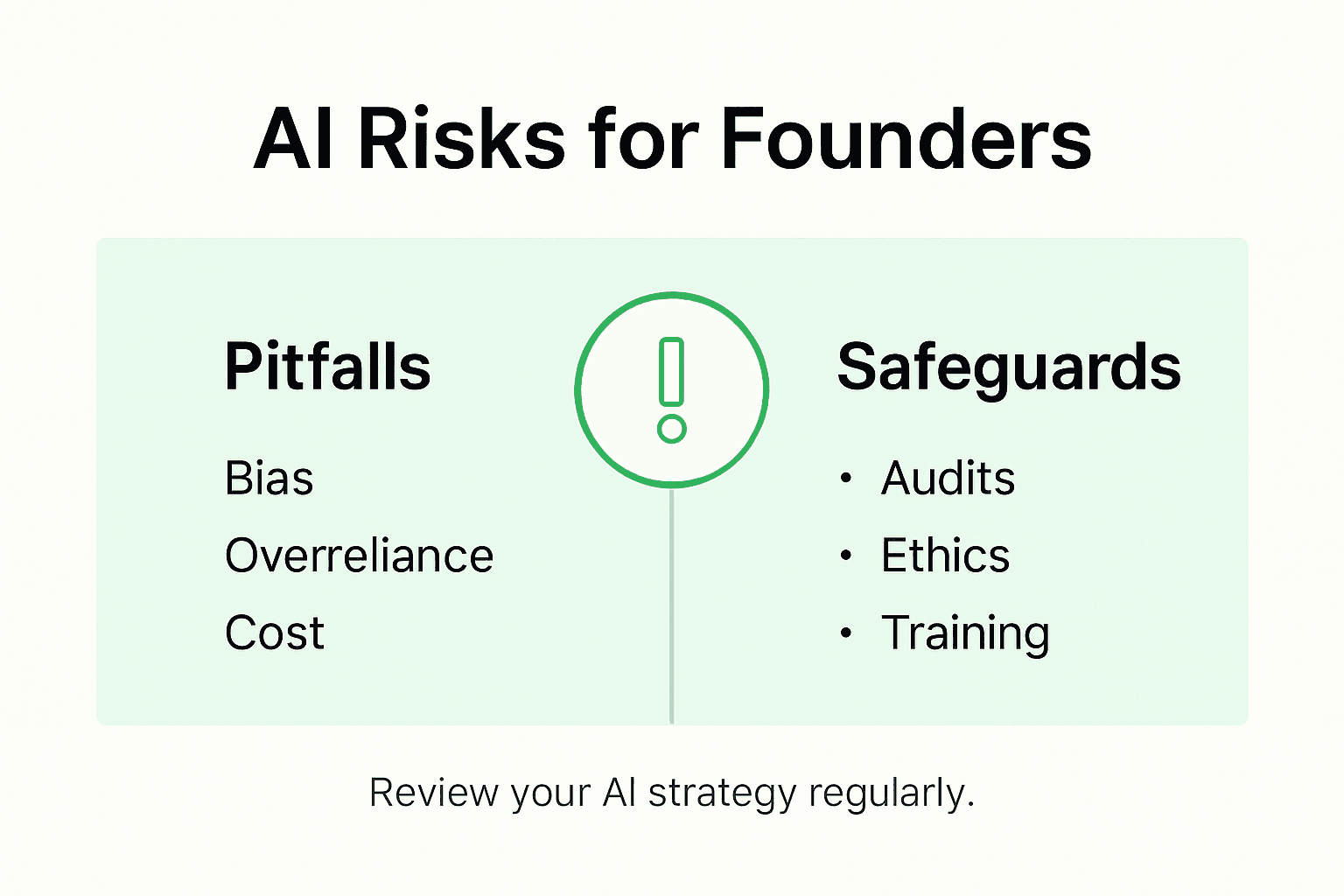
Understanding these risks enables founders to develop more robust, responsible AI strategies. This involves creating transparent processes, maintaining human oversight, continuously validating AI outputs, and aligning technological capabilities with specific business objectives. Founders must approach AI implementation as an iterative, learning-driven process that demands ongoing evaluation and refinement.
Below is a summary of key risks and mistakes founders should consider with AI adoption:
| Risk/Mistake Category | Example Challenge | Long-Term Impact |
|---|---|---|
| Data Quality | Using biased datasets | Poor predictive performance |
| Technical Constraints | Outdated AI models | Slower growth and innovation |
| Ethical Oversight | Unchecked algorithmic bias | Reputational and legal damage |
| Operational Complexity | High maintenance costs | Reduced scalability and agility |
| Governance Neglect | Lack of oversight and audits | Increased compliance risk |
Pro Risk Management Tip: Develop a comprehensive AI governance framework that includes regular audits, ethical guidelines, and mechanisms for human intervention to mitigate potential technological and strategic risks.
Empower Your Startup Journey with Intelligent Strategic Guidance
Starting a new business is a complex challenge filled with uncertainty. This article highlights how first-time founders face obstacles like validating ideas, managing biases, and piecing together fragmented insights from market research, risk assessment, and strategic planning. Founders need an intuitive process that offers personalized feedback, actionable recommendations, and a clear roadmap to de-risk their journey.
This is exactly where the siift.ai Intelligent Business Canvas excels. Designed as a modern founder’s strategy platform it guides you step-by-step through ideation, validation, and go-to-market preparation using AI-powered insights. Unlike traditional planning, it removes blind spots and gatekeepers by providing data-driven feedback tailored to your unique startup context. If you want to transform your ideas into a viable business without second-guessing every step explore the AI Business Canvas and embrace a smarter startup strategy. Don’t wait until challenges slow you down — visit siift.ai now and start turning your vision into reality today.
Frequently Asked Questions
What are AI tools for first-time founders?
AI tools for first-time founders are digital platforms designed to automate complex business processes and generate insights, helping startups streamline operations and make informed decisions.
How do AI platforms differ from traditional software for startups?
AI platforms utilize machine learning and natural language processing to quickly analyze data and adapt business contexts, whereas traditional software typically follows static rules and lacks predictive capabilities.
What are the main capabilities of AI tools that founders should consider?
Key capabilities of AI tools include automated data analysis, intelligent market research, predictive financial modeling, workflow optimization, and generating strategic recommendations.
What risks should founders be aware of when adopting AI technologies?
Founders should be mindful of risks such as data quality issues, technical constraints, ethical considerations, operational complexity, and the importance of a governance framework to mitigate potential pitfalls.