

TL;DR:
- Digital marketing is a strategic, data-driven system focused on audience targeting, messaging, and customer journeys. It involves channels like SEO, content, email, and paid ads, each serving specific stages of the customer lifecycle. Effective digital marketing relies on a clear strategy, analytics, and deep audience understanding to generate sustainable growth and engagement.
Most people launching a business idea assume digital marketing means posting on Instagram, running a few ads, and hoping something sticks. It doesn’t work that way. What is digital marketing, really? It’s a strategic, data-driven system for reaching the right people with the right message at exactly the moment they’re ready to hear it. Understanding this distinction is what separates founders who get traction from those who burn their budget and wonder what went wrong. This guide breaks down everything you need to know, including the digital marketing definition, how it works, which channels matter, and how to actually start.
Table of Contents
- Key takeaways
- What digital marketing actually is
- Types of digital marketing channels
- Why strategy and analytics make or break your results
- How to start digital marketing as a beginner
- My honest take on digital marketing for founders
- Start smarter with Siift
- FAQ
Key takeaways
| Point | Details |
|---|---|
| Digital marketing is a system | It works as a connected ecosystem, not a collection of random online posts or isolated ads. |
| Channel selection matters | Choose channels based on where your audience actually spends time, not where you think you should be. |
| Analytics drive results | Measuring dwell time, conversion paths, and ROI lets you improve campaigns continuously rather than guessing. |
| Content beats paid ads for cost | Content marketing generates 3x more leads at 62% lower cost than traditional outbound. |
| Strategy before tactics | Knowing your customer’s mindset before picking a platform is the single most important move a founder can make. |
What digital marketing actually is
Let’s clear something up fast. The digital marketing definition most people hear is vague, something about “promoting products online.” That framing misses the point entirely.
Digital marketing is the practice of connecting with your audience through digital channels, using data and strategy to move people from “never heard of you” to “loyal customer.” It replaces the old broadcast model of shouting at strangers with something far more powerful: meeting people where they already are and giving them something genuinely useful.
What makes this different from putting a flyer on a telephone pole? A few things:
- Two-way communication. Digital platforms enable genuine back-and-forth interaction that one-way traditional media simply cannot replicate.
- Precision targeting. You can reach a 32-year-old founder in Austin who reads productivity blogs and just searched “how to validate a business idea.” Good luck doing that with a billboard.
- Real-time feedback. Every click, scroll, and purchase generates data you can act on immediately.
- Compounding returns. A well-written blog post or email sequence keeps working for you months after you create it.
The important insight here is that effective digital marketing integrates channels into a structured customer journey rather than treating each platform as a standalone experiment. Think of it less like flipping switches and more like building a circuit. Every component needs to connect for the current to flow.
Pro Tip: Before you choose a single channel or write a single post, map out your customer’s journey from awareness to purchase. That map becomes your strategy.
Types of digital marketing channels
Understanding what digital marketing includes means getting familiar with the core channels, what they do, and when to use them. Each one serves a different purpose along the customer journey.
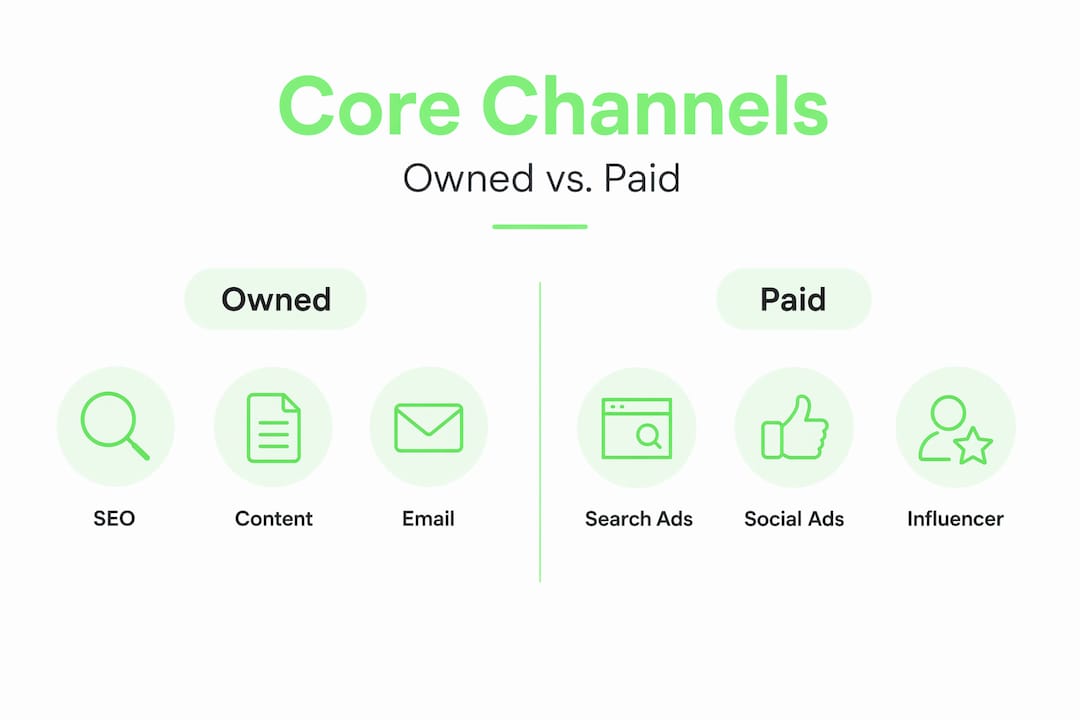
| Channel | Primary purpose | Best stage | Key challenge |
|---|---|---|---|
| SEO | Drive organic search traffic | Awareness, consideration | Takes time to compound |
| Content marketing | Build trust and educate | Awareness, consideration | Requires consistency |
| Social media | Build community and awareness | Awareness, retention | Algorithm dependency |
| Email marketing | Nurture and convert leads | Consideration, decision | List building takes effort |
| Paid ads (PPC) | Fast, targeted reach | All stages | Costs rise without optimization |
| Influencer marketing | Borrowed trust and reach | Awareness | Quality varies widely |
| Affiliate marketing | Performance-based growth | Decision | Requires strong offer economics |
Here’s how these channels actually play out in practice.
SEO is the long game. A well-structured SEO program for a B2B SaaS company achieved up to 702% ROI over seven months. That’s not a typo. It compounds because every piece of content you optimize keeps ranking and driving traffic without ongoing spend. If you’re building something for the long term, SEO is non-negotiable. Check out these SEO basics for beginners to get a solid starting foundation.
Content marketing is the workhorse most founders underestimate. It costs 62% less than outbound marketing while generating three times as many leads. A startup founder who writes genuinely useful guides about their customer’s problem builds trust before the sales conversation even begins.

Email marketing is still the highest-converting channel in the mix. Email automation converts 34% of clickers into buyers, compared to just 7% for standard online ads. An automated welcome sequence that delivers real value can turn a cold subscriber into a paying customer while you sleep.
Paid ads are powerful for speed. If you need results this week, not next quarter, a targeted paid campaign on Google or Meta can put you in front of qualified prospects immediately. The catch is that the moment you stop paying, the traffic stops. Use paid ads to accelerate momentum, not to substitute for organic foundations.
The big picture on types of digital marketing: no single channel wins alone. The founders who grow fastest are those who select a channel mix appropriate to their business stage and integrate those channels into a coherent experience for their audience.
Why strategy and analytics make or break your results
Here’s where most beginners go wrong. They pick a platform because it’s trendy, create content based on gut feeling, and then wonder why nothing converts. Digital marketing without strategy is just expensive noise.
The single most important principle in digital marketing strategies is this: understanding your customer matters more than understanding any platform. Without knowing what your audience fears, wants, and searches for at 11pm, even a generous budget will fail to produce meaningful engagement.
Analytics is what turns guesswork into growth. Behavioral analytics tracks not just clicks but dwell time, scroll depth, and conversion paths, letting you optimize campaigns in real time based on what’s actually working. A founder who reviews their data weekly and adjusts accordingly will outperform someone with twice the budget who never looks at the numbers.
A few common pitfalls to avoid:
- Spreading too thin. Trying to be active on every channel simultaneously produces mediocre results everywhere instead of strong results somewhere. Pick two or three channels and own them.
- Buying tools before building strategy. A $500/month marketing automation platform means nothing if you don’t have a defined funnel it’s supposed to support.
- Chasing vanity metrics. Follower count and impressions feel good but rarely correlate with revenue. Track conversions, cost per acquisition, and customer lifetime value instead.
- Ignoring the retention side. Most digital marketing focuses on acquisition, but keeping a customer costs far less than acquiring a new one. Email sequences, loyalty content, and community-building are where the compounding magic happens.
The importance of digital marketing lies not in presence but in relevance. Showing up everywhere with nothing meaningful to say is worse than showing up in one place and saying exactly the right thing.
Pro Tip: Set one primary goal per campaign before you launch it. “Get 50 email subscribers from this blog post” is a strategy. “Get more traffic” is a wish.
How to start digital marketing as a beginner
Good news: you don’t need a massive team or a six-figure budget to start. You need a clear process and the discipline to follow it.
-
Define your goal. What does success look like in 90 days? More leads? Email subscribers? Product signups? Be specific. Vague goals produce vague results.
-
Know your audience before anything else. Write out who your ideal customer is, what problems they’re trying to solve, what words they use to describe those problems, and where they spend time online. This single exercise will save you from enormous amounts of wasted effort.
-
Choose one or two channels. Based on your audience research, pick the channels where your people actually are. A B2B founder targeting enterprise buyers should probably prioritize LinkedIn and content SEO. A consumer brand selling to Gen Z needs a very different approach.
-
Create content that earns attention. This doesn’t mean going viral. It means producing something that answers a real question your audience is already asking. One useful blog post, one honest email, one clear explainer can outperform a thousand generic promotional posts.
-
Measure what matters. Use free tools like Google Analytics and platform-native insights to track the metrics tied to your goal. Review them weekly. Ask “what’s working and why?” not just “what’s the number?”
-
Iterate fast. Digital marketing’s greatest advantage over traditional marketing is the speed of feedback. You can test a headline on Monday, see results by Wednesday, and improve by Friday. Use that cycle aggressively.
For founders validating a new idea, understanding growth strategies for startups alongside digital marketing fundamentals creates a compounding advantage. Strategy and execution reinforce each other.
Pro Tip: Start with the channel that requires the least budget but the most clarity. If you can write one genuinely useful email per week to a small list, you’re already ahead of 90% of beginners.
My honest take on digital marketing for founders
I’ve watched a lot of founders approach digital marketing the same way they approach their product launch: with a burst of energy, a lot of tools, and not enough patience. And I get it. When you have something you believe in, you want the world to know immediately.
But here’s what I’ve learned from working with early-stage founders at every budget level. The ones who get traction are not the ones with the flashiest campaigns. They’re the ones who treat digital marketing as relationship-building, not broadcasting. They think about what their audience needs to hear, not just what they want to say.
The contrarian truth about digital marketing strategies is that presence without relevance is just spam at scale. Posting every day on five platforms because you read that “consistency is key” will drain your energy without building your audience, unless every post is genuinely useful to someone specific.
My advice? Go narrow and go deep. Pick one person you’re trying to reach, understand their world better than anyone else in your space, and create content that makes them feel understood. That’s what two-way engagement actually looks like in practice. Not a comments section, but a posture.
Data is your equalizer. As a founder without a big marketing team, your analytics tell you what a room full of strategists would spend weeks debating. Read them honestly, without attachment to what you hoped was working.
— Samim
Start smarter with Siift
Digital marketing is only as powerful as the strategy behind it. And building that strategy, especially when you’re validating a new idea, is exactly where most founders lose momentum.
That’s where Siift comes in. Siift’s AI-powered platform guides founders step-by-step through ideation, validation, and go-to-market planning, so you’re not guessing which channels to prioritize or which messages to test. It helps you build a validated strategy before you spend a dollar on marketing, filtering out the noise, biases, and blind spots that derail most early-stage efforts.
If you’re serious about turning your idea into something with real traction, Siift gives you the structure to make digital marketing actually work. Explore the platform and see how it fits your founder journey.
FAQ
What is the simplest digital marketing definition?
Digital marketing is the practice of promoting products, services, or ideas through digital channels like search engines, social media, email, and websites. It uses data and strategy to reach the right audience at the right time.
How does digital marketing work for a beginner?
It works by selecting channels where your audience spends time, creating content or ads that address their needs, and measuring results to refine your approach. The core loop is create, publish, measure, and improve.
What does digital marketing include?
Digital marketing includes SEO, content marketing, social media, email marketing, paid advertising, influencer marketing, and affiliate marketing. Each channel serves a different stage of the customer journey from awareness to retention.
Why is digital marketing important for founders?
Digital marketing levels the playing field. With the right strategy, a founder with a small budget can reach and convert a highly specific audience far more efficiently than traditional advertising ever allowed.
How long does digital marketing take to show results?
Paid ads can generate results within days. SEO and content marketing typically take three to six months to build momentum but deliver compounding returns over time. Most founders benefit from running both in parallel.