
TL;DR:
- SEO helps make your content discoverable and attracts free, targeted search traffic.
- Building a strong technical foundation, keyword research, helpful content, and regular monitoring are essential.
- Consistent effort and systems-building outperform shortcuts, leading to lasting organic growth.
Most people assume SEO is a dark art reserved for developers and big-budget marketing teams. It isn’t. Whether you’re a student testing a side project, a corporate professional exploring a business idea, or an indie developer launching your first app, SEO is simply the practice of making your work discoverable to people who are already searching for it. This guide strips away the jargon, walks you through the foundational steps, and shows you exactly where to start, so you can attract real users without spending a dollar on ads.
Table of Contents
- What is SEO and why does it matter?
- Key pillars of SEO: The beginner’s checklist
- Making your site visible: Crawlability, indexability, and site structure
- Content and keywords: How to get found for what matters
- Measuring success: Tracking, testing, and adapting your SEO efforts
- The real SEO secret: There are no shortcuts, just simple systems
- Ready to boost your reach? Get smart SEO help
- Frequently asked questions
Key Takeaways
| Point | Details |
|---|---|
| SEO unlocks organic growth | Anyone can use SEO basics to get more attention for their business or idea online. |
| Crawlability and content matter most | Ensuring your site is accessible and creating useful content lay the groundwork for results. |
| Small smart actions beat shortcuts | Consistent improvements and monitoring drive steady, lasting SEO success. |
| Track and adapt | Use simple tools to measure what works, then refine your strategy over time. |
What is SEO and why does it matter?
SEO stands for Search Engine Optimization. In plain terms, it means improving how your website appears in search results on Google, Bing, or any other search engine. When someone types a question or phrase into a search bar, search engines scan billions of pages and rank the most relevant ones. Your goal is to be one of those pages.
Here’s what makes SEO so powerful for early-stage founders and creators: it’s free traffic. Unlike paid advertising, where visibility disappears the moment your budget runs out, organic search traffic keeps coming as long as your content stays relevant and your site stays healthy. That’s a compounding asset, not a one-time expense.
“SEO helps search engines discover, index, and rank your site, opening the door to consistent, organic traffic for new ideas.”
A common misconception is that SEO only works for established brands with thousands of backlinks and years of history. That’s simply not true. A focused, well-structured new site with genuinely helpful content can absolutely outperform a bloated, neglected old one. Search engines reward relevance and quality, not just age or authority.
For entrepreneurs, this matters enormously. Before you spend money on ads or influencer campaigns, SEO lets you test whether real people are searching for what you’re building. If you’re getting organic clicks on a landing page about your product concept, that’s early validation. If nobody’s searching for it, that’s equally valuable information. You can learn more about get traction basics to see how SEO fits into a broader early-stage strategy.
Here’s what SEO can do for a new project:
- Attract targeted visitors who are already interested in your topic or solution
- Validate demand by revealing what people actually search for in your niche
- Build credibility because ranking in search signals trustworthiness to users
- Reduce customer acquisition costs over time compared to paid channels
- Create a compounding growth engine where each piece of content adds to your visibility
The bottom line: SEO is not a technical luxury. It’s a foundational growth lever that every founder, developer, and creator should understand from day one.
Key pillars of SEO: The beginner’s checklist
Now that you see the opportunity SEO creates for all kinds of projects, let’s break down the fundamentals with simple steps. Think of SEO as a structure with several interconnected pillars. Neglect one, and the whole thing wobbles. Strengthen all of them, and you build a stable foundation for long-term growth.
According to core SEO guidance, the foundational sequence is: ensure crawlability and indexability, conduct keyword research, create helpful content with E-E-A-T, optimize on-page elements, build backlinks, and monitor rankings and traffic consistently.
Let’s walk through each pillar:
- Technical setup: Submit your site to Google Search Console, create an XML sitemap, and make sure Googlebot can access your pages without errors.
- Keyword research: Identify the words and phrases your target users type into search engines. Focus on relevance, search volume, and intent.
- Content creation: Publish helpful, reliable content that demonstrates E-E-A-T, which stands for Experience, Expertise, Authoritativeness, and Trustworthiness. This is Google’s framework for evaluating content quality.
- On-page optimization: Place your target keywords in page titles, meta descriptions, headers, and naturally throughout your content.
- Link building: Earn links from other reputable websites pointing to yours. Start with internal links between your own pages.
- Monitoring: Track your rankings and traffic regularly. SEO is not a set-and-forget activity.
| SEO pillar | Beginner priority | Key tool |
|---|---|---|
| Crawlability | High | Google Search Console |
| Keyword research | High | Google Keyword Planner |
| Content quality | High | Your own expertise |
| On-page optimization | Medium | Yoast SEO or similar |
| Link building | Medium | Manual outreach |
| Performance monitoring | High | Google Analytics |
Pro Tip: Don’t panic about 404 errors (broken pages) when you’re just starting. A handful of 404s won’t tank your SEO. Schema markup (structured data that helps search engines understand your content) is also worth exploring once you have your basics covered, but it’s not a day-one priority. Focus on the fundamentals first, then layer in advanced tactics. Check out startup launch steps and step-by-step traction for context on how SEO fits your broader launch plan. If you ever need specialized help, an SEO specialist can accelerate your progress significantly.
Making your site visible: Crawlability, indexability, and site structure
With the checklist in hand, the next vital step is to make sure your site is findable. This is where many beginners stumble, not because the concepts are hard, but because they skip this step entirely and wonder why their content never appears in search results.
Crawlability means that search engine bots, specifically Googlebot, can visit and read your pages. If your site blocks bots accidentally through a misconfigured robots.txt file, your content simply won’t be seen. Test this immediately in Google Search Console using the URL Inspection tool.
Indexability means that once a bot visits your page, it can add that page to the search engine’s index, which is the giant catalog of all discoverable web content. A page can be crawlable but not indexable if you’ve accidentally added a “noindex” tag. Always verify your key pages are indexed.
Mobile-first indexing is now the default for Google, meaning it primarily uses the mobile version of your site to rank pages. If your mobile experience is broken or your primary content only loads on desktop, you’re invisible to Google’s ranking system. Avoid lazy-loading your main content on mobile, as this can prevent bots from seeing it.
Site structure matters more than most beginners realize. Here’s what a clean structure looks like in practice:
- Simple navigation: Users and bots should reach any page within three clicks from your homepage.
- Clean URLs: Use readable URLs like "/blog/seo-basics
rather than/page?id=4872`. - No orphan pages: Every page should be linked to from at least one other page on your site. Orphan pages are invisible to both users and search engines.
- Consistent internal linking: Connect related pages to each other to help bots understand your site’s topic clusters.
| Action | Impact | Difficulty |
|---|---|---|
| Submit XML sitemap | High | Low |
| Fix broken internal links | Medium | Low |
| Enable mobile-responsive design | High | Medium |
| Remove accidental noindex tags | High | Low |
| Add alt text to images | Medium | Low |
Building a discoverable site is the unglamorous but essential work of SEO. Get this right early, and everything else becomes easier. Explore the business traction guide for a broader view of how technical foundations support faster growth.
Content and keywords: How to get found for what matters
Once your site is easily found by search engines, the next challenge is to attract the right audience with smart content and keyword choices. This is where SEO becomes genuinely exciting for founders, because it forces you to think deeply about your customers’ real needs.

Search intent is the single most important concept in keyword strategy. Every search query has a purpose behind it. Google classifies intent into four categories: informational (learning something), navigational (finding a specific site), commercial (researching before buying), and transactional (ready to purchase). Choosing keywords without understanding intent is like writing answers to questions nobody asked.
Here’s a practical process for keyword research as a beginner:
- Brainstorm your topic universe: Write down every problem your product or idea solves. Think from your customer’s perspective, not your own.
- Use free tools: Google’s autocomplete, “People Also Ask” boxes, and the free tier of Google Keyword Planner reveal real search behavior.
- Filter by intent: Match keywords to the stage of awareness your audience is in. Early-stage users search for problems; ready-to-buy users search for solutions.
- Check difficulty: New sites should target lower-competition, longer phrases (called long-tail keywords) before going after high-volume, competitive terms.
- Prioritize relevance over volume: A keyword with 200 monthly searches that perfectly matches your offering beats a 10,000-search term that’s only loosely related.
The E-E-A-T framework, which stands for Experience, Expertise, Authoritativeness, and Trustworthiness, is Google’s way of evaluating whether content deserves to rank. For new creators and founders, this means writing from genuine experience, citing credible sources, being transparent about who you are, and keeping your information accurate and up to date.
Pro Tip: Structure every piece of content around one primary keyword and two or three supporting keywords. Use your primary keyword in the page title, the first paragraph, at least one subheading, and the meta description. Don’t stuff it in awkwardly; write for humans first, and search engines will follow.
Once you publish, revisit your content every few months. Search trends shift, competitors publish new material, and your own understanding of your audience deepens over time. Consistent refinement beats a one-time perfect post. See growth strategies for startups for ideas on how content and SEO integrate with your overall growth plan.
Measuring success: Tracking, testing, and adapting your SEO efforts
Now that your content is optimized, it’s essential to measure what’s working and what isn’t. Many beginners publish content and then wait passively, hoping for results. The founders who actually grow treat SEO like a feedback loop, constantly learning and adjusting.
Two free tools cover most of what you need at the start:
- Google Search Console: Shows you which queries trigger your pages, how often you appear in results (impressions), and how often people click through. It also alerts you to crawl errors and indexing issues.
- Google Analytics: Tracks what happens after someone lands on your site, including how long they stay, which pages they visit, and whether they convert into leads or customers.
What does SEO “success” look like for a new project? It doesn’t start with page-one rankings. It starts with impressions, meaning search engines are at least showing your pages. Then come clicks. Then engagement (time on page, pages per session). Then conversions. Each stage tells you something different.
New sites can outrank older, more established ones by providing better content and a smarter strategy. This is genuinely encouraging, but it requires patience. Most SEO changes take weeks or months to reflect in rankings. Don’t make dramatic changes every week based on short-term fluctuations.
Here’s how to respond to common setbacks:
- Sudden ranking drop: Check for Google algorithm updates, recent site changes, or new competitors targeting your keywords.
- Spike in 404 errors: Audit your internal links and fix broken ones quickly. A few 404s won’t hurt you, but a pattern signals a structural problem.
- Low click-through rate despite good rankings: Rewrite your meta titles and descriptions to be more compelling and specific.
- High bounce rate: Your content may not be matching the search intent of the keywords you’re targeting.
Iteration is the real secret of lasting SEO growth. Every data point is a clue. Treat your site like a living experiment, and review your common startup mistakes to make sure SEO missteps aren’t compounding other early-stage errors.
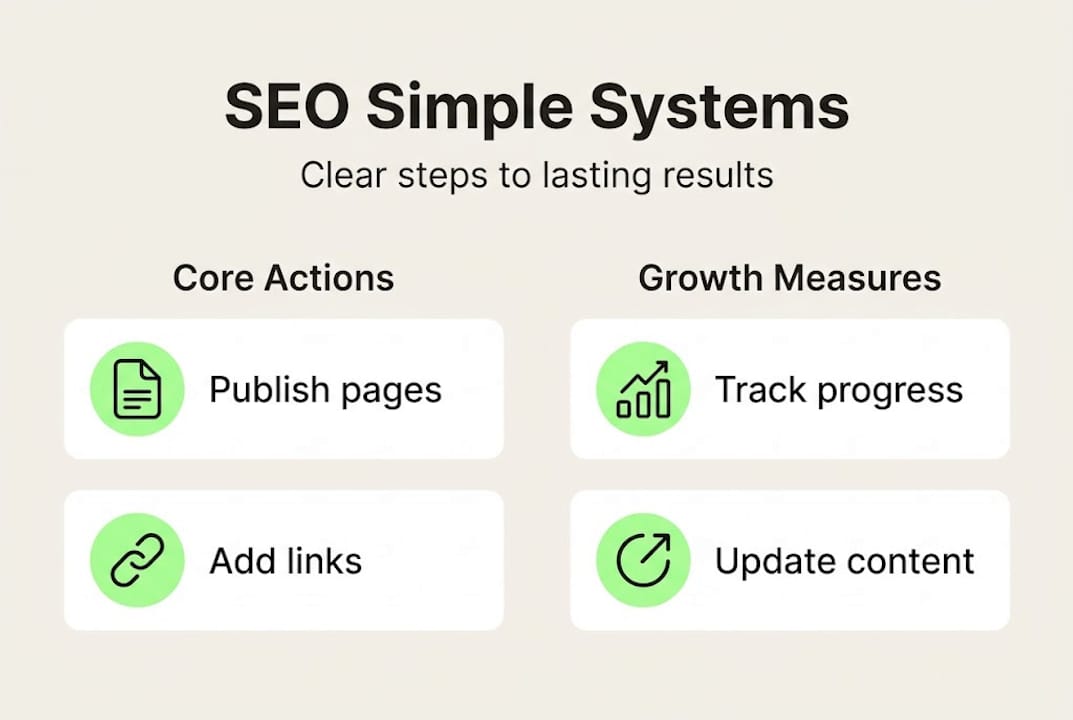
The real SEO secret: There are no shortcuts, just simple systems
Here’s our honest take after working with hundreds of early-stage founders: the biggest SEO mistake isn’t a technical error. It’s chasing shortcuts instead of building systems.
The internet is full of promises about “ranking hacks” and “algorithm secrets.” Most of them are either outdated, ineffective, or actively harmful to your site’s long-term health. The founders who build real, durable organic traffic do something far less glamorous: they show up consistently, publish genuinely helpful content, fix what’s broken, and keep learning.
SEO is cumulative. Every page you publish, every internal link you add, every piece of content you improve adds to a growing foundation of authority and relevance. It doesn’t feel dramatic in week two. It feels transformative in month twelve. The actionable traction steps that compound over time always outperform the clever tactics that spike and fade.
Our encouragement to you: master the basics, stay curious, and trust the process. Algorithms change, but the principle of genuinely helping real people never does. Build for humans, and the search engines will follow.
Ready to boost your reach? Get smart SEO help
Applying SEO principles is far easier when you have a structured system guiding your decisions, not just a checklist. The Siift platform is built exactly for this moment in your founder journey, helping you move from idea to validated strategy with clarity and speed. Whether you’re figuring out your keyword positioning, testing your value proposition, or mapping your go-to-market approach, Siift’s Intelligent Business Canvas gives you the agentic AI support that generic tools simply can’t match. Start with the startup traction guide to see how SEO fits into a complete, actionable growth strategy built for founders like you.
Frequently asked questions
What is the first step in SEO for beginners?
The first step is making sure your site is crawlable and indexable by search engines using tools like Google Search Console and an XML sitemap.
Do I need to know coding to do SEO?
You don’t need coding skills to begin SEO; most foundational tasks like keyword research and content creation are completely non-technical and accessible to anyone.
How do I choose the right keywords for my business?
Focus on keywords that match your offering and align with user intent, balancing relevance, search volume, and competition level.
Can new sites really outrank old established sites?
Yes, new sites can outrank older ones by delivering better, more relevant content paired with a smarter, more focused SEO strategy.
What tools should I use to track my SEO progress?
Google Search Console and Google Analytics are the best beginner-friendly tools for monitoring impressions, clicks, rankings, and on-site user behavior.