
Launching a startup often feels confusing when you are a tech or creative professional without a business background. Many find themselves stuck at the starting line, unsure how to move from inspiration to action. Clarifying your business idea and core value is the essential foundation, and using a conceptual framework helps you create a roadmap that sets the right direction from day one. You will discover strategies for defining, validating, and prioritizing your entrepreneurial vision for real-world traction.
Table of Contents
- Step 1: Clarify Your Business Idea And Core Value
- Step 2: Validate Market Demand Using Rapid Feedback
- Step 3: Choose And Prioritize High-Impact Launch Actions
- Step 4: Leverage Siift’s Founder Intelligence Platform For Accelerated Growth
- Step 5: Track Progress And Refine Strategies For Continuous Traction
Quick Summary
| Key Takeaway | Explanation |
|---|---|
| 1. Define core business values | Clearly articulate the problem you solve and your unique solution to engage customers effectively. |
| 2. Validate market demand | Use customer feedback to test whether your idea addresses real needs before investing resources. |
| 3. Prioritize impactful actions | Focus on high-impact launch actions that align with your core business goals for maximum progress. |
| 4. Utilize siift platform | Leverage siift’s AI-driven insights to refine your business strategy and validate market assumptions. |
| 5. Track performance regularly | Implement key performance indicators to monitor progress and adapt strategies based on insights. |
Step 1: Clarify your business idea and core value
Defining your business idea and core value is the foundational first step in transforming your entrepreneurial vision into reality. This process helps you articulate exactly what problem you solve and why customers should care.
To craft a compelling business concept, start by identifying the specific customer pain point you aim to address. Ask yourself: What unique solution can I provide? Conceptual frameworks help clarify core values that differentiate your offering. Map out the precise problem, your target audience, and how your solution is distinctly better than existing alternatives.
Break down your core value proposition into three key components: the problem you solve, your target customer, and your unique approach. Avoid generic statements. Instead, create a laser-focused description that communicates immediate value. Validate your idea by discussing it with potential customers, seeking honest feedback that confirms you’re solving a real need.
Pro tip: Create a one-sentence description of your business that a 10-year-old could understand, which forces clarity and simplicity in your core value statement.
Step 2: Validate market demand using rapid feedback
Validating market demand is your critical checkpoint for transforming a business idea into a viable product. This step helps you confirm whether real customers actually want your solution before investing significant time and resources.

Rapid research methods provide actionable market insights that can save you from costly mistakes. Start by creating a targeted feedback strategy that includes customer interviews, online surveys, and prototype demonstrations. Approach potential customers directly, asking specific questions about their pain points and how your proposed solution might address them. Focus on understanding their genuine needs rather than seeking confirmation of your existing assumptions.
Develop a minimum viable product (MVP) that demonstrates your core value proposition. This doesn’t need to be a fully polished product but should clearly communicate your solution’s unique benefits. Test this MVP with a small, representative group of potential customers, collecting detailed feedback on its functionality, appeal, and perceived value. Pay close attention to their emotional reactions and specific suggestions for improvement.
Pro tip: Create a feedback collection system that allows for anonymous and candid responses, as people are more likely to share honest insights when they feel their input is truly confidential.
Here’s a comparison of common market validation methods for startups:
| Validation Method | Speed to Results | Cost to Implement | Depth of Insight |
|---|---|---|---|
| Customer Interviews | Rapid, within days | Low, mostly time | High, qualitative |
| Online Surveys | Moderate, 1-2 weeks | Low to moderate | Moderate, quantitative |
| Prototype Demos | Fast, real-time | Variable, depends on MVP | High, real-world feedback |
| Analytics from MVP | Ongoing | Moderate | Detailed, data-driven |
Step 3: Choose and prioritize high-impact launch actions
Choosing the right launch actions can make or break your startup’s initial momentum. This step is about strategically selecting and sequencing activities that will generate the most significant progress with your limited resources.
Decision frameworks help founders prioritize critical actions by focusing on initiatives with maximum potential impact. Begin by creating a comprehensive list of potential launch activities, then systematically evaluate each against key criteria. Consider the potential return on investment, alignment with your core business goals, resource requirements, and likelihood of execution. Rank your actions based on their strategic value, looking beyond immediate gains to understand how each initiative contributes to your long-term vision.
Develop a prioritized action roadmap that breaks down your top initiatives into specific, measurable tasks. Assign clear ownership and realistic timelines for each action. Be prepared to remain flexible and adjust your priorities as you gain more market insights. Remember that effective prioritization is not about doing everything but about doing the most impactful things exceptionally well.
Pro tip: Create a simple scoring matrix that objectively rates each potential launch action across dimensions like potential revenue, customer impact, and strategic alignment to remove personal bias from your decision making.
Step 4: Leverage siift’s Founder Intelligence platform for accelerated growth
The siift Founder Intelligence platform is your ultimate strategic partner in transforming entrepreneurial ideas into successful business realities. This powerful AI-driven tool provides personalized guidance that helps you systematically navigate the complex landscape of startup development with unprecedented precision and insight.
Start by uploading your initial business concept into the platform, which will immediately analyze your idea using advanced AI algorithms. The system generates comprehensive feedback, identifying potential strengths, weaknesses, market opportunities, and critical blind spots you might have overlooked. By breaking down your concept into granular components, siift offers actionable recommendations that help you refine your business model, validate your market assumptions, and create a more robust strategy.
Utilize the platform’s intelligent features to generate detailed market research, competitive analysis, and strategic roadmaps tailored specifically to your unique business concept. The AI continuously learns from your inputs, providing increasingly sophisticated insights that adapt to your evolving business needs. This dynamic approach ensures you receive real-time, data-driven guidance that helps you make informed decisions, minimize risks, and accelerate your path to sustainable business growth.
Pro tip: Treat the siift Founder Intelligence platform as an active collaborator, not just a tool by consistently updating your progress, exploring its suggested modifications, and integrating its recommendations into your strategic planning.
Step 5: Track progress and refine strategies for continuous traction
Tracking your business progress is the critical lifeline that transforms good intentions into measurable success. This step is about creating a dynamic, responsive system that helps you understand exactly how your startup is performing and where you need to adjust.
Continuous improvement cycles enable strategic refinement by providing a systematic approach to evaluating your business performance. Implement a robust tracking mechanism that captures key performance indicators (KPIs) relevant to your specific business model. These might include customer acquisition costs, conversion rates, revenue growth, and user engagement metrics. Regular assessment allows you to identify trends, recognize emerging opportunities, and quickly address potential challenges before they become significant roadblocks.
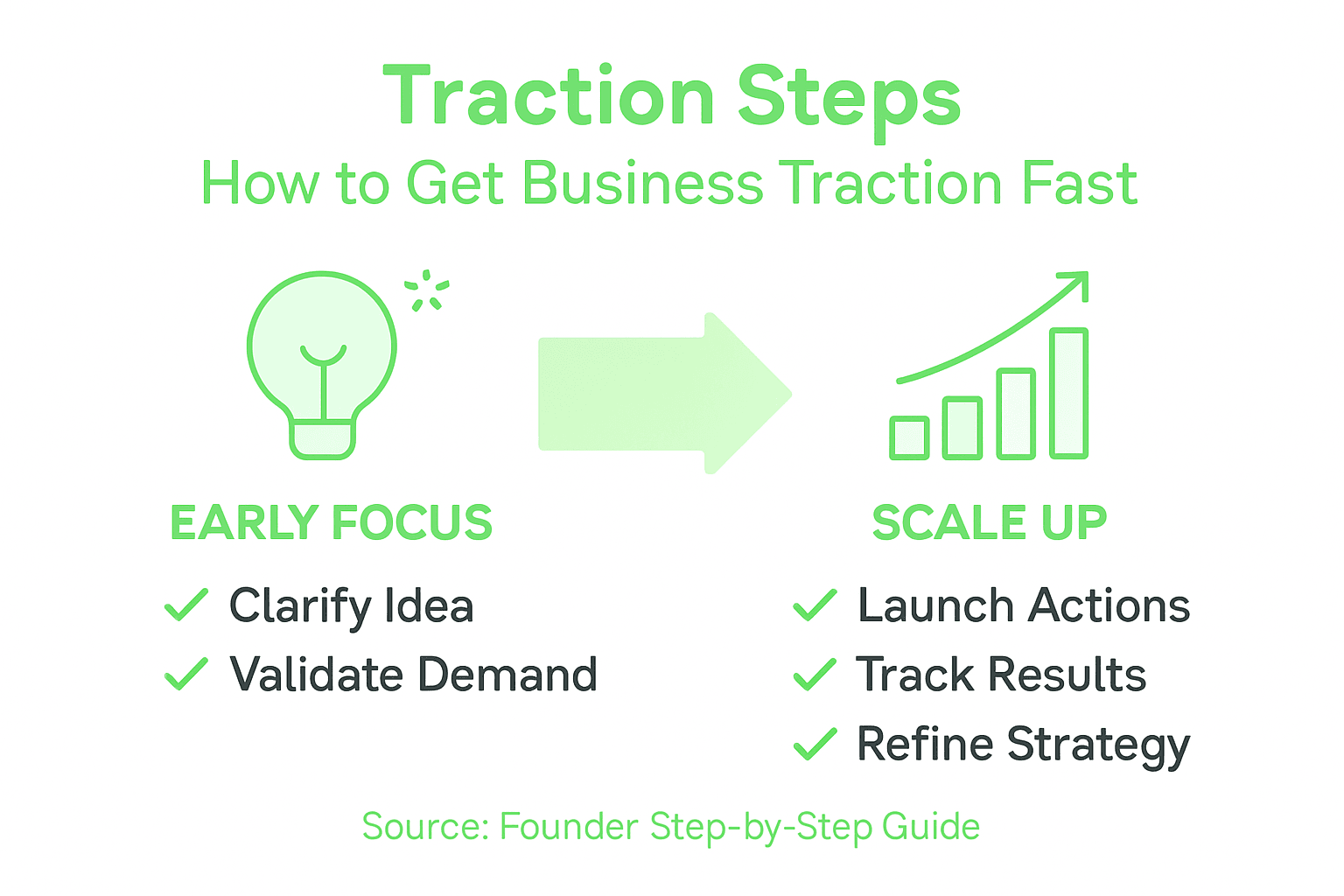
Establish a rhythm of periodic review and adaptation. Set up monthly or quarterly checkpoints where you comprehensively analyze your progress, compare actual results against your initial projections, and make data driven adjustments to your strategy. This iterative process ensures your business remains agile, responsive, and continuously aligned with market dynamics. Remember that tracking is not about perfection but about learning and evolving your approach with each new insight.
Pro tip: Create a simple dashboard that visualizes your most critical metrics, making it easy to spot trends and quickly communicate progress to potential investors and team members.
Below is a summary of key performance indicators (KPIs) to track for continuous startup growth:
| KPI Name | What It Measures | Why It Matters |
|---|---|---|
| Customer Acquisition Cost | Cost per new customer | Controls marketing efficiency |
| Conversion Rate | Percentage of visitors to buyers | Assesses sales funnel performance |
| Revenue Growth Rate | Increase in sales over time | Signals market traction |
| User Engagement | Activity and retention metrics | Indicates product value and loyalty |
Accelerate Your Business Traction with siift.ai
Struggling to clarify your core business idea or validate market demand quickly? The article highlights common challenges entrepreneurs face such as defining a clear value proposition and prioritizing launch actions without bias or blind spots. If you want to avoid costly mistakes and gain rapid, personalized feedback along every step—from ideation to go-to-market—siift.ai Intelligent Business Canvas is designed precisely for founders like you.
Experience an intuitive AI platform that guides you systematically with no gatekeepers or pressure. It helps you uncover hidden opportunities, prioritize high-impact actions, and track progress with clarity. Don’t let uncertainty hold you back. Take control today by exploring how siift.ai empowers you to turn your startup ideas into real traction faster than ever. Start your journey now and gain confidence in every decision with siift.ai.
Frequently Asked Questions
What is the first step to getting business traction?
Defining your business idea and core value is the first step to gaining traction. Clarify the specific problem you solve for your customers, and articulate your unique solution in a simple, one-sentence description.
How can I validate market demand for my business idea?
To validate market demand, conduct customer interviews and surveys to gather feedback on your proposed solution. Create a minimum viable product (MVP) and test it with potential customers to see if there’s genuine interest within the next few weeks.
What actions should I prioritize for a successful business launch?
Prioritize high-impact actions by evaluating potential launch activities based on their return on investment and alignment with your business goals. Develop a roadmap that details these initiatives along with timelines to execute them effectively.
How does the siift Founder Intelligence platform help with business growth?
The siift Founder Intelligence platform provides personalized guidance by analyzing your business concept and identifying strengths, weaknesses, and market opportunities. Upload your business idea, and leverage the platform to receive actionable insights to refine your strategy, ideally within a few days.
What key performance indicators (KPIs) should I track to measure startup success?
Key performance indicators to track include customer acquisition cost, conversion rate, revenue growth rate, and user engagement. Establish a tracking system and review these metrics monthly to adjust your strategy and ensure continual improvement.
Recommended
- How to Get Startup Traction: Actionable Steps for Fast Growth | siift
- What Is Business Traction? Essential Guide for New Founders 2025 | siift
- Master Early Business Traction Metrics Step-by-Step | siift
- Accelerate Startup Traction: Actionable Steps for Professionals | siift
- Why Do Startups Fail at AI Automation and How to Avoid It?
- Life-Changing Coaching for Business Leaders: 7 Tips to Empower Your Team