
TL;DR:
- Digital marketing channels include search, social, direct, referral, content, and community platforms.
- Choosing the right channels depends on goals, audience, budget, and testing results.
- AI tools enhance lean, effective marketing with automation, testing, and data insights.
Most founders launching their first product assume digital marketing means one thing: run some Facebook ads and wait for customers to roll in. That assumption burns through budgets fast. The reality is that digital marketing channels span a rich ecosystem, from organic search and niche community forums to AI-powered automation and micro-influencer partnerships. Each channel has its own economics, its own audience behavior, and its own right moment in a startup’s lifecycle. This article breaks down what these channels actually are, how to compare them, and how to build a lean, high-impact channel strategy that fits where your business is right now.
Table of Contents
- What are digital marketing channels?
- Major digital marketing channels and their strengths
- How to choose your startup’s best-fit marketing channels
- Modern tactics: AI tools, automation, and emerging platforms
- Our take: Why smart channel selection beats chasing trends
- Ready to unlock smarter marketing channel growth?
- Frequently asked questions
Key Takeaways
| Point | Details |
|---|---|
| Channel mix matters | Combining multiple digital marketing channels produces more sustainable startup growth than relying on just one approach. |
| Test before scaling | Lean, fast experiments in the right channels reveal what works before significant investment. |
| AI amplifies results | AI-powered tools help startups save time and optimize campaigns for better performance with less budget. |
| Communities drive traction | Niche communities like Reddit and Discord are low-cost, high-engagement channels for authentic early customer growth. |
What are digital marketing channels?
At its core, a digital marketing channel is any platform or method you use to reach potential customers online. But that definition barely scratches the surface. The real power comes from understanding the categories and knowing which one serves your goal at a given stage.
Here is a quick breakdown of the main channel types:
- Search (organic and paid): Google, Bing, and YouTube. Organic search builds long-term visibility through content and SEO. Paid search, like Google Ads, delivers immediate traffic but costs money per click.
- Social (organic and paid): Instagram, TikTok, LinkedIn, X. Organic social builds community over time. Paid social accelerates reach but requires strong targeting to avoid waste.
- Direct: Email and SMS. These are owned channels, meaning you control the relationship. High ROI when the list is warm and the message is relevant.
- Referral and partnerships: Affiliate programs, co-marketing, community mentions. Often underused but can generate highly qualified leads.
- Content and influencer: Blog posts, podcasts, YouTube videos, and creators who amplify your message to their audience.
- Community platforms: Reddit, Discord, Slack groups, and Product Hunt. Increasingly important for authentic, trust-driven growth.
Founders often mistakenly believe digital marketing is just social ads or SEO. That narrow view leads to over-investment in one channel and zero visibility into better alternatives.
Why does this matter so much? Because the wrong channel mix is one of the most common reasons early-stage startups stall. A B2B SaaS company spending heavily on Meta ads is likely funneling budget into a channel with poor audience intent. Meanwhile, a well-timed post in the right LinkedIn community or a targeted email sequence to 500 warm leads can generate 10x the return at a fraction of the cost.
Understanding your channel options is foundational. If you want to go deeper on which AI tools can help you navigate this landscape, the guide on best AI for founders is worth bookmarking. The bottom line: channel selection is a strategic decision, not a default one.
Pro Tip: Before you spend a dollar on any channel, write down your answer to this question: Who is my ideal customer, and where do they already spend time online? That single exercise eliminates at least half of the wrong choices.
Major digital marketing channels and their strengths
Not all channels are built the same, and not all of them will serve your startup at every stage. Here is how the major options compare across the dimensions that matter most to early-stage founders.
| Channel | Best for | Cost to start | Time to results | Execution difficulty |
|---|---|---|---|---|
| Paid search (Google Ads) | High-intent buyers, pre-launch awareness | Medium | Fast (days) | Medium |
| Organic search (SEO) | Long-term traffic, authority building | Low | Slow (months) | Medium to high |
| Paid social (Meta, LinkedIn) | Brand awareness, B2C retargeting | Medium to high | Fast | Medium |
| Organic social | Community building, brand voice | Low | Slow | Low to medium |
| Email marketing | Nurturing leads, retention | Low | Fast | Low |
| Reddit and Discord | Niche community trust, authentic reach | Very low | Medium | Low |
| Influencer and content | Brand storytelling, new audience reach | Variable | Medium | Medium |
| Referral and affiliate | Scalable word-of-mouth | Low | Medium | Medium |
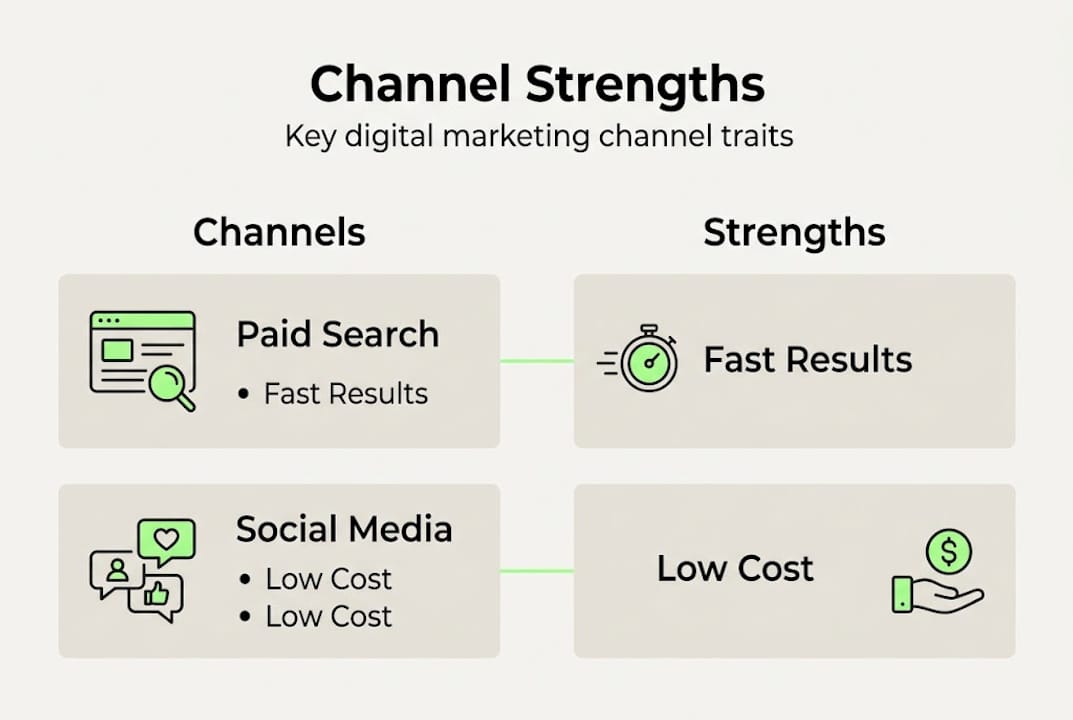
Certain channels, like Google Ads, are strong for pre-launch awareness, while channels like Reddit and Discord serve niche communities authentically. This is a crucial distinction. A product that solves a specific developer problem will find far more genuine traction in a focused Discord server than in a broad Instagram campaign.
A few channel-specific insights worth noting:
- Pre-launch: Google Discovery and YouTube are cost-effective for building brand awareness before your product is even live.
- B2B SaaS: Be cautious with paid Meta ads. The ROI for B2B often disappoints because the platform’s audience intent skews toward entertainment, not business purchasing decisions.
- Niche products: Reddit threads, Discord servers, and Product Hunt launches can generate early adopters who become your most vocal advocates.
- Retention-focused businesses: Email remains the highest-ROI channel for turning one-time buyers into loyal customers.
For a deeper look at tools that can support your execution across these channels, the guide on AI tools for entrepreneurs covers the landscape well. And if you are still working out how to land your first wave of users, the playbook on getting early customers pairs well with this section.
Pro Tip: Combine at least two channels with different time horizons. Pair a fast channel like paid search with a slow-burn channel like organic content. You get immediate feedback while building a long-term asset.
How to choose your startup’s best-fit marketing channels
Knowing what channels exist is one thing. Knowing which ones to actually pursue is where most founders get stuck. Here is a practical, step-by-step process to cut through the noise.
- Set a clear goal. Are you trying to drive awareness, generate leads, or convert existing interest? Your goal shapes everything. Awareness favors social and content. Conversion favors email and paid search.
- Define your audience precisely. Age, profession, platform habits, and pain points. A millennial SaaS buyer behaves very differently from a local small business owner.
- Shortlist two to three channels. Resist the urge to be everywhere. Pick the channels where your audience already spends time and where your content format fits naturally.
- Run a lean test. Set a minimum viable budget for each channel, write one strong message, and measure results over two to four weeks.
- Analyze ruthlessly. Look at CAC (cost to acquire a customer), CTR (click-through rate), and conversion rate per channel. Kill what doesn’t work. Double down on what does.
- Iterate and scale. Once one channel shows clear signal, optimize it before adding another.
| Selection factor | What to assess |
|---|---|
| Speed to results | How fast do you need traction? |
| Budget available | What is your monthly marketing ceiling? |
| Audience fit | Is your buyer actually on this platform? |
| Content requirements | Do you have the assets this channel needs? |
| Analytics ease | Can you track ROI without a data team? |
| Risk level | What happens if this channel underperforms? |
Resource-constrained founders can leverage AI tools to run lean multi-channel tests without needing a full marketing team. That is a genuine unlock. Tools that automate A/B testing, ad copy generation, and performance tracking make it possible for a solo founder to run experiments that would have required an agency just three years ago.
The biggest pitfall? Chasing trends. Launching on every new platform because someone in a podcast mentioned it is a distraction. Focus on the one or two channels that match your audience and your current resources. Guides on AI tools for startup marketing and AI tools for first-time founders can help you build a lean, smart stack without overspending.

Modern tactics: AI tools, automation, and emerging platforms
The gap between what a scrappy two-person startup can execute today versus five years ago is staggering. AI has changed the economics of digital marketing in ways that genuinely favor lean, fast-moving founders.
Here are the modern tactics making the biggest difference right now:
- Automated bidding: Platforms like Google Ads now use machine learning to optimize bids in real time, squeezing more value from every dollar without manual oversight.
- AI-powered creative generation: Tools can now produce ad copy, email subject lines, and social captions in minutes. This is not about replacing creativity, it is about testing more variations faster.
- Chatbots and conversational marketing: Deploying a simple chatbot on your landing page can qualify leads 24/7 without adding headcount.
- Predictive analytics: AI tools can identify which leads are most likely to convert, so you stop treating every prospect the same way.
- Omnichannel dashboards: Platforms like Databox or HubSpot consolidate performance across channels into one view, saving hours of manual reporting.
- Short-form video and UGC: TikTok, Instagram Reels, and YouTube Shorts continue to offer organic reach that paid channels cannot match at the same cost.
- Micro-influencers: Creators with 5,000 to 50,000 followers in your niche often deliver higher engagement and more authentic trust than mega-influencers.
AI tools enable lean execution for founders with limited resources, unlocking affordable A/B testing, campaign automation, and data-driven optimizations. Small teams using these tools are achieving 2 to 3x faster execution cycles compared to manual approaches.
That said, there is a real risk of AI stack bloat. You do not need 12 tools to run a smart marketing operation. A lean AI stack might be one content tool, one analytics integration, and one automation layer. Start there.
Pro Tip: Your first AI win in marketing should come from automating one repetitive task, like writing ad copy variations or scheduling posts, rather than trying to automate an entire channel at once. Build confidence with small wins before scaling the automation.
For further reading on building your tool stack, the resources on AI tools for founders and AI tools for entrepreneurs are solid starting points.
Our take: Why smart channel selection beats chasing trends
Here is what we have seen consistently in the startup world: the founders who win on digital marketing are rarely the ones with the biggest ad budgets or the flashiest platforms. They are the ones who chose two or three channels deliberately, tested fast, and iterated honestly.
Startups see poor results when blindly copying popular playbooks instead of thoughtfully validating channels. This is one of the most expensive mistakes we see. A B2C founder copies a SaaS playbook and wonders why LinkedIn ads are not converting. A B2B founder pours money into Instagram because it feels active. The channel was never the problem. The mismatch was.
We also believe most founders dramatically undervalue small, engaged communities. A well-timed, genuinely helpful post in a Discord server of 800 ideal customers will outperform a $2,000 paid social campaign aimed at a cold, broad audience. Authenticity compounds in ways that ad spend cannot replicate.
And yes, AI is a powerful accelerant. But AI cannot compensate for the absence of a real strategy. If you have not validated your positioning or understood your customer’s actual language, no automation tool will fix that gap. The foundation has to come first.
Scrappy, low-budget experiments are where the best startup marketing signals live. They tell you what your customer actually responds to, and that signal is the earliest indicator of product-market fit. Explore how AI startup strategy tools can help you build that foundation before you scale any channel.
Ready to unlock smarter marketing channel growth?
If this article has given you a clearer picture of the digital marketing landscape, you are already ahead of most early-stage founders. At siift.ai, we have built a platform specifically for entrepreneurs who want to move from idea to traction without the guesswork. siift’s Intelligent Business Canvas guides you through validation, positioning, and go-to-market strategy, so your channel selection is grounded in real data, not gut instinct. Whether you are choosing your first channel or optimizing an existing mix, the AI tools for entrepreneurs section of our blog is packed with actionable, founder-tested guidance. Your next move is closer than you think.
Frequently asked questions
What is the most cost-effective digital marketing channel for startups?
Community marketing through niche platforms like Reddit or Discord, combined with targeted organic content, are usually the lowest-cost, highest-impact channels for early-stage startups with limited budgets.
How do I measure which digital marketing channels are most effective?
Set clear goals, then track per-channel metrics like CAC, CTR, and conversions. AI tools automate tracking and help you optimize channel selection without needing a full data team.
Are paid ads always the best digital marketing choice for new businesses?
Not at all. B2B SaaS often sees low ROI from paid Meta ads compared to organic content and community channels, especially at the early stage when audience trust is still being built.
How can AI help with digital marketing channels?
AI tools streamline campaign execution, automate routine tasks like copy generation and reporting, and provide data-driven insights to quickly optimize performance across multiple channels simultaneously.