Choosing an AI tool for startup strategy depends on what you need help with: market research, validation, business modeling, prioritization, planning, or execution.
This guide compares several AI startup strategy tools across their core capabilities, best-fit users, limitations, and current pricing. The goal is to help founders and startup teams understand how the platforms differ and identify which type of workflow aligns with their needs.
Because product features and pricing can change, verify current details on each provider's website before making a decision.
How We Tested These Tools
To make this comparison more practical, we used a real founder-validation workflow rather than comparing feature lists alone.
Test task
The task was to analyze aggregate findings from a 27-response early-access survey and determine:
What respondents were already using AI for in their decision process
Which needs appeared most frequently
Which observations were supported by the available data
Which conclusions were still assumptions
What experiment or next step would reasonably follow from the evidence
The survey export was available on September 11, 2026, and the Siift workflow was tested on September 24, 2026.
Inputs
The same aggregate survey findings were supplied to the workflow. The dataset showed, among other responses, that:
23 of 27 respondents (85.2%) reported using AI chatbots in their current decision process.
13 of 27 (48.1%) selected validation as a current need.
12 of 27 (44.4%) selected structured guidance.
11 of 27 (40.7%) selected AI that challenges assumptions.
9 of 27 (33.3%) selected workflow automation.
5 of 27 (18.5%) selected organizing data or strategy.
The question allowed up to two selections, so these percentages are not mutually exclusive.
What Siift produced
Siift generated a structured analysis separating observations from assumptions and proposed a bounded next-step experiment. The output was saved as a reusable asset for review.
Human review then identified limitations in the analysis. In particular, the output initially introduced an unsupported comparison suggesting that ChatGPT would simply agree with the founder and placed too much weight on the assumption-challenging use case. Those points were corrected during review.
What this test does — and does not — show
This is a documented product-use example, not a benchmark proving that Siift outperforms other AI tools.
It shows how Siift handled one real research-to-decision workflow. It does not establish product-market fit, willingness to pay, population-level adoption, or superiority over named competitors.
The founder's resulting decision was to differentiate Siift from generic AI chatbots while maintaining validation, structured guidance, assumption-challenging, and the broader workflow.
Table of Contents
siift.ai
At a Glance
siift.ai is a New Business OS designed to act as an AI-native strategy and execution filter for people building and growing businesses.
Rather than functioning only as an AI chatbot or idea generator, Siift is designed to maintain business context, distinguish evidence from assumptions, identify important priorities and help determine what should happen next.
Its approach combines an Intelligent Business Canvas, living business memory, evidence-backed feedback, prioritization and human-in-the-loop AI workflows. Siift's current product positioning extends across ideation, validation, building, go-to-market and growth.
The underlying idea is that AI can make execution easier while also creating more choices and more noise. Siift therefore positions itself as a decision-making layer above individual execution tools — helping serious builders focus attention on the decisions and actions that matter most.
Core Features
Intelligent Business Canvas: Organizes business context, assumptions, insights and actions into a structured view rather than leaving strategy scattered across separate AI conversations.
Living business context: Siift maintains business information over time so new research and evidence can inform later recommendations.
Truth Hierarchy: Separates assumptions, observations and stronger evidence so new validated signals can have more influence on future decisions.
Riskiest-assumption filtering: Helps identify assumptions that could materially change the business and prioritize what should be tested first.
Evidence-based validation: Supports customer interviews, competitor research, landing-page tests and other practical experiments connected to specific decisions.
Decision-ready views: Connects insights, actions and supporting assets so users can work from a shared view of the business.
AI-native workflows: Supports strategy and execution workflows while keeping humans involved in important decisions.
Execution across the stack: Siift is designed to work alongside existing tools rather than requiring every specialized business function to be replaced.
Pros
Connects business context, evidence, priorities, and decisions in one workflow
Intelligent Business Canvas helps structure and maintain business context
Truth Hierarchy helps distinguish stronger evidence from weaker assumptions
Supports validation, prioritization, and AI-assisted strategic workflows
Can be used across multiple stages of startup and business development
Cons
Not a replacement for specialized engineering, design, HR, legal, compliance, or finance tools
Credit usage varies depending on activity and workflow
Credits do not roll over between billing periods
Teams focused only on a specific validation task may prefer a more specialized tool
Who It’s For
siift.ai is designed for people who need a structured way to connect business context, evidence, priorities, and execution.
It can be relevant for:
Founders and founding teams — working through business strategy, validation, and prioritization
Growing startups — managing strategic questions as the business evolves
Product leaders and innovation teams — evaluating assumptions, opportunities, and product decisions
Business operators and intrapreneurs — structuring initiatives and turning insights into prioritized actions
Advisors and consultants — organizing strategic context and decision-making workflows
What Makes Siift Different?
Siift's current differentiation is its New Business OS approach.
Instead of positioning AI primarily as a content generator, chatbot or autonomous task executor, Siift is designed as a strategy layer above the execution stack.
Its execution-filter model focuses on three questions:
What is the goal?
What information are we confident in?
What should happen next?
The platform combines business context, evidence, priorities, memory and AI-assisted execution into one operating layer. Its Truth Hierarchy is designed to distinguish evidence from assumptions, while its business context can be updated as new information and learning emerge.
That makes Siift's positioning different from platforms that primarily focus on generating startup ideas, producing artifacts or guiding users through a fixed validation workflow.
How We Tested Siift
We ran a documented Siift product-use exercise on September 24, 2026 using the Validate workflow. The exercise used aggregate findings from an early-access survey of 27 respondents as its evidence base.
Test Setup
Item | What we used |
|---|---|
Workflow | Siift Validate |
Test date | September 24, 2026 |
Evidence base | Aggregate early-access survey |
Survey sample | 27 respondents |
Main task | Separate observations from assumptions and identify a bounded next experiment |
Founder update | Strengthen differentiation from other AI chatbots while maintaining broader business-building use cases |
Comparison status | No completed head-to-head benchmark with another AI tool |
What the Survey Showed
The survey findings used in the exercise included:
23 of 27 respondents (85.2%) reported using AI chatbots for project decisions.
13 of 27 (48.1%) selected validating whether an idea has potential.
12 of 27 (44.4%) selected structured guidance about what to work on.
11 of 27 (40.7%) selected an AI that challenges assumptions.
9 of 27 (33.3%) selected workflow automation.
5 of 27 (18.5%) selected organizing data and strategy in one place.
The Q4 question allowed multiple selections, so these figures represent selections, not unique respondents, and the percentages should not be added together.
What Siift Produced
We provided Siift with the aggregate survey findings and asked it to:
Separate observed evidence from assumptions.
Identify unanswered demand questions.
Propose a bounded next experiment.
Incorporate the founder's subsequent strategic update.
The first response:
Preserved the survey counts.
Distinguished evidence from unknowns.
Identified unanswered demand questions.
Proposed a concrete validation test.
Generated and saved an analysis asset inside the Siift project.
Human Review and Correction
The first follow-up response introduced unsupported comparative language about another AI tool and narrowed the differentiation too heavily toward assumption-challenging.
A reviewer then corrected the reasoning by:
Removing the unsupported comparison.
Restoring Siift's broader use cases.
Correcting the respondent/selection denominator wording.
Removing the assumption that survey respondents were automatically available for recruitment.
Keeping future tool comparisons subject to matched inputs and predefined evaluation criteria.
What This Test Does — and Does Not — Show
It does show:
Siift can be used to structure aggregate business evidence.
The workflow can separate observations, assumptions, and unknowns.
Siift can turn the supplied evidence into a proposed next experiment.
Human review can identify and correct unsupported interpretations.
It does not show:
That Siift is more accurate than ChatGPT or another AI tool.
That Siift is faster or cheaper.
That Siift produces better business outcomes.
Product-market fit or willingness to pay.
Customer retention or conversion.
A statistically validated performance advantage.
Limitations
This was a documented product-use exercise, not a controlled performance benchmark.
The exact Siift model/build was not displayed.
Exact execution time was not measured.
A defensible per-run cost was not established.
No completed head-to-head comparison with another AI tool was obtained.
The proposed traffic, duration, budget, and response thresholds were planning parameters, not completed experiment results.
The saved analysis asset retained parts of the earlier draft after the correction, so retained artifacts require explicit human review and updating before publication or decision-making.
Evidence note: The survey evidence comes from an aggregate 27-response sample. The strategic decision to strengthen differentiation from other AI chatbots was reported by the founder and should not be presented as measured customer behavior.
Pricing
Siift currently offers four access levels:
Explore: $0/month, with 50 credits per user/month
Discover: $29/user/month when billed monthly, with 200 credits per user/month
Focus: $99/user/month when billed monthly, with 1,000 credits per user/month
Enterprise: Custom pricing for teams and organizations
Pricing verified September 22, 2026. Siift currently displays promotional and annual billing options as well, so readers should check the current Siift pricing page for the latest offers and billing terms.
Cofounder AI
At a Glance
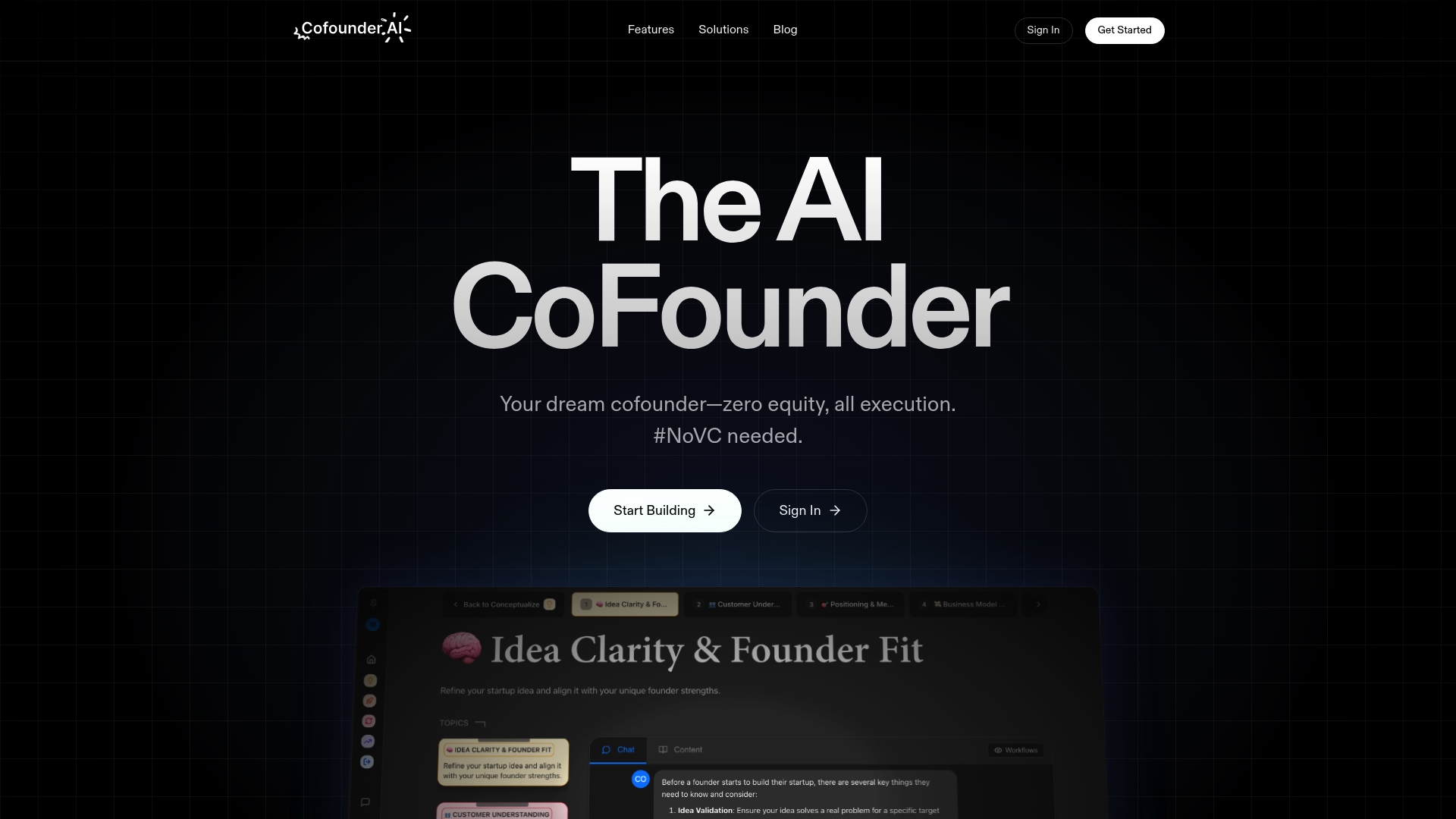
Cofounder AI positions itself as a virtual cofounder that supports founders across idea validation, planning, artifact creation, and growth-related workflows. Its platform combines AI guidance, structured playbooks, market-validation resources, and startup artifact generation in one workspace. It can be useful for founders who want a guided process for moving from an idea toward validation and launch, while complex business decisions may still require human expertise.
Core Features
Cofounder AI bundles an AI chat for instant startup guidance, structured playbooks that span idea-to-exit workflows, and a curated directory of AI tools chosen by experts. It generates essential artifacts—pitch decks, business plans, and investor materials—and provides market validation and customer interview frameworks directly on the platform. The product emphasizes step-by-step guidance for validation, launch, and growth so you have a repeatable process rather than a scattershot checklist.
Pros
All-in-one workflow: Combines AI guidance, templates, tool recommendations, and artifact generation in one platform.
Stage-oriented guidance: Provides AI chat and playbooks covering different stages of the startup process.
Curated resources: Includes a directory of AI tools and startup playbooks presented as resources for different stages of the startup process.
Validation resources: Includes customer interview frameworks and market-validation workflows for founders working through early-stage questions.
Growth and exit planning: Includes resources covering scaling and exit-related planning in addition to early-stage startup workflows.
Cons
May not replace human expertise in complex cases: Relying on AI guidance can fall short when situations require deep domain experience or nuanced negotiation skills.
Feature effectiveness can vary by user: Specific results depend on how you apply the playbooks and artifacts, so outcomes are not guaranteed and will differ by founder and market.
Pricing information: Current pricing should be verified on the provider's website because plans and costs can change.
Who It’s For
Cofounder AI can be relevant for early-stage founders, side hustlers, and startup teams looking for structured AI-assisted guidance, validation resources, and startup artifact creation. It may be less suitable for teams that need specialized product development, engineering, or domain-specific expertise beyond the platform's workflows.
Unique Value Proposition
Cofounder AI combines AI advice, startup playbooks, and artifact generation in one platform, giving founders a structured workflow for organizing research, validation activities, and startup materials.
Illustrative Scenario
A founder could use Cofounder AI to structure an early-stage idea, organize market research, work through validation questions, and generate supporting startup artifacts. This is an illustrative workflow, not a documented customer result or guaranteed outcome.
Pricing
Pricing varies by plan and usage. Check the current Cofounder AI pricing page for the latest rates and billing terms.
Website: https://cofounder.ai
Aicofounder
At a Glance
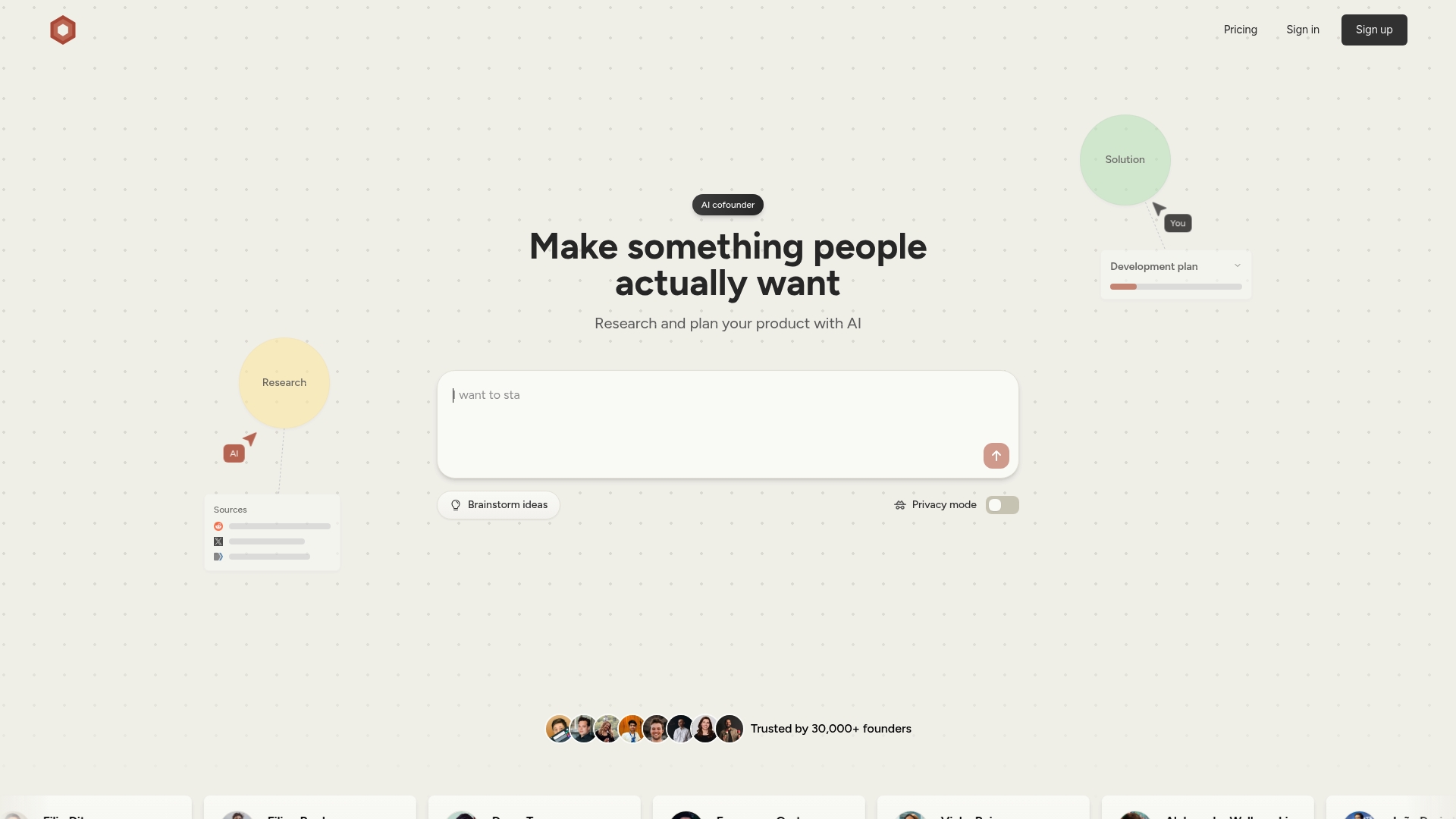
Aicofounder is a focused AI-driven platform that guides founders through a five-phase process covering ideation, market research, problem-solution fit, feature prioritization, and product visualization. It combines structured validation workflows with market research, project memory, collaboration, and data export. It may be suitable for founders who want a guided validation workflow rather than a broader product development suite.
Core Features
Aicofounder structures the founder journey into a guided five-phase process covering ideation, market research, problem-solution fit, feature prioritization, and product visualization. It pulls market and competitor signals from social media discussions to inform research, includes a memory feature that learns about your project for tailored advice, and provides collaboration plus data export for handoff to developers or partners. Security is built in with a privacy mode and data encryption to protect early concepts.
Pros
Structured validation process: Guides users through defined stages covering ideation, research, problem-solution fit, feature prioritization, and product visualization.
AI-assisted research: Uses AI to organize market and competitor signals and provide them within the validation workflow.
Market research: Uses social discussions and competitor signals as inputs for early-stage research.
Collaboration and export: Supports team collaboration and data export for sharing research and project information with developers or partners.
Multiple plans: Offers multiple subscription options, including a free tier, for different levels of usage.
Cons
Limited free credits per month means heavy users will need a paid plan to run continuous research and validation cycles.
Focus primarily on early-stage validation, not full product development, so you’ll still need design and engineering tools afterward.
Some features may require basic familiarity with startup concepts, which can slow adoption for absolute beginners without mentorship.
Who It’s For
Aicofounder can be relevant for early-stage founders, indie hackers, and small startup teams that need a structured workflow for idea validation, market research, and feature prioritization. It is primarily focused on early-stage product validation rather than end-to-end product engineering or post-MVP growth.
Unique Value Proposition
Aicofounder's positioning combines a step-by-step validation framework with AI-assisted market research and project memory. The platform also provides collaboration and data-export features, allowing users to organize research and hand off relevant work to developers or partners.
Illustrative Scenario
A founder could use Aicofounder to move through structured validation steps, organize market research, prioritize features, and export research or project data for further work. This describes a potential workflow rather than a documented customer result or guaranteed outcome.
Pricing
Pricing varies by plan and usage. Check the current Aicofounder pricing page for the latest rates, included credits, and billing terms.
Website: https://aicofounder.com
Glidr AI
At a Glance
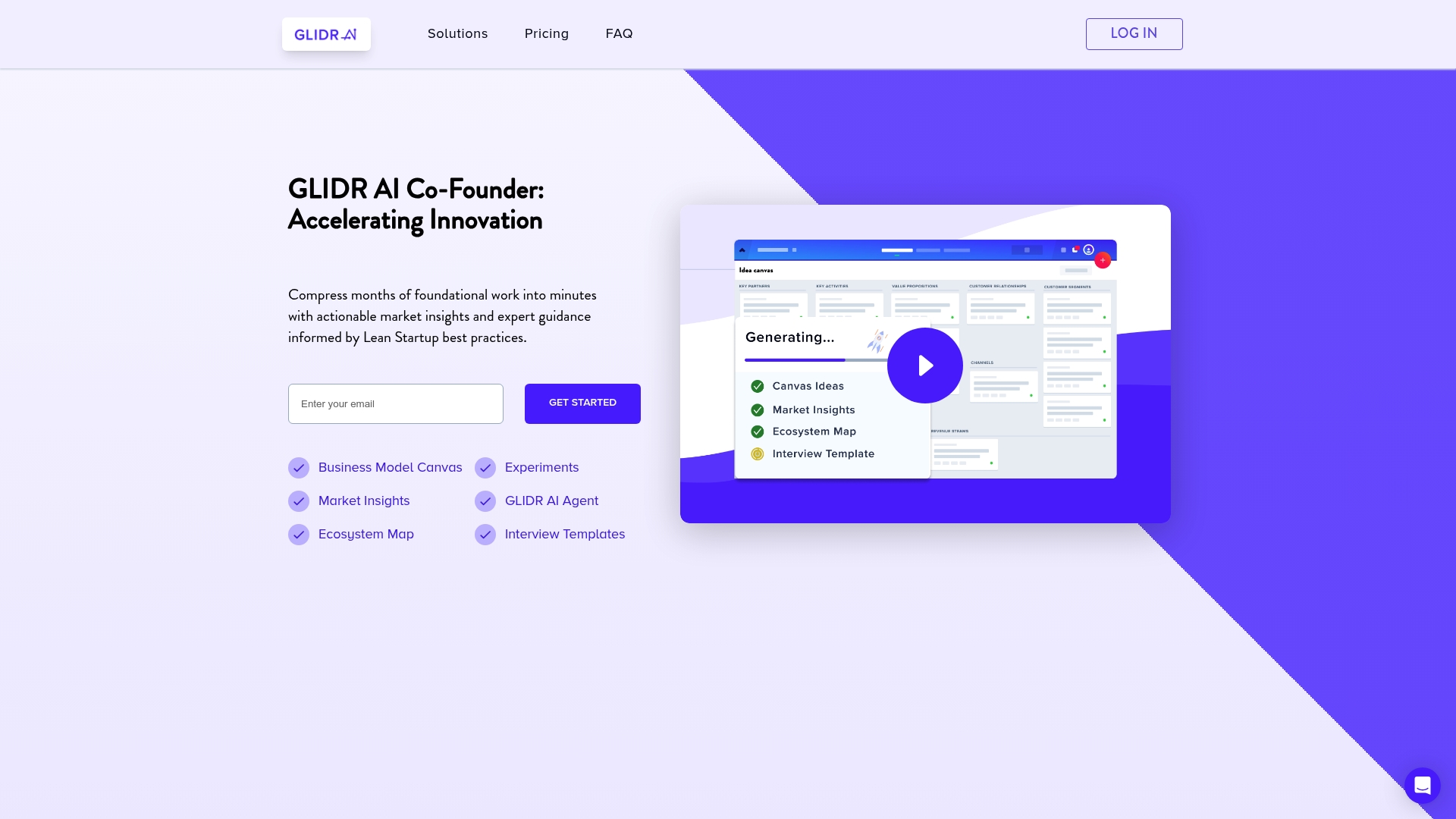
Glidr AI is a platform that combines AI agents, structured lean-startup workflows, market analysis, and integrations in a single workspace. Its capabilities cover areas such as business modeling, customer discovery, market intelligence, and ecosystem mapping. The platform is positioned for startup teams, innovation programs, accelerators, and organizations that need structured innovation workflows.
Core Features
Glidr AI centers on AI-powered agents for brainstorming and strategy, a Business Model Canvas with deep linking for rapid validation, and market insights paired with ecosystem maps to orient product-market fit. It includes templates for customer discovery interviews and a suite of integrations—email, Chrome extension, Slack, Zoom, Trello, Jira, Figma, and Zapier—so your discovery, design, and delivery tools work together without manual copying. The platform supports role-based access and structured experimentation workflows for organizing innovation and validation activities.
Pros
Broad innovation toolkit: Covers ideation, validation, market analysis, and business-model workflows within one platform.
Flexible plans for team scale: Pricing tiers are designed for small project teams up to enterprise deployments, which helps organizations scale their processes as they grow.
Third-party integrations: Connects with tools including Slack, Zoom, Trello, Jira, Figma, and Zapier.
Multi-role support and security controls: The platform accommodates different user roles and access controls, which is useful when campuses, accelerators, and startups collaborate.
Team and enterprise support: Provides onboarding and support options for larger organizations.
Cons
Steep learning curve for new users: The platform’s breadth and integrations can be overwhelming if you’re solo or early-stage, requiring time to learn how all pieces fit together.
Pricing may be heavy for solo founders: The entry-level Garage plan helps, but the Business and Enterprise tiers are priced for teams, which could strain early budget-conscious founders.
Limited detail on AI model customization: The product information lacks specifics about which AI models power agents and how much you can customize them, which may matter for advanced users.
Who It’s For
Glidr AI fits teams and organizations focused on research, tech transfer, accelerator programs, or structured startup development. It’s especially useful for university tech transfer offices, government innovation units, and startup teams that need repeatable workflows and evidence-based market guidance. Solo side hustlers can use the Garage plan, but should expect a learning investment.
Unique Value Proposition
Glidr AI combines lean-startup frameworks, market intelligence, ecosystem maps, AI-assisted workflows, and third-party integrations in one platform. This positioning makes it relevant to teams and organizations looking for structured innovation and market-discovery workflows.
Illustrative Scenario
A startup team could use Glidr AI to map its business model, organize market intelligence, explore customer-discovery activities, and connect relevant workflows through its available integrations. This is an illustrative scenario based on the platform's capabilities, not a documented customer result or guaranteed outcome.
Pricing
Pricing varies by plan, team size, projects, and included features. Check the current Glidr AI pricing page for the latest rates and billing terms.
Website: https://glidr.ai
Startup Strategy Tools Comparison
This table compares the platforms across core capabilities, target users, limitations and current pricing so founders can assess which approach fits their needs.
Platform | Core Capabilities | Best Fit | Key Limitations | Current Pricing |
|---|---|---|---|---|
Intelligent Business Canvas, business context, Truth Hierarchy, assumption testing, validation, prioritization and AI-assisted workflows | Founders, founding teams, product leaders and business operators | Not a replacement for specialized engineering, design, HR, legal, compliance or finance tools; credit usage varies by activity | Explore: $0/month; Discover: $29/user/month billed monthly; Focus: $99/user/month billed monthly; Enterprise: custom pricing | |
Cofounder AI | AI guidance, startup playbooks, market validation, customer interview frameworks and artifact generation | Founders looking for structured startup guidance and business artifacts | AI guidance may not replace human expertise in complex situations; pricing should be verified on the provider's current website | Current pricing should be verified |
Aicofounder | Five-phase validation workflow, market research, feature prioritization, project memory, collaboration and data export | Early-stage founders, indie hackers and small startup teams | Primarily focused on early-stage validation rather than full product development; additional tools may be needed for design and engineering | Pricing varies by plan and usage; verify current rates and billing terms |
Glidr AI | AI agents, Business Model Canvas, market intelligence, ecosystem maps, customer discovery workflows and third-party integrations | Startup teams, innovation programs, accelerators and institutions | Broad functionality may require more onboarding; higher-tier plans are designed for teams and organizations | Pricing varies by plan, team size, and included features; verify current rates and billing terms. |
Turn Startup Strategy Into Action
Siift helps founders and teams organize business context, evaluate evidence, identify priorities, and turn strategic questions into structured next steps.
Instead of working across disconnected strategy tools, use a single workspace to connect assumptions, evidence, decisions, and execution.
Explore Siift and see how the New Business OS approach fits your workflow.
Frequently Asked Questions
What are the best AI tools for startup strategy in 2026?
AI startup strategy tools vary in their focus. Some specialize in idea validation and market research, while others provide business modeling, prioritization, planning, or broader strategy workflows. Compare each platform's capabilities, intended users, limitations, and current pricing to determine which type of workflow matches your needs.
What are the benefits of using AI for startup strategy?
AI tools can help founders organize research, evaluate assumptions, summarize evidence, prioritize strategic questions, and structure next steps. The specific benefits depend on the tool, the quality of the inputs, and how the founder uses the outputs. AI can support the strategy process, but it does not guarantee a specific validation timeline or business outcome.
What features should I look for in an AI startup strategy tool?
Look for features such as task prioritization, personalized feedback, and structured workflows that match the type of strategy work you need to perform. Consider whether the tool supports the specific activities you need, such as market research, validation, business modeling, prioritization, or planning.
How do AI tools assist in creating investor materials?
AI tools can assist with investor materials by generating or structuring documents such as pitch decks and business plans. The quality and usefulness of these outputs depend on the information provided, the tool's capabilities, and the level of human review applied before using them with investors.
Can AI tools help with customer journey mapping?
Yes. AI tools can support customer journey mapping by helping organize customer workflows, research findings, feedback, and potential friction points. Their usefulness depends on the quality of the underlying research and how the resulting insights are reviewed and applied.
How much do AI startup strategy tools cost?
Pricing varies significantly by platform, plan, usage limits, and whether the product is designed for individual founders or teams. Some tools offer free or low-cost plans, while team and enterprise plans can cost substantially more. Because pricing can change, founders should check each provider's current pricing page before making a decision.