
Over 80 percent of American startups fail to reach their ideal customers in the first year. Getting a precise understanding of who you should target is not just smart strategy, it is essential for survival. Powerful AI tools now help entrepreneurs go far beyond generic buyer profiles, revealing the deep insights that can make the difference between growth and stagnation. Learn how these advanced solutions can transform your approach and give your business an enviable edge.
Table of Contents
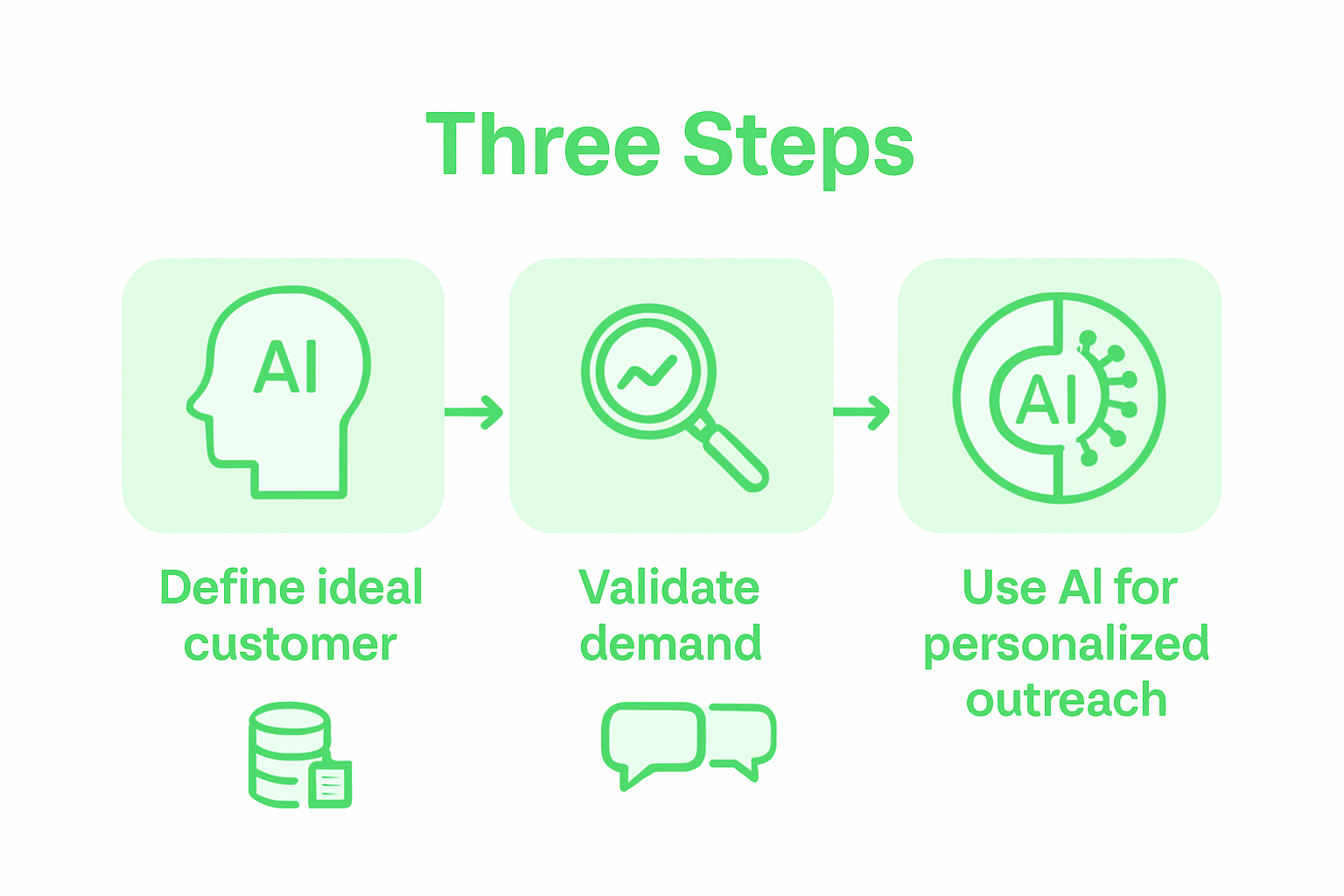
- Step 1: Define Your Ideal Customer Using AI Insights
- Step 2: Validate Demand And Niche With Siift.ai Founder Intelligence
- Step 3: Leverage AI Outreach Tools For Personalized Engagement
- Step 4: Showcase Proof With Real Startup AI Case Studies
- Step 5: Refine Your Strategy Based On Outreach Data
Quick Summary
| Key Point | Explanation |
|---|---|
| 1. Define customers with AI insights | Utilize AI tools to create precise customer profiles, incorporating behavior patterns and preferences beyond traditional demographics. |
| 2. Validate market demand intelligently | Use AI to analyze data and validate startup ideas, identifying customer interests and market potential before investing. |
| 3. Personalize outreach for better engagement | Implement AI-powered tools to develop targeted communication strategies that resonate with specific customer segments. |
| 4. Build credibility through case studies | Showcase real-world impact of your solution with authentic case studies that highlight measurable results and customer experiences. |
| 5. Continuously refine strategy with data | Analyze outreach data to improve customer acquisition techniques, balancing AI insights with human judgment for better results. |
Step 1: Define your ideal customer using AI insights
Defining your ideal customer is a crucial first step in startup success that AI can dramatically streamline. By leveraging advanced intelligence tools, you can develop a precise customer profile that goes far beyond traditional demographics.
Start by utilizing comprehensive customer profile templates that help map out detailed customer characteristics. AI tools can analyze vast datasets to reveal nuanced insights about potential customer behaviors, preferences, and pain points. Begin by inputting basic information about who you believe might benefit from your product or service. Then let AI algorithms uncover deeper patterns you might have missed.
The key is moving beyond surface level assumptions. AI can help you understand not just who your customers are, but why they might be interested in your solution. Look for patterns in professional backgrounds, online behaviors, purchasing histories, and even subtle digital footprints that indicate potential interest. By combining machine learning insights with your own industry knowledge, you can create a hyper targeted customer persona that feels almost eerily precise.
Warning: While AI provides incredible insights, never completely replace human intuition. These tools are most powerful when used as a collaborative intelligence approach where technology enhances your strategic thinking rather than completely replacing it.
Step 2: Validate demand and niche with siift.ai founder intelligence
Validating your startup idea requires more than gut instinct. You need strategic intelligence that helps you understand market potential and customer interest before investing significant resources.
Start by leveraging AI tools that can generate precise buyer personas and customer insights. These advanced systems analyze market data to reveal nuanced details about potential customer segments, their pain points, and likely response to your solution. By combining machine learning algorithms with your unique industry knowledge, you can create a comprehensive understanding of your market landscape that goes beyond traditional research methods.
The most powerful approach involves triangulating multiple data sources. Look for patterns in online conversations, professional networks, purchasing behaviors, and demographic trends. AI can help you uncover hidden opportunities and potential niches that might not be immediately apparent. Pay special attention to areas where existing solutions fall short or where customer frustrations are most intense.
Warning: While AI provides incredible market insights, remember that technology should enhance your strategic thinking not replace human creativity and intuition. Use these tools as a collaborative intelligence platform that helps you make more informed decisions while maintaining your unique entrepreneurial perspective.
Step 3: Leverage AI outreach tools for personalized engagement
Personalized customer outreach is the cornerstone of converting potential leads into actual customers. Your goal is to craft communication strategies that feel genuinely relevant and compelling to each potential client.

Start by utilizing AI powered buyer persona generators that can help you develop targeted communication strategies. These advanced tools analyze complex datasets to understand customer motivations, allowing you to create messaging that resonates deeply with specific audience segments. By combining machine learning insights with your unique understanding of your product, you can develop outreach campaigns that feel more like personalized conversations than generic marketing attempts.
The most effective AI outreach strategies involve layering multiple intelligence approaches. Analyze communication patterns, professional networks, social media interactions, and past purchasing behaviors to create multidimensional customer profiles. Focus on identifying specific pain points and crafting messages that demonstrate how your solution provides unique value. Remember that personalization goes beyond just inserting a first name into an email template.
Warning: While AI tools offer unprecedented targeting capabilities, authenticity remains key. Avoid over automated messaging that feels robotic or impersonal. The best outreach feels like a genuine human connection, with AI serving as an intelligent assistant that helps you understand and connect more meaningfully.
Step 4: Showcase proof with real startup AI case studies
Building credibility is critical for early-stage startups. Your potential customers need concrete evidence that your solution actually delivers meaningful results beyond theoretical promises.
One powerful approach involves developing representative audience personas that demonstrate how deeply you understand customer needs. By leveraging advanced AI techniques to extract nuanced insights from actual user interactions, you can create compelling narratives that showcase your product’s real world impact. These case studies should go beyond generic success stories and highlight specific challenges solved, quantifiable outcomes achieved, and the unique value your solution provides.
The most effective case studies blend technical precision with human storytelling. Personalized marketing models can help you generate targeted narratives that speak directly to different customer segments. Look for opportunities to highlight percentage improvements, time saved, revenue generated, or other concrete metrics that transform abstract promises into tangible results. Your goal is to help potential customers visualize themselves achieving similar successes by using your solution.
Warning: Authenticity matters more than perfection. While AI can help craft compelling narratives, ensure every case study represents genuine customer experiences. Avoid exaggeration or fabrication that could damage your startup’s hard earned reputation.
Step 5: Refine your strategy based on outreach data
Successful startup growth requires continuous learning and adaptation. Your outreach data is a goldmine of insights that can help you progressively improve your customer acquisition strategy.
Begin by leveraging AI powered buyer persona generators that can transform raw interaction data into actionable strategic intelligence. These advanced tools analyze response rates, engagement patterns, and communication nuances to help you understand which messaging approaches resonate most effectively with different customer segments. Track metrics like open rates, response times, conversion percentages, and qualitative feedback to build a comprehensive understanding of your outreach performance.
The most sophisticated strategy involves creating a dynamic feedback loop where each interaction informs and improves future communication attempts. Pay close attention to not just quantitative metrics but also subtle signals like tone of response, specific language used by potential customers, and the types of questions or objections that emerge during initial conversations. This granular approach allows you to continuously refine your value proposition and messaging to become increasingly precise and compelling.
Warning: Data interpretation requires human judgment. While AI tools provide powerful insights, always filter recommendations through your deep understanding of your product and market. Avoid making radical changes based on limited data points, and maintain a balanced perspective that combines technological insights with your entrepreneurial intuition.
Accelerate Your Startup Growth with AI-Powered Strategy
If you are struggling to define your ideal customer or validate your market niche with AI insights, you are not alone. Many founders face the challenge of turning data into clear, actionable steps while avoiding costly blind spots. This article highlights how personalized AI tools can help you craft hyper targeted buyer personas and gather authentic customer feedback. The key is to combine human intuition with smart technology to create outreach strategies that truly resonate and convert.
Take control of your founder’s journey by using siift.ai Intelligent Business Canvas. Our intuitive AI app guides you through ideation, validation, and go-to-market strategies with personalized feedback and prioritized actions designed to de-risk your startup success. Stop guessing and start building with confidence. Discover how siift.ai helps you uncover hidden opportunities and continuously refine your approach based on real outreach data and validated insights. Ready to transform your early customer acquisition process? Visit siift.ai today and turn your startup ideas into a viable, thriving business.
Frequently Asked Questions
How can I define my ideal customer using AI tools?
To define your ideal customer, start by using comprehensive customer profile templates that outline customer characteristics. Input basic information about your target audience and allow AI algorithms to identify deeper patterns in behaviors and preferences.
What are effective ways to validate startup demand with AI insights?
You can validate your startup idea by utilizing AI tools to analyze market data and generate detailed buyer personas. Focus on triangulating multiple data sources to reveal potential customer segments and areas of demand within the first 60 days of research.
How can AI help in personalizing outreach strategies?
AI can enhance your outreach by processing data to develop targeted communication strategies that resonate with specific audience segments. Start by analyzing engagement patterns and customer motivations to craft messages that feel personal and relevant to potential customers.
What should I include in case studies to build credibility for my startup?
Include specific challenges solved, quantifiable outcomes achieved, and unique value propositions in your case studies. Aim for metrics that demonstrate effectiveness, such as percentage improvements or time savings, which can help customers visualize similar successes.
How can I refine my strategy based on outreach data?
Refine your strategy by analyzing response rates and engagement patterns from your outreach efforts. Create a feedback loop where each interaction informs future strategies, allowing you to continuously improve messaging and approach over a few weeks.
Why is authenticity important when using AI tools for customer outreach?
Authenticity is crucial because it helps maintain a genuine connection with potential customers. Ensure your messages do not come off as overly automated and prioritize building real relationships through thoughtful interactions complemented by AI insights.