
Startup survival isn’t a solo sport. Research shows that 70% of startups survive five years with mentoring compared to significantly lower rates without it. Yet many Millennial and Gen Z founders still chase traditional senior mentors while overlooking the power of peers at similar career stages. Peer mentorship offers tactical, real-time support that addresses startup isolation, imposter syndrome, and decision fatigue through reciprocal relationships. This article breaks down what peer mentorship actually is, why it works for young entrepreneurs, and how you can leverage it to accelerate your startup journey from idea to product-market fit.
Table of Contents
- Key takeaways
- What is peer mentorship and why it matters for entrepreneurs
- The measurable benefits of peer mentorship for startup success
- Designing and participating in effective peer mentorship programs
- How Millennials and Gen Z can leverage peer mentorship to overcome startup challenges
- Discover siift.ai: your founder mentorship platform
- FAQ
Key Takeaways
| Point | Details |
|---|---|
| Peer mentorship value | Reciprocal, real time support from peers at similar stages addresses isolation, imposter syndrome, and decision fatigue while accelerating problem solving. |
| Immediate tactical guidance | Peers provide practical feedback on current challenges such as strategy and skill development through regular check ins and mutual accountability. |
| Complementary skill swap | Pairing with peers who have different strengths unlocks mutual benefits and accelerates learning. |
| Measured outcomes | Peer programs correlate with gains in leadership and risk management, higher retention, and more promotions, with mentored startups achieving about seventy percent five year survival. |
What is peer mentorship and why it matters for entrepreneurs
Peer mentorship provides reciprocal guidance at similar career levels, offering real-time tactical feedback on current challenges like project strategy, leadership, and skill development for aspiring entrepreneurs. Unlike the hierarchical dynamic of traditional mentoring where a senior expert guides a junior protégé, peer mentorship operates as a mutual exchange. Both parties bring complementary strengths, share vulnerabilities, and problem-solve together on issues they’re facing right now.
Traditional mentorship typically focuses on long-term strategic guidance and career trajectory. A business mentor role usually involves someone with decades of experience offering wisdom from above. Peer mentorship flips this script entirely. It’s informal, tactical, and centered on immediate challenges rather than distant goals. You might swap skills with your peer mentor, hold weekly accountability sessions, or exchange asynchronous messages when you hit roadblocks.
Millennials and Gen Z entrepreneurs especially resonate with peer mentorship because they face shared challenges that older mentors may not fully grasp. Imposter syndrome hits hard when you’re launching your first startup. Startup isolation can crush motivation when you’re working alone from your apartment. These generations grew up collaborating online, valuing authenticity over hierarchy, and seeking communities over gatekeepers. Peer mentorship matches this cultural DNA perfectly.
“The best mentorship relationships are those where both parties grow. Peer mentorship removes the pressure of perfection and creates space for honest struggle.”
Common misconception alert: many founders believe only senior mentors with proven exits can add real value. That’s simply not true. Your peer who’s six months ahead wrestling with customer acquisition can offer more immediately useful insights than a retired executive who scaled a company in a completely different era. Peer mentors understand your context because they’re living it too.
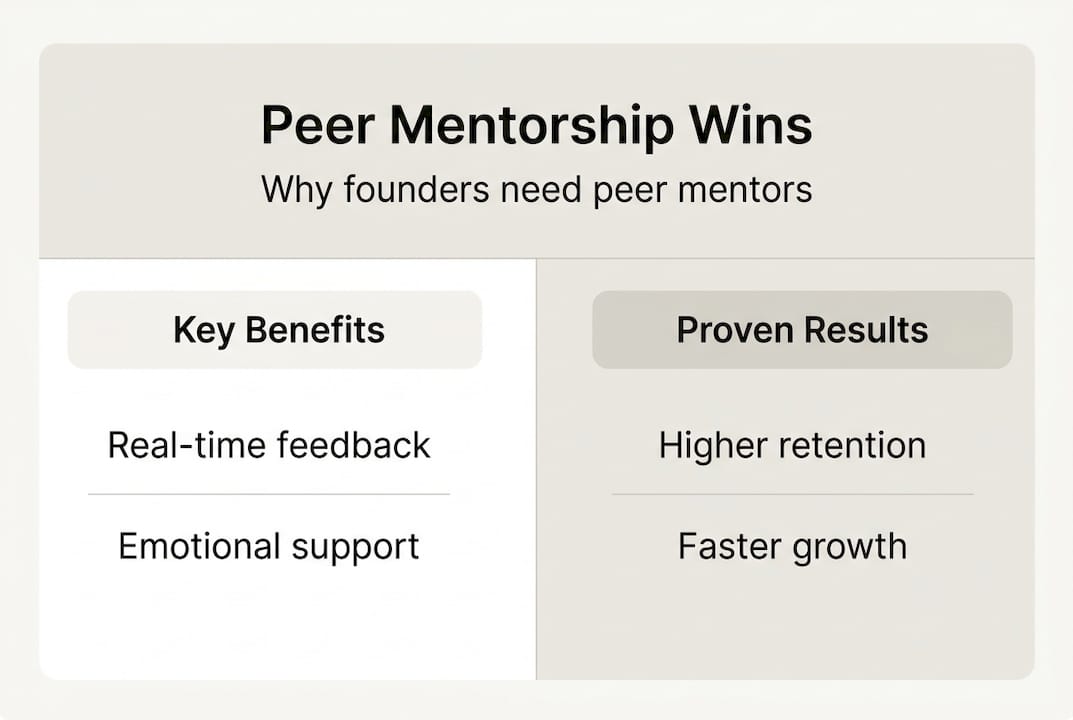
Pro Tip: Look for peer mentors with complementary gaps, not identical experiences. If you’re strong in product but weak in marketing, find someone with the opposite profile for maximum mutual benefit.
The measurable benefits of peer mentorship for startup success
The data on peer mentorship’s impact is compelling. Studies show that 67% of participants improved leadership and team skills while 55% enhanced risk management abilities through structured peer mentorship programs. These aren’t soft skills that sound good on paper. They translate directly to better hiring decisions, stronger team culture, and smarter resource allocation for cash-strapped startups.

Retention and career advancement metrics tell an even stronger story. Employees with mentors experience 72% retention rates compared to 49% without mentorship. They receive promotions five times more often than their non-mentored peers. While these statistics come from corporate environments, the principle holds for startup founders: consistent mentorship creates accountability structures that keep you moving forward when motivation dips.
The startup survival statistic bears repeating because it’s staggering. Startups with mentoring support achieve 70% five-year survival rates versus much lower rates for those going it alone. That’s not correlation, it’s causation. Mentorship provides the emotional support, tactical guidance, and reality checks that prevent catastrophic mistakes and premature shutdowns.
| Metric | With peer mentorship | Without mentorship |
|---|---|---|
| Leadership skill improvement | 67% report gains | Baseline |
| Five-year startup survival | 70% survive | Significantly lower |
| Promotion rate | 5x higher | Baseline |
| Retention rate | 72% | 49% |
Beyond survival, peer mentorship reduces burnout and stress. Launching a startup means constant decision-making under uncertainty. Having a peer who validates your struggles and offers perspective prevents the mental exhaustion that leads to founder burnout. Revenue growth accelerates when you can pressure-test ideas with someone who understands your market constraints.
Pro Tip: Structured or paid peer mentorship programs deliver significantly better results than informal arrangements. Free mentorship often lacks commitment. When both parties invest financially or join organized programs, implementation rates jump 4x higher according to mentorship effectiveness research.
The confidence boost matters too. Self-efficacy, the belief in your ability to execute, improves measurably through peer mentorship. When you see someone at your level solving problems you thought were insurmountable, it rewires your brain’s possibility framework. You stop asking “Can this be done?” and start asking “How will I do this?”
For founders seeking mentorship guidance, understanding these metrics helps justify the time investment. Peer mentorship isn’t networking or casual coffee chats. It’s a deliberate practice with measurable ROI.
Designing and participating in effective peer mentorship programs
Peer mentorship takes many forms, each suited to different founder needs and schedules. One-on-one partnerships offer deep, focused relationships where you meet regularly with a single peer mentor. Peer circles or mastermind groups bring together 4-6 founders for monthly sessions where each person presents challenges and receives group feedback. Asynchronous mentorship happens through messaging platforms where you exchange voice notes, documents, and advice on your own schedules.
Effective peer mentoring programs share common design elements: specific goal-setting at the outset, reciprocal relationship structures where both parties give and receive, and flexible communication formats that adapt to founder lifestyles. Some programs incorporate group peer mentoring after initial training sessions to build cohort bonds before pairing individuals.
Matching matters enormously. The best peer mentorship pairs complement each other’s strengths and fill each other’s gaps. If you’re technical but struggle with sales, pair with someone strong in customer conversations who needs help with product architecture. Matching based on identical experiences creates echo chambers. Matching on complementary perspectives generates breakthrough insights.
| Factor | Peer mentorship | Traditional mentorship |
|---|---|---|
| Relationship dynamic | Reciprocal equals | Hierarchical senior-junior |
| Focus area | Tactical current challenges | Strategic long-term guidance |
| Formality level | Informal flexible | Often formal structured |
| Time horizon | Immediate problem-solving | Career trajectory planning |
| Best for | Real-time startup execution | Industry wisdom and connections |
Session frequency recommendations vary by intensity level. Weekly 30-minute check-ins work well for active execution phases when you’re launching products or running experiments. Biweekly hour-long sessions suit strategic planning periods. Monthly deep dives make sense for peer circles tackling bigger picture challenges. Consistency beats duration every time.
Common challenges plague peer mentorship when not addressed upfront. Mismatched expectations lead to frustration when one person wants tactical advice while the other seeks emotional support. Lack of commitment in free informal arrangements means cancelled sessions and ghosting. Role confusion happens when peers try to become traditional mentors instead of staying equals.
Pro Tip: Set explicit goals and accountability measures in your first session. Write them down. Examples: “Launch landing page by next meeting,” “Interview 10 customers this month,” “Finalize pricing strategy by end of quarter.” Vague intentions produce vague results.
Structured programs solve many of these pitfalls through facilitation, curriculum, and financial commitment. Paid mentoring leads to 4x greater implementation success because money creates skin in the game. Both parties show up prepared, follow through on commitments, and take the relationship seriously.
For founders exploring alternatives to traditional business coaching, peer mentorship offers affordability with accountability. You’re not paying consultant rates for generic advice. You’re investing in mutual growth with someone navigating similar terrain.
How Millennials and Gen Z can leverage peer mentorship to overcome startup challenges
Millennial and Gen Z founders face distinct emotional and cognitive challenges that peer mentorship addresses directly. Startup isolation hits hard when you’re building alone without a team. Decision fatigue compounds when every choice feels make-or-break. Imposter syndrome whispers that you’re not qualified, not experienced enough, not worthy of success. These aren’t character flaws, they’re predictable responses to high-uncertainty environments.
Research on Generation Z’s need for mentor support confirms that younger entrepreneurs especially benefit from mentorship to address imposter syndrome and fear of failure. Gen Z grew up with curated social media perfection, creating unrealistic comparisons. When your Instagram feed shows only polished success stories, your messy startup reality feels like personal failure. Peer mentors shatter this illusion by sharing their own struggles in real time.
Peer mentorship provides relatable, immediate feedback that traditional mentors often can’t match. Your peer mentor remembers what it felt like to send that first cold email last month. They understand the anxiety of a product launch because they did one last quarter. This temporal proximity creates relevance that decade-old war stories simply cannot replicate.
Emotional support through peer validation is underrated but critical. When you share a setback and your peer responds with “I felt exactly that way when my beta launch flopped,” something shifts psychologically. You’re not alone. You’re not uniquely incompetent. You’re experiencing the normal founder journey. This validation reduces anxiety and restores motivation faster than any productivity hack.
Top startup challenges and peer mentorship responses:
- Isolation and loneliness: Regular peer sessions create community and accountability beyond solo work
- Imposter syndrome: Seeing peers struggle and succeed normalizes the founder experience
- Decision fatigue: Talking through options with someone at your level clarifies priorities
- Fear of failure: Peer vulnerability about mistakes reduces shame and encourages experimentation
- Skill gaps: Reciprocal teaching fills knowledge holes without expensive courses
- Lack of feedback: Peers offer honest reactions to your ideas without corporate politeness
“Mentorship isn’t about having all the answers. It’s about having someone in the arena with you when things get hard. Peer mentors are in that arena too.”
For founders reflecting on lessons learned, peer mentorship accelerates the learning curve by compressing years of trial and error into months of guided experimentation. You still make mistakes, but you make different mistakes than your peer already made. Collectively, you cover more ground faster.
The real-time relevance factor cannot be overstated. When you’re wrestling with whether to pivot your product positioning this week, you need input from someone who understands current market conditions, not someone who built their company before smartphones existed. Peer mentors operate in your reality: today’s tools, today’s customer expectations, today’s competitive landscape.
Discover siift.ai: your founder mentorship platform
If you’re ready to move from understanding peer mentorship to actually implementing it in your startup journey, siift.ai offers the structure and intelligence to accelerate your progress. As a founder intelligence platform, siift combines AI-powered guidance with human peer support to help you validate ideas, build strategy, and reach product-market fit faster than generic tools.
siift’s Intelligent Business Canvas acts as your New Business OS, systematically guiding you through ideation, validation, and go-to-market execution. Unlike chatbots that give generic advice, siift filters out biases, blindspots, and distractions that derail most startups. The platform helps you derisk your business decisions in the age of AI while connecting you with a community of founders facing similar challenges.
The combination of AI mentorship and peer networking creates a multiplier effect. The AI helps you structure your thinking and identify gaps in your strategy. The peer community provides the emotional support and tactical feedback that only humans can deliver. Together, they form a comprehensive support system designed specifically for Millennial and Gen Z entrepreneurs building in 2026.
Pro Tip: Technology amplifies mentorship but doesn’t replace it. Use AI tools like siift to prepare better questions, document insights, and track progress between peer mentorship sessions for maximum growth potential.
FAQ
What is peer mentorship and how is it different from traditional mentoring?
Peer mentorship involves mutual support between people at similar career stages rather than a senior-junior hierarchy. It focuses on current tactical challenges like customer acquisition or product decisions instead of long-term strategic career guidance. The reciprocal nature means both parties give and receive advice, creating a more balanced and relatable dynamic than traditional mentorship.
How can recent graduates find suitable peer mentors or groups?
Use structured platforms that match founders based on complementary skills and startup stages for the best fit. Attend startup events, accelerator programs, and online communities where aspiring entrepreneurs gather. Analyze your specific gaps, whether technical skills, marketing knowledge, or emotional support, then seek mentors who complement those needs rather than mirror your existing strengths.
What are common challenges in peer mentorship and how do I avoid them?
Mismatched expectations and lack of commitment are the biggest pitfalls in peer mentorship relationships. Free informal arrangements often fail because neither party has enough skin in the game to maintain consistency. Set explicit goals in your first session, establish regular meeting schedules, and consider paid or structured programs that create accountability through financial investment. Clear communication about what each person needs prevents role confusion.
Can peer mentorship improve leadership and business growth?
Yes, research shows 67% of participants improved leadership skills through peer mentorship programs. Startups with mentoring support achieve significantly higher five-year survival rates than those without guidance. For early-stage founders, peer mentorship provides the accountability and feedback loops that accelerate learning and prevent costly mistakes, directly impacting business resilience and growth trajectory.