
Business mentorship is changing the way entrepreneurs grow, and the numbers prove it. Mentored businesses see 3.5 times higher growth and nearly 9 out of 10 make it past their first year. Most people think mentors just hand out advice or give the occasional pep talk, but the real story is much bigger. These relationships are the secret engines behind lasting success, fueling everything from problem solving skills to industry connections that most never see coming.
Table of Contents
Quick Summary
Takeaway | Explanation |
|---|---|
Business mentors empower entrepreneurs | Mentors help individuals develop critical thinking and overcome obstacles, enhancing their professional resilience. |
Mentored businesses thrive | Studies show that 87% of mentored businesses survive their first year, compared to lower rates for unmentored firms. |
Effective mentorship fosters growth | Mentors provide personalized guidance and support, facilitating significant business performance improvements across various dimensions. |
Networking is essential | Mentors often introduce mentees to valuable industry contacts, opening doors to opportunities that can accelerate business success. |
Emotional support is crucial | Mentors help entrepreneurs manage stress and self-doubt, which are key factors in maintaining confidence and focus during challenges. |
Defining a Business Mentor: Who Are They?
A business mentor is a seasoned professional who provides strategic guidance, emotional support, and practical insights to entrepreneurs and business professionals navigating complex professional landscapes. Unlike traditional consultants or coaches, mentors develop deep, personalized relationships that extend beyond transactional advice.
To help clarify the key differences between business mentors, coaches, and consultants, the following table summarizes their main roles and relationship dynamics.
Role | Focus Area | Relationship Type | Main Value Provided |
|---|---|---|---|
Business Mentor | Long-term growth and strategic guidance | Personalized, developmental | Emotional support, industry insight |
Business Coach | Skill development and performance | Structured, goal-oriented | Accountability, tactical improvement |
Business Consultant | Specific business problems, expertise | Transactional, short-term | Problem solving, expert solutions |
The Core Characteristics of Business Mentors
Business mentors are distinguished by several key attributes that set them apart from other professional advisors. Research highlights that effective mentors typically possess:
Extensive industry experience spanning multiple years or decades
Strong emotional intelligence and communication skills
Proven track record of professional success
Genuine commitment to supporting others’ professional growth
Ability to provide objective, candid feedback
Their primary goal is not to dictate solutions but to empower mentees by sharing knowledge, challenging assumptions, and helping them develop critical thinking and problem solving skills. Think of them as experienced navigators who help entrepreneurs chart their professional course through turbulent business waters.
How Business Mentors Create Value
Mentors create transformative value by offering more than just advice. They serve as trusted confidants who provide multifaceted support across professional and personal domains. This includes strategic planning, networking introductions, skill development, and emotional support during challenging business phases.
While formal mentorship programs exist, many mentor relationships develop organically through professional networks, industry events, or personal connections. The most impactful mentorships are built on mutual respect, trust, and a genuine desire for professional development.
If you’re looking to accelerate your entrepreneurial journey, understanding how to connect with the right mentor can be a game changing strategy for your professional growth.
The Importance of Business Mentorship in Entrepreneurship
Business mentorship has emerged as a critical catalyst for entrepreneurial success, offering far more than simple advice or occasional guidance. The right mentorship can dramatically transform an entrepreneur’s trajectory, providing strategic insights, emotional support, and practical wisdom that cannot be learned through traditional educational channels.
Survival and Growth Statistics
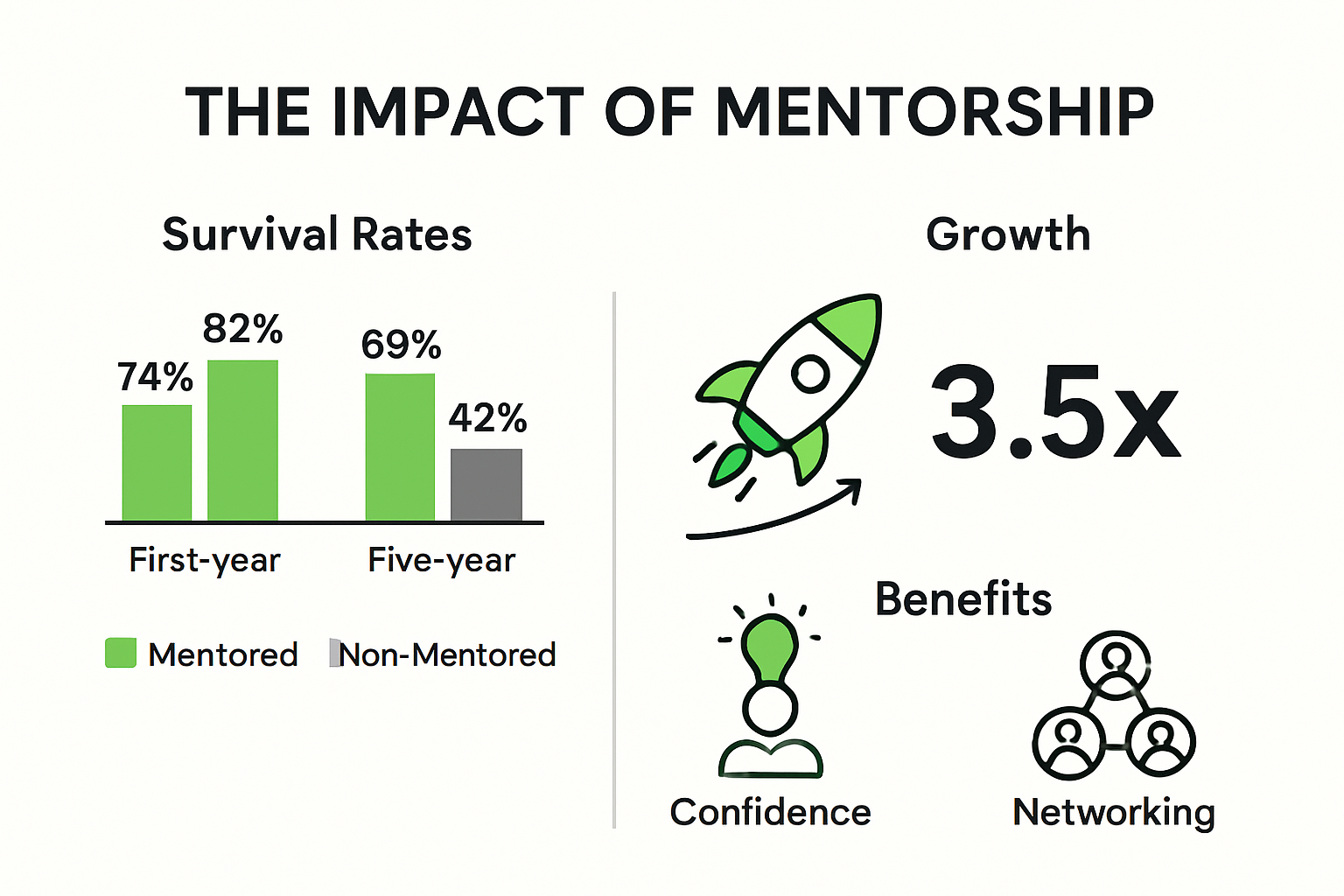
Research from the Small Business Administration reveals compelling evidence of mentorship’s impact. Entrepreneurs with mentors demonstrate significantly higher survival rates and business performance. Key statistics highlight this transformative potential:
87% of mentored businesses survive beyond their first year
Mentored companies experience 3.5 times more growth compared to non-mentored businesses
Entrepreneurs with mentors report higher levels of confidence and strategic decision making
These numbers underscore mentorship as more than a luxury. It represents a strategic investment in professional development and business resilience.
Here is a summary of key statistics related to the impact of mentorship on business survival and growth, organized for quick reference.
Statistic | Mentored Businesses | Non-Mentored Businesses |
|---|---|---|
First-year survival rate | 87% | Significantly lower |
Relative business growth (compared to baseline) | 3.5x higher growth | Baseline |
Five-year survival rate | 70% | Not specified |
Confidence & decision-making | Higher | Lower |
Multidimensional Support Mechanisms
Mentorship transcends traditional consulting by offering holistic support across multiple professional dimensions. Mentors provide nuanced guidance that addresses both tactical business challenges and broader personal development needs.
They help entrepreneurs navigate complex landscapes by sharing lived experiences, offering unfiltered perspectives, and helping mentees anticipate potential pitfalls. This might involve strategic networking introductions, skill development guidance, emotional support during challenging periods, or critical feedback that challenges existing assumptions.
For ambitious entrepreneurs seeking structured guidance, exploring strategic mentorship approaches can unlock unprecedented growth opportunities. Mentorship is not just about receiving advice. It is about building a collaborative relationship that accelerates personal and professional transformation.
How Business Mentors Facilitate Growth and Learning
Business mentors serve as powerful catalysts for professional development, employing sophisticated strategies that transform raw potential into measurable entrepreneurial success. Their approach goes far beyond traditional teaching methods, creating personalized learning experiences that adapt to each entrepreneur’s unique challenges and aspirations.
Knowledge Transfer and Skill Development
Research from the Commerce Department reveals that mentors facilitate learning through multiple intentional approaches. These methods include:
Direct instruction and practical guidance
Experiential learning opportunities
Critical feedback and performance modeling
Strategic networking introductions
Personalized skill enhancement frameworks
Through these techniques, mentors help entrepreneurs develop critical thinking skills, expand their professional networks, and gain insights that traditional educational environments cannot replicate. They transform theoretical knowledge into actionable strategies tailored to real world business scenarios.
Psychological and Emotional Support Mechanisms
Beyond technical skills, business mentors provide crucial psychological scaffolding that helps entrepreneurs navigate complex emotional landscapes. They offer unbiased perspectives, helping mentees overcome self doubt, manage stress, and maintain resilience during challenging business phases.
This emotional intelligence component of mentorship is often the difference between entrepreneurs who survive and those who truly thrive. Mentors help reframe challenges as opportunities, providing strategic emotional support that builds confidence and promotes adaptive thinking.
For entrepreneurs seeking structured guidance on developing essential professional skills, exploring proven entrepreneurial habits can provide additional insights into continuous personal and professional growth.
Key Qualities and Skills of an Effective Business Mentor
Effective business mentors are not just experienced professionals. They are strategic guides who possess a unique combination of skills, emotional intelligence, and professional wisdom that transform mentorship from a transactional interaction into a profound developmental relationship.
Core Professional Competencies
Research from the Association of Business Mentors identifies critical qualities that distinguish exceptional mentors. These foundational competencies include:
Deep industry expertise and practical experience
Advanced communication and active listening skills
Strong emotional intelligence and empathy
Ability to provide constructive, objective feedback
Commitment to continuous learning and personal growth
Technical knowledge is merely the starting point. Great mentors leverage their experience to help mentees develop strategic thinking, emotional resilience, and adaptive problem solving skills that extend far beyond technical capabilities.
The following table highlights core qualities and skills that set effective business mentors apart. This helps distinguish the essential traits that aspiring mentors and mentees should recognize.
Quality/Skill | Description |
|---|---|
Extensive industry experience | Brings years or decades of real-world expertise |
Emotional intelligence | Empathizes, reads situations, and communicates with sensitivity |
Advanced communication | Actively listens and delivers feedback constructively |
Objectivity | Offers honest and unbiased feedback |
Commitment to growth | Invested in ongoing learning for self and mentee |
Interpersonal and Psychological Attributes
Beyond professional credentials, effective mentors demonstrate remarkable psychological sophistication. They create safe, supportive environments where mentees can explore vulnerabilities, challenge assumptions, and develop authentic professional identities.
These mentors excel at reading subtle interpersonal dynamics, offering guidance that balances empathetic support with honest, sometimes uncomfortable truths. They understand that true mentorship involves nurturing potential rather than simply transferring knowledge.
For entrepreneurs eager to understand how to cultivate meaningful professional relationships, exploring strategies for finding the right mentor can provide invaluable insights into building transformative mentorship connections.
The Impact of Mentorship on Startup Success
Mentorship represents a transformative force in the entrepreneurial ecosystem, providing startups with strategic advantages that significantly increase their probability of sustainable growth and long term success. Beyond traditional advice, mentorship operates as a critical performance accelerator that addresses multiple dimensions of business development.
Statistical Evidence of Mentorship Effectiveness
Research from the Small Business Administration reveals compelling statistical insights into mentorship’s profound impact. Key findings demonstrate that:
70% of mentored businesses survive beyond five years
Mentored startups experience accelerated revenue growth
Entrepreneurs with mentors make more informed strategic decisions
Mentored businesses demonstrate higher resilience during economic challenges
Survival rates tell only part of the story. Mentorship fundamentally transforms how entrepreneurs perceive challenges, approach problem solving, and navigate complex business landscapes.
Strategic Knowledge Transfer and Network Expansion
Mentors provide more than theoretical guidance. They offer practical, battle tested insights derived from real world entrepreneurial experiences. By sharing their personal journeys, successes, and failures, mentors help startups avoid common pitfalls and accelerate their learning curves.
The networking potential of mentorship cannot be overstated. Mentors frequently introduce mentees to critical professional connections, potential investors, strategic partners, and industry resources that would otherwise remain inaccessible. These introductions can be game changing for emerging businesses.

For entrepreneurs looking to understand the nuanced pathways to startup success, exploring real entrepreneurial journeys can provide additional inspiration and strategic insights.
Find the Mentor-Like Guidance Your Startup Journey Deserves
You have learned that business mentors offer real-world insight, strategic navigation, and emotional support. But finding consistent, actionable advice without bias or barriers can be tough. The path from ambition to achievement is rarely a straight line. Many founders wish for a mentor who truly understands their unique challenges and provides personalized direction, just like outlined in this article.
Here is the good news. With siift, you no longer need to search for answers in the dark. Discover an AI-driven guide that delivers step-by-step feedback, actionable strategies, and supportive insights tailored to your entrepreneurial journey. Skip the guesswork and let siift be your digital mentor, always available and tuned to your growth needs. Start shaping your success today by visiting https://app.siift.ai/.
Frequently Asked Questions
What is the primary role of a business mentor?
A business mentor provides strategic guidance, emotional support, and practical insights to entrepreneurs, helping them navigate complex business landscapes and develop critical thinking skills.
How can a business mentor create value for an entrepreneur?
A business mentor creates value by offering multifaceted support, including strategic planning, networking introductions, skill development, and emotional support during challenging times.
What qualifications should an effective business mentor have?
An effective business mentor should possess extensive industry experience, strong emotional intelligence, advanced communication skills, and a genuine commitment to supporting others’ professional growth.
How does mentorship influence startup success rates?
Research shows that mentored startups have significantly higher survival rates, experience accelerated revenue growth, and make better-informed strategic decisions compared to non-mentored businesses.
Recommended
blog | siift | How to Find Mentors: A Guide for Aspiring Entrepreneurs
blog | siift | 10 Essential Habits of Successful Entrepreneurs Explained
blog | siift | What Is a Business Model? Simple Guide for Future Entrepreneurs 2025
blog | siift | Building Resilience in Business: A 2025 Guide for New Entrepreneurs