

TL;DR:
- Design thinking is a human-centered, iterative approach that emphasizes understanding users before creating solutions. It involves five stages—Empathize, Define, Ideate, Prototype, and Test—that form a flexible problem-solving system. Effectively applying this process requires rigorous research, rapid prototyping, and deliberate iteration to prevent common execution failures and foster innovation.
The design thinking process is a human-centered, iterative methodology for solving complex problems by deeply understanding users before committing to solutions. The Stanford d.school model defines five core stages: Empathize, Define, Ideate, Prototype, and Test. Companies like Google, Apple, and Nike have adopted this framework precisely because it prevents the most expensive mistake in product development: building the right answer to the wrong question. This guide walks you through each stage, the tools that make them work, the traps that derail most teams, and how to embed this methodology into your actual workflow.
What are the stages of the design thinking process?
The five stages are not a checklist. They are a thinking system, and the order matters less than the intention behind each one.
Empathize is where you suspend assumptions and go talk to real people. Interviews, observation sessions, and empathy maps are the primary tools here. The goal is to understand what users actually experience, not what you imagine they experience.
Define converts raw research into a focused problem statement. Teams synthesize interview findings into a clear “How Might We” question that frames the challenge without prescribing a solution. A well-crafted problem statement is the difference between a team that builds something useful and one that builds something impressive.

Ideate is structured divergence. Quantity over quality is the operating principle here. Delaying judgment allows teams to surface non-obvious solutions that would never survive a premature filter. Brainstorming, SCAMPER, and “Crazy 8s” sketching are common techniques.
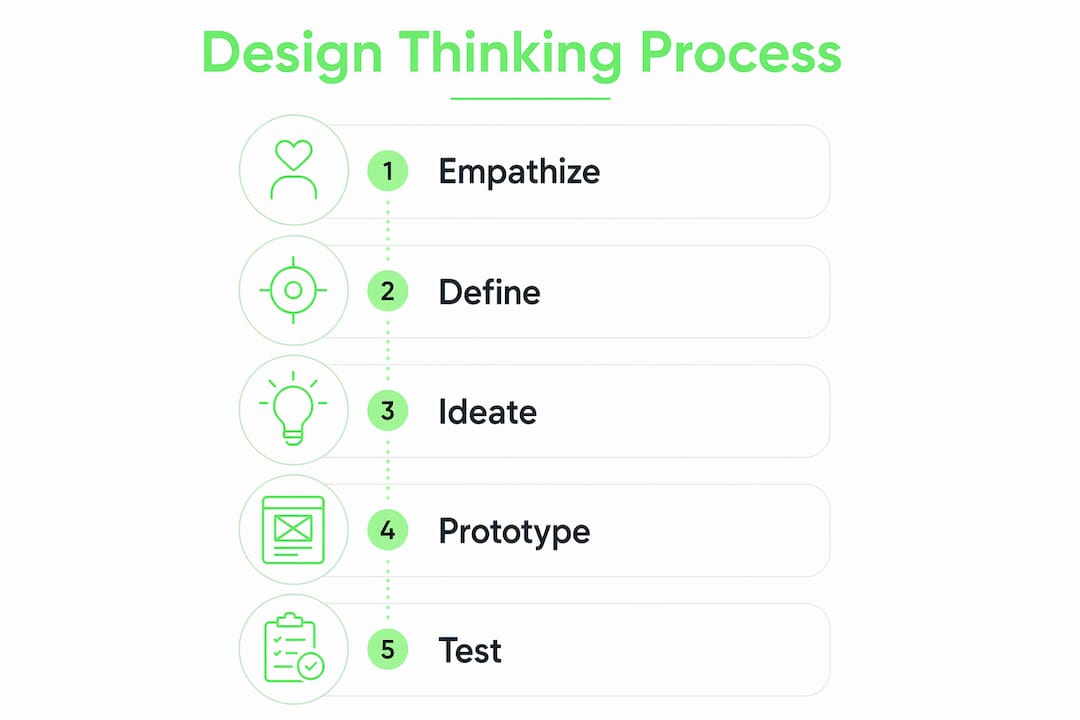
Prototype means building the cheapest possible version of your idea to test a specific assumption. Prototypes built in hours, not weeks, are the goal. Paper sketches, cardboard models, and Figma wireframes all qualify.
Test closes the loop. You put the prototype in front of real users, observe their behavior, and let their confusion or delight tell you what to do next.
- Empathize: interviews, observation, empathy maps
- Define: affinity diagrams, problem statements, “How Might We” questions
- Ideate: brainstorming, SCAMPER, Crazy 8s, dot voting for prioritization
- Prototype: paper sketches, Figma mockups, role-play scenarios
- Test: usability sessions, think-aloud protocols, iterative feedback loops
The critical insight most teams miss is that iterative loops are fundamental, not failures. A test session that sends you back to the Define stage is not a setback. It is the methodology working exactly as designed.
Pro Tip: Schedule explicit revisit checkpoints after user research and after prototype testing. Teams that plan for iteration outperform those that treat looping back as a sign something went wrong.
How to execute each design thinking stage effectively
Knowing the stages is table stakes. Executing them well is where most teams separate from the pack.
-
Empathize with rigor. Conduct at least five user interviews per persona before drawing conclusions. Use open-ended questions like “Walk me through the last time you tried to solve X” rather than “Do you like X?” Pair interviews with direct observation when possible. Empathy maps, which capture what users say, think, do, and feel, help teams synthesize qualitative data without losing nuance.
-
Define with precision. Synthesize your research into a single, actionable problem statement. The format “User needs a way to [goal] because [insight]” forces specificity. Avoid problem statements that already contain a solution. “Users need a mobile app” is a solution. “Users need a faster way to track expenses on the go” is a problem.
-
Ideate without judgment. Run a 20-minute brainstorm where no idea is criticized. Volume is the goal. Then use dot voting or an impact/effort matrix to prioritize the most promising concepts. For deeper ideation techniques tailored to entrepreneurs, the methods vary significantly by context and team size.
-
Prototype cheaply and fast. The fastest quality gain comes from low-fidelity prototypes built in hours, not polished builds that take weeks. A paper sketch of a mobile screen tests the same core assumption as a coded prototype, at a fraction of the cost. Tools like Figma, Balsamiq, or even sticky notes on a whiteboard work perfectly at this stage.
-
Test with real users, not colleagues. Colleagues know too much context. Real users expose the gaps. Observe without intervening. When a user struggles, resist the urge to explain. Their confusion is data. Document observations in real time and debrief the team immediately after each session while details are fresh.
Pro Tip: Pair each prototype test with a single hypothesis: “We believe users will [do X] because [reason Y].” This keeps testing focused and makes it easy to evaluate what you actually learned.
User-centered problem framing and iterative testing also improve cross-team collaboration. When everyone anchors decisions to observed user behavior rather than personal opinions, the politics of product development get quieter fast.
Common mistakes teams make when applying design thinking
Most design thinking failures are not methodology failures. They are execution failures rooted in a handful of predictable habits.
-
Treating stages as a waterfall. The most common mistake is running Empathize, Define, Ideate, Prototype, and Test in strict sequence and calling it done. High-performing teams plan deliberate revisit points after key activities rather than marching linearly toward a predetermined finish line.
-
Skipping user research. Teams under time pressure often substitute assumptions for interviews. This is where the methodology breaks down entirely. You cannot empathize with a spreadsheet. Even two or three short user interviews will surface insights that invalidate weeks of assumption-based work.
-
Defining the problem too early. Jumping to a problem statement before completing empathy research is like writing a diagnosis before examining the patient. The Define stage should feel like a synthesis, not a starting point.
-
Over-engineering prototypes. Building a polished, high-fidelity prototype before validating core assumptions is one of the most expensive mistakes in product development. Rapid prototyping that tests assumptions early reduces rework and surfaces gaps before they become costly.
-
Siloed teams. Design thinking works best with cross-functional participation. Engineers, marketers, customer success, and designers each bring different lenses to the same problem. Keeping the process inside a single department produces solutions that are technically sound but organizationally orphaned.
“Better problem discovery reduces costly rework. Design thinking helps teams avoid building solutions to the wrong problem by emphasizing early and ongoing validation.” Microsoft HVE Core
The mindset shift that unlocks the methodology is simple: treat every iteration as information, not inefficiency.
How design thinking integrates with Lean Startup and design sprints
Design thinking does not exist in isolation. It sits within a broader ecosystem of innovation frameworks, and understanding where it fits helps teams use it more deliberately.
| Framework | Core Strength | Time Horizon | Best Used When |
|---|---|---|---|
| Design Thinking | Deep empathy, problem framing, open-ended ideation | Weeks to months | Problem is ambiguous or poorly understood |
| Lean Startup | Build-measure-learn cycles, market validation | Days to weeks | Core problem is known, solution needs testing |
| Design Sprint | Structured five-day problem-solving sprint | One week | Specific question needs rapid, focused resolution |
Design sprints compress discovery into structured one-week cycles while design thinking allows open-ended exploration. Think of a design sprint as design thinking with a deadline and a very specific question. They complement each other well: use design thinking to understand the problem space, then run a sprint to pressure-test a specific solution direction.
The Lean Startup methodology adds a market validation layer that design thinking alone does not provide. Where design thinking focuses on user empathy and ideation, Lean Startup focuses on the build-measure-learn cycle. Together, they cover the full arc from problem discovery to market fit.
Microsoft’s HVE Core framework extends design thinking into a scalable organizational practice, incorporating synthesis, validation, and iteration at the level of engineering workflows. It bridges the gap between workshop artifacts and delivery-ready specifications, which is exactly where most organizations lose momentum after an inspiring design thinking session.
Embedding design thinking into team culture requires more than running workshops. It means building habits: weekly user touchpoints, standing retrospectives after each prototype test, and shared documentation of what was learned and why decisions changed. Asana and similar project management tools help teams track these iteration cycles without losing institutional knowledge between sprints.
Key takeaways
The design thinking process succeeds when teams treat iteration as the method, not the exception, anchoring every decision in observed user behavior rather than internal assumptions.
| Point | Details |
|---|---|
| Five iterative stages | Empathize, Define, Ideate, Prototype, and Test work as a loop, not a linear sequence. |
| Low-fidelity prototypes win | Build prototypes in hours to expose assumptions early and avoid costly late-stage rework. |
| User research is non-negotiable | Even three interviews will surface insights that invalidate weeks of assumption-based planning. |
| Plan deliberate revisit points | High-performing teams schedule explicit loops back to earlier stages after testing and research. |
| Integrate with complementary frameworks | Pair design thinking with Lean Startup for validation and design sprints for focused execution. |
Why most teams get design thinking backwards
Here is the uncomfortable truth I have seen play out repeatedly: most teams treat design thinking as a creativity exercise rather than a problem-solving discipline. They run a brainstorm, call it ideation, skip the empathy work entirely, and then wonder why their prototype tests produce shrugs instead of insights.
The methodology’s real power is in the Define stage, not the Ideate stage. Getting the problem statement right is harder and more valuable than generating a hundred ideas. I have watched teams spend three days on ideation and thirty minutes on problem framing. The ratio should be closer to the reverse.
The other thing nobody tells you: cross-disciplinary teams are not just nice to have. They are structurally necessary. When an engineer, a designer, and a customer success rep sit in the same user interview, they hear three completely different things. That tension is where the best problem statements come from.
For founders specifically, design thinking is not just a product tool. It is a startup idea validation system. The empathy and define stages map almost perfectly onto the discovery work that separates founders who find product-market fit from those who build in the dark. Adapt the framework to your context. Drop the rigidity. Keep the curiosity.
— Samim
How Siift helps you apply design thinking from day one
If you are a founder or early-stage team trying to apply the design thinking methodology without a dedicated research team or a six-week sprint budget, Siift was built for exactly that constraint. Siift’s Agentic AI platform guides you step-by-step through ideation, validation, and go-to-market, systematically mapping to the same stages this article covers. It captures insights, surfaces blindspots, and keeps your iteration cycles moving without the overhead of enterprise tooling. Where generic AI tools give you answers, Siift gives you a structured process. For teams ready to move from workshop theory to real traction, it is the practical next step.
FAQ
What is the design thinking process?
The design thinking process is a human-centered, iterative methodology with five stages: Empathize, Define, Ideate, Prototype, and Test. It is used to solve complex problems by deeply understanding users before developing solutions.
How many stages does design thinking have?
The Stanford d.school model defines five stages: Empathize, Define, Ideate, Prototype, and Test. These stages are iterative and non-linear, meaning teams regularly loop back to earlier stages as new insights emerge.
What is the difference between design thinking and Lean Startup?
Design thinking focuses on deep user empathy and open-ended problem framing, while Lean Startup focuses on rapid build-measure-learn cycles for market validation. The two frameworks complement each other across the full arc from problem discovery to product-market fit.
Why do design thinking projects fail?
Most failures trace back to skipping user research, treating the stages as a strict linear sequence, or building polished prototypes before validating core assumptions. Iteration is the methodology, not a sign of failure.
Can design thinking be used by small teams or solo founders?
Yes. The methodology scales down effectively. Even two or three user interviews and a paper prototype test deliver meaningful insights. Tools like Figma and platforms like Siift make the process accessible without enterprise resources.