
TL;DR:
- The core challenge of building breakthrough businesses is understanding and fostering the drivers of innovation, especially during scaling. Implementing structured workflows, strategic partnerships, and disciplined resource allocation is essential for sustained innovation success. Focused integration of learning, partnerships, and execution discipline enables startups to scale effectively and gain a competitive advantage.
Most founders believe that a brilliant idea is the hardest part of building a breakthrough business. It isn’t. The real challenge is understanding what actually drives innovation from spark to scale, and then putting the right conditions in place before your momentum stalls. Innovation often fails at the scaling stage when organizations lack the partnerships and structural “bridgers” needed to move ideas from prototype to real-world traction. If you’re an aspiring founder or small business owner in the AI era, mastering those drivers isn’t optional. It’s the difference between a great idea that dies quietly and a business that actually compounds.
Table of Contents
- The core drivers of innovation: What you need in place first
- Operationalizing innovation: Tools, practices, and workflow redesign
- Executing with discipline: Funding, portfolio thinking, and scaling up
- Common pitfalls and how to verify true innovation progress
- What most guides miss: The execution edge isn’t about more ideas, but better integration and relentless discipline
- Unlock your innovation advantage with siift.ai
- Frequently asked questions
Key Takeaways
| Point | Details |
|---|---|
| Innovation needs structure | Systems, not just ideas, allow innovation to scale and deliver real value. |
| Partnerships drive scale | Forming cross-boundary connections multiplies your chances of moving ideas to market. |
| Execution beats inspiration | Disciplined funding and clear learning practices differentiate top innovators from the rest. |
| Workflow redesign leverages AI | Optimizing workflows, not just adopting technology, unlocks the full value of AI-driven innovation. |
| Beware common pitfalls | Innovation stalls most often due to poor integration of learning and partnership gaps, not lack of ideas. |
The core drivers of innovation: What you need in place first
Before you can innovate consistently, you need to understand the conditions that make innovation possible in the first place. Think of these as the soil before the seed.
At the macro level, three recurring innovation drivers emerge across the research literature: intellectual property rights and institutional structures, the supply side of technical change (meaning access to new technology and knowledge), and the financing of innovation. These are the broad forces shaping whether innovation gets funded, protected, and commercialized. For founders, understanding this trio helps you spot where your venture may be exposed or underprepared. Are you operating in a market where IP protection is weak? Are you building on technical infrastructure that hasn’t matured yet? Are your funding sources aligned with your innovation timeline?
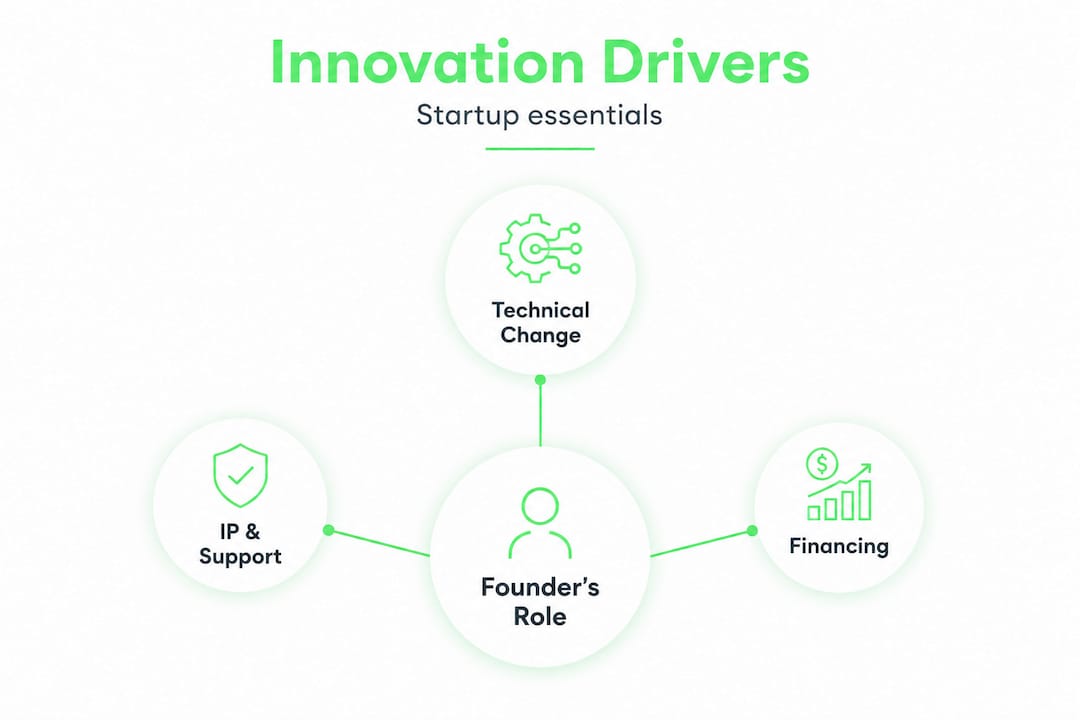
At the small business level, the picture gets more personal. Empirical evidence in small-business contexts consistently shows that knowledge management practices, social capital, and owner or entrepreneurial factors are the strongest predictors of innovativeness. In plain terms: how you capture and share what you learn, who you know and trust, and your own qualities as a founder matter enormously. This is good news. You can work on all three directly, starting today.
Here’s a summary of how these drivers map to practical startup realities:
| Driver | What it means for founders | Example |
|---|---|---|
| IP and institutions | Legal protection, regulatory clarity | Filing a provisional patent early |
| Technical change | Access to new tools and platforms | Adopting AI APIs before competitors |
| Financing | Matching capital type to innovation stage | Grants for early R&D, VC for scale |
| Knowledge management | Capturing and applying lessons learned | Running weekly retrospectives |
| Social capital | Networks, partnerships, and trust | Co-founders with complementary networks |
| Founder qualities | Resilience, learning agility, vision | Iterating quickly based on user feedback |
Ask yourself these diagnostic questions to check whether your startup has the basics covered:
- Do you have a clear IP strategy, even at the earliest stage?
- Are you building on technical platforms that give you a genuine advantage?
- Does your current funding structure support the time horizon your innovation requires?
- How do you document and apply what you learn from customers and experiments?
- Who in your network can open doors that your product alone cannot?
A solid growth strategy for startups answers all of these questions deliberately, not by accident. And understanding your startup funding stages early means you won’t be caught flat-footed when you need capital to move fast.
Pro Tip: When allocating your limited budget, prioritize activities that create visible learning or visible connections, such as customer discovery calls, pilot partnerships, or open-source contributions. These compound. Spending on features that nobody has validated yet does not.
Operationalizing innovation: Tools, practices, and workflow redesign
Knowing the drivers is step one. Embedding them into how you actually work every day is step two. This is where most founders stall.
Leading innovation practice emphasizes building an innovation operating system that spans the entire business, not just the R&D function or the product team. Think of it as infrastructure for consistent creative output. Just as a factory needs machines, processes, and quality checks, your venture needs structures that make good ideas repeatable and scalable.
A useful framework for this involves three roles that must exist in any innovating organization, whether you have three people or thirty:
- Architects design the overall innovation strategy and set priorities. In early-stage startups, this is usually the founder.
- Bridgers connect ideas across teams, partners, and customer segments. They translate technical possibilities into market realities. This role is often underfilled, and its absence is one of the top reasons scaling fails.
- Catalysts accelerate adoption and execution. They remove blockers, build buy-in, and push initiatives from pilot to practice.
Here’s how ad-hoc innovation compares to a systematized approach:
| Dimension | Ad-hoc innovation | Systematized innovation |
|---|---|---|
| Idea capture | Informal, memory-dependent | Structured discovery and logging |
| Decision-making | Reactive, based on loudest voice | Evidence-based, portfolio prioritized |
| Resource allocation | Spread thin across many ideas | Concentrated on highest-potential bets |
| Learning loops | Occasional, unstructured | Regular retrospectives with documented insights |
| Partnerships | Opportunistic | Strategic and mapped to scaling goals |
| AI integration | Tool-by-tool experimentation | Workflow-level redesign with clear KPIs |
On the AI front specifically, the data is clear. Rewiring workflows and focusing on management practices, including road maps, KPIs, and change management, captures more value from generative AI adoption than technology investment alone. Buying the best AI tools without redesigning how work flows through your organization is like installing a jet engine on a bicycle.
Here’s a practical step-by-step for redesigning your workflows around innovation:
- Map your current workflows end to end. Where are the bottlenecks? Where do ideas die before being tested?
- Identify three to five automation opportunities that would free your team’s cognitive bandwidth for higher-value work.
- Assign an owner for each innovation initiative. Accountability without authority is just wishful thinking.
- Implement lightweight KPIs for each initiative: what does success look like in 30, 60, and 90 days?
- Run bi-weekly learning reviews where you discuss what experiments revealed, not just what was built.
- Adjust resource allocation based on evidence from those reviews, not on optimism alone.
Developing strong AI productivity strategies is central to this process. And if you’re building an AI-native venture, a clear business strategy for AI ventures will help you sequence these workflow changes intelligently. For solopreneurs especially, an AI Lean Canvas can be a powerful way to map your operating model before you scale.
Pro Tip: Map your customer journey specifically to find automation candidates, but be disciplined. Over-automating the wrong touchpoint, especially high-trust moments like onboarding or first-time support, can actually hurt the customer relationship you’re trying to build.
Executing with discipline: Funding, portfolio thinking, and scaling up
Here’s an uncomfortable truth most startup content won’t say plainly: having twenty innovation initiatives running in parallel is usually a sign of confusion, not ambition. Real execution requires discipline, focus, and a portfolio mindset.

Portfolio-level discipline and execution practices drive innovation performance. Companies with stronger performance on key innovation practices are measurably more likely to find white space opportunities, launch innovations within budget, and scale new offerings successfully. The data is consistent: focused execution beats scattered activity every time.
Here’s a practical four-step portfolio discipline process for founders:
- Evaluate your current initiatives. Score each one on strategic fit, evidence of traction, and resource requirements. Be ruthless about what’s actually earning its place on your roadmap.
- Test at minimum viable scale. Before committing significant resources, run the smallest possible experiment that could give you a real answer. One landing page, one customer interview sprint, one pilot partner.
- Allocate based on evidence. Move funding and team attention toward initiatives with the strongest early signals, not the ones that feel most exciting internally.
- Review and rebalance quarterly. Markets shift. Customer needs evolve. Your portfolio should reflect current reality, not last quarter’s assumptions.
Scaling innovation is not about creating the most new projects. Standout firm research confirms that productivity impact at scale depends on a small number of firms executing strategic moves with real depth and commitment, not on a proliferation of half-built experiments.
What does truly scaling up require? Here are the non-negotiables:
- A team with complementary strengths, not just people who agree with the founder
- Capital structured for the right stage, whether that’s grants, angel investment, or revenue-based financing
- Clear strategic focus, meaning you know exactly which customer segment you’re solving for and why
- Partnership infrastructure, including distribution, technology, and co-development partners who extend your reach without requiring you to build everything yourself
- A feedback system that connects real customer outcomes to your product decisions continuously
Learning to sequence your growth strategies for startups is as important as the strategies themselves. And if you’re capital-constrained, understanding your bootstrapping strategies deeply can help you make disciplined bets without burning through your runway on the wrong priorities.
Common pitfalls and how to verify true innovation progress
Even founders who understand the drivers and set up the right structures hit walls. Recognizing the common pitfalls early gives you a significant edge.
Here are the most frequent blockers we see:
- Solo learning loops. One person absorbs insights from customers or experiments but never transfers them to the rest of the team. Knowledge hoards are innovation killers.
- Lack of partnerships. Founders often try to build too much internally. Partnerships, whether for distribution, technology, or credibility, dramatically accelerate what a small team can accomplish.
- Measurement gaps. Tracking vanity metrics like app downloads or social followers instead of leading indicators like activation rates, repeat usage, or willingness to pay.
- Feature bloat. Adding capabilities because they’re technically interesting, not because customers asked for them or evidence supports them.
- Over-reliance on AI tools. Using AI as a substitute for strategic thinking rather than as an accelerant for it. AI primarily helps with idea generation and pattern discovery, not with choosing the right direction.
On the learning side, the research offers a sharp warning worth taking seriously:
“Learning and clarity about how different learning activities connect can materially affect innovation progress, beyond simply doing many learning actions.” HBR
In other words, doing a lot of customer calls, A/B tests, and retrospectives isn’t enough if those activities aren’t connected to each other and to your decision-making process. The integration of learning matters as much as the volume of it.
Partnership breakdown is equally dangerous. When initiatives stall, it’s frequently because the partnerships that were supposed to move ideas forward dissolved due to misaligned incentives or poor communication. Build partnership agreements with clear expectations from day one.
To verify your innovation progress honestly, build these habits into your operating cadence:
- Cross-functional reviews every two weeks. Bring together product, customer-facing, and operational team members to share what they’re learning, not just what they’re building.
- After-action insights for every experiment. Document what you expected, what actually happened, and what you’ll do differently. This transforms individual experiments into organizational knowledge.
- Impact feedback from first users. Your earliest adopters are your best signal. Create structured ways to hear from them regularly, even as you scale. And integrate AI risk management thinking into your review process so you’re not blindsided by dependencies you didn’t anticipate.
What most guides miss: The execution edge isn’t about more ideas, but better integration and relentless discipline
Most innovation content focuses on generating ideas. More brainstorming. More AI prompts. More creativity techniques. We think that’s mostly misdirection for founders who are serious about building lasting businesses.
The founders and small firms that actually win at innovation aren’t the ones with the most ideas or the flashiest tech stack. They’re the ones who create disciplined feedback loops, connect their experiments to scalable systems, and make sharp choices about where to focus. That last part is particularly counterintuitive. Saying no to interesting opportunities is an innovation discipline, not a failure of creativity.
We’ve seen this pattern repeatedly: a small team with clear learning integration and ruthless focus will consistently outperform a larger, better-funded team that’s operating on inspiration alone. The advantage often shifts to problem framing and execution, knowing what to build and how to embed it into customer workflows, because AI gives everyone similar raw capabilities. Your edge lives in the choices you make before the AI ever gets involved.
There’s also a myth that more AI equals more innovation. It doesn’t. AI amplifies whatever systems and disciplines you already have. If your learning loops are disconnected, AI will just help you generate more disconnected insights faster. If your execution is disciplined and your partnerships are strong, AI becomes a genuine multiplier. Context matters enormously.
Our perspective, shaped by working with founders across many stages: treat your AI startup growth strategies as a living system, not a checklist. Revisit your assumptions quarterly. Map how your experiments connect to scaling mechanisms, not just to the next idea on your roadmap. That practice alone will put you ahead of most of your competition.
Pro Tip: Once a month, draw a simple map connecting your three most recent experiments to your core scaling hypothesis. If you can’t trace the connection clearly, that’s a signal your innovation activities may be drifting from your actual strategic goals.
Unlock your innovation advantage with siift.ai
Understanding innovation drivers is clarifying. Actually embedding them into your daily workflow is where the real work begins, and where most founders need support. That’s exactly what siift.ai is built to provide. siift’s New Business OS acts as your agentic AI guide, walking you step by step through ideation, validation, and go-to-market with the kind of structured discipline this guide describes. It helps you filter out biases, avoid blindspots, and build a holistic, validated strategy that moves you toward product-market fit faster than going it alone. If you’re ready to stop improvising your innovation process and start systematizing it, siift.ai is where that journey gets real.
Frequently asked questions
What are the three main drivers of innovation for startups?
Intellectual property and institutional support, access to technical change, and financing are the three main macro-level innovation drivers identified consistently across the research literature.
How does AI specifically impact innovation for small businesses?
AI primarily accelerates idea generation and pattern discovery, but the real competitive edge comes from execution, workflow integration, and knowing which problems are worth solving in the first place.
Why do many innovations fail to scale?
Scaling most often fails when organizations lack the “bridger” roles and partnership infrastructure needed to move a validated idea from prototype into repeatable, market-ready execution.
How can founders measure if their innovation system is working?
Track how well learning activities connect to actual business outcomes, not just the number of experiments run, and measure whether partnerships and funding decisions are moving your core scaling hypothesis forward.