
Finding real market opportunities can feel overwhelming when launching your first AI venture, especially if you lack a background in strategy or marketing. Understanding how to spot and fill meaningful gaps is what sets thriving businesses apart from those that fizzle out. This step-by-step guide will help you master systematic market assessment, uncover authentic customer needs, and position your AI idea for real-world success.
Table of Contents
Quick Summary
Key Insight | Explanation |
|---|---|
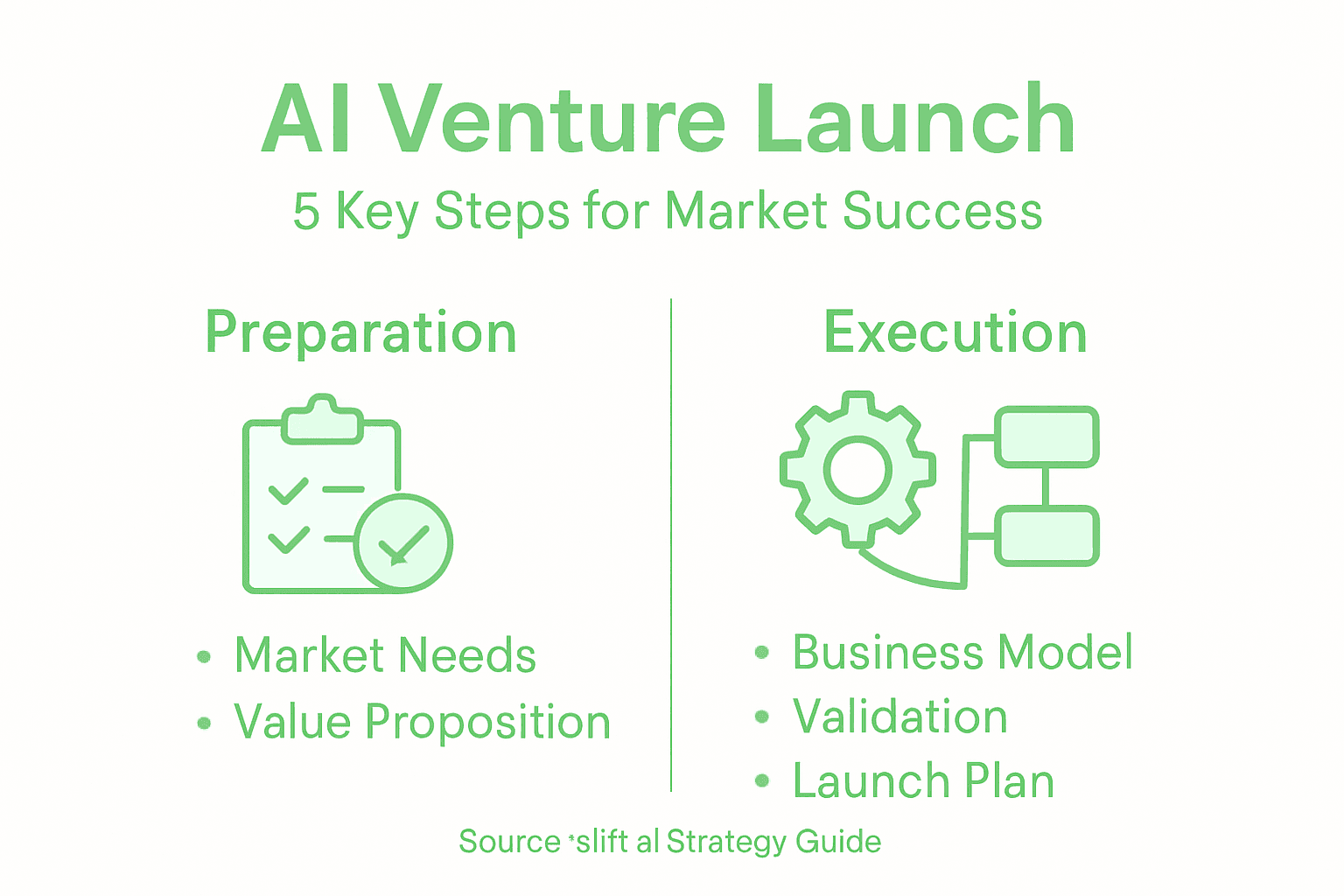
1. Conduct In-Depth Market Research | Go beyond surface knowledge; understand customer pain points and industry challenges to identify genuine market opportunities. |
2. Create a Compelling Value Proposition | Clearly articulate how your AI solution solves specific problems, emphasizing unique benefits and measurable outcomes. |
3. Develop a Flexible Business Model | Ensure your business model adapts to technological changes and customer needs, supporting scalability and user-centricity. |
4. Validate Strategies with Customer Feedback | Implement structured testing with real customers to refine your core assumptions and align your offering with genuine market demands. |
5. Optimize Launch for Market Fit | Execute a responsive launch plan that addresses real user needs, incorporating continuous feedback to enhance alignment and success. |
Step 1: Assess market needs and identify opportunities
Successfully launching an AI venture requires a strategic approach to understanding market dynamics and uncovering untapped opportunities. In this section, you’ll learn how to systematically evaluate potential markets and identify promising gaps where your AI solution can make a significant impact.
To begin your market assessment, you’ll want to conduct comprehensive research that goes beyond surface-level observations. Analyzing AI market trends provides critical insights into emerging technological demands and potential growth areas.
Here are key strategies for identifying market opportunities:
Conduct deep customer pain point research
Analyze industry-specific challenges
Map out potential solution gaps
Study competitor offerings and limitations
Evaluate technology readiness levels
Start by developing a comprehensive understanding of your target market’s specific needs. This means going beyond generic market reports and diving deep into niche industry requirements. Interview potential customers, attend industry conferences, and review recent research publications to gain nuanced insights.
Your goal is to find the intersection between technological capability and genuine market demand. Not every AI solution solves a real problem, so focus on identifying authentic customer needs that current solutions fail to address.
The most successful AI ventures solve specific, well-defined problems with measurable impact.
When evaluating market opportunities, consider factors like scalability, potential revenue models, and the complexity of implementation. Look for markets with clear pain points where AI can provide significant efficiency improvements or cost reductions.
Pro tip: Create a systematic scoring matrix to objectively evaluate and rank potential market opportunities based on multiple criteria like market size, competition, and solution complexity.
Step 2: Define your unique value proposition
Defining a compelling unique value proposition (UVP) is the critical foundation for differentiating your AI venture in a crowded marketplace. Your UVP will communicate exactly why customers should choose your solution over every alternative available.
To craft a powerful value proposition, you’ll need to deeply understand how your AI solution solves specific customer problems in ways that existing solutions cannot. Developing a clear value proposition requires strategic thinking and precise articulation of your product’s distinctive benefits.
Here are key components to build a remarkable value proposition:
Identify your target customer’s most critical pain points
Quantify the specific benefits your AI solution delivers
Highlight what makes your approach fundamentally different
Articulate measurable outcomes customers can expect
Create a concise, memorable statement that resonates emotionally
Start by conducting thorough customer research to understand exact problems your target market experiences. Don’t rely on assumptions. Talk directly to potential users, analyze their challenges, and map out how your AI technology provides a unique solution.
A truly exceptional value proposition transforms a technical solution into a story of transformation and hope.
Your value proposition should communicate three fundamental elements: who you help, what problem you solve, and why your approach is uniquely powerful. Focus on creating a narrative that connects your technical capabilities with genuine human needs.
Successful AI ventures don’t just offer features. They promise meaningful change. Your value proposition must convince potential customers that your solution is not just different, but dramatically better than existing alternatives.
Pro tip: Test your value proposition with at least 10 potential customers, collecting specific feedback to refine your messaging and ensure it truly resonates with your target market.
Step 3: Align your business model for AI-driven growth
Aligning your business model for AI-driven growth requires a strategic approach that transforms technological capabilities into sustainable revenue streams. Your goal is to create a flexible framework that leverages AI’s unique potential while delivering exceptional value to your target market.

Strategic business model innovation demands a comprehensive understanding of how AI can fundamentally reshape your value creation and delivery mechanisms. This means going beyond traditional linear business approaches and embracing dynamic, adaptive strategies.
Key components for building an AI-optimized business model include:
Identify scalable AI-powered revenue streams
Design flexible pricing strategies
Develop modular product architectures
Create data-driven feedback loops
Establish continuous learning mechanisms
Start by mapping out how AI creates unique value in your specific context. This isn’t just about implementing technology, but fundamentally reimagining how your business generates and captures value. Consider multiple monetization strategies that align with your AI capabilities.
Successful AI business models transform technological potential into tangible economic advantages.
Your AI-driven business model should demonstrate three critical attributes: adaptability, scalability, and customer-centricity. Focus on creating a framework that can rapidly evolve with technological advancements and market dynamics.
Effective AI ventures treat their business model as a living ecosystem, not a static document. Continuously experiment, measure outcomes, and be prepared to pivot quickly based on real-world performance and customer feedback.
Use this summary to connect essential business model attributes with their practical effects:
Business Model Attribute | Description | Practical Effect |
|---|---|---|
Adaptability | Ability to pivot and evolve | Responds quickly to market shifts |
Scalability | Grows with demand | Supports rapid user base increase |
Customer-Centricity | Focus on user value | Boosts satisfaction and loyalty |
Pro tip: Develop multiple business model scenarios and use simulation techniques to stress-test your AI venture’s potential growth trajectories and resilience.
Step 4: Validate your strategy with actionable feedback
Validating your AI venture’s strategy requires a systematic approach that transforms assumptions into data-driven insights. Your mission is to create a robust feedback mechanism that continuously refines your business concept and ensures genuine market alignment.
Technology venture validation methodologies demonstrate the critical importance of iterative testing and strategic adaptation. This means moving beyond theoretical planning and engaging directly with potential customers to validate your core hypotheses.
Key strategies for effective strategy validation include:
Conduct structured customer interviews
Design targeted prototype experiments
Build minimum viable product (MVP)
Collect quantitative and qualitative feedback
Implement rapid iteration cycles
Start by developing precise validation experiments that test your most critical business assumptions. This isn’t about confirming what you want to believe, but uncovering genuine market realities. Create scenarios that can definitively prove or disprove your core value propositions.
Real validation happens when you’re willing to hear answers you didn’t expect.
Your validation process should be ruthlessly objective. Seek feedback from diverse sources, including potential customers who might be skeptical of your approach. The goal is to gather insights that can fundamentally reshape your strategy if necessary.
Successful AI ventures treat strategy validation as a continuous dialogue with the market. Be prepared to pivot quickly, abandon unproductive directions, and double down on promising opportunities revealed through systematic testing.
Pro tip: Develop a structured feedback matrix that scores each validation experiment across multiple dimensions, allowing you to quantitatively track your strategy’s evolution and potential.
Step 5: Optimize your launch plan for market fit
Launching an AI venture requires a strategic approach that transforms your innovative concept into a compelling market offering. Your objective is to design a launch plan that maximizes market penetration while minimizing potential risks and barriers to adoption.
Validate product market fit by creating a comprehensive strategy that goes beyond traditional marketing approaches. This means developing a nuanced plan that speaks directly to your target audience’s most pressing needs and expectations.
Key elements of an optimized launch strategy include:
Create targeted customer personas
Design phased rollout approach
Develop compelling initial use cases
Build strategic early adopter network
Establish clear success metrics
Start by mapping out your precise market entry strategy. This involves understanding the specific segments most likely to embrace your AI solution and crafting messaging that resonates deeply with their unique challenges and aspirations.
The most successful launches solve real problems before selling features.
Your launch plan must be flexible and responsive. Anticipate potential friction points and develop contingency strategies that allow you to pivot quickly based on initial market feedback. Treat your launch not as a single event, but as a continuous process of learning and adaptation.
Effective AI ventures understand that market fit is an ongoing dialogue. Your launch strategy should include robust mechanisms for collecting, analyzing, and responding to user insights, ensuring continuous improvement and alignment with market needs.
Here’s a quick reference comparing the core success factors for each step of launching an AI venture:
Step | Key Focus | Critical Success Factor | Common Pitfall |
|---|---|---|---|
Market Assessment | Finding genuine needs | Deep customer research | Relying on assumptions |
Value Proposition | Differentiation | Quantified benefits | Imitating competitors |
Business Model | Scalable monetization | Adaptive frameworks | Sticking to static plans |
Strategy Validation | Market feedback | Objective experimentation | Ignoring disconfirming data |
Launch Plan | Market fit | Responsive iterations | One-time launch mindset |
Pro tip: Create a launch readiness scorecard that objectively evaluates your product’s market preparedness across technical, marketing, and customer experience dimensions.
Take Control of Your AI Venture’s Success Today
Launching an AI startup comes with complex challenges like pinpointing real customer needs, crafting a unique value proposition, and aligning your business model for scalable growth. The article highlights crucial steps such as deep market research, strategy validation, and continuous iteration—key factors you must master to avoid costly pitfalls and build a business that truly fits the market.
siift.ai’s Intelligent Business Canvas is designed specifically to guide you through these challenges. This AI-powered platform offers personalized feedback and prioritized actions so you can systematically de-risk your Founder’s Journey and accelerate your path to Product-Market-Fit. Whether you are refining your value proposition or validating your launch plan, the Canvas helps you filter out biases and blind spots that often stall AI ventures.
Explore how the Intelligent Business Canvas can help you apply deep customer insights and create adaptive business models discussed in the article. Ready to turn strategic ideas into actionable steps that are proven to work? Visit siift.ai now and start building your AI venture with confidence and clarity.
Frequently Asked Questions
What is the first step to launching my AI venture?
The first step is to assess market needs and identify opportunities. Conduct thorough research to understand genuine customer pain points and explore market gaps where your AI solution can provide value.
How can I define my unique value proposition for an AI solution?
To define your unique value proposition, identify the specific problems your AI solution addresses and quantify the benefits it offers. Create a concise statement that illustrates how your approach is distinct from existing alternatives.
What should be included in an AI-driven business model?
An AI-driven business model should include scalable revenue streams, flexible pricing strategies, and data-driven feedback loops. Focus on creating a customer-centric framework that adapts to new technology and market trends.
How do I validate my AI venture’s strategy with customer feedback?
You validate your strategy by conducting structured customer interviews and designing prototype experiments. Gather both quantitative and qualitative feedback to test your key assumptions and adjust your strategy accordingly.
What are key elements of a successful launch plan for an AI venture?
Key elements include creating targeted customer personas, designing a phased rollout approach, and developing initial use cases. Ensure you establish clear metrics for success to measure your impact in the market.
How can I optimize my AI venture for market fit after the initial launch?
To optimize for market fit, implement robust mechanisms for collecting and analyzing user insights. Continuously respond to feedback and be willing to adapt your product based on user needs to enhance satisfaction and loyalty.