
Most American entrepreneurs underestimate the power of a well-defined value proposition. In fact, research shows that companies with clear value statements grow revenue up to 2.2 times faster than their competitors. In a crowded marketplace where every business fights for attention, knowing how to craft and adapt your core message can make all the difference. This guide breaks down what makes a value proposition effective and offers practical steps to sharpen your business’s competitive edge.
Table of Contents
- Defining The Value Proposition Statement
- Core Elements And Common Variations
- How Value Propositions Shape Startup Strategy
- Crafting A Compelling Value Proposition
- Pitfalls To Avoid And Real-World Examples
Key Takeaways
| Point | Details |
|---|---|
| Value Proposition Importance | A clear value proposition differentiates a product or service, turning interest into customer commitment. |
| Core Components | An effective value proposition includes a specific challenge, a solution, and differentiation from competitors. |
| Strategic Variations | Businesses can adopt different strategies, including price leadership and innovation focus, to position themselves effectively in the market. |
| Dynamic Nature | Value propositions should evolve with customer feedback and market changes, serving as a living document rather than a static statement. |
Defining the Value Proposition Statement
At its core, a value proposition represents a strategic promise that communicates the unique benefits and economic value a product or service delivers to potential customers. When crafted effectively, it becomes the critical differentiator that transforms casual interest into committed customer engagement.
Based on research from academic sources, a value proposition is a statement that enhances a firm’s core strategy by promising improved products and services. It serves as a powerful marketing tool designed to convince customers why they should choose your specific offering over competing alternatives. Unlike generic marketing language, an exceptional value proposition distills complex business value into a clear, compelling narrative that speaks directly to customer needs and desires.
The most effective value propositions share several key characteristics. They are concise yet comprehensive, addressing specific customer pain points while highlighting unique advantages. Typically, they articulate three fundamental elements: the core problem being solved, the specific solution your product provides, and the distinctive way your solution differs from existing market options. By creating a precise, resonant statement, entrepreneurs can rapidly communicate their business’s fundamental value in a manner that cuts through market noise and captures potential customer attention.
Pro Tip: Rapid Value Proposition Design: Spend no more than 30 minutes drafting your initial value proposition, focusing on clarity and directness. Treat it as a dynamic document you’ll refine through customer feedback, not a permanent tablet carved in stone.
Core Elements and Common Variations
A strong value proposition is not a one-size-fits-all document, but a nuanced communication strategy that adapts to specific business contexts. Typically, it includes references to the sector, products, target clients, and key differentiating factors that demonstrate why a particular offering stands out in a competitive marketplace.
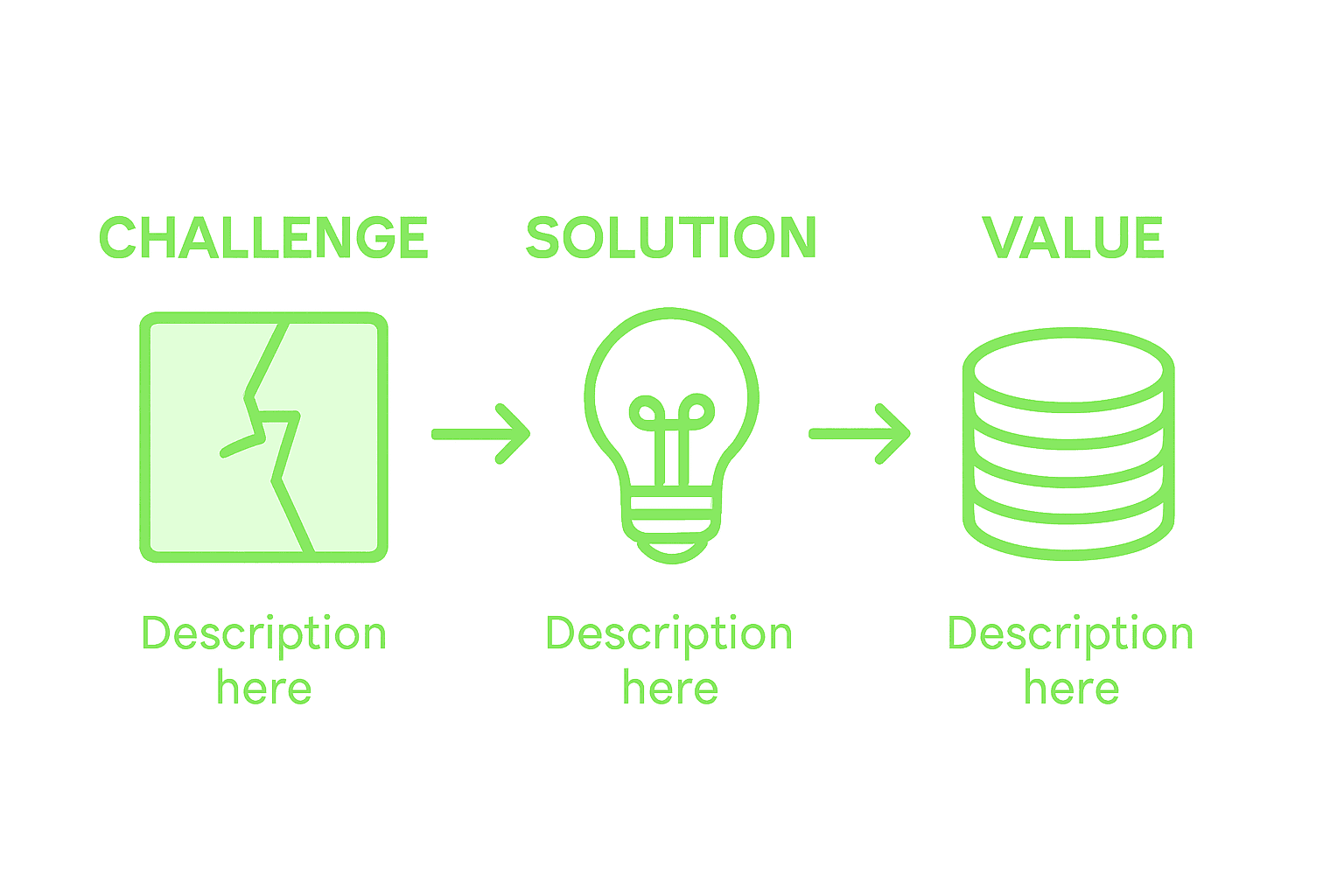
The core elements of an effective value proposition can be distilled into three fundamental components. First, the Challenge Component articulates the specific problem or unmet need that exists in the market. Second, the Solution Component precisely describes how your product or service uniquely addresses that challenge. Third, the Differentiation Component clearly explains why your approach is superior to alternative solutions. These elements work together to create a compelling narrative that transforms abstract business value into a concrete, attractive proposition for potential customers.
Value propositions manifest in several strategic variations, often categorized by their core positioning strategy. Some common approaches include:
- Price Leadership: Offering more value for less money
- Quality Premium: Providing superior features at a higher price point
- Innovation Focus: Introducing breakthrough solutions that redefine existing market expectations
- Customer Experience: Emphasizing exceptional service and support beyond the core product
These variations allow businesses to strategically position themselves based on their unique strengths and target market preferences. The approach distinguishes a program by highlighting what makes its solution uniquely well-suited to solving a specific problem, creating a clear and compelling market differentiation.
Here’s a summary comparing common value proposition strategies and their typical business impacts:
| Strategy Type | Main Focus | Typical Business Impact |
|---|---|---|
| Price Leadership | Delivering best value | Drives high volume, attracts budget-conscious customers |
| Quality Premium | Superior features/quality | Builds brand prestige, supports premium pricing |
| Innovation Focus | New solutions, disruption | Creates market differentiation, attracts early adopters |
| Customer Experience | Service and engagement | Increases loyalty, enhances referrals |
Pro Tip: Value Proposition Diagnostic: Conduct a rapid 15-minute audit of your current value proposition by asking three critical questions from a customer’s perspective - What problem am I solving? Why choose me over alternatives? What makes my solution special?
How Value Propositions Shape Startup Strategy
Startup strategy fundamentally revolves around creating a compelling narrative that transforms innovative ideas into marketable solutions. Value propositions facilitate critical product differentiation and market positioning, serving as the strategic blueprint that guides a startup’s entire growth trajectory. By articulating a clear, distinctive value, entrepreneurs can cut through market noise and establish a unique competitive stance.
The strategic impact of a value proposition extends far beyond simple marketing rhetoric. It enables marketing to re-establish itself as a core business strategy, shifting from traditional product-centric approaches to a more dynamic, customer-focused model. Successful startups understand that their value proposition is not just a statement, but a living framework that evolves with market dynamics, customer feedback, and emerging technological opportunities. This adaptability allows entrepreneurs to pivot quickly, reallocate resources, and maintain strategic agility.
Effective startup strategies leverage value propositions across multiple dimensions. In understanding lean startup methodology, entrepreneurs can use their value proposition as a north star for product development, customer acquisition, and resource allocation. Key strategic applications include:
- Market Positioning: Defining a unique space in the competitive landscape
- Product Development: Guiding feature prioritization and innovation
- Customer Targeting: Identifying and focusing on the most receptive audience segments
- Fundraising: Communicating potential value to investors and stakeholders
These strategic dimensions transform a value proposition from a mere marketing tool into a comprehensive business navigation system. By continuously refining their core value narrative, startups can create a resilient framework that adapts to changing market conditions while maintaining a clear, compelling mission.
Below is a quick reference table illustrating how startups use value propositions to guide fundamental business functions:
| Startup Function | Value Proposition Role | Example Outcome |
|---|---|---|
| Market Positioning | Defines unique market space | Stand out from competitors |
| Product Development | Informs feature priorities | Builds solutions customers want |
| Customer Targeting | Identifies ideal buyer segments | Focuses sales and marketing |
| Fundraising | Communicates value to investors | Improves investment interest |
Pro Tip: Strategic Value Proposition Review: Schedule a quarterly review of your startup’s value proposition, treating it as a living document that requires regular calibration based on market feedback, customer interactions, and emerging competitive landscapes.
Crafting a Compelling Value Proposition
Crafting a compelling value proposition requires more than just articulating product features—it demands a deep understanding of customer needs and market dynamics. The process involves describing how an offer connects directly with customers’ core issues while differentiating from competitive alternatives, creating a narrative that resonates beyond traditional marketing approaches.

The architecture of an exceptional value proposition follows a strategic framework designed to communicate immediate and tangible benefits. Developing this proposition means articulating the unique value an organization delivers by addressing specific challenges with an innovative approach, ensuring that potential customers perceive the solution as a worthwhile investment. This requires entrepreneurs to move beyond generic claims and construct a precise, emotionally compelling story that speaks directly to their target audience’s most pressing pain points.
A robust value proposition typically encompasses several critical elements:
- Clarity: Using straightforward language that instantly communicates core value
- Specificity: Quantifying benefits and outcomes wherever possible
- Relevance: Directly addressing customer problems and desires
- Differentiation: Highlighting what makes your solution uniquely superior
- Credibility: Providing evidence or validation of promised benefits
In pitching ideas for new businesses, founders must recognize that a value proposition is not a static document but a dynamic communication tool. It should evolve with market feedback, technological shifts, and changing customer expectations. Successful entrepreneurs treat their value proposition as a living strategy that continuously adapts to maintain its compelling edge.
Pro Tip: Value Proposition Stress Test: Gather five potential customers and present your value proposition, then ask them to explain what they heard. If their interpretation differs significantly from your intended message, it’s time to refine your communication.
Pitfalls to Avoid and Real-World Examples
Common mistakes in developing value propositions can dramatically undermine a startup’s potential for success. Entrepreneurs frequently fall into predictable traps that dilute their core message and minimize their competitive advantage. These pitfalls range from overly generic descriptions to complex jargon that obscures the fundamental value being offered, creating barriers between the business and its potential customers.
The most critical errors in value proposition development typically manifest in several distinct patterns. Drawing inspiration from transformative business models like Amazon’s evolution, successful startups understand that a value proposition must be both precise and adaptable. The most frequent missteps include:
- Vague Messaging: Using ambiguous language that fails to communicate specific benefits
- Feature Overload: Listing technical details instead of addressing customer problems
- Competitor Blindness: Ignoring unique market positioning and differentiation
- Emotional Disconnect: Failing to connect with the customer’s underlying needs and desires
- Static Thinking: Treating the value proposition as a fixed document rather than a dynamic strategy
Real-world success stories provide powerful insights into effective value proposition design. In exploring purpose-driven business strategies, entrepreneurs can learn from companies that have masterfully articulated their unique value. Netflix, for instance, transformed from a DVD-by-mail service to a global streaming platform by continuously redefining its value proposition. Similarly, Spotify revolutionized music consumption by solving multiple customer pain points—convenience, affordability, and personalized discovery—through a clear, compelling value narrative.
Pro Tip: Value Proposition Reality Check: Create a one-paragraph description of your business value that a ten-year-old could understand. If you can’t explain it simply, you haven’t clarified your core value proposition sufficiently.
Unlock Your Startup’s Potential with a Clear Value Proposition
The article highlights the critical challenge many founders face in crafting a concise and compelling value proposition that directly addresses customer pain points and differentiates from competitors. If you are struggling to clearly define the problem you solve, articulate what makes your solution unique, or connect emotionally with your target audience you are not alone. These are common hurdles that can stall your startup’s growth and make fundraising, product development, and marketing more difficult.
That is where the siift.ai Intelligent Business Canvas comes in. This modern founder’s strategy platform guides you step-by-step with personalized feedback to shape your value proposition and build a resilient business model. It helps you systematically clarify your core message, prioritize actions to reduce risk, and adapt your strategy based on real customer insights. With no biases or gatekeepers you can confidently transform your startup idea into a market-ready solution.
Are you ready to unlock a compelling value proposition that captures attention and accelerates your path to success Discover how siift.ai can support your journey from ideation to go-to-market with an intuitive AI-driven process designed for founders just like you. Start building clarity and confidence today by visiting siift.ai and see how your business vision can become reality.
Frequently Asked Questions
What is a value proposition statement?
A value proposition statement is a strategic promise that communicates the unique benefits and economic value of a product or service, serving as a critical differentiator in converting interest into customer engagement.
How do I create an effective value proposition for my startup?
To create an effective value proposition, focus on clarity and directness, addressing the core problem you’re solving, the specific solution you provide, and how your offering differs from competitors. Draft your initial statement quickly, and refine it based on customer feedback.
What are the core elements of a strong value proposition?
The core elements of a strong value proposition include the Challenge Component (the problem being addressed), the Solution Component (how your product solves the issue), and the Differentiation Component (how your approach stands out from alternatives).
Why is a value proposition important for startups?
A value proposition is crucial for startups as it helps establish market positioning, informs product development, guides customer targeting, and enhances fundraising efforts, ultimately shaping the startup’s overall strategy and growth trajectory.
Recommended
- blog | siift | Understanding the Startup Business Model: Key Insights
- blog | siift | Startup Success Stories: Real Paths to Business Wins 2025
- blog | siift | Top Growth Strategies for Startups in 2025: Practical Steps for Beginners
- blog | siift | How to Pitch Ideas in 2025: A Guide for Aspiring Founders