

Over ninety percent of startups never make it past the early stages, yet first-time founders shape the future by learning to adapt and evolve. Launching a venture means confronting uncertainty, tough decisions, and rapid change at every step. Whether you are grappling with founder-market fit, seeking to harness AI, or searching for sustainable strategies, understanding each critical phase can help transform a good idea into a thriving business.
Table of Contents
- Defining The First-Time Founder Journey
- Phases Of AI Adoption For Startups
- Building An AI Strategy: Key Foundations
- Common Pitfalls In Startup AI Adoption
- Leveraging Siift.ai: The AI Business Canvas Advantage
Key Takeaways
| Point | Details |
|---|---|
| First-Time Founder Approach | Successful founders should adopt a mindset of rapid experimentation and adaptability, viewing their initial business concept as a hypothesis to be tested and refined. |
| AI Adoption Phases | Effective AI integration follows a structured approach, including strategic assessment, proof of concept, and continuous optimization to align technology with business objectives. |
| Common Pitfalls to Avoid | Startups must be cautious of pitfalls such as misaligned expectations and poor integration of AI tools to ensure successful implementation and avoid resource misallocation. |
| AI Business Canvas Advantage | Siift.ai’s AI Business Canvas enhances opportunity assessment and strategic development through dynamic modeling and real-time feedback tailored to unique startup characteristics. |
Defining the First-Time Founder Journey
Launching a startup isn’t a linear path—it’s more like navigating an intricate maze where every turn tests your resilience and strategic thinking. Understanding Founder Market Fit becomes your compass in this complex terrain. The first-time founder’s journey is fundamentally about transforming an abstract vision into a tangible, sustainable business model.
According to the Lean Startup methodology introduced by Eric Ries, successful founders don’t just plan—they experiment rapidly. This approach emphasizes validated learning, where each product iteration serves as a strategic experiment to understand market needs. First-time entrepreneurs must embrace a mindset of continuous adaptation, treating their initial concept as a hypothesis to be tested and refined.
The entrepreneurial path demands more than just a great idea. The Market Opportunity Navigator provides a strategic framework for assessing core capabilities and evaluating potential market opportunities. Founders must critically analyze:
- Their unique skill sets and resources
- Potential market segments
- Competitive landscape
- Customer pain points
- Scalability of their solution
Successful first-time founders recognize that resilience trumps perfection.
 Your initial business model will inevitably evolve, and your ability to pivot intelligently determines your startup’s survival. The most valuable skill isn’t predicting the future—it’s maintaining the flexibility to respond to emerging opportunities and challenges. For a deeper exploration of entrepreneurial strategies, check out our comprehensive guide on business opportunity analysis.
Phases of AI Adoption for Startups
AI adoption isn’t a one-size-fits-all process—it’s a strategic journey that demands careful navigation and thoughtful implementation. Understanding the Best AI Tools for Founders can provide critical insights into how startups can effectively integrate artificial intelligence into their business models.
According to Gartner, successful AI adoption follows a structured approach with five critical phases designed to maximize business impact while managing potential risks. These phases represent a progressive roadmap for startups looking to leverage AI strategically:
- Strategic Assessment: Evaluate current technological capabilities and potential AI use cases
- Proof of Concept: Develop small-scale AI implementations to test feasibility
- Pilot Deployment: Launch initial AI solutions in controlled environments
- Scalable Implementation: Expand AI tools across broader business functions
- Continuous Optimization: Regularly refine and enhance AI systems
Research from arXiv further emphasizes that effective AI adoption begins with leadership commitment. Successful startups don’t just implement AI tools—they create a comprehensive strategy that aligns technological capabilities with business objectives. This means moving beyond generic applications to developing custom AI solutions that address unique organizational challenges. By treating AI as a strategic asset rather than a mere technological trend, founders can transform their operational efficiency and competitive positioning. For founders seeking a deeper understanding of strategic growth, our guide on startup growth strategies offers additional insights into leveraging emerging technologies.
Building an AI Strategy: Key Foundations
Building an effective AI strategy isn’t about jumping on a technological bandwagon—it’s about creating a deliberate, thoughtful approach that aligns artificial intelligence with your startup’s core objectives. Business Plan Essentials 2025 provides crucial context for integrating AI into your broader business framework.
Research from arXiv introduces the FAIGMOE framework, which offers a structured pathway for AI integration that goes beyond mere implementation. This approach emphasizes critical strategic considerations:
- Strategic Assessment: Deeply understand your organization’s unique challenges
- Problem Contextualization: Identify specific areas where AI can create meaningful impact
- Capability Mapping: Evaluate current technological and human resources
- Ethical Considerations: Establish guidelines for responsible AI deployment
- Continuous Learning: Build mechanisms for ongoing strategy refinement
The CDAC AI Life Cycle further illuminates the complexity of AI strategy, highlighting that successful implementation is not a one-time event but a continuous process of design, development, and strategic monitoring. Founders must view AI not as a standalone technology, but as an integrated system that evolves with their business needs. By approaching AI strategically—understanding its potential while remaining adaptable—startups can transform technological potential into genuine competitive advantage. For entrepreneurs seeking to build organizational resilience alongside their AI strategy, our guide on building business resilience offers complementary insights into navigating technological transformation.
Common Pitfalls in Startup AI Adoption
AI adoption is a minefield of potential missteps that can derail even the most promising startup initiatives. While the allure of cutting-edge technology is strong, founders must navigate this landscape with strategic precision. Top Reasons Businesses Fail provides critical context for understanding the broader challenges of technological implementation.
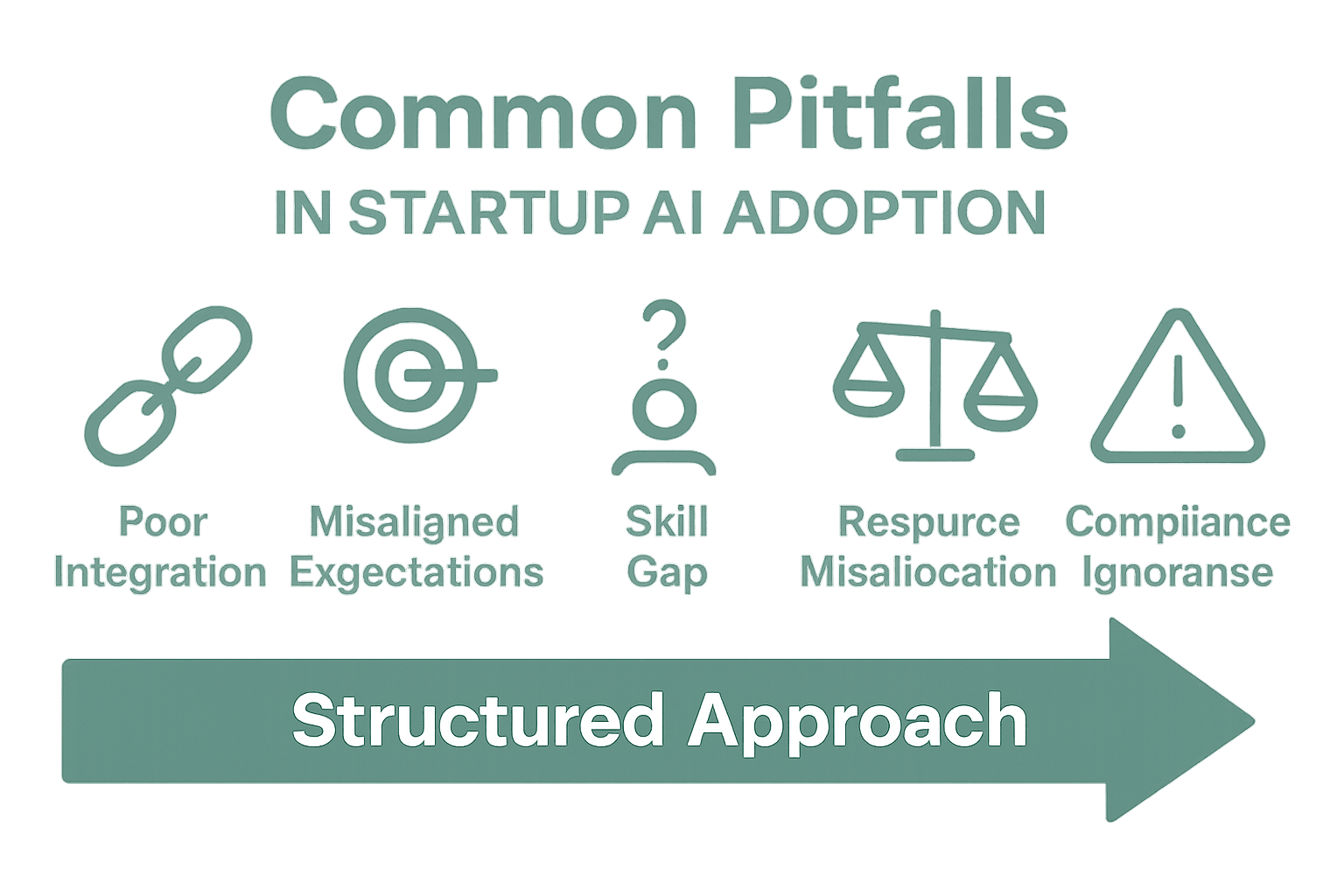
Research from arXiv reveals that early AI adoption is fundamentally about workflow compatibility. Startups frequently stumble by treating AI as a standalone solution rather than an integrated system. The most common pitfalls include:
- Misaligned Expectations: Overestimating AI’s immediate capabilities
- Poor Integration: Failing to align AI tools with existing operational processes
- Skill Gap: Lacking necessary technical expertise to implement effectively
- Resource Misallocation: Investing disproportionately in AI without clear ROI strategy
- Compliance Ignorance: Overlooking regulatory and ethical considerations
According to research from the Journal WJARR, successful AI adoption demands a structured and scalable approach that balances innovative potential with practical constraints. Founders must recognize that AI implementation is not a one-time event, but a continuous journey of learning, adaptation, and strategic refinement. The most resilient startups view AI as a collaborative tool that augments human capabilities, not a replacement for strategic thinking.
 For entrepreneurs seeking deeper insights into navigating these challenges, our guide on startup success stories offers real-world perspectives on overcoming technological hurdles.
Leveraging Siift.ai: The AI Business Canvas Advantage
Navigating the complex landscape of startup development requires more than traditional planning—it demands intelligent, adaptive strategy tools that can transform raw ideas into viable business models. Understanding Lean Canvas provides foundational insights into strategic business planning, but Siift.ai takes this approach to the next level with its AI-powered business canvas.
According to the Market Opportunity Navigator, identifying and selecting valuable market opportunities is crucial for startup success. Siift.ai’s AI Business Canvas revolutionizes this process by offering intelligent opportunity analysis that goes beyond traditional frameworks:
- Rapid Opportunity Assessment: AI-driven insights into market potential
- Dynamic Scenario Modeling: Predictive analysis of business trajectories
- Personalized Feedback: Tailored recommendations based on unique startup characteristics
- Risk Mitigation: Intelligent identification of potential challenges
- Adaptive Strategy Development: Real-time strategic refinement
The Venture Meets Mission framework emphasizes aligning entrepreneurial ventures with broader societal goals—a principle deeply embedded in Siift.ai’s approach. By integrating AI-powered insights with human creativity, the platform enables founders to develop strategies that are not just financially viable, but also meaningful and impactful. This isn’t just a tool—it’s a comprehensive ecosystem that supports founders from initial concept to market validation. For entrepreneurs seeking a deeper understanding of strategic business modeling, our guide on the Business Canvas Model offers additional context for navigating the startup landscape.
Drive Your AI Strategy Forward with Siift.ai
Launching your first AI-powered startup is challenging. The article highlights common hurdles such as aligning AI with business goals, adopting a structured AI approach, and avoiding pitfalls like poor integration and unrealistic expectations. These pain points can create uncertainty and slow progress on your founder’s journey.
Siift.ai Intelligent Business Canvas offers a modern, step-by-step solution to these challenges. With personalized feedback and AI-driven insights, it helps you validate ideas, plan strategically, and adjust in real time without blind spots or pressure. If you want to transform your AI strategy into a clear, actionable roadmap and build resilience for your startup’s future, start with Business Plan Essentials 2025 and see how our platform guides you through ideation to go-to-market.
Ready to make your AI strategy a competitive advantage today Visit Siift.ai and take control of your startup’s future with the Intelligent Business Canvas. Explore practical frameworks like the AI Business Canvas Model that empower first-time founders to turn uncertainty into opportunity.
Frequently Asked Questions
What is the first step to creating an AI strategy for my startup?
Building an effective AI strategy starts with a strategic assessment of your startup’s current technological capabilities and identifying potential AI use cases that align with your business objectives.
How can I avoid common pitfalls in AI adoption for startups?
To avoid pitfalls, ensure that your AI tools are well-integrated with existing workflows, manage expectations regarding AI capabilities, and allocate resources wisely with a clear ROI strategy while being aware of compliance and ethical considerations.
What is the FAIGMOE framework and how does it help in AI integration?
The FAIGMOE framework provides a structured approach for AI integration, emphasizing strategic assessment, problem contextualization, capability mapping, ethical considerations, and continuous learning to ensure impactful deployment of AI solutions.
How can Siift.ai’s AI Business Canvas benefit first-time founders?
Siift.ai’s AI Business Canvas offers intelligent opportunity analysis, dynamic scenario modeling, personalized feedback, and real-time strategic refinement, enabling founders to transform their ideas into viable business models effectively.
Recommended
- blog | siift | Understanding the Best AI Tools for Founders
- blog | siift | …is small beautiful yet?
- blog | siift | Startup Success Stories: Real Paths to Business Wins 2025
- blog | siift | Founder Problems
- Onze visie op AI – Re:Positive
- I Need AI: The Essential Guide for 2025 Beginners - Vertech Academy