
Startups dream big, but reality hits hard when around 90% fail within their first five years. Most would expect lack of funding or tough competition to be the main culprits. Surprisingly, it is often a simple oversight in risk management that sends new businesses off course before they ever see real traction.
Table of Contents
- What Is Risk Management And Why Is It Important For Startups?
- Identifying And Assessing Risks: Key Concepts For Entrepreneurs
- Understanding Risk Mitigation Strategies In Startup Contexts
- The Role Of Market Research In Risk Management For Startups
- Real-World Examples: Successful Startup Risk Management Practices
Quick Summary
| Takeaway | Explanation |
|---|---|
| Implement proactive risk management strategies | Startups need to systematically identify and evaluate risks to protect their business and ensure sustainable growth. |
| Embrace continuous monitoring and feedback mechanisms | Ongoing evaluation of risks allows startups to adapt quickly and remain resilient in a changing environment. |
| Leverage market research for informed decisions | Comprehensive market analysis helps identify customer needs and potential challenges, aiding in risk mitigation. |
| Develop contingency plans for critical risks | Preparing for potential challenges ensures that startups can respond effectively when issues arise, minimizing negative impacts. |
| Cultivate a culture of risk awareness | Encouraging an organizational mindset focused on risk helps teams identify issues early and foster innovation. |
What is Risk Management and Why is it Important for Startups?
Risk management is a strategic process where entrepreneurs identify, assess, and mitigate potential challenges that could negatively impact their business’s success. For startups navigating an unpredictable business landscape, understanding and implementing effective risk management is not just a recommendation—it’s a survival strategy. Learn more about business risks for new entrepreneurs.
Understanding the Risk Landscape
Startups face a unique set of risks that can derail their growth and sustainability.
The following table summarizes the main categories of risks that startups face, providing definitions and examples to clarify each type within the startup context.
| Risk Category | Description | Startup Examples |
|---|---|---|
| Financial Risks | Risks related to money management, funding, and revenue stability | Cash flow limitations, funding challenges, unexpected expenses |
| Market Risks | Threats from competition, customer behavior, and industry changes | Competitive pressures, changing customer preferences, technological disruptions |
| Operational Risks | Risks arising from internal operations and resource management | Inefficient processes, talent acquisition struggles, scalability issues |
| Technological Risks | Challenges stemming from tech infrastructure and adoption | Outdated systems, cybersecurity threats, adapting to new technology |
| Regulatory Risks | Risks due to changing laws, rules, or industry regulations | New compliance standards, evolving tax laws, licensing issues |
| These risks span multiple dimensions, including financial, operational, technological, and market-related challenges. |
VIDEO:video_content] According to [Harvard Business Review, approximately 90% of startups fail within the first five years, with many citing inadequate risk management as a primary contributor.
Key risk categories for startups include:
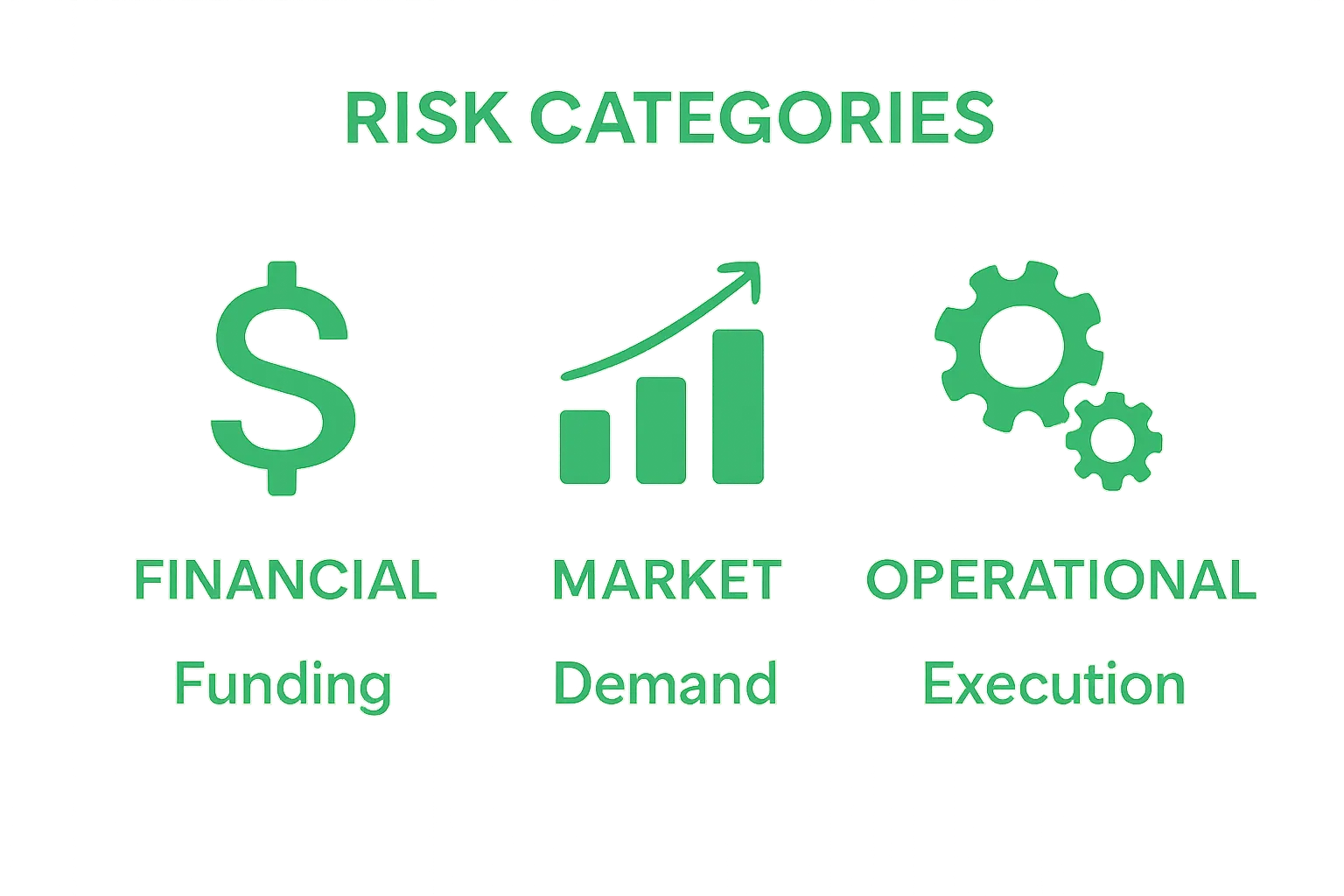
- Financial Risks: Cash flow limitations, funding challenges, unexpected expenses
- Market Risks: Competitive pressures, changing customer preferences, technological disruptions
- Operational Risks: Inefficient processes, talent acquisition struggles, scalability issues
Strategic Risk Management Framework
Effective risk management for startups involves a proactive, systematic approach that transforms potential threats into strategic opportunities. This framework requires continuous monitoring, scenario planning, and adaptive strategies. Successful entrepreneurs view risk not as a barrier but as a navigational tool for making informed business decisions.
The core components of a robust startup risk management strategy include:
- Comprehensive risk identification and assessment
- Developing mitigation strategies and contingency plans
- Implementing real-time monitoring and feedback mechanisms
- Maintaining financial flexibility and resource allocation
- Cultivating an organizational culture of risk awareness
By integrating risk management into their strategic planning, startups can build resilience, make data-driven decisions, and increase their probability of long-term success.
This table outlines the core components of an effective startup risk management strategy, helping founders understand the essential functions each part contributes to overall business resilience.
| Component | Purpose |
|---|---|
| Risk Identification and Assessment | Pinpointing and evaluating potential threats across all business areas |
| Mitigation Strategies and Contingency Plans | Creating proactive steps and backup solutions to address identified risks |
| Real-Time Monitoring and Feedback | Ongoing observation to quickly detect and respond to emerging issues |
| Financial Flexibility and Resource Allocation | Ensuring the ability to adjust spending and access resources as circumstances change |
| Culture of Risk Awareness | Building a mindset throughout the organization to recognize and manage risks proactively |
Identifying and Assessing Risks: Key Concepts for Entrepreneurs
Risk identification and assessment form the foundation of an effective entrepreneurial risk management strategy. By systematically understanding potential threats, entrepreneurs can develop proactive solutions that protect their business and create sustainable growth paths. Learn more about entrepreneurial strategies.
The Risk Identification Process
Successful risk identification requires a comprehensive and structured approach. According to McKinsey & Company, entrepreneurs should conduct thorough environmental scanning across internal and external dimensions.
Key domains for risk identification include:
- Internal Business Risks: Operational inefficiencies, talent limitations, technological constraints
- External Market Risks: Competitive landscape, regulatory changes, economic fluctuations
- Financial Risks: Funding gaps, cash flow volatility, investment uncertainties
Quantifying and Prioritizing Risks
Risk assessment goes beyond mere identification. Entrepreneurs must develop a systematic method for evaluating potential impact and probability. This involves creating a risk matrix that helps prioritize potential challenges based on their severity and likelihood of occurrence.
Prioritization criteria typically involve:
- Potential financial impact
- Probability of occurrence
- Speed of potential negative consequences
- Long-term strategic implications
- Resources required for mitigation
By adopting a structured risk assessment framework, entrepreneurs transform risk from an abstract concept into a manageable strategic tool.
 The goal is not to eliminate risks entirely but to understand them deeply and develop resilient response mechanisms that can adapt to changing business environments.
Understanding Risk Mitigation Strategies in Startup Contexts
Risk mitigation is a strategic approach where entrepreneurs develop targeted interventions to minimize potential negative outcomes and protect their business’s core objectives. Learn more about business resilience strategies for comprehensive understanding.
Core Risk Mitigation Principles
Effective risk mitigation requires a proactive and dynamic strategy that anticipates potential challenges before they become critical problems. According to Boston Consulting Group, successful startups develop multilayered approaches that balance prevention and adaptability.
Key principles of risk mitigation include:
- Anticipatory Planning: Developing scenarios and contingency frameworks
- Continuous Monitoring: Real-time tracking of potential risk indicators
- Flexible Response Mechanisms: Creating adaptable intervention strategies
- Resource Allocation: Maintaining financial buffers for unexpected challenges
Strategic Risk Reduction Techniques
Startup risk mitigation is not about eliminating risks entirely, but about building organizational resilience. Entrepreneurs can implement various techniques to reduce potential negative impacts:
- Diversifying revenue streams
- Maintaining lean operational structures
- Building robust financial reserves
- Developing strong network and partnership ecosystems
- Investing in scalable and adaptable technological infrastructure
By approaching risk as a strategic opportunity rather than a threat, entrepreneurs can transform potential challenges into competitive advantages. The most successful startups view risk management not as a defensive strategy, but as a dynamic tool for continuous innovation and growth.
The Role of Market Research in Risk Management for Startups
Market research is a critical risk management tool that provides entrepreneurs with deep insights into potential challenges and opportunities within their business ecosystem. Learn more about business opportunity analysis to enhance strategic planning.
Understanding Market Research Fundamentals
Comprehensive market research goes beyond simple data collection. According to Small Business Administration, it involves systematic investigation of target markets, customer behaviors, competitive landscapes, and emerging industry trends.
Key dimensions of market research in risk management include:
- Customer Insights: Understanding needs, preferences, and potential adoption barriers
- Competitive Landscape: Analyzing existing and potential market competitors
- Industry Trend Analysis: Identifying emerging technologies and market shifts
- Regulatory Environment: Mapping potential legal and compliance risks
Strategic Risk Reduction Through Market Intelligence
Market research transforms uncertainty into actionable strategic intelligence. By developing a nuanced understanding of market dynamics, startups can:
- Validate product market fit
- Anticipate potential market resistance
- Identify potential pivot opportunities
- Develop targeted marketing strategies
- Create more resilient business models
Effective market research enables entrepreneurs to make data-driven decisions, reducing the likelihood of costly mistakes and increasing the probability of sustainable business growth. The goal is not just to collect information, but to translate insights into proactive risk management strategies.
Real-World Examples: Successful Startup Risk Management Practices
Real-world case studies provide invaluable insights into effective risk management strategies that transform potential challenges into opportunities for growth. Explore reasons why businesses fail to help prevent similar risks and learn from others’ experiences.
Innovative Risk Mitigation Case Studies
Successful startups demonstrate that intelligent risk management is not about avoiding risks, but strategically navigating them. According to Harvard Business Review, companies that develop comprehensive risk assessment frameworks are 60% more likely to survive their first five years.
Notable examples of strategic risk management include:
- Dropbox: Implemented robust cybersecurity protocols before scaling
- Airbnb: Developed comprehensive insurance models to mitigate property damage risks
- Stripe: Created flexible payment infrastructure to manage financial transaction risks
- Slack: Continuously monitored and adapted to changing communication technology landscapes
Learning from Startup Risk Management Strategies
Successful risk management is an ongoing process of learning, adapting, and anticipating. Entrepreneurs can draw critical lessons from these case studies:
- Prioritize continuous learning and market intelligence
- Build flexible technological and operational infrastructures
- Develop multiple revenue streams to reduce financial vulnerability
- Create robust contingency and scenario planning mechanisms
- Maintain a culture of transparency and proactive problem solving
These real-world examples demonstrate that effective risk management is not about eliminating uncertainty, but about developing organizational resilience and adaptive capabilities that transform potential challenges into strategic advantages.
De-Risk Your Startup Journey with siift’s Intuitive Guidance
Feeling overwhelmed by all the financial, market, and operational risks described in this article? You are not alone. Many founders struggle with identifying and reducing threats that can slow down or even sink their business. Building resilience and having a real plan for risk is not easy, especially if you are just starting out. Imagine having a guide that helps you uncover hidden dangers, prioritize solutions, and turn uncertainty into a real advantage. That is what siift was built to do.
Meet siift, your founder’s compass designed for startup risk management. With siift, you get step-by-step support, personalized feedback, and clear next actions—so you can assess risks, respond faster, and build smarter. Ready to stop guessing and start making confident moves? Join siift now to access actionable insights and build your foundation for long-term success. You do not have to face risk alone. Unlock the advantage of tailored, AI-powered risk management today.
Frequently Asked Questions
What is risk management for startups?
Risk management for startups is a strategic process where entrepreneurs identify, assess, and mitigate potential challenges that could negatively impact their business success.
Why is risk management important for startups?
Risk management is crucial for startups as it helps them navigate uncertainties, make informed decisions, and increase their chances of long-term success by transforming potential threats into opportunities.
What are the key categories of risks that startups face?
Key risks for startups include financial risks (like cash flow issues), market risks (such as competitive pressures), and operational risks (including inefficiencies and talent acquisition challenges).
How can startups effectively mitigate risks?
Startups can mitigate risks by developing targeted interventions, maintaining financial flexibility, creating contingency plans, continuously monitoring risk indicators, and fostering a culture of risk awareness within the organization.