

TL;DR:
- An MVP is a structured experiment designed to validate critical business assumptions with minimal effort. It focuses on learning from real user behavior, not just shipping a basic or incomplete product. Carefully defining hypotheses and choosing appropriate low-fidelity approaches can significantly accelerate early validation and reduce wasted resources.
Most founders hear “MVP” and picture a half-finished product shipped with crossed fingers. That framing is wrong, and it’s expensive to get wrong. Understanding what is MVP at its core — a structured experiment designed to validate your riskiest business assumptions with the least possible effort — changes everything about how you build, test, and decide. This guide cuts through the noise and gives you a working, practical understanding of the Minimum Viable Product concept, from its origins to real-world application.
Table of Contents
- Key takeaways
- What is MVP, really?
- Common MVP misconceptions to avoid
- Types of MVPs: picking the right approach
- How to define and build your MVP
- When to stop iterating and scale
- My take on what MVP actually teaches you
- Start building smarter with Siift
- FAQ
Key takeaways
| Point | Details |
|---|---|
| MVP is a learning tool | The goal is validated learning about customers, not shipping a polished or reduced product. |
| Test one riskiest assumption | Design your MVP around a single falsifiable hypothesis to get clear, usable signals. |
| Low-fidelity can outperform | Landing pages and manual processes often validate faster and cheaper than built software. |
| Use 20–50 pilot users | A focused test group over roughly four weeks generates reliable behavioral data without overspending. |
| Know when to stop iterating | A 60 to 90 day retention window without prompting is your clearest green light to scale. |
What is MVP, really?
The term Minimum Viable Product was popularized by Eric Ries in The Lean Startup, but it’s been misquoted, misapplied, and misunderstood ever since. The formal definition is deceptively simple.
“The minimum viable product is that version of a new product which allows a team to collect the maximum amount of validated learning about customers with the least effort.” — Eric Ries
That word “learning” is the one most founders skip over. The MVP meaning is not “a cheap version of your product.” It’s a deliberate experiment inside the build-measure-learn loop. You form a hypothesis about user behavior or willingness to pay, you build the smallest possible test of that hypothesis, and then you measure what actually happens.
The Minimum Viable Product concept emerged from the Lean Startup movement as a direct counter to the “waterfall” approach to building software, where teams spent 12 to 18 months building something fully formed before getting a single piece of real user feedback. The result was predictably painful: products launched to silence, markets that had shifted, and capital burned with nothing to show. The MVP development process was designed as the antidote.
What does MVP stand for in practice? It stands for a time-limited, hypothesis-driven experiment with a binary outcome. Either you confirm that users behave the way you predicted, or you learn that they don’t and you adjust. MVP as a learning strategy means you are making decisions under uncertainty with real data, not gut feel or survey responses.
Common MVP misconceptions to avoid
Here is where founders lose months and money. The misconceptions around what an MVP is are almost as influential as the concept itself.
- An MVP is not a prototype. A prototype tests whether something can be built. An MVP tests whether it should be built, and whether users care enough to change their behavior because of it.
- An MVP is not a “version 1.0.” Treating your MVP as a product launch, with feature roadmaps and press releases, skips the entire learning phase. Without a falsifiable hypothesis, your MVP is just a product launch with a fancy label.
- An MVP is not an excuse to ship something broken. “Minimum” refers to scope, not quality. A buggy, confusing experience generates noise, not signal.
- An MVP is not permanent. The single most common failure mode is founders who fall in love with their MVP and keep tweaking it indefinitely, never committing to a real scaling decision.
The real danger is what you might call “hypothesis avoidance.” Founders who never explicitly define what they are testing have no way to know when they’ve passed or failed. They just keep building. That is not a lean startup approach. That is procrastination with a product attached.
Pro Tip: Before you write a single line of code or spend a dollar on design, write your hypothesis in one sentence: “We believe [user type] will [do this behavior] because [this reason]. We will know we are right when [measurable outcome].” If you can’t write that sentence, you’re not ready to build.
Types of MVPs: picking the right approach
Not all MVPs look the same, and choosing the wrong format wastes exactly the time you were trying to save. The spectrum runs from “almost no build” to “real working product with a manual backend.”
Low-fidelity MVPs are faster and cheaper for initial validation and include:
- Landing pages. A single-page site describing your product with a signup or purchase button. If nobody clicks, the market signal is immediate. Dropbox famously validated demand this way before building anything.
- Explainer videos. A short video showing what the product would do. You measure watch time, shares, and signups.
- Wizard of Oz MVPs. The user believes they are interacting with an automated system, but a human is manually fulfilling requests behind the scenes. It looks like software; it runs on people.
High-fidelity MVPs involve actual build work but remain tightly scoped:
| MVP type | Build cost | Speed to data | Best for |
|---|---|---|---|
| Landing page | Very low | Days | Demand validation |
| Explainer video | Low | Days to 1 week | Concept clarity testing |
| Wizard of Oz | Low to medium | 1 to 3 weeks | Service or workflow validation |
| Functional core feature | Medium to high | 4 to 8 weeks | Product-behavior validation |
| Concierge MVP | Low | 1 to 2 weeks | High-touch service validation |
The Wizard of Oz and Concierge approaches deserve special attention. Both use manual processes behind the scenes to fake automation, letting you validate the business model without writing a single algorithm. Zappos, early on, validated online shoe retail by manually buying shoes from local stores and shipping them to customers. No inventory. No warehouse. Just proof that people would buy shoes online.
How to define and build your MVP
This is where theory becomes practice. The MVP development process is not random. It follows a sequence that keeps you from building the wrong thing.
- Identify your riskiest assumption. Every startup has a list of assumptions baked into its business model. Your job is to find the one that, if wrong, kills everything. Usually it’s some version of: “Users will change their current behavior to use our solution.” That’s the one to test first.
- Write a testable hypothesis. As noted above, this is non-negotiable. A hypothesis has a user, a behavior, and a measurable outcome. No hypothesis, no experiment. Just noise.
- Select only the features that test that hypothesis. Use a prioritization framework like MoSCoW — Must Have vs. Could Have — to ruthlessly cut scope. If a feature doesn’t directly test your core assumption, it does not belong in the MVP.
- Set your test parameters. The sweet spot for an initial market test is 20 to 50 pilot users over about four weeks. This gives you enough behavioral data to be meaningful without spending a runway on recruiting.
- Measure behavior, not opinions. Surveys tell you what people say. Retention and usage data tell you what people do. Real user behavior data is far more reliable than what anyone tells you in an interview.
- Make a binary decision. Once your test window closes, answer the question: did users behave the way you predicted? Yes or no. Then pivot, persevere, or stop.
On the budget side, expect the MVP development phase to run roughly 6 to 10 weeks for a software-based product. That discipline upfront protects you from burning months of capital on something the market never wanted. A well-scoped MVP is not a cost. It’s insurance.
Pro Tip: Don’t recruit your friends as pilot users. They’ll tell you what you want to hear. Find people who currently have the problem you’re solving, ideally people who are already spending money trying to solve it some other way.
When to stop iterating and scale
There’s a peculiar trap that catches even experienced founders. The MVP becomes comfortable. You’re always “almost ready to scale.” If that sounds familiar, here’s your wake-up call.
The clearest signal that you’re ready to move beyond an MVP is unprompted user retention. Experienced founders observe user behavior over a 60 to 90 day window without nudging, prompting, or emailing users back. If users return on their own, that’s product-market fit forming. If they don’t, you have more learning to do.
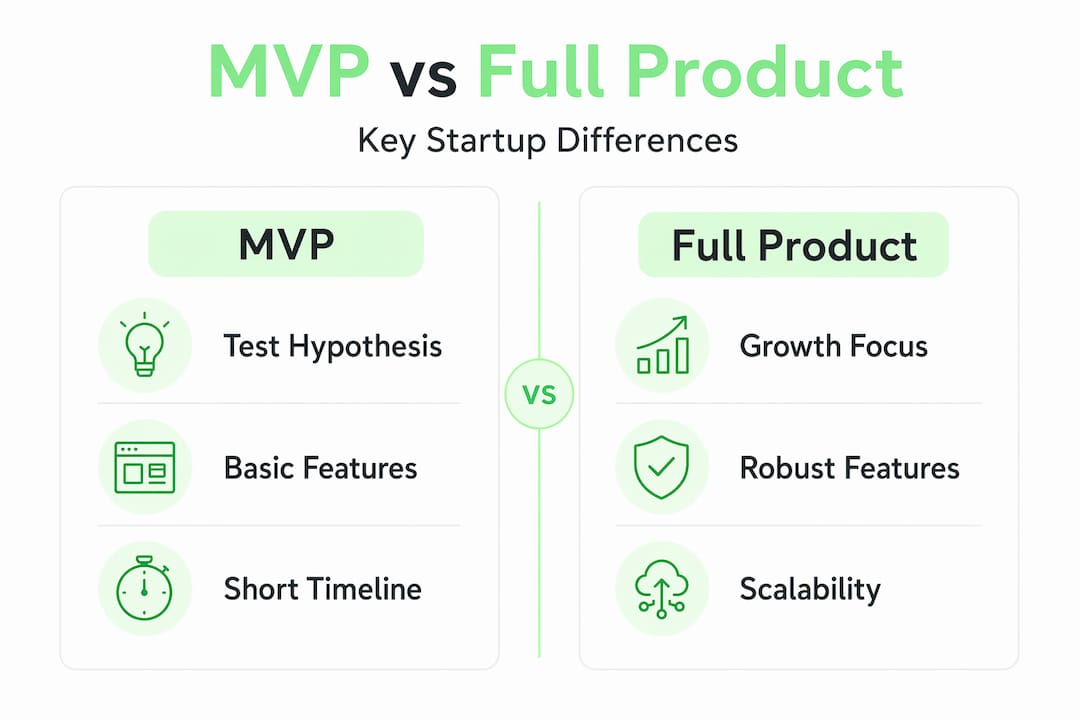
Here is how the MVP phase and the full product phase differ structurally:
| Dimension | MVP phase | Full product phase |
|---|---|---|
| Primary goal | Validated learning | Revenue and growth |
| Team focus | Hypothesis testing | Scaling operations |
| Codebase approach | Scrappy and fast | Maintainable and scalable |
| Success metric | Retention and engagement | Customer acquisition cost and LTV |
| Failure mode | Endless iteration | Premature scaling |
Many founders stay trapped in the MVP loop, adding features instead of committing to scale. The MVP is a time-limited experiment. Treat it like one. When validation is confirmed, your entire operational posture needs to shift: team structure, infrastructure, and priorities all change in the move from learning to scaling.
My take on what MVP actually teaches you
I’ve watched founders spend nine months building “the perfect MVP,” which is a contradiction so perfect it would be funny if it weren’t so costly. What I’ve learned, repeatedly, is that the hardest part of the MVP process isn’t the build. It’s the intellectual honesty it demands.
An MVP forces you to admit that you don’t know if your idea works. That’s uncomfortable. Most founders instinctively respond by building more, as if adding features is a form of certainty. It isn’t. In my experience, the founders who succeed fastest are the ones who validate startup ideas early with the minimum necessary evidence, then act decisively on what they find.
The MVP mental model is ultimately about making peace with uncertainty and choosing to learn your way through it rather than build your way past it. What I’ve found is that the most dangerous assumption isn’t the one you test. It’s the one you never thought to question. A well-designed MVP surfaces those hidden assumptions before they surface themselves at the worst possible moment.
Don’t wait for your MVP to be “good enough.” Define what good looks like in measurable terms, build toward that measurement, and commit to the answer it gives you.
— Samim
Start building smarter with Siift
Understanding MVP theory is step one. Applying it without a structured process is where most founders stall. Siift’s New Business OS guides you step by step through ideation, hypothesis formation, and market validation, so you’re not just building an MVP, you’re building the right one. Siift filters out the bias and blindspots that derail early-stage founders, and gives you a systematic path from raw idea to validated business strategy. If you’re serious about de-risking your next move, explore Siift’s founder platform and get the clarity your idea deserves. You can also go deeper with Siift’s resource on defining your MVP fast to put today’s learning straight into practice.
FAQ
What does MVP stand for in startups?
MVP stands for Minimum Viable Product. It refers to the smallest version of a product or experiment that allows a founder to test a specific business hypothesis and collect validated learning from real users.
How is an MVP different from a prototype?
A prototype tests whether something can be built technically. An MVP tests whether users actually want it and will change their behavior to use it, making it a market experiment rather than a technical demo.
How long does it take to build an MVP?
For most software-based startups, the MVP development phase typically takes 6 to 10 weeks. Low-fidelity approaches like landing pages or explainer videos can generate initial signals in days.
How do you know if your MVP succeeded?
Success is measured by whether users behave the way your hypothesis predicted. Unprompted user retention over 60 to 90 days is the strongest behavioral signal that you’ve found real product-market demand.
What are some examples of MVP done right?
Dropbox used an explainer video to validate demand before building its product. Zappos validated online shoe retail by manually fulfilling orders. Both examples of MVP relied on low-fidelity approaches to confirm real user behavior before committing to full builds.