TL;DR:
- A minimum viable product (MVP) is a focused, functional version of a product that tests market demand through real user feedback. Building an MVP helps reduce risk, save resources, and generate valuable insights for iterative development. Its primary purpose is to maximize validated learning, not to create a polished final product.
Most founders hear “minimum viable product” and picture something cobbled together, barely functional, and quietly embarrassing. That framing is exactly what kills promising startups before they ever gain traction. A minimum viable product, or MVP, is not a half-baked version of your idea. It is a precise, intentional tool for learning what your market actually wants before you sink months of savings into building the wrong thing. This guide breaks down the real definition, the strategy behind it, and how to build one that works.
Table of Contents
- What is a minimum viable product (MVP)?
- Why build a minimum viable product? Benefits and goals
- Minimum vs viable: striking the right balance
- How to develop your minimum viable product: practical steps and timelines
- Common pitfalls and pro tips for MVP success
- A fresh take: why MVPs are not just products but powerful learning milestones
- Launch your MVP confidently with siift.ai
- Frequently asked questions
Key Takeaways
| Point | Details |
|---|---|
| MVP defined | A minimum viable product is a simple, working version of a product with only essential features for early users to validate a business idea. |
| Balance scope | Focus on core features that deliver value and allow users to complete tasks, avoiding building too much or too little. |
| MVP purpose | MVPs reduce risk and cost by gathering real user feedback early, enabling smarter product development decisions. |
| Development timeline | Build your MVP within 2 to 6 weeks to maintain focus and speed in learning from the market. |
| MVP mindset | Treat your MVP as a learning milestone, not a polished product, and iterate rapidly based on validated insights. |
What is a minimum viable product (MVP)?
The cleanest way to understand an MVP is to treat it as a question, not a product. You are asking: does this core idea solve a real problem for real people? A minimum viable product is the simplest functional version of your product that lets you test that question with actual users.
As Atlassian defines it, an MVP is “the simplest version of a product that lets you validate ideas and gather real user feedback with minimal effort, typically by including only the core features needed by early adopters.” That word “simplest” carries a lot of weight. It does not mean sloppy. It means ruthlessly focused.
Here is where a lot of first-time founders go wrong: they confuse an MVP with a prototype or a proof-of-concept. These are fundamentally different things.
- Prototype: An early model, often not functional, used to test design and feasibility. Usually internal-facing.
- Proof-of-concept (PoC): A small experiment to verify a technical idea is possible. Again, rarely customer-facing.
- MVP: A real, working product released to actual users to test whether market demand exists.
According to ProductPlan, an MVP must have enough features to attract early adopters and be a working product that customers can use to complete a task. The emphasis on completing a task is critical. Your MVP is not a teaser or a landing page demo. It is a slice of real value, delivered end-to-end.
Think of it like this: if you are building a food delivery app, a prototype might be mockup screens in Figma. A PoC might be a backend test confirming GPS tracking works. But an MVP is an actual app where someone can order a meal, pay for it, and receive it. Narrow scope. Real transaction. Real feedback.
Now that you know what an MVP exactly is and isn’t, let’s break down why this approach matters for your startup journey.
Why build a minimum viable product? Benefits and goals
Launching without an MVP is like opening a restaurant without a single tasting session. You might spend six months perfecting the menu, only to discover nobody in your neighborhood wants that cuisine. The importance of minimum viable product thinking is that it forces you to confront reality early, when the cost of being wrong is still low.
The benefits are concrete:
- Reduces financial risk by validating before large investment
- Saves development time by building only what matters now
- Generates real feedback from actual users, not assumptions
- Reveals what customers actually want, not what you think they want
- Sets up the Build-Measure-Learn cycle that drives agile iteration
The MVP’s core purpose is to reduce risk and minimize resources before investing heavily, while learning what customers want so you can refine accordingly. In practice, this means you are not betting your entire runway on a guess. You are running a structured experiment.
Building an MVP allows you to validate an idea without building the entire product, minimizing time and resources on products that won’t succeed. This is not a minor efficiency gain. This is the difference between staying in the game or burning out.
“Research shows MVP testing reduces startup failure risk by 60-70% compared to skipping validation.”
That is a staggering number. And it makes intuitive sense. When you test early, you either confirm you are on the right track or you discover the pivot before it costs everything. Either outcome is valuable.
Understanding why MVPs are essential, let’s clarify what makes an MVP truly effective and what mistakes to avoid.
Minimum vs viable: striking the right balance
The word “minimum” seduces founders into thinking smaller is always better. But there is a floor. Drop below it and you are not building an MVP anymore. You are building something that cannot teach you anything useful.
The biggest mistake most teams make is actually building too much, not too little. Chasing polish and extra features delays the feedback that actually matters. But here is the equally dangerous flip side: stripping so much out that the product no longer works. As ProductPlan emphasizes, the “V” in MVP means the product must be viable enough for users to complete the task and have a quality experience.
And an MVP that doesn’t work isn’t minimum — it’s broken, and users won’t return.
So how do you find the balance? Use the MoSCoW framework to slice your feature list:
- Must have: Core features without which the product cannot function
- Should have: Important but not critical for launch
- Could have: Nice additions for a later version
- Won’t have: Explicitly out of scope for now
Only build the “Must haves.” Ruthlessly push everything else to later. Setting a strict timeline of 2 to 6 weeks also forces this discipline. Deadlines are your best protection against scope creep.
Pro Tip: Write down your single riskiest assumption before you build anything. Your entire MVP should exist to test that one assumption. If a feature does not help answer it, cut it.
With a clearer view on balanced scope, let’s dive into practical steps and timelines to develop your MVP efficiently.
How to develop your minimum viable product: practical steps and timelines
Here is a step-by-step process you can follow whether you are a solo side hustler or a two-person founding team.
- Define your riskiest assumption. What is the one thing that, if wrong, kills your business? Start there.
- List every feature you think you need. Get it all out of your head and onto a page.
- Apply MoSCoW prioritization. Use ConsoleOps’ MVP guide to define the scope using must-have features needed for core value. Cut everything else.
- Set a timebox of 2 to 6 weeks. A good MVP takes 2 to 6 weeks. If it takes longer than 8 weeks, the scope is too large.
- Build the core workflow end-to-end. Make sure users can complete the key task from start to finish.
- Add analytics from day one. MVPs should include analytics and measurement to enable rapid validated learning. Without data, you are guessing.
- Release to real users. Not friends. Not internal testers. Real early adopters.
- Collect, measure, and iterate. Use what you learn to decide: build more, change direction, or stop.
For no-code or low-code founders, tools like Vybe can compress development timelines dramatically, letting you build functional internal apps without a full engineering team. Pairing that with AI tools for prototyping can cut your MVP cycle down to weeks rather than months.
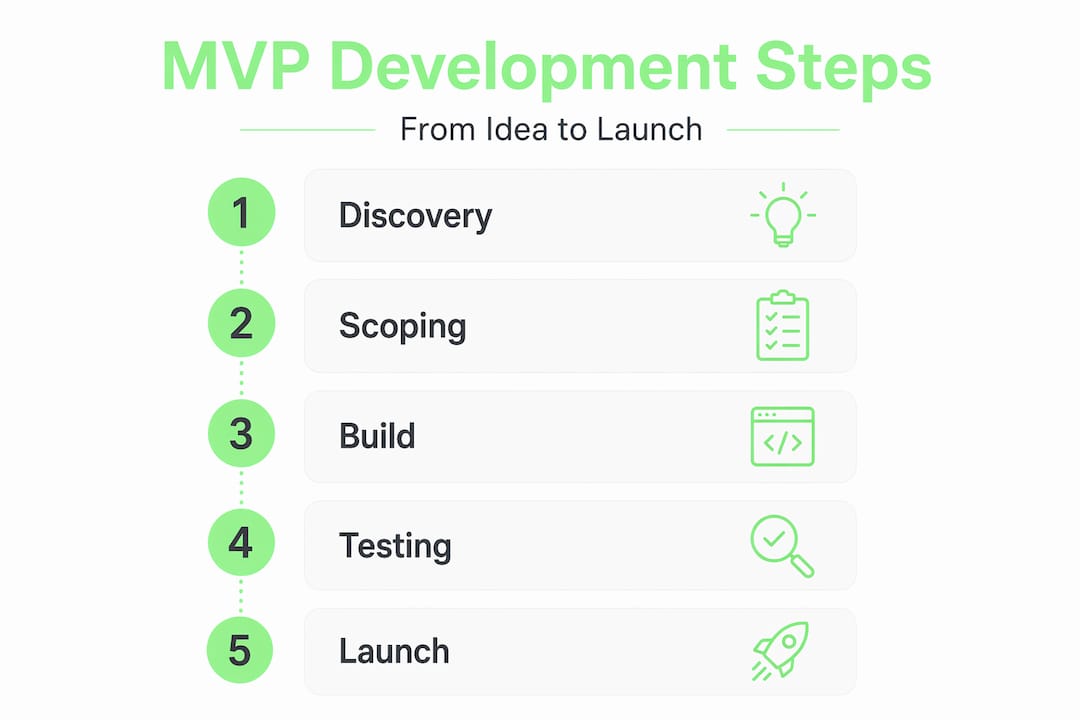
| Phase | Key action | Timeframe |
|---|---|---|
| Discovery | Define riskiest assumption | Days 1-3 |
| Scoping | MoSCoW prioritization | Days 3-5 |
| Build | Core workflow only | Weeks 1-5 |
| Launch | Release to early adopters | Week 5-6 |
| Learn | Collect data, measure, iterate | Ongoing |
Pro Tip: Resist the urge to announce your MVP broadly at first. Release to a small, targeted group of early adopters. Their feedback is far more valuable than vanity metrics from a big launch that tells you nothing specific.
Knowing how to build your MVP efficiently, let’s look at common pitfalls and expert tips to maximize your chances of startup success.
Common pitfalls and pro tips for MVP success
Even founders who understand MVP theory stumble in practice. Here is what tends to go wrong and how to sidestep it.
- Confusing prototypes with MVPs. A common failure is treating a prototype as an MVP. Prototypes test design. MVPs test market demand. If real customers cannot use it to complete a real task, it is not an MVP.
- Building too many features. Most teams build too much, which delays learning and burns runway. Every feature you add is a hypothesis you have not tested yet.
- Skipping analytics. Without tracking user behavior, you cannot know if your assumptions were right. You are flying blind.
- Incomplete core workflow. An MVP must work end-to-end for its core function or it generates misleading feedback. A checkout flow that breaks at payment tells you nothing useful.
- Stealth overbuilding. This is the sneaky version of the problem. You agree on a lean scope, then gradually add “just one more thing.” Use strict timeboxes to prevent it.
“Startups that stay narrow early move faster. The learning you get from 50 highly engaged users beats vague data from 5,000 passive ones every time.”
Knowing these startup blindspots to avoid changes how you approach every decision from day one. The founders who succeed with MVPs are the ones who stay genuinely curious about what users do, not just what they say.
Pro Tip: After your MVP launch, schedule a “kill or continue” decision meeting at the end of week two. Force yourself to answer: are users completing the core task? Are they coming back? Use data, not hope, to decide next steps.
With these pitfalls and tips in mind, let’s step back for a unique perspective that reframes how you should think about MVPs in your entrepreneurship journey.
A fresh take: why MVPs are not just products but powerful learning milestones
Here is something most MVP guides will not tell you: the product is almost beside the point.
The real value of building an MVP is not what you ship. It is what you discover. Think of it as the ignition for your Build-Measure-Learn cycle, not the destination. The MVP’s purpose is to maximize validated learning speed, not to release a finished “version 1.0.” That reframe changes everything about how you approach the process.
Most founders get emotionally attached to their features. They fall in love with the product vision and start treating the MVP as a statement of identity. It is not. It is a question. And questions should be easy to revise when the answer surprises you.
We have seen founders paralyzed by the fear that their MVP will look unsophisticated. But sophistication is irrelevant at this stage. What matters is a meaningful signal from real users. And the only way to get that signal is to ship something real, fast, and focused.
The fastest path to the validation of your business idea is to accept that your MVP will change. Every assumption you test either sharpens your direction or reveals a necessary pivot. Either result is a win, because it replaces guesswork with evidence.
Building less and moving faster is not a compromise. It is your competitive advantage, especially as a solo founder or side hustler without deep pockets. Think of the MVP as a minimal yet viable slice of real value delivered to real people. That slice, understood correctly, is the most powerful tool you have.
Launch your MVP confidently with siift.ai
Building an MVP is equal parts discipline and strategy, and it is much harder to get right alone. That is exactly why we built siift.ai, an AI-powered platform designed specifically for founders, side hustlers, and first-time entrepreneurs who want a clear, step-by-step path from idea to launch. siift guides you through ideation, assumption mapping, MVP scoping, and go-to-market planning in one place, cutting through the noise that usually slows founders down. If you want to stop guessing and start learning faster, explore how siift helps you validate ideas with less risk and more confidence. Your MVP journey starts here.
Frequently asked questions
What makes an MVP different from a prototype?
An MVP is a functional product released to real users to test market demand and gather feedback, while a prototype is usually an internal or early-stage model used to test feasibility and design. As Atlassian notes, MVPs are tested with real users, whereas proofs-of-concept are usually internal and not customer-facing.
How long should it take to build a minimum viable product?
A focused MVP typically takes between 2 and 6 weeks to develop. If it takes longer than 8 weeks, the scope is almost certainly too large and needs to be cut back.
Can an MVP be low quality or incomplete?
No. An MVP must be viable, meaning it fully works for its core function and delivers a usable experience. An MVP that doesn’t work is not minimal, it is broken, and users will not give it a second chance.
What is the biggest mistake founders make when building an MVP?
The biggest mistake is building too much instead of focusing on the smallest feature set that can generate meaningful learning from real users. Scope creep kills MVPs faster than anything else.
Why is validated learning important in MVP development?
Validated learning confirms whether your product assumptions are correct by collecting real user behavior data, not opinions. The MVP allows a team to collect the maximum amount of validated learning about customers with the least effort, which directly reduces your risk of building the wrong product.