
Starting a new business idea often feels daunting when you have no entrepreneurial background and a full-time job. Many Millennial employees and recent graduates want faster ways to test—and validate—their concepts before investing too much time or money. By combining AI-driven customer segmentation with targeted rapid experimentation, you can accurately identify your audience, clarify their needs, and gather actionable feedback. This guide reveals practical methods to turn vague ideas into genuine opportunities with measurable results.
Table of Contents
- Step 1: Define Your Core Problem And Idea Hypothesis
- Step 2: Leverage AI To Pinpoint Target Customer Segments
- Step 3: Craft And Deploy Rapid Experiments For Feedback
- Step 4: Analyze Results And Refine Your Business Model
- Step 5: Verify Demand With Real-World Customer Validation
Quick Summary
| Key Point | Explanation |
|---|---|
| 1. Clearly Define Your Core Problem | Identify a specific issue your audience faces, ensuring it is meaningful and solvable to guide your business opportunity effectively. |
| 2. Utilize AI for Customer Segmentation | Apply AI tools to analyze customer behavior, demographics, and purchasing patterns for precise market insights and targeted marketing strategies. |
| 3. Conduct Rapid Experiments for Feedback | Implement quick, low-fidelity tests of your hypothesis to gather real user reactions, shaping your approach based on documented insights. |
| 4. Analyze Results and Refine Model | Use key performance indicators to evaluate experiment outcomes, making data-informed adjustments to your business model as necessary. |
| 5. Validate Demand Through Customer Interaction | Engage with potential customers using structured interviews and pre-order tests to measure genuine interest and willingness to pay for your solution. |
Step 1: Define your core problem and idea hypothesis
Defining your core problem and hypothesis represents the critical foundation of transforming a vague concept into a solid business opportunity. This initial step helps you understand precisely what challenge you are solving and for whom.
Start by identifying the specific problem your target audience experiences. Use methods like targeted research problem analysis to uncover genuine pain points. Observe real customer interactions, conduct interviews, and analyze existing solutions. Your goal is to pinpoint a concrete problem that is specific enough to solve but broad enough to matter.
When articulating your hypothesis, be precise about who experiences the problem and why current solutions fall short. A strong hypothesis connects three key elements: the specific customer segment, their unmet need, and your proposed unique solution. For example: “Working parents between 30-45 struggle to find reliable childcare that offers flexible scheduling and affordable rates. Our app will match parents with vetted caregivers using real-time availability and transparent pricing.”
Pro tip: Validate your problem hypothesis by speaking directly with at least 10 potential customers and documenting their unfiltered reactions and feedback.
Step 2: Leverage AI to pinpoint target customer segments
AI tools offer powerful capabilities for precisely identifying and understanding your potential customer base. By using advanced data analysis techniques, you can transform vague market assumptions into razor-sharp insights about who might actually want your product.
Utilize AI technologies to perform advanced customer segmentation techniques, which analyze behavioral patterns, demographic data, and purchase histories. Modern machine learning algorithms can cluster potential customers into distinct groups based on shared characteristics. For instance, you could discover segments like “tech-savvy professionals aged 28-35” or “budget-conscious suburban parents”. These granular insights help you craft targeted marketing strategies and product positioning that resonate with specific audience subgroups.
When applying AI segmentation, focus on combining multiple data dimensions. Clustering algorithms with RFM analysis can reveal nuanced customer profiles by examining recency, frequency, and monetary value of interactions. This approach goes beyond basic demographics, uncovering deeper motivational patterns that traditional market research might miss. By leveraging these intelligent tools, you can develop a more sophisticated understanding of your potential customers before investing significant resources.
Pro tip: Experiment with multiple AI segmentation tools and cross-validate their insights to ensure you’re not relying on a single potentially biased data source.
Here’s a summary of how AI techniques enhance customer segmentation:
| AI Technique | What It Does | Business Impact |
|---|---|---|
| Clustering Algorithms | Groups customers by shared traits | Enables precise targeting of marketing |
| RFM Analysis | Segments by recency, frequency, monetary value | Identifies most valuable customer groups |
| Demographic Profiling | Analyzes age, location, and other attributes | Supports tailored product positioning |
| Behavioral Analytics | Tracks actions and preferences | Reveals hidden preferences and opportunities |
Step 3: Craft and deploy rapid experiments for feedback
Rapid experimentation is your secret weapon for transforming abstract business ideas into validated concepts with real market potential. This critical step allows you to test your assumptions quickly and efficiently before investing significant time and resources.

Rapid experimentation techniques enable you to create low-fidelity prototypes that gather authentic user feedback. Start by breaking down your core hypothesis into testable components. Design lightweight experiments that can be executed within days or weeks, such as landing page mock-ups, simple clickable prototypes, or targeted social media surveys. The goal is to engage potential customers directly and capture their unfiltered reactions to your proposed solution.
Adopt a systematic approach to your experiments by clearly defining your hypothesis, selecting appropriate measurement metrics, and establishing precise success criteria. Systematic experimentation processes help you minimize risk and maximize learning. Document every insight rigorously, paying special attention to unexpected responses that might reveal hidden market opportunities or critical product improvements. Remember that negative feedback is just as valuable as positive validation it provides clear signals about what needs adjustment.
Pro tip: Create a standardized experiment tracking template that captures hypotheses, methods, results, and key learnings to build institutional knowledge across your validation journey.
Step 4: Analyze results and refine your business model
Once you have gathered experimental data, the critical task of transforming insights into actionable business strategy begins. This stage is about interpreting your findings systematically and making intelligent adjustments to your initial concept.
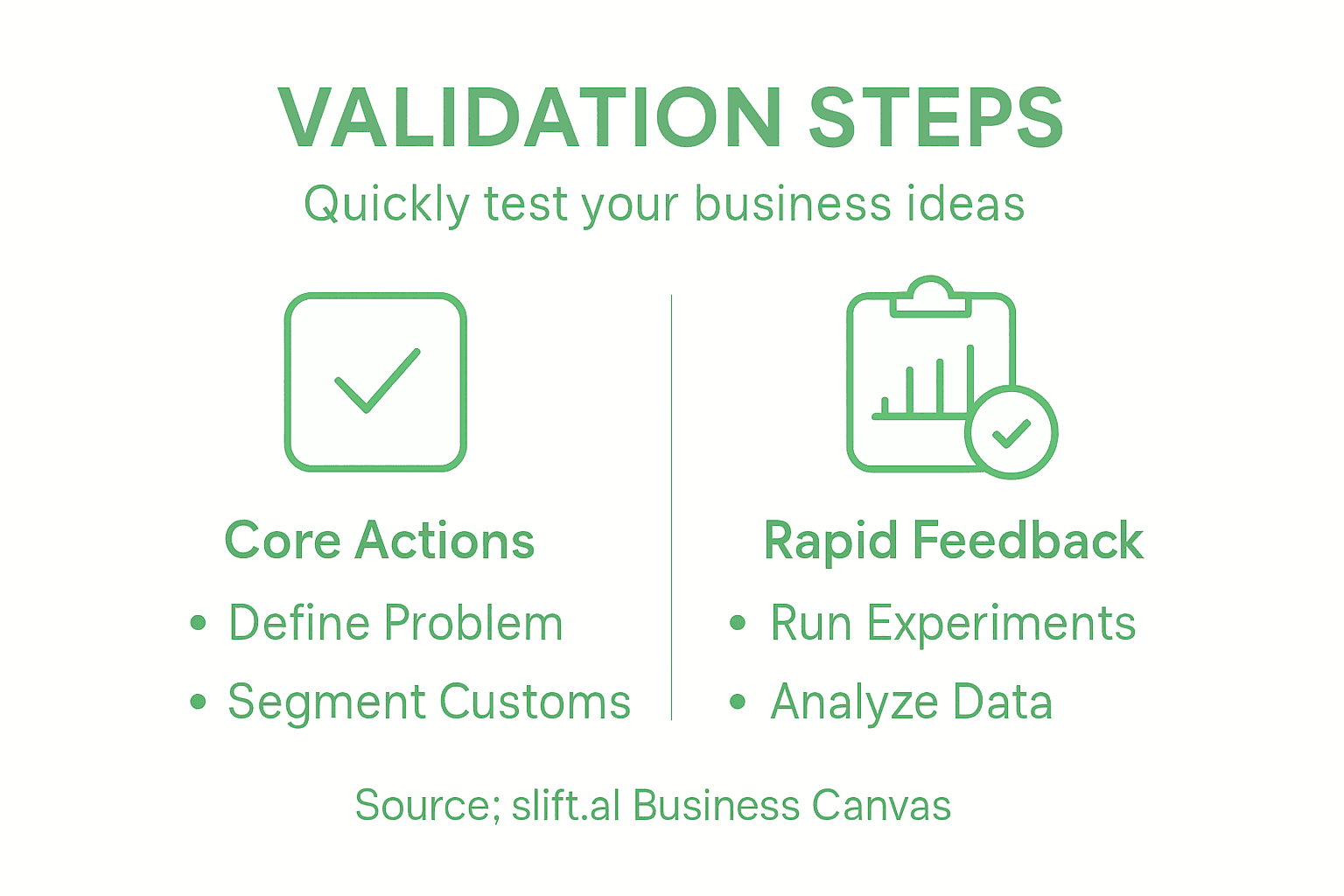
Utilize key performance indicators to objectively evaluate your experiment results. These metrics provide a quantitative lens for understanding how your business idea performs across different dimensions. Look beyond surface level numbers and dig into patterns that reveal deeper market insights. Are your customer acquisition costs aligning with projected lifetime value? Do user engagement metrics suggest genuine interest or merely superficial curiosity?
Employ strategic assessment methodologies to comprehensively review your business model. This might involve conducting a SWOT analysis to identify strengths, weaknesses, opportunities, and threats. Pay special attention to unexpected feedback or counterintuitive results that challenge your original assumptions. These moments often contain the most valuable insights for pivoting or refining your approach. Be prepared to make surgical adjustments to your value proposition, target customer segment, or revenue model based on empirical evidence.
Pro tip: Create a decision matrix that weights different feedback signals, helping you prioritize which insights warrant immediate action versus those that can be addressed in later iterations.
Here’s a decision guide for refining your business model after experiments:
| Insight Type | Adjustment Area | Possible Strategic Action |
|---|---|---|
| Positive Feedback | Value Proposition | Scale successful features |
| Negative Feedback | Target Market Segment | Pivot audience focus |
| Low Engagement | Product Offering | Revise main solution design |
| High Acquisition Cost | Revenue Model | Explore alternative pricing |
Step 5: Verify demand with real-world customer validation
Customer validation transforms your business hypothesis from theoretical speculation into a concrete understanding of market potential. This critical stage determines whether people will actually pay for your solution or simply nod politely at your pitch.
Leverage customer demand validation techniques that go beyond surface level conversations. Start by conducting structured interviews with potential customers, focusing on uncovering genuine pain points rather than confirming your preexisting beliefs. Observe how customers currently solve the problem you are targeting. Are they cobbling together makeshift solutions? Paying for alternatives that do not fully address their needs? These insights reveal the true market opportunity.
Design experiments that test customers willingness to commit real resources. This could mean creating a landing page with pre-order options, developing a minimal prototype, or offering a concierge service that manually delivers your proposed solution. The goal is not just collecting feedback but measuring actual intent through tangible actions. Look for signals like customers sharing your concept, requesting more information, or ideally putting down a deposit. Quantitative metrics matter more than qualitative enthusiasm.
Pro tip: Always record and categorize customer interview insights systematically, creating a living document that tracks evolving market understanding beyond individual interactions.
Accelerate Your Business Idea Validation with siift.ai
The article highlights the critical challenge of transforming broad concepts into validated business opportunities by clearly defining the core problem, leveraging AI for customer segmentation, and running rapid experiments. If you are struggling with uncertainty, bias, or blindspots while validating your startup idea or want to avoid costly missteps, then the pain points of unclear customer targeting and unreliable validation resonate deeply.
siift.ai Intelligent Business Canvas directly addresses these challenges by guiding you systematically through ideation, validation, and go-to-market strategies with personalized AI-driven feedback. Its intuitive platform helps define your hypothesis, prioritize actions based on real data, and turn assumptions into measurable progress in a fraction of the time. This is your chance to confidently move from guesswork to growth without gatekeepers or pressure. Explore how to de-risk your founder’s journey with siift.ai and discover your next steps for actionable validation insights today.
Ready to take control of your business idea validation process and unlock targeted insights using AI-powered tools Try the Intelligent Business Canvas for a hands-on, step-by-step experience. See how rapid experimentation and customer segmentation become simpler and more precise so you can start building with certainty now.
Frequently Asked Questions
How can I effectively define my core problem for my business idea?
To effectively define your core problem, start by researching your target audience’s genuine pain points through interviews and observing customer interactions. Document their needs and clearly articulate your hypothesis that connects the specific customer segment, their unmet needs, and your unique solution.
What role does AI play in identifying my target customer segments?
AI can significantly enhance your understanding of potential customer segments by analyzing behavioral patterns, demographic data, and purchase histories. Utilize AI segmentation tools to group customers by shared traits, enabling you to craft targeted marketing strategies that resonate with specific audience subgroups.
What are some rapid experimentation techniques I can use to validate my business idea?
Rapid experimentation techniques include creating low-fidelity prototypes, such as landing page mock-ups or simple clickable prototypes, to gather authentic user feedback. Implement these experiments within days or weeks, and track customer reactions to make informed decisions about your business concept.
How do I analyze results to refine my business model after experiments?
To refine your business model, analyze your experimental data using key performance indicators to evaluate how your idea performs across different dimensions. Look for patterns that inform your adjustments, such as customer acquisition costs or engagement metrics, and adjust your value proposition accordingly.
What methods can I use to verify demand for my business idea with customers?
To verify demand, conduct structured interviews to uncover genuine pain points and measure customers’ willingness to commit resources through actions like pre-orders or requests for more information. Focus on tangible actions as indicators of intent, rather than just qualitative enthusiasm from customers.
How many potential customers should I speak with to validate my assumptions effectively?
Aim to speak with at least 10 potential customers to gather unfiltered feedback on your problem hypothesis and proposed solution. This will help you capture a diverse range of insights and test your assumptions effectively, contributing to a more refined business concept.