
Most american entrepreneurs lose money by pursuing ideas that never solve real problems for customers. For first-time founders and recent graduates, understanding the difference between a dream and a viable business could mean the difference between lasting success and rapid failure. This guide reveals practical, step-by-step strategies that help you systematically test and validate your business concepts so you can avoid costly mistakes and confidently develop ideas with real market potential.
Table of Contents
Key Takeaways
Point | Details |
|---|---|
Importance of Validation | Business idea validation is a critical process that helps entrepreneurs avoid wasting resources on unproven concepts. |
Methods of Validation | Combining customer interviews, prototype testing, and competitive analysis creates a robust validation strategy. |
Consequences of Skipping Validation | Failing to validate can lead to significant financial loss and market rejection of products. |
Continuous Validation | Validation should be viewed as an ongoing process rather than a one-time task to ensure market fit and adaptability. |
What Is a Business Idea Validation Framework?
A business idea validation framework is a structured approach that helps founders evaluate customer demand, test assumptions, and reduce launch risk before investing significant resources.. Systematically testing your business concept now represents a critical filter that prevents founders from wasting resources on ideas with minimal market potential.
Today’s validation process goes far beyond simple market research. It involves a comprehensive approach that combines quantitative data analysis, user feedback, prototype testing, and economic feasibility assessments. Entrepreneurs must now demonstrate not just that an idea exists, but that it addresses a painful problem for a specific target audience who will actively pay for a solution. This means conducting deep customer interviews, building minimum viable products (MVPs), and rigorously validating both the technical feasibility and economic sustainability of the proposed business model.
The modern validation framework requires founders to answer three fundamental questions: First, does the idea solve a genuine, unmet need? Second, is there sufficient market demand to support a viable business? And third, can the solution be delivered profitably and differentiated from existing alternatives? Validating early protects entrepreneurs from investing resources into concepts with limited market traction, allowing them to pivot, refine, or abandon ideas before significant capital expenditure.
Pro tip: Allocate at least 20% of your initial planning time to systematic idea validation, treating it as an investment in reducing future business risks rather than a bureaucratic hurdle.
Major Validation Methods Explained
Entrepreneurs have multiple strategic approaches to validate their business ideas, each offering unique insights into market potential and customer demand. Several proven methods exist to systematically test startup concepts, ranging from traditional market research techniques to modern data-driven validation strategies. These methods are not mutually exclusive but work best when combined to create a comprehensive validation framework that reduces investment risks and increases the likelihood of market success.
The most effective validation methods typically include customer interviews, which provide direct qualitative feedback about market needs; prototype testing, which allows founders to gather real user experience data; and competitive analysis, which helps understand existing market solutions. Additional techniques like A/B testing, landing page experiments, and minimum viable product (MVP) development can provide quantitative evidence of market interest. Founders should approach these methods with a structured yet flexible mindset, recognizing that validation is an iterative process of learning and refinement.
Each validation method offers distinct advantages: customer interviews reveal deep insights into user pain points, prototype testing demonstrates technical feasibility, and competitive analysis helps position the product uniquely. Advanced founders often combine multiple approaches, creating a multi-layered validation strategy that examines the business concept from technical, market, and economic perspectives. This holistic approach minimizes blind spots and provides a more robust assessment of the idea’s potential success.
Pro tip: Create a systematic validation scorecard that tracks key metrics across different validation methods, helping you objectively evaluate your business idea’s potential and make data-driven decisions.
Here’s a comparison of key business idea validation methods and what each reveals:
Validation Method | Business Insight Uncovered | Typical Outcome |
|---|---|---|
Customer Interviews | Understand real needs and behaviors | Clarity on pain points |
Prototype Testing | Demonstrate product feasibility | Usability and feature feedback |
Competitive Analysis | Identify gaps in current solutions | Unique positioning strategies |
A/B Testing | Test market response to variations | Data on effective messaging |
Landing Page Test | Measure genuine customer interest | Lead generation metrics |
MVP Development | Assess willingness to pay | Early sales or strong signals |
Key Steps: From Problem to Payment
The business idea validation process typically includes identifying a problem, researching demand, interviewing customers, testing a solution, and confirming willingness to pay. Transforming a business idea from a conceptual spark to a revenue-generating solution requires a systematic approach that methodically validates each critical aspect of market potential. The validation process begins with identifying a genuine, unmet market need, moving through a strategic sequence of steps designed to minimize risk and maximize the probability of successful market entry. Entrepreneurs must approach this journey not as a linear progression, but as an iterative exploration of customer problems and potential solutions.

The key steps in this validation journey typically involve a structured progression: First, deeply understand the specific problem you aim to solve by conducting extensive customer research and interviews. Second, validate the market opportunity by assessing the scale of the problem, potential customer segments, and competitive landscape. Third, develop a minimum viable product (MVP) that demonstrates your proposed solution’s core value proposition. This MVP serves as a critical testing mechanism, allowing founders to gather real-world feedback, validate technical feasibility, and understand customers’ genuine willingness to pay for the solution.
Successful validation requires more than just proving a concept exists. Founders must rigorously test multiple hypotheses about their business model, customer behavior, and economic viability. This means not only confirming that customers recognize the problem but also demonstrating that they will invest financial resources to solve it. Advanced validation includes detailed cost analysis, potential revenue modeling, and understanding the scalability of the proposed solution. The ultimate goal is ensuring repeatable sales readiness and building a sustainable business framework that can withstand market complexities and competitive pressures.
Pro tip: Create a validation scorecard with weighted criteria for problem significance, market size, customer willingness to pay, and solution differentiation to objectively track your idea’s potential.
Assessing Real Market Demand
Understanding genuine market demand goes far beyond surface-level assumptions or wishful thinking. Conducting comprehensive feasibility analyses requires systematic exploration of customer needs, preferences, and emerging market dynamics, especially in rapidly evolving economic landscapes. Entrepreneurs must develop a nuanced approach that combines quantitative research, qualitative insights, and adaptive strategies to accurately assess whether a business concept can generate sustainable customer interest.
Successful market demand assessment involves multiple strategic components. Data collection methods should include direct customer interviews, comprehensive market research, competitive landscape analysis, and statistical trend evaluation. Founders need to move beyond theoretical market size calculations and focus on understanding the specific pain points that drive customer behavior. This means creating detailed customer personas, mapping their journey, identifying unmet needs, and determining the economic value of potential solutions. Quantitative techniques like surveying, conjoint analysis, and statistical modeling can provide rigorous evidence of market receptiveness.
The most effective demand assessment strategies incorporate both macro and micro perspectives, blending broad market trends with granular customer insights. Advanced entrepreneurs utilize techniques like price sensitivity mapping, willingness-to-pay studies, and predictive demand modeling to create a multidimensional view of market potential. These approaches help identify not just whether a market exists, but the precise economic conditions, customer segments, and value propositions that will drive actual purchasing decisions. By combining empirical data with strategic interpretation, founders can develop a robust understanding of market demand that goes beyond conventional market research.
Pro tip: Create a demand validation matrix that scores potential market opportunities across multiple dimensions, including problem severity, target audience size, competitive landscape, and potential revenue streams.
Risks of Skipping Validation and Common Mistakes
Skipping business idea validation transforms entrepreneurship from a strategic endeavor into a high-stakes gambling exercise. The early startup validation process serves as a critical risk management framework that separates calculated innovation from potentially catastrophic financial mistakes. Most entrepreneurs underestimate the profound consequences of launching without thoroughly understanding market dynamics, customer needs, and competitive landscapes.
The most significant risks of bypassing validation include wasting substantial financial resources, creating products nobody wants, and experiencing complete market rejection. Common mistakes founders repeatedly make involve assuming market demand instead of proving it, neglecting comprehensive customer research, building complex solutions before validating core value propositions, and failing to distinguish between personal enthusiasm and genuine market opportunity. These errors can lead to devastating outcomes like running out of capital, experiencing zero customer traction, and ultimately business failure. Successful entrepreneurs recognize that validation is not a bureaucratic hurdle but a strategic filtering mechanism that systematically reduces investment risks.
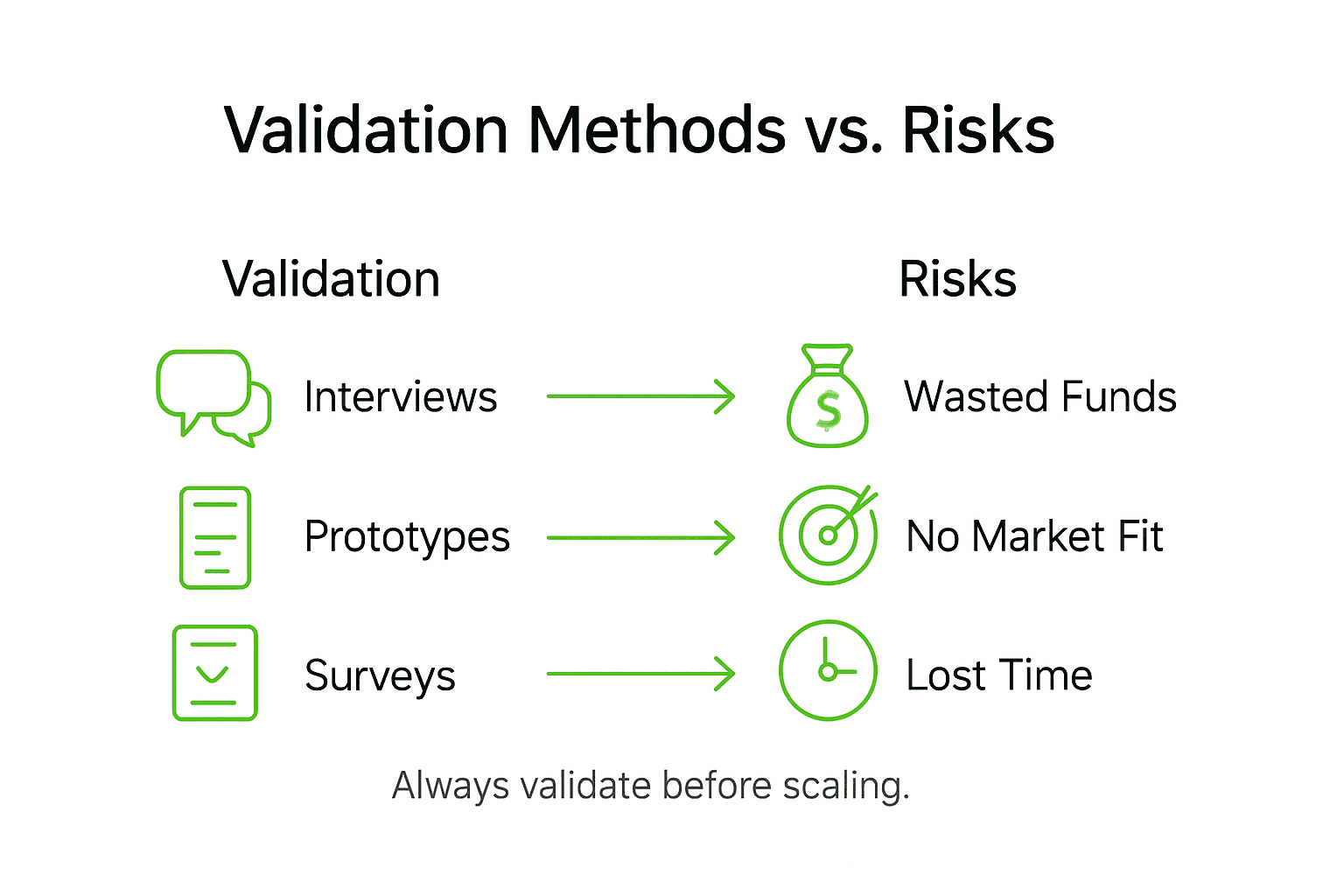
Entrepreneurial mythology often romanticizes the maverick founder who intuitively understands market needs, but reality demonstrates a far more nuanced path. Rigorous validation requires systematic testing of multiple hypotheses about customer behavior, willingness to pay, and solution effectiveness. This means conducting structured customer interviews, building minimum viable products, running controlled experiments, and continuously iterating based on empirical evidence. Advanced founders view validation not as a one-time checkpoint but as an ongoing process of learning, adapting, and refining their understanding of market dynamics.
The following table summarizes typical consequences of skipping business idea validation:
Risk Type | Description | Possible Result |
|---|---|---|
Financial Loss | Large spend before market fit | Depleted startup capital |
Missed Demand Signals | Ignoring customer needs | Product-market misalignment |
Competitive Blind Spots | Lack of awareness about competitors | Duplicate or obsolete offering |
Unreliable Revenue | No proof of customer willingness | Poor initial sales, fast decline |
Pro tip: Allocate at least 20% of your initial startup budget and timeline specifically for comprehensive validation activities, treating this investment as a critical risk reduction strategy rather than an optional expense.
De-Risk Your Business Launch with Intelligent Validation
The article highlights the crucial challenge many founders face: validating business ideas systematically to avoid costly mistakes and ensure there is real, paying customer demand. If you struggle with understanding your customer’s pain points, testing your MVP, or confidently assessing market opportunity, you are not alone. These common hurdles can turn a promising idea into wasted time and lost capital.
siift.ai Intelligent Business Canvas is designed specifically to tackle these pain points head-on. This intuitive AI-powered platform walks you through the full journey from ideation to validation and go-to-market with personalized feedback, clear insights, and prioritized next steps. By eliminating biases and blind spots, it empowers founders to build a data-driven, risk-managed business model that earns customer trust and investment.
Ready to move beyond assumptions and guesswork? Explore how you can systematically validate your startup idea with siift.ai now. Discover step-by-step guidance and real-time strategic insights tailored for founders who want to de-risk their launch and accelerate success. Take control of your entrepreneur journey today with the Intelligent Business Canvas and turn your vision into a validated, thriving business.
Frequently Asked Questions
What is a business idea validation framework?
A business idea validation framework is a step-by-step process used to assess customer demand, validate assumptions, and determine whether a business idea is viable before launch.
What does business idea validation entail?
Business idea validation involves systematically testing and verifying whether a potential business concept can solve real market problems and generate sustainable revenue. It includes customer interviews, prototype testing, and economic feasibility assessments.
Why is validation essential for new business ideas?
Validation is critical as it helps entrepreneurs minimize risks and ensure that their business idea meets actual market needs. It prevents wasting resources on concepts with limited demand and allows for necessary pivots before significant investments are made.
What are effective methods for validating a business idea?
Effective methods for validation include customer interviews to gather qualitative insights, prototype testing for user feedback, competitive analysis to understand market position, and quantitative techniques like A/B testing and developing a minimum viable product (MVP).
How do I assess real market demand for my business idea?
To assess market demand, conduct thorough customer research, analyze market trends, and develop detailed customer personas. Use techniques like surveys and price sensitivity studies to evaluate specific pain points and determine customer willingness to pay.