

Most american startups fail before their ideas reach the market, often because they skip a crucial step. Early startup validation offers a way to test business ideas without gambling away time or resources. This process helps entrepreneurs understand what real customers actually want before making expensive commitments. By focusing on proven validation methods and tracking meaningful data, founders can avoid the common traps that lead so many american businesses to struggle from the start.
Table of Contents
- Defining Early Startup Validation Basics
- Core Validation Methods And Strategies
- Key Metrics And Data To Track
- Real-World Examples And Use Cases
- Major Pitfalls And Risks To Avoid
Key Takeaways
| Point | Details |
|---|---|
| Importance of Startup Validation | Systematic validation helps test and prove a business idea’s viability before significant investment. |
| Minimum Viable Product (MVP) | Creating an MVP allows entrepreneurs to test assumptions and gather feedback, minimizing the risk of building unwanted products. |
| Continuous Learning and Adaptation | Validation is an ongoing process, requiring founders to continually test and iterate based on customer insights. |
| Key Metrics for Success | Founders should track metrics like CAC, CLV, and churn rate to transform data into actionable insights for decision making. |
Defining Early Startup Validation Basics
Startup validation is the critical process of systematically testing and proving the viability of a business idea before investing significant time and resources. According to Wikipedia, the lean startup methodology focuses on developing businesses through rapid experimentation and validated learning, which means shortening product development cycles and quickly discovering if a proposed business model can actually succeed.
At its core, early startup validation involves creating a minimum viable product (MVP) that allows founders to test core assumptions about their market and potential customers. As Wikipedia explains, an MVP is a product version with just enough features to be usable by early customers who can provide critical feedback for future development. This approach helps entrepreneurs avoid the costly mistake of building something nobody wants.
The validation process typically includes several key steps:
- Market research to understand potential customer needs
- Developing a basic prototype or initial product concept
- Gathering direct customer feedback through interviews or product testing
- Analyzing whether the solution truly solves a meaningful problem
- Iterating quickly based on real-world insights

Successful startup validation isn’t about achieving perfection on the first try. It’s about creating a learning mechanism that helps you rapidly understand what works, what doesn’t, and how to pivot or refine your idea. By embracing an iterative approach, founders can dramatically reduce the risk of failure and increase their chances of building a sustainable business. If you want to dive deeper into effective validation strategies, check out our comprehensive guide on business idea validation.
Core Validation Methods and Strategies
Startup founders must deploy systematic approaches to validate their business ideas effectively. Wikipedia highlights the customer development methodology, which emphasizes getting out of the building to test hypotheses about business models through direct customer interaction and feedback. This means moving beyond assumptions and actively engaging with potential users to understand their real needs and pain points.
Core validation strategies typically involve multiple complementary techniques designed to reduce risk and gather meaningful insights. Customer interviews serve as a foundational method, allowing founders to deeply explore market problems and potential solutions. Landing page testing enables entrepreneurs to measure interest by creating a simple web page that describes their product and tracks visitor engagement. Prototype demonstrations help founders get direct user reactions and understand how potential customers might interact with their proposed solution.
An emerging approach in startup validation is the use of cognitive mapping techniques. According to ArXiv, the HyMap technique helps early-stage software startups systematically identify and elicit hypotheses, facilitating structured experimentation and validation processes. This method provides a more scientific approach to understanding potential market opportunities and reducing entrepreneurial uncertainty.
Validation isn’t a one-time event but an ongoing process of learning and adaptation. Successful founders continuously test assumptions, gather feedback, and iterate quickly. By embracing a methodical approach to validation, entrepreneurs can significantly improve their chances of building sustainable businesses that genuinely solve real-world problems.
Key Metrics and Data to Track
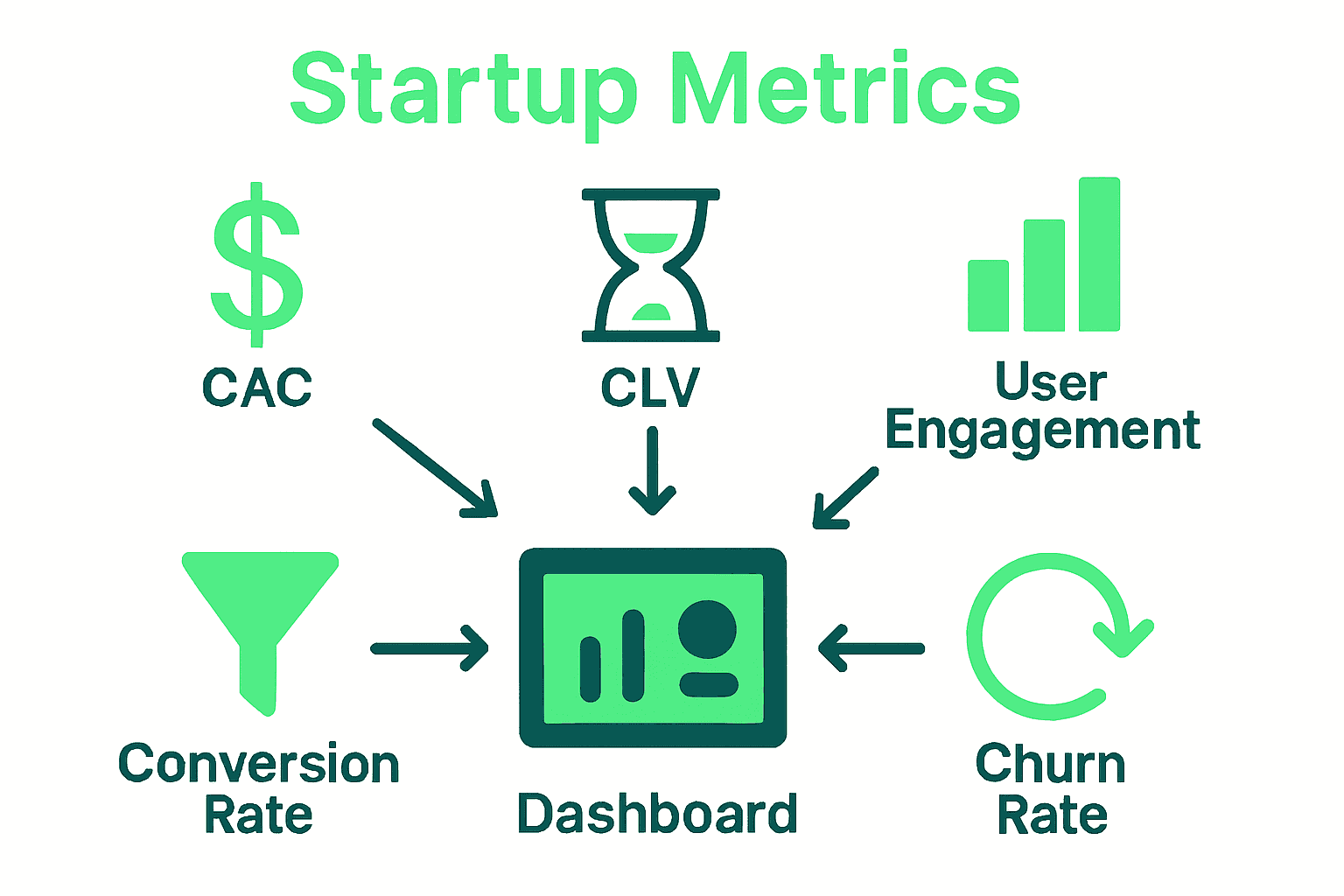
Successful startup validation requires tracking a comprehensive set of metrics that go beyond traditional financial measurements. ArXiv research on the Startup Success Forecasting Framework highlights the importance of developing an automated system for evaluating early-stage startups through predictive metrics. This approach transforms raw data into actionable insights that can guide critical business decisions.
Key metrics founders should prioritize include:
- Customer Acquisition Cost (CAC): The total expense of acquiring a single customer
- Customer Lifetime Value (CLV): Projected revenue from a customer throughout their relationship with your business
- User Engagement Rate: Percentage of users actively interacting with your product
- Conversion Rates: Proportion of potential customers who complete a desired action
- Churn Rate: Percentage of customers who stop using your product over a specific period
According to ArXiv, a sophisticated approach to startup success involves combining human intuition with machine learning insights. This hybrid intelligence method emphasizes tracking both quantitative data and qualitative insights. Founders should not just collect numbers but understand the story behind those metrics, examining how different data points interconnect and reveal deeper patterns about their business potential.
Effective metric tracking is an ongoing process of learning and refinement. By consistently monitoring these key indicators and remaining adaptable, entrepreneurs can make data-driven decisions that significantly improve their startup’s chances of success. Want to dive deeper into understanding how these metrics can transform your business strategy? Check out our guide on understanding growth metrics for startups.
Real-World Examples and Use Cases
Startup validation strategies have proven transformative across multiple industries, demonstrating how systematic testing can dramatically improve entrepreneurial success. First Round Review highlights the Minimum Viable Test (MVT) method developed by Gagan Biyani, which has been successfully applied by companies like Udemy, Lyft, Sprig, and Maven to validate critical business hypotheses before significant product investment.
Companies have used unique validation approaches to test their core assumptions. For instance:
- Dropbox created a simple explainer video demonstrating their file-sharing concept before building the actual product
- Airbnb founders initially rented out their own apartment during a design conference to prove their marketplace concept
- Zappos started by taking photos of shoes in local stores and listing them online, purchasing inventory only after confirming customer interest
- Instagram pivoted from a complex check-in app to a photo-sharing platform after understanding user preferences
Wikipedia provides an example of validation in action through MyoTecSci, a South Korean biotech startup that used structured methods to focus and prioritize market opportunities in the life sciences sector. This demonstrates how systematic validation isn’t limited to tech startups but can be applied across diverse industries. By systematically testing assumptions and remaining adaptable, entrepreneurs can significantly reduce risk and increase their chances of building sustainable businesses. Want to explore more about turning insights into action? Check out our guide on business goal tracking to help transform your startup validation journey.
Major Pitfalls and Risks to Avoid
Startup founders face numerous potential landmines that can derail their entrepreneurial journey before it truly begins. ArXiv research on hybrid intelligence decision support systems reveals a critical warning: founders must avoid the dangerous trap of relying exclusively on either human intuition or machine intelligence. The most successful entrepreneurs create a balanced approach to decision making that combines analytical insights with creative problem solving.
Common validation pitfalls that can sink early-stage startups include:
- Confirmation Bias: Seeking only information that supports your existing beliefs
- Premature Scaling: Investing heavily in product development before validating market need
- Ignoring Customer Feedback: Failing to listen and adapt based on real user insights
- Overestimating Market Size: Believing your potential customer base is larger than reality
- Underestimating Competition: Assuming your idea is completely unique
Medium highlights perhaps the most significant risk: completely skipping the validation step. Many founders rush to build products without first engaging in thorough customer discovery and prototype testing. This approach virtually guarantees building something nobody actually wants or needs. Systematic validation isn’t just a recommended step it’s the difference between entrepreneurial success and spectacular failure. Interested in understanding how to mitigate these risks? Our guide on business risk management provides deeper insights into protecting your startup’s future.
Take Control of Your Startup Validation Journey with AI-Powered Guidance
Early startup validation can feel overwhelming when facing challenges like confirmation bias, premature scaling, and unclear customer feedback. You want to test your core assumptions but avoid costly mistakes and wasted effort. The article highlights the need for rapid experimentation, continuous learning, and tracking validated metrics to reduce risk and build a sustainable business.
Our siift.ai Intelligent Business Canvas is designed precisely to help founders overcome these obstacles. With personalized feedback and prioritized actions, our AI-driven platform guides you step-by-step through ideation, validation, and go-to-market strategies. Avoid blind spots and accelerate your learning curve by systematically validating your ideas with confidence. Ready to make informed decisions and turn your vision into reality? Discover how to de-risk your founder’s journey with Early Startup Validation: Complete Guide for Founders and start building smarter today at siift.ai.
Frequently Asked Questions
What is early startup validation?
Early startup validation is the process of testing and proving the viability of a business idea before committing substantial time and resources. It involves creating a minimum viable product (MVP) and systematically gathering feedback from potential customers.
Why is creating a minimum viable product (MVP) important?
An MVP is crucial because it helps founders test core assumptions about their market with just enough features to engage early customers. This approach reduces the risk of building a product that nobody wants.
What are some common methods for validating a startup idea?
Common methods include customer interviews, landing page testing, prototype demonstrations, and cognitive mapping techniques. These approaches allow founders to gather meaningful insights and direct feedback from potential users.
What key metrics should founders track during the validation process?
Founders should focus on metrics such as Customer Acquisition Cost (CAC), Customer Lifetime Value (CLV), user engagement rates, conversion rates, and churn rates. Tracking these metrics provides actionable insights to guide business decisions.
Recommended
- blog | siift | What Is Business Validation? A Simple Guide for New Founders
- blog | siift | How to Validate Idea in 2025: A Simple Guide for New Founders
- blog | siift | Master Business Idea Validation: Steps to Success in 2025
- blog | siift | Startup Success Stories: Real Paths to Business Wins 2025
- The Essential Guide to Brand Strategy for Startups
- The Symbiosis of Innovation and Investment: Navigating the Strategic Continuum of Product Development