
Most American tech professionals dream of launching a side business, yet over 60 percent struggle to move past the idea stage. For millennial corporate employees juggling demanding careers, the uncertainty of where to begin holds many back. Learning how to clarify your business idea, find your first potential customers, and validate your concept step by step can make the difference between constant hesitation and confident progress.
Table of Contents
Quick Summary
Key Point | Explanation |
|---|---|
1. Clearly define your business idea | Transform your vague concept into a clear, actionable description. This aids in attracting customers and investors effectively. |
2. Conduct thorough market research | Use primary and secondary data to understand customer pain points and market dynamics for informed decision making. |
3. Use customer interviews for validation | Engage with potential customers to uncover genuine insights and feelings about your product, moving beyond assumptions. |
4. Utilize siift.ai for instant feedback | Leverage advanced technology for real-time insights on your business idea’s viability, improving your strategic approach. |
5. Validate insights and outline next actions | Cross-reference data to ensure a robust understanding of your market and outline strategic steps for your business development. |
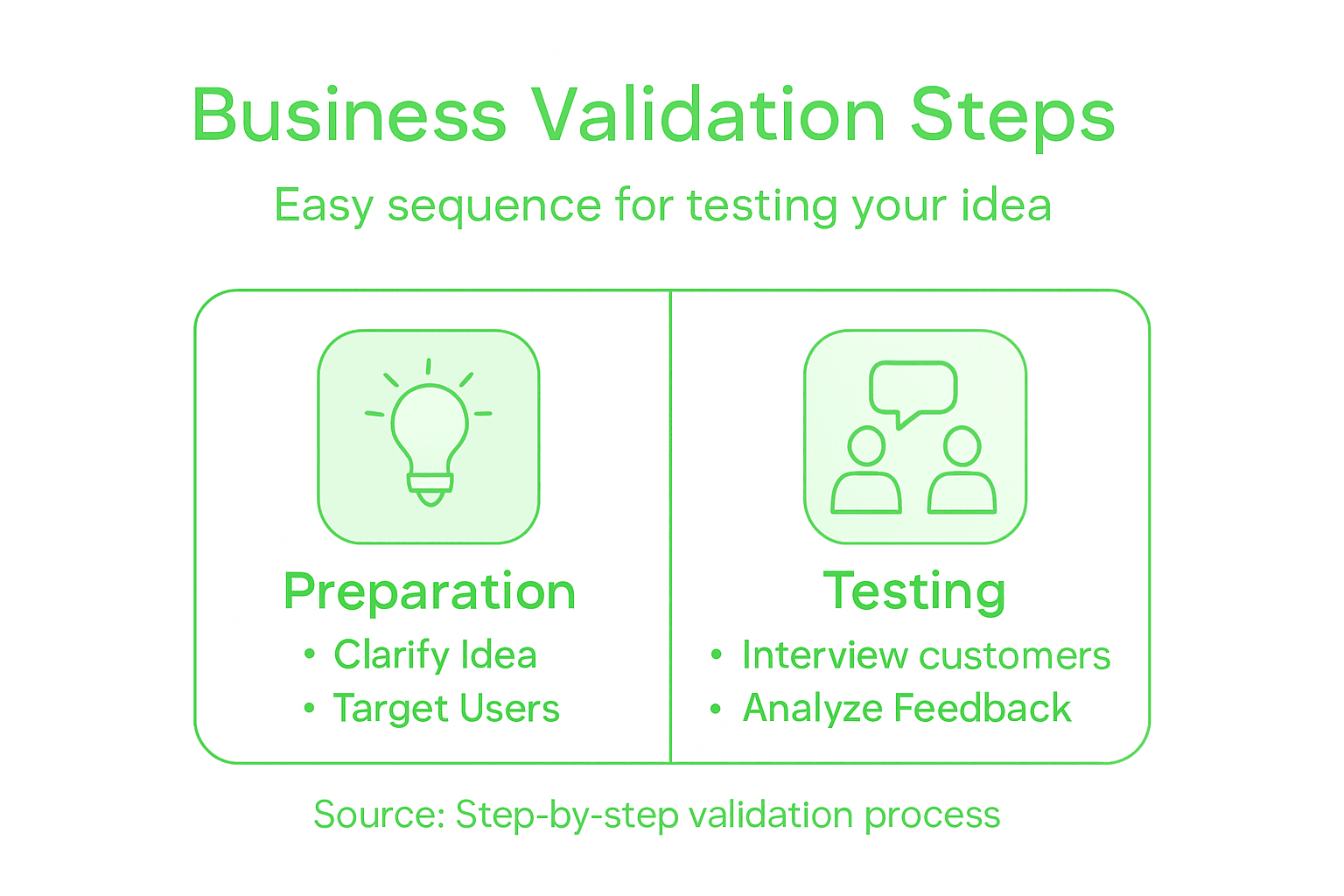
Step 1: Clarify your business idea and target users
Starting a business begins with crystal clear understanding of your core concept and the specific audience you want to serve. Your initial step involves transforming that fuzzy idea swirling in your mind into a precise, actionable business concept that solves a real problem for a defined group of people.
To effectively clarify your business idea, you need a systematic approach to segmenting and targeting digital markets. This means moving beyond traditional geographic boundaries and diving deep into consumer behavior, interests, and specific needs. Start by asking yourself critical questions: What unique problem does my product or service solve? Who experiences this problem most acutely? What makes my solution different from existing alternatives?
Draft a concise description of your business idea that a 10 year old could understand. Avoid technical jargon or complex explanations. Your goal is to communicate the core value proposition simply and clearly. Validate this description with potential users or peers to ensure it resonates and makes sense. The more precisely you can articulate your idea, the easier it will be to attract the right customers and investors.
Pro tip: Create a one sentence “elevator pitch” that captures the essence of your business idea and practice saying it out loud to friends and potential customers to refine its clarity and impact.
Step 2: Research the market using reliable data
Market research is your strategic compass for understanding potential opportunities and challenges before launching your business. This critical step transforms your initial idea from a hunch into a data-driven strategy that can withstand real-world scrutiny.

To conduct comprehensive market research, you need to master primary and secondary data collection techniques. This means triangulating information from multiple credible sources such as government databases, industry reports, academic publications, and firsthand surveys. Focus on gathering insights that reveal your target market’s pain points, spending habits, and unmet needs. Look beyond surface level demographics to understand deeper behavioral patterns and emerging trends that could impact your business concept.
Start by creating a research matrix that categorizes different data sources and their relevance to your specific business idea. Government statistical websites, industry association reports, and academic research platforms can provide foundational market intelligence. Supplement these with direct customer interviews or online surveys to gain nuanced qualitative insights. Pay special attention to market size, growth potential, competitive landscape, and specific customer segments that might be most interested in your solution.
Here is a summary of primary versus secondary market research approaches:
Research Type | Data Sources | Advantage | Limitation |
|---|---|---|---|
Primary Research | Interviews, surveys, focus groups | Direct customer insights | Time-consuming to collect |
Secondary Research | Government reports, academic articles | Broad market trends | May lack specificity |
Pro tip: Always cross-reference multiple data sources to validate your findings and avoid drawing conclusions from single, potentially biased reports.
Step 3: Test assumptions with customer interviews
Customer interviews are your secret weapon for transforming abstract business ideas into validated market opportunities. This critical step moves you from guesswork to genuine understanding of what potential customers truly need and want.
To conduct effective interviews, you need to master customer discovery techniques. Begin by identifying your ideal customer persona and designing a structured yet conversational interview approach. Your goal is not to pitch your idea, but to listen deeply and uncover genuine insights. Prepare open ended questions that explore customer challenges, current solutions, and pain points without leading them toward your preconceived notions. Ask about their experiences, frustrations, and desired outcomes related to the problem your business might solve.
Draft an interview script that balances systematic questioning with natural dialogue. Aim to interview at least 10 to 15 potential customers from your target market. Record their responses carefully, looking for patterns and recurring themes that validate or challenge your initial assumptions. Pay special attention to emotional language and specific examples they share. These interviews are not just about collecting data but understanding the deeper motivations and context behind customer behaviors.
Pro tip: Record and transcribe interviews to capture nuanced insights you might miss during live conversations, and always approach each interview with genuine curiosity rather than a sales mindset.
Step 4: Leverage siift.ai for real-time feedback
Siift.ai represents the next generation of intelligent business validation tools, transforming how entrepreneurs test and refine their startup concepts. This powerful platform allows you to move beyond traditional market research methods and gain immediate, actionable insights into your business potential.
To maximize siift.ai’s capabilities, you’ll want to leverage its advanced real-time feedback analysis features. Upload your initial business concept, target market details, and key hypotheses into the platform. The AI will immediately begin processing your information, comparing it against extensive market databases and generating nuanced insights about your idea’s viability. Unlike traditional research methods that can take weeks or months, siift.ai provides instant feedback that helps you quickly identify strengths, potential challenges, and critical areas for refinement.
Focus on interpreting the platform’s comprehensive reports, which go beyond surface level data to uncover deeper market dynamics. Pay close attention to the AI generated recommendations, sentiment analysis, and predictive modeling that can highlight potential pivot points or optimization strategies for your business concept. The platform’s intelligent algorithms can surface insights you might have overlooked, providing a 360 degree view of your startup’s potential that combines market trends, customer preferences, and competitive landscape analysis.
This table highlights key benefits of using siift.ai for business validation:
Feature | Business Advantage | Example Outcome |
|---|---|---|
Real-time Analysis | Instant feedback on concept viability | Fast go/no-go decisions |
AI Recommendations | Data-driven strategy suggestions | Improved value proposition |
Market Comparison | Identifies strengths and weaknesses | Clear differentiation points |
Predictive Insights | Anticipates future market trends | Better long-term planning |
Pro tip: Run multiple iterations of your business concept through siift.ai, making incremental adjustments based on each analysis to progressively strengthen your startup strategy.
Step 5: Validate your results and outline next steps
Validating your market research results is the critical bridge between gathering insights and transforming them into actionable business strategy. This final step ensures that your startup concept is not just a theoretical possibility but a viable path forward with real market potential.
To effectively validate your findings, you need to compare and cross reference market research results. Begin by critically examining the data collected from customer interviews, siift.ai analysis, and secondary research sources. Look for consistent patterns, validate assumptions against multiple information streams, and identify any potential contradictions or gaps in your understanding. Your goal is to build a robust, evidence based perspective on your business idea that goes beyond surface level observations.
Outline your next strategic steps based on the validated insights. Create a detailed roadmap that includes specific actions for product development, marketing approach, target customer segments, and potential pivot strategies. Consider developing a minimum viable product (MVP) that can help you test your core value proposition in the real market. Be prepared to iterate quickly based on ongoing feedback and remain flexible in your approach. Your initial validation is not a final destination but a launching point for continuous learning and refinement.
Pro tip: Treat your business validation as an ongoing process and maintain a growth mindset that welcomes new information and is willing to adapt your strategy based on emerging market signals.
Turn Your Business Idea Into a Real Opportunity with siift.ai
The article “Step-by-Step Help Validating Business Idea Easily” highlights the challenge of transforming rough business ideas into clear, validated concepts that truly resonate with your target customers. It addresses common pain points like uncertainty in market research, difficulty in gathering reliable data, and the complexity of customer validation. If you are looking to overcome these obstacles and gain real-time, unbiased feedback to sharpen your business strategy, siift.ai Intelligent Business Canvas is designed exactly for you.
Our platform guides you through every stage of ideation, validation, and go-to-market strategy with personalized AI-powered insights that eliminate blind spots and reduce risk. Whether you need help crafting your elevator pitch or testing customer assumptions quickly, siift.ai offers step-by-step clarity and actionable recommendations that save time and boost confidence. Start turning your business dreams into viable ventures today by exploring siift.ai and discover why so many founders trust our intuitive app to build a winning startup. Visit siift.ai Intelligent Business Canvas now to take the decisive next step and bring your idea to life.
Frequently Asked Questions
How can I clarify my business idea effectively?
To clarify your business idea, draft a simple description that anyone can understand without technical jargon. Ask yourself what problem your product or service solves and who experiences it most. Practice refining this description and consider getting feedback from potential users to ensure clarity.
What methods should I use for market research?
Use a mix of primary and secondary data collection methods for comprehensive market research. Conduct interviews or surveys for primary data and consult government reports or industry publications for secondary data. Aim to gather actionable insights about customer needs and market trends that can help shape your business concept.
How do I structure customer interviews to gather useful feedback?
Start by designing a script with open-ended questions that encourage conversation. Focus on understanding customer experiences and pain points related to your business idea without steering the conversation toward your solution. Interview at least 10 to 15 potential customers to identify common themes and insights.
What benefits does using siift.ai provide in validating my business idea?
siift.ai offers real-time feedback that helps you assess the viability of your business concept quickly. By uploading your business details, you can receive insights on strengths and areas needing improvement, enabling faster decision-making. Leverage its comprehensive data analysis to make informed adjustments to your strategy.
How can I validate my market research results?
To validate your market research results, cross-reference findings from customer interviews and data collected from platforms like siift.ai. Look for consistent patterns and any gaps in understanding, then outline actionable next steps based on validated insights. Creating a detailed roadmap can further guide your product development and marketing efforts.
What is the next step after validating my business idea?
After validating your business idea, outline a strategic plan detailing actions for product development and marketing. Consider developing a minimum viable product (MVP) to test your core value proposition in the market, and remain open to iterating based on ongoing feedback and new information.