

TL;DR:
- Profitability measures how efficiently a business converts resources into earnings, unlike profit, which is simply a dollar figure.
- Tracking multiple margins, such as gross, operating, and net, provides a comprehensive view of financial health and operational efficiency.
Most founders celebrate their first profitable month like they’ve cracked the code. Then, six months later, they’re scrambling to make payroll. Sound familiar? That’s the gap between profit and profitability, and confusing the two is one of the most common financial blind spots for aspiring entrepreneurs and business students. Profit is a number on a page. Profitability is a measure of how efficiently your business turns resources into earnings. This guide breaks down what is profitability, how to measure it, and why it matters more than any single revenue milestone you’ll ever hit.
Table of Contents
- Key takeaways
- What is profitability in business
- How to measure profitability
- Factors affecting profitability
- Practical steps to monitor your profitability
- My take: profitability is a mindset, not a metric
- Build a business that’s profitable by design
- FAQ
Key takeaways
| Point | Details |
|---|---|
| Profit vs. profitability | Profit is an absolute dollar figure; profitability is a ratio that reveals business efficiency. |
| Multiple metrics matter | Relying on one margin gives an incomplete picture; use gross, operating, and net margins together. |
| Costs shape everything | Misclassifying fixed and variable costs distorts your break-even and profitability calculations. |
| Growth can deceive | Rapid revenue growth can mask poor unit economics and unsustainable cost structures. |
| Measure consistently | Tracking profitability monthly or quarterly gives you the data investors and lenders actually want. |
What is profitability in business
Let’s clear this up once and for all. Profit and profitability are related but not the same thing. Profit is the absolute number left over after you subtract expenses from revenue. Profitability, on the other hand, is a ratio. It expresses how much profit you generate relative to a base metric like revenue, assets, or equity.
The formulas are straightforward:
- Profit = Revenue minus Expenses
- Profitability = (Profit ÷ Base Metric) × 100
Here’s why the distinction matters. A business generating $1 million in profit sounds impressive. But if that company spent $20 million to earn it, the profitability ratio is only 5%. Meanwhile, a scrappy startup earning $100,000 in profit on $200,000 in revenue has a 50% profitability ratio. Which business would you rather own? The ratio tells the real story.
The definition of profitability is ultimately about efficiency. It answers a question that raw profit never can: “How well is this business converting its resources into returns?” That question is what separates a scalable business from a cash-burning machine that just looks good on the surface.
Pro Tip: When pitching to investors, never lead with profit alone. Always frame your numbers as margins and ratios. Investors think in percentages because they’re comparing your business against every other opportunity they see.
How to measure profitability
Measuring profitability means picking the right ratios for the right questions. Each metric illuminates a different layer of your business operations.
The core profitability ratios
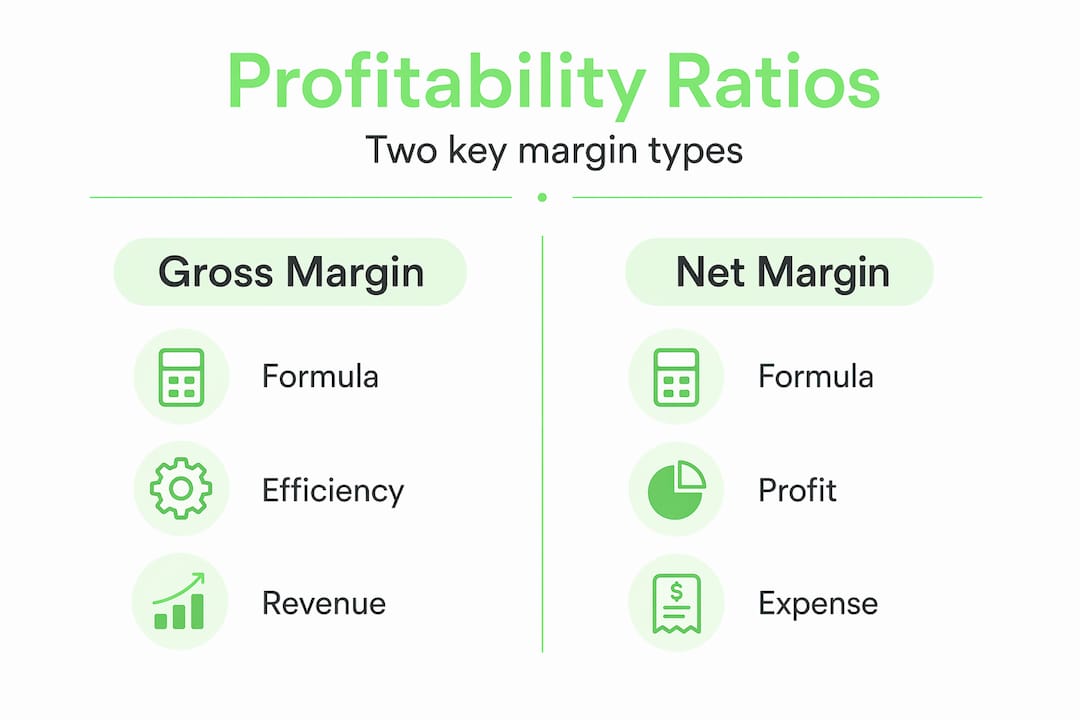
Here’s a comparison of the key profitability ratios every founder should know:
| Ratio | Formula | What it reveals |
|---|---|---|
| Gross margin | (Revenue minus COGS) ÷ Revenue × 100 | Efficiency of production or service delivery |
| Operating margin | Operating income ÷ Revenue × 100 | Profitability after operating expenses |
| Net margin | Net income ÷ Revenue × 100 | Overall bottom-line efficiency |
| Contribution margin | Selling price minus variable cost per unit | Amount each sale contributes to fixed costs and profit |
Different profitability margins like gross, EBITDA, EBIT, and net reflect distinct operational and financial factors. You need all of them to form an accurate picture. Think of it like a health checkup: your doctor doesn’t just take your temperature and call it a day.
The contribution margin deserves special attention for early-stage founders. A healthy contribution margin typically falls between 40% and 60% for most businesses. It tells you how much each unit sold is actually working toward covering your fixed costs and generating profit. Once you know your contribution margin, you can calculate your break-even point:
Break-Even Units = Fixed Costs ÷ (Selling Price minus Variable Cost per Unit)
This formula, drawn from break-even analysis principles, is the foundation of any serious financial plan. It tells you exactly how many units you need to sell before your business stops bleeding cash.
There’s one critical warning here. Relying on a single ratio to assess your business health is a trap. A high gross margin means nothing if operating expenses are spiraling. A decent net margin can mask a fragile contribution margin that collapses under volume pressure. Use all the ratios together and you’ll start seeing the real shape of your business.
Pro Tip: Build a simple monthly dashboard with at least three margins: gross, operating, and net. If any one of them drops sharply without a clear reason, investigate immediately. Margins are early warning signals, not lagging indicators.
You can also pair your ratio tracking with traction metrics for startups to connect profitability analysis to broader business performance indicators.
Factors affecting profitability
Understanding what drives profitability is where theory becomes real power for founders. The main levers are your cost structure, your pricing, and the relationship between volume and value.
Fixed vs. variable costs
Fixed costs stay the same regardless of how much you sell. Think rent, salaries, and software subscriptions. Variable costs change with output. Think raw materials, packaging, and shipping. Most businesses carry fixed costs representing between 30% and 70% of total costs at normal operating volume. Getting this classification wrong wrecks your break-even analysis and gives you false confidence about your margins.

Here’s a scenario that plays out constantly in early-stage companies. A founder prices their product based on gut feel, sells a high volume, and watches revenue climb. The problem? Their variable costs are eating into each sale faster than they realized. When variable costs exceed your selling price, your contribution margin turns negative. Selling more units doesn’t fix a negative contribution margin. It makes things worse. That’s not a scaling problem. That’s a pricing problem.
The factors that most directly affect profitability include:
- Pricing strategy. Pricing below your value proposition compresses margins before you even start. Even modest price increases dramatically improve profitability when margins are thin.
- Cost of goods sold (COGS). Supplier negotiations, production efficiency, and waste reduction all directly impact gross margin.
- Operating expense discipline. Payroll, marketing spend, and overhead are recurring costs that erode operating margins when left unchecked.
- Revenue mix. Not all products or services carry equal margins. Shifting your mix toward higher-margin offerings can improve profitability without changing total revenue.
- Volume and scale. Spreading fixed costs across more units lowers the cost per unit, improving margins. But only if variable costs are already under control.
The profit paradox
Here’s the concept most business courses skip. Growth without profitability is not value creation. It’s the illusion of it. Many startups chase top-line revenue growth while their unit economics quietly deteriorate. They raise more capital, spend aggressively to acquire customers, and report impressive revenue numbers. But if each customer costs more to acquire and serve than they generate in margin, no amount of growth fixes that math.
Businesses that prioritize unit economics and capital efficiency consistently outperform peers in long-term returns. The best time to fix your unit economics is before you scale. Scaling a broken cost structure just means losing money faster.
Practical steps to monitor your profitability
Knowing the theory is half the battle. Actually building the habit of tracking profitability is where most founders fall short. Here’s a concrete approach to make it practical.
-
Calculate your baseline margins today. Pull your most recent income statement and calculate your gross, operating, and net margins. This is your starting point. You cannot manage what you have not yet measured.
-
Set a regular review cadence. Measuring profitability monthly or quarterly is the standard recommended by financial advisors and required by most lenders and investors. Monthly is better for early-stage businesses where the situation changes fast.
-
Track your contribution margin per product or service. If you sell multiple offerings, not all of them are equally profitable. Calculate contribution margins by line item and prioritize the ones that actually carry weight.
-
Use a dedicated tool. Spreadsheets get messy fast. Check out options like the best free expense trackers to keep your income and cost data clean and ready to analyze.
-
Monitor your break-even point monthly. Your break-even shifts whenever fixed or variable costs change. Rent increase? New hire? Update the formula. Founders who watch their break-even point closely are rarely caught off guard by cash crunches.
-
Separate profitability from cash flow. This one trips up even experienced operators. A business can be profitable on paper while facing negative cash flow, particularly when accrual accounting is involved and revenue is recognized before cash is received. Run both analyses side by side.
-
Tie profitability targets to business goals. Connect your margin targets to specific milestones like hiring, product launches, or expansion. Your business goal tracking becomes far more meaningful when it’s grounded in financial thresholds rather than vague ambitions.
My take: profitability is a mindset, not a metric
I’ve worked with dozens of early-stage founders, and the pattern is painfully consistent. They know their revenue. They know their burn rate. But ask them about their contribution margin or operating margin, and you get a blank stare or a rough approximation. That’s not ignorance. That’s a gap in how entrepreneurship tends to be taught.
What I’ve found is that the founders who internalize profitability early, not as a formula to memorize but as a lens for every decision, build far more resilient businesses. They ask different questions when evaluating a new hire, a marketing channel, or a pricing change. They don’t just ask “will this generate more revenue?” They ask “will this improve or erode my margins?”
The uncomfortable truth is that many businesses that looked successful from the outside were quietly unprofitable for years. They raised capital to mask it. The ones that endured were the ones where the founder understood that profitability isn’t a finish line. It’s the operating condition under which a business earns the right to grow.
— Samim
Build a business that’s profitable by design
Understanding profitability in business is one thing. Building systems to track, protect, and improve it is another. That’s where Siift comes in. Siift’s AI-driven platform helps founders and aspiring entrepreneurs move beyond guesswork by validating business strategies with real financial logic built in from day one. Whether you’re mapping your unit economics, testing pricing scenarios, or preparing your pitch with solid margin data, Siift guides you through each step systematically.
If you’re serious about building a business that scales without self-destructing, start with Siift and put profitability at the center of every decision you make.
FAQ
What is the difference between profit and profitability?
Profit is an absolute dollar amount representing earnings after expenses. Profitability is a ratio that measures how efficiently a business generates that profit relative to revenue, assets, or equity.
What are the main profitability analysis methods?
The most common profitability analysis methods include gross margin analysis, operating margin analysis, net margin analysis, and contribution margin analysis. Each reveals a different layer of financial efficiency.
What factors affect profitability the most?
The key factors affecting profitability include pricing strategy, cost of goods sold, operating expense levels, revenue mix, and the relationship between fixed and variable costs. Unit economics underpin all of them.
Can a profitable business still run out of cash?
Yes. A business can be profitable on paper while experiencing negative cash flow, especially under accrual accounting where revenue is recorded before cash is actually received.
How often should you measure profitability?
Tracking profitability monthly or quarterly is the standard practice recommended for business owners. Monthly tracking is especially useful for early-stage businesses where cost structures and revenue are still evolving.