
TL;DR:
- Treat competition as a source of market insights to identify gaps and build better solutions.
- Use AI tools to streamline research, validate your positioning, and adapt your strategy regularly.
You’re sitting on a business idea you believe in. You’ve done the late-night research, sketched out a rough model, maybe even talked to a few potential customers. Then you search the market and find five well-funded players already doing something similar. That familiar sinking feeling sets in. Sound familiar? You’re not alone, and more importantly, you’re not done. Competition, handled strategically, is one of the most powerful catalysts a founder can use to sharpen an idea, find real customers, and build something that actually lasts. This guide gives you a practical, AI-powered roadmap to turn competitive pressure into your biggest advantage.
Table of Contents
- Understand your competition: Preparation and mindset
- Prepare your tools: Setting up for competitive analysis
- Analyze strategically: Uncover gaps and define your edge
- Validate and adapt: Use AI for smarter decision-making
- What most guides miss: It’s not just analysis — it’s action and iteration
- Next steps: Turn competitive insight into startup success
- Frequently asked questions
Key Takeaways
| Point | Details |
|---|---|
| Competition is insight | Treat your rivals as sources of actionable learning, not just threats. |
| Structured analysis wins | Systematically search for gaps between what competitors say and what customers want. |
| AI-driven validation | Modern AI tools enable faster, evidence-based business idea testing that aligns with expert judgment. |
| Continuous adaptation matters | Regularly update your strategy to keep your edge in a fast-changing market. |
Understand your competition: Preparation and mindset
Let’s start by changing how you see competition before any research or tactical move.
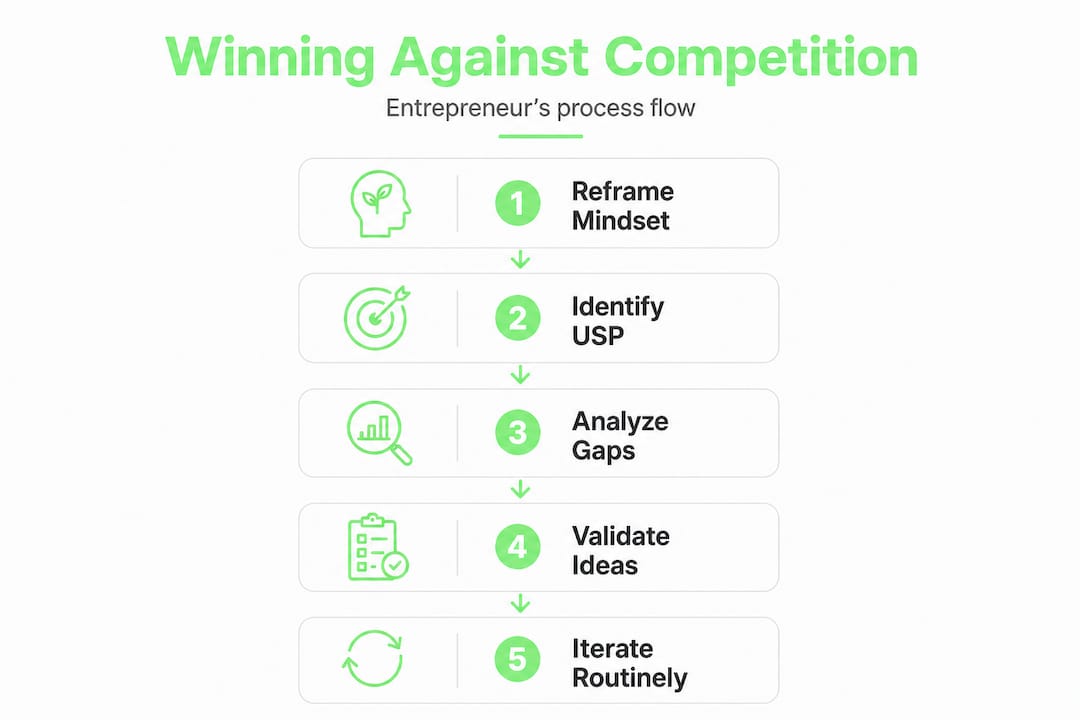
Most early-stage founders treat competitors as threats to be feared or, worse, templates to be copied. Neither approach works. When you study a competitor, you’re really studying the market’s current best guess at solving a problem. And best guesses always leave gaps. Your job is to find those gaps and build something better aimed at them.
According to Baremetrics’ approach, the right way to handle competition is by explicitly defining a clear value proposition, focusing relentlessly on customers, and continuously adapting through competitive analysis and innovation. That’s not a one-time task. It’s a discipline.
When you look at a competitor, here’s what you actually want to understand:
- What they offer and how they frame it to customers
- What customers genuinely value about it (read reviews, forums, social media)
- Where the frustration lives, because that’s almost always where your opportunity is
- How they position themselves and what they deliberately leave out
Identifying your unique value proposition (USP) early isn’t about being creative for its own sake. It’s about being precise. Customers don’t buy products. They buy solutions to specific, felt pain points. The sharper your USP, the easier every downstream decision becomes, from your messaging to your pricing to your go-to-market strategy.
Two common mistakes founders make: copying a rival’s feature set instead of understanding why those features exist, and ignoring smaller or newer players who might be moving faster on customer insights. The scrappy startup with 500 users and a passionate online community might tell you more about emerging customer needs than the category leader with millions of users.
“Competition is the market telling you what the current best answer looks like. Your role is to imagine the next answer.”
Pro Tip: Track both direct competitors (same audience, same solution) and indirect competitors (different solution, same underlying problem). Indirect competitors often reveal what customers are tolerating rather than what they truly want. That tolerance gap is frequently where breakthroughs happen. For more on navigating opportunity and noise in a crowded market, the framing matters as much as the data.
Prepare your tools: Setting up for competitive analysis
With your mindset set, you need to gather the right tools and structure your preparation for pain-free, effective research.
You don’t need a 40-slide deck or a strategy consultant. You need a simple, repeatable system. Here’s the minimum viable toolkit every solo founder or small team should have before diving into competitive research:
- Competitor matrix (a spreadsheet comparing key attributes across 4 to 6 competitors)
- Customer feedback sources (Google reviews, Reddit, Trustpilot, app store comments, LinkedIn comments)
- AI-powered research and ideation tools for rapid synthesis and gap spotting
- A simple data analysis template to track patterns over time, not just one-time snapshots
- Job-to-be-done (JTBD) framework to anchor every insight to an actual customer need
Here’s a practical overview of what your setup should cover:
| Tool or resource | Data source | Outcome |
|---|---|---|
| Competitor matrix | Company websites, pricing pages | Feature and positioning comparison |
| Customer review aggregator | G2, Trustpilot, Reddit threads | Real user sentiment and frustration themes |
| AI research assistant | News, forums, product discussions | Rapid trend and gap identification |
| JTBD interview template | Direct customer conversations | Deep motivation and context mapping |
| Business model canvas | Internal strategy sessions | Structural clarity on your own model |
The efficiency gains from AI in this phase are real and significant. Research on AI-generated business-idea evaluations shows that AI tools can produce structured assessments of business concepts at a quality level that tracks with expert judgment. For a solo founder, this is a game-changer. What used to take weeks of market research can now happen in hours, giving you more time to talk to actual customers instead of reading about them.
Using Business Model Canvas AI tools helps you map your own model against competitors quickly, revealing structural advantages and blind spots before you spend a dollar on marketing or development.
The Baremetrics’ approach reinforces this: continuous adaptation requires building systems for data collection and review, not just doing a one-off competitive sweep at the start of your journey.
Pro Tip: Use AI tools for rapid exploration and validation of business ideas before deep investment. They’re particularly powerful for stress-testing your assumptions early, when changing course is cheap. Explore the full range of AI for business idea validation approaches to find the right fit for your stage.
Analyze strategically: Uncover gaps and define your edge
Once you have your toolkit, here’s how to dig in and extract insights that competitors often miss.
The most common mistake in competitive analysis is comparing features. Features are the surface layer. What you want to analyze is the gap between what competitors promise and what customers actually experience. That gap is where trust erodes, and where your differentiated positioning can take root.

As Inc.com describes, the real mechanics of turning competition into a strategic asset involve running structured analysis on what rivals promise versus what customers report, then translating those gaps into your positioning, your USP, and your go-to-market choices.
Here’s a simple step-by-step process to execute this well:
- Collect competitor claims. Pull their homepage copy, pricing page messaging, and taglines. What specific outcomes do they promise?
- Gather real customer feedback. Search for your competitors by name on Reddit, Trustpilot, and G2. Look for patterns in complaints and praises.
- Map promise versus reality. Create a two-column list for each competitor: what they claim versus what users actually say.
- Identify recurring frustrations. These are your market’s unmet needs, stated in customers’ own words.
- Translate into your USP. Build your positioning around the most important unmet need that you can credibly solve better than anyone else.
Here’s what this analysis looks like in practice:
| Competitor | What they promise | What customers actually report |
|---|---|---|
| Competitor A | “All-in-one business platform” | “Too many features, confusing to get started” |
| Competitor B | “Simple and fast setup” | “Works fine initially but doesn’t scale well” |
That table tells you something powerful. There’s a gap between simplicity and scalability. Customers want a product that’s easy to start and grows with them. That’s your positioning opportunity, stated clearly, grounded in evidence, and defensible.
“Don’t just differentiate. Make sure you’re differentiating on what customers actually notice and value, not just what’s technically impressive to you.”
This process connects directly to your go to market strategy. Once you know what gap you fill, your channel choices, messaging, and early customer targeting become much clearer. The Baremetrics’ approach and LLM business idea assessments both point in the same direction: clarity of positioning, grounded in real customer input, is the foundation of competitive advantage. For deeper frameworks on launching an AI venture, this analysis phase is non-negotiable.
Validate and adapt: Use AI for smarter decision-making
After analysis, avoid overconfidence. Validate your insights and business edge with evidence, not guesswork.
Here’s an uncomfortable truth. Many founders do excellent competitive analysis and still launch products that miss the mark. Why? Because they treat their analysis as proof rather than as a hypothesis. Analysis tells you where an opportunity might exist. Validation tells you whether you can actually capture it.
The Strategy Science (INFORMS) paper is worth paying attention to here. Empirically, AI can help with strategy evaluation and business-idea assessment. Research indicates AI-generated evaluations can correlate with expert judges, and LLM pairwise rankings can resemble human expert assessments when aggregated. That’s significant. It means that AI-powered validation isn’t just faster than traditional methods. It can be genuinely rigorous.
Here are the validation tools and methods worth building into your process:
| AI tool type | Primary use | Benefit for founders |
|---|---|---|
| Idea assessment tools | Evaluate business concept strength | Fast, structured feedback on viability |
| Market research AI | Identify trends and customer pain points | Reduces blind spots in positioning |
| Business model simulators | Stress-test revenue and cost assumptions | Spots structural weaknesses early |
| Feedback loop tools | Rapid survey and concept testing | Validates messaging before launch |
Here’s a practical step-by-step process for using AI in your validation phase:
- Feed your USP into an AI assessment tool and ask it to challenge your assumptions, not just confirm them.
- Simulate customer objections. Ask the AI to generate the five strongest reasons a target customer would NOT choose your product.
- Cross-check with a second tool. Different AI tools weight different factors. Agreement across tools increases your confidence. Disagreement tells you where to dig deeper.
- Run lean customer experiments. Even a simple landing page with clear messaging and a waitlist signup can give you real conversion data within days.
- Iterate your positioning based on what you learn, then run the loop again.
Pro Tip: Never rely on a single AI output when validating a business idea. Run your concept through multiple tools and compare outputs. Consistency builds confidence. Divergence reveals hidden risks you hadn’t considered. This is exactly what accelerate business idea validation frameworks recommend as best practice.
The AI business-idea assessment research shows this approach isn’t just convenient. It’s increasingly credible. Explore the fastest way to validate a business idea and consider following a structured approach to step-by-step validation help to make sure you’re not skipping critical checkpoints.
What most guides miss: It’s not just analysis — it’s action and iteration
Here’s our honest take, earned from watching thousands of founders go through this process.
Most competitive analysis guides give you a framework, pat you on the back, and send you off to do research. What they rarely tell you is that the founders who win aren’t the ones who did the best initial analysis. They’re the ones who stayed in motion after it.
The competitive landscape in 2026 is not static. AI is reshaping entire categories in months, not years. Customer expectations evolve. New entrants emerge with fresh funding and fresh angles. The positioning that was your sharpest edge in January can be table stakes by September. We’ve seen it happen repeatedly.
The uncomfortable truth? Most businesses don’t fail because their initial analysis was wrong. They fail because they analyzed once and then operated on autopilot. They built a product for the market as it was, not the market as it became.
What separates resilient founders is a habit, not a skill. It’s the habit of returning regularly to the core questions: Are we still solving the right problem? Are we still solving it better than the alternatives? What are customers saying now that they weren’t saying six months ago?
Our recommendation is to build what we call a competitive review cadence. Set a recurring calendar event, quarterly at minimum, where you repeat the core analysis process. Update your competitor matrix. Pull fresh customer reviews. Run your USP through an AI assessment again and see if the answer has changed. This isn’t paranoia. It’s professional discipline.
The smarter business validation tools available today make this kind of ongoing review genuinely lightweight. You don’t need to spend two weeks on it every quarter. A focused half-day with the right AI-powered setup can tell you everything you need to know to stay calibrated and ahead of the curve.
“Analysis is a snapshot. Strategy is a film. Keep the camera rolling.”
Next steps: Turn competitive insight into startup success
Ready to put these strategies in action? Here’s where to start.
Everything in this guide, from reframing competition as insight to validating your positioning with AI, points toward one underlying truth: strategy without a system is just guesswork. The founders who move fastest and waste the least aren’t smarter. They have better tools and cleaner processes.
The Founder’s Intelligence Platform at siift was built specifically to operationalize everything described here. From ideation and competitive mapping to validation and go-to-market planning, siift guides you step-by-step through the decisions that actually determine whether your business gains traction. It’s not a generic AI chat tool. It’s a purpose-built OS for founders who want to derisk their ideas, filter out bias and noise, and accelerate toward product-market fit faster than going it alone. If competition feels like a wall right now, siift helps you find the door.
Frequently asked questions
How do I define my unique selling point when the market is crowded?
Study what your competition promises versus what customers actually say in reviews and forums, then position your business to solve the most common unmet frustration. As the Baremetrics’ approach reinforces, a clear value proposition starts with deeply understanding customers, not just copying what already exists.
Can AI really help me evaluate business ideas better than gut instinct?
Yes. AI business-idea assessment research shows that AI evaluations can align with expert judges, providing fast, structured feedback that reduces the blind spots gut instinct alone tends to miss.
What is the first step after identifying my main competitors?
Gather real customer feedback on your rivals, specifically looking for patterns in what users complain about versus what they praise. As Inc.com notes, turning competition into a decision tool means comparing what rivals promise to what customers actually report, then translating that gap into your positioning.
How often should I revisit my competition analysis?
At minimum, re-evaluate competitors and customer needs every quarter, or whenever you notice a significant shift in your industry, a new well-funded entrant appears, or your conversion rates start to change unexpectedly.