
TL;DR:
- Competitive advantage is the unique reason customers prefer your business over others.
- Frameworks like Porter’s value chain and vrio help identify and assess advantage durability.
- Sustaining advantage requires focus, regular audits, and leadership commitment to your core position.
Most entrepreneurs assume winning in business comes down to being cheaper, faster, or louder than the competition. That’s a trap. Real competitive advantage is about finding a position that’s genuinely hard for rivals to copy and then building everything around defending it. Whether you’re launching a side hustle or scaling a young venture, understanding this concept changes how you make every decision, from who you hire to how you price. This guide will walk you through what competitive advantage actually means, how to find yours, and how to keep it once you’ve built it.
Table of Contents
- defining competitive advantage: what it really means for your venture
- frameworks to uncover and sustain advantage: Porter’s value chain, vrio, and more
- how to identify your unique edge: customer needs, market mapping, and resource audits
- sustaining competitive advantage: repeatability, alignment, and leadership focus
- What most guides miss: the uncomfortable truth about competitive advantage
- Take your competitive advantage further with siift.ai
- frequently asked questions
Key Takeaways
| Point | Details |
|---|---|
| Competitive advantage basics | It’s what makes your business stand out and consistently win customers over rivals. |
| Frameworks give clarity | Tools like Porter’s Value Chain and VRIO help you identify and sustain your edge. |
| Start with customer needs | Surveying your market lets you uncover and validate differentiators that truly matter. |
| Sustain with repeatability | Long-term advantage comes from alignment, core focus, and leadership consistency. |
| Avoid common traps | Committing early to cost or unique value prevents losing your edge in the marketplace. |
defining competitive advantage: what it really means for your venture
Competitive advantage is the specific reason customers choose you over everyone else, and keep choosing you. It’s not a tagline. It’s not a feature. It’s the structural position your business holds in the market that makes it sustainably more attractive or more profitable than alternatives.
Here’s where most new founders go wrong. They confuse tactics with advantage. Running a flash sale is a tactic. Having the lowest cost structure in your category because of a proprietary supplier relationship — that’s an advantage. Being fast is a tactic. Having a delivery network your rivals would take years to replicate — that’s an advantage. The difference matters enormously.
Michael Porter, the Harvard economist who formalized much of this thinking, identified three core types of competitive advantage:
- Cost leadership: You produce or deliver at a lower cost than anyone else, letting you price aggressively or pocket higher margins.
- differentiation: You offer something unique that customers value enough to pay a premium for.
- Focus: You serve a narrow segment better than generalists can, whether through cost or differentiation.
| Type | Core question | Example | Risk if done poorly | Best for… |
|---|---|---|---|---|
| Cost leadership | Can we be the cheapest to operate? | Budget airline, bulk retailer | Race to the bottom on margins | High-volume, price-sensitive markets |
| differentiation | Can we be genuinely unique? | Premium software, craft brand | Hard to scale, easy to imitate | Value-driven, loyal customer bases |
| Focus | Who do we serve best? | niche consultancy, local specialist | Small market ceiling | Deep expertise or community plays |
This choice isn’t cosmetic. sustaining competitive advantage over the long run is genuinely rare — fewer than 1 in 10 companies manage even modest sustained profitable growth over a decade. The ones that do share common traits: a clear core, activities that reinforce each other, and leadership that stays relentlessly focused.
For early-stage founders, business differentiation is often the most accessible path. You don’t need scale to be different. You need clarity.
frameworks to uncover and sustain advantage: Porter’s value chain, vrio, and more
With the basics covered, let’s explore proven frameworks you can use to pinpoint and sustain your advantage. Two stand out as especially useful for founders who are new to strategic thinking.
Porter’s value chain maps every activity inside a business into two categories: primary activities (things directly involved in creating and delivering your product or service) and support activities (things that enable the primary ones, like HR, technology, and infrastructure). The insight from value chain analysis is that competitive advantage doesn’t live in one department — it emerges from how all your activities connect and reinforce each other.
“Every firm is a collection of activities that are performed to design, produce, market, deliver, and support its product. All these activities can be represented using a value chain.” — Michael Porter
| Value chain category | Activities included | Why it matters for advantage** |
|---|---|---|
| Primary | inbound logistics, operations, outbound logistics, marketing & sales, service | Direct source of customer value |
| Support | procurement, technology development, HR management, firm infrastructure | enables and amplifies primary activities |
To apply it, map your own activities in both rows. Then ask: where do we do this noticeably better or cheaper than rivals? That gap is a candidate for your advantage.
The vrio framework (Value, rarity, inimitability, organization) is a resource audit tool. You ask four questions about each resource or capability your business has:
- Does it create value for customers?
- Is it rare — do few or no rivals have it?
- Is it inimitable — would it be hard or expensive to copy?
- Is your business organized to actually exploit it?
Only resources that pass all four tests are true sources of sustained advantage. Most capabilities only clear one or two bars. That’s a useful and often humbling discovery. You can learn more about applying resource-based approaches to your startup strategy.
For business model strategy decisions, these two frameworks work well together. The value chain tells you where your advantage lives. vrio tells you how durable it really is.
Pro tip: before running either framework, collect real feedback from your best customers about why they chose you. Let their language guide which activities and resources you audit first. Customer-validated differentiators are always more reliable than founder assumptions.
how to identify your unique edge: customer needs, market mapping, and resource audits
Now that frameworks are clear, let’s apply them — here’s how you can identify and validate your own unique position.
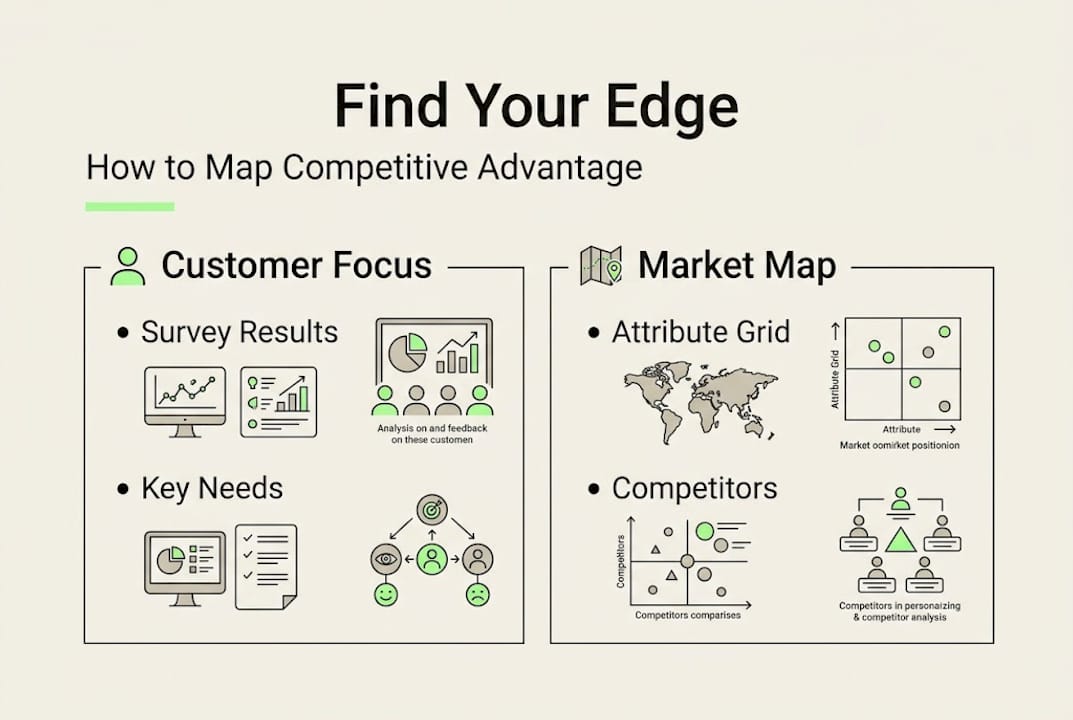
Step 1: Survey your best customers. Ask them three questions. What made you choose us? What would you miss most if we disappeared? What do you tell friends about us? Their answers reveal your actual edge, not the one you think you have.

Step 2: Map the competitive landscape simply. Draw a two-axis grid. Pick the two attributes that matter most to your customers — price and speed, or quality and convenience, for example. Plot yourself and your top three rivals. Where you sit alone on that map is where your position lives.
Step 3: Run a quick vrio audit. List your top five capabilities or assets. For each one, ask the four vrio questions. Be brutally honest. If a rival could replicate it in six months with moderate budget, it’s not a durable advantage.
Key pitfalls to avoid:
- Feature stacking: Adding more features doesn’t equal a stronger position. It often dilutes it.
- copying rivals: if your plan is to do what the market leader does but slightly cheaper, you’ve already lost.
- ignoring weak signals: Early customer complaints often point directly to what a future competitor will exploit.
The most critical trap, and the one Porter specifically warned against, is being stuck in the middle. That’s when a business tries to compete on both cost and differentiation without fully committing to either. The result is a business that’s average at everything and compelling to no one.
Committing to one clear edge early is hard. It means saying no to customers who don’t fit, pricing choices that feel risky, and marketing messages that exclude as much as they include. But that commitment is what makes validating ideas so much more powerful — you know exactly what you’re testing for. And as you scale, the startup growth strategies you choose will compound on a much stronger foundation.
Pro tip: pick one edge and own it completely before considering a second. depth beats breadth at every early stage.
sustaining competitive advantage: repeatability, alignment, and leadership focus
Once you’ve found your edge, the real challenge is keeping it — here’s how you can sustain your advantage for the long run.
Most young ventures don’t lose their edge to a smarter competitor. They lose it to themselves. Feature creep, scope expansion, hiring for growth before the core is solid — these are the most common culprits. The business drifts, and by the time the founder notices, the original position has blurred beyond recognition.
The research is direct here: repeatability leadership focus is what separates the rare companies that sustain advantage from the majority that don’t. repeatability means building your advantage into repeatable routines, decisions, and structures so it doesn’t depend on any single person or moment of inspiration.
Practical actions to sustain your edge over time:
- Define your core in writing. What does your business do better than anyone? Write it down and revisit it quarterly.
- align every activity to that core. If a new product, hire, or partnership doesn’t reinforce your edge, treat it as a red flag.
- audit regularly. Markets shift. What was rare last year may be commoditized today. Build a habit of checking whether your advantage still passes the vrio test.
- Leadership attention is a resource. Where founders focus, the business follows. If you’re not actively protecting your edge, it’s quietly eroding.
- Build switching costs. The most durable advantages make it genuinely inconvenient or costly for customers to leave. Think integrations, community, data, or relationships.
Good startup validation metrics will tell you when your edge is holding. declining net promoter scores, rising churn, and increasing price sensitivity are early warning signs worth tracking. startup growth that happens without a reinforced core is growth that creates fragility, not strength.
Pro tip: schedule a quarterly “edge audit” with your team. Ask honestly — is our advantage getting stronger or weaker? That question alone is worth more than most strategy sessions.
What most guides miss: the uncomfortable truth about competitive advantage
Stepping back, the uncomfortable reality is that most competitive advantage content teaches theory without warning you about the emotional difficulty of applying it. Reading about cost leadership is easy. choosing not to serve a customer segment because they dilute your position — that’s genuinely hard. Most founders never make that call clearly.
There’s also a false security that comes from feature stacking. Adding new capabilities feels like progress. It looks like growth. But each addition that isn’t rooted in your core position is actually a quiet retreat from it. We’ve seen this pattern repeatedly: a venture starts sharp and focused, grows a little, adds features to chase adjacent markets, and suddenly can’t explain what it’s actually best at.
The differentiation pitfalls that hurt founders most aren’t the obvious ones. They’re the slow, well-intentioned drift. Porter was clear that being stuck in the middle is a strategic failure, not just a positioning nuisance. It means lower margins, confused customers, and an organization that can’t prioritize effectively.
The founders who sustain their edge are the ones who treat their position as a constraint to protect, not a starting point to expand from. That mindset shift is the real lesson.
Take your competitive advantage further with siift.ai
Understanding competitive advantage is one thing. Building a strategy that actually holds up under pressure — and keeps evolving as your market shifts — is where most founders struggle alone. That’s exactly where siift.ai can change the game for you.
siift’s intelligent Business Canvas is an agentic AI platform built specifically for founders like you. It guides you step by step through identifying your unique edge, validating it with real market logic, and building a go-to-market strategy that’s coherent and defensible. No generic templates. No guesswork. Just a systematic process that filters out bias, blindspots, and noise so you can move faster with real conviction.
frequently asked questions
What is the simplest definition of competitive advantage?
Competitive advantage is what your business does better or more uniquely than rivals to consistently win customers and generate profit. It’s the structural reason people choose you, not just once, but repeatedly.
How can a side hustle find its competitive advantage?
Start by asking your best customers why they chose you, then map your activities and run a quick vrio audit to spot where you’re genuinely rare and hard to copy.
Which frameworks help identify competitive advantage?
Porter’s Value Chain and the vrio resource audit are the two most practical tools — the value chain shows where your advantage lives, while vrio tests how durable it actually is.
What are signs your business is losing its competitive advantage?
Declining customer loyalty, feature overload that blurs your core offer, and leadership attention spread too thin are the clearest signals that your edge is weakening and needs urgent reinforcement.
What is the ‘stuck in the middle’ trap?
It’s when a business fails to commit fully to either cost leadership or differentiation, ending up average at both and compelling to no one — a strategic failure that undermines market position over time.
Recommended
- Master Business Differentiation: Stand Out and Succeed | siift
- Smart startup exit strategies: how to maximize your value | siift
- How to improve productivity for entrepreneurs in 2026 | siift
- Power of curiosity in 2026: Boost startup success 42% faster | siift
- Scalable AI solutions for service businesses in 2026
- Innovative marketing strategies for service businesses 2026 - Jarrod Harman