
Launching a new business can feel like stepping into the unknown, especially when every decision carries real risks. For Millennial founders and indie hackers in cities from Berlin to New York, understanding how to measure what matters most can set the right foundation. Founder metrics dig beyond financials to reveal the personal strengths and signals that truly influence startup success, helping you validate your idea—and yourself—before investing time or capital.
Table of Contents
Key Takeaways
Point | Details |
|---|---|
Founder Metrics are Crucial | Personal attributes like resilience and technical expertise significantly influence startup success. |
Diverse Metric Usage | Employing a variety of metrics, including product engagement and financial performance, offers a holistic view of a startup’s viability. |
Dynamic Product-Market Fit Tracking | Continuously measuring market resonance with key performance indicators helps refine the product and improve customer alignment. |
Avoiding Common Tracking Mistakes | Focus on actionable metrics and context to prevent misinterpretation and strengthen strategic decision-making. |
Core Founder Metrics and Their Role
Founder metrics represent critical predictive indicators that help entrepreneurs validate their startup potential before significant capital investment. While traditional business metrics focus on financials and market performance, founder metrics dig deeper into the human capital driving innovation.
Research demonstrates that individual founder characteristics significantly influence startup success. Innovative background predictors like patent history and academic achievements can forecast entrepreneurial potential with surprising accuracy. These metrics go beyond standard business evaluations by assessing the founder’s intrinsic capabilities.
Key founder metrics typically include:
Personal Resilience: Capacity to navigate challenges and pivot strategies
Technical Expertise: Domain knowledge and skill depth in relevant industry
Network Strength: Quality and breadth of professional connections
Prior Innovation History: Track record of creating novel solutions
Emotional Intelligence: Ability to manage team dynamics and stakeholder relationships
Founders can leverage these metrics for self-assessment and strategic planning. Startup success factors reveal that personal attributes often matter more than initial business plans.
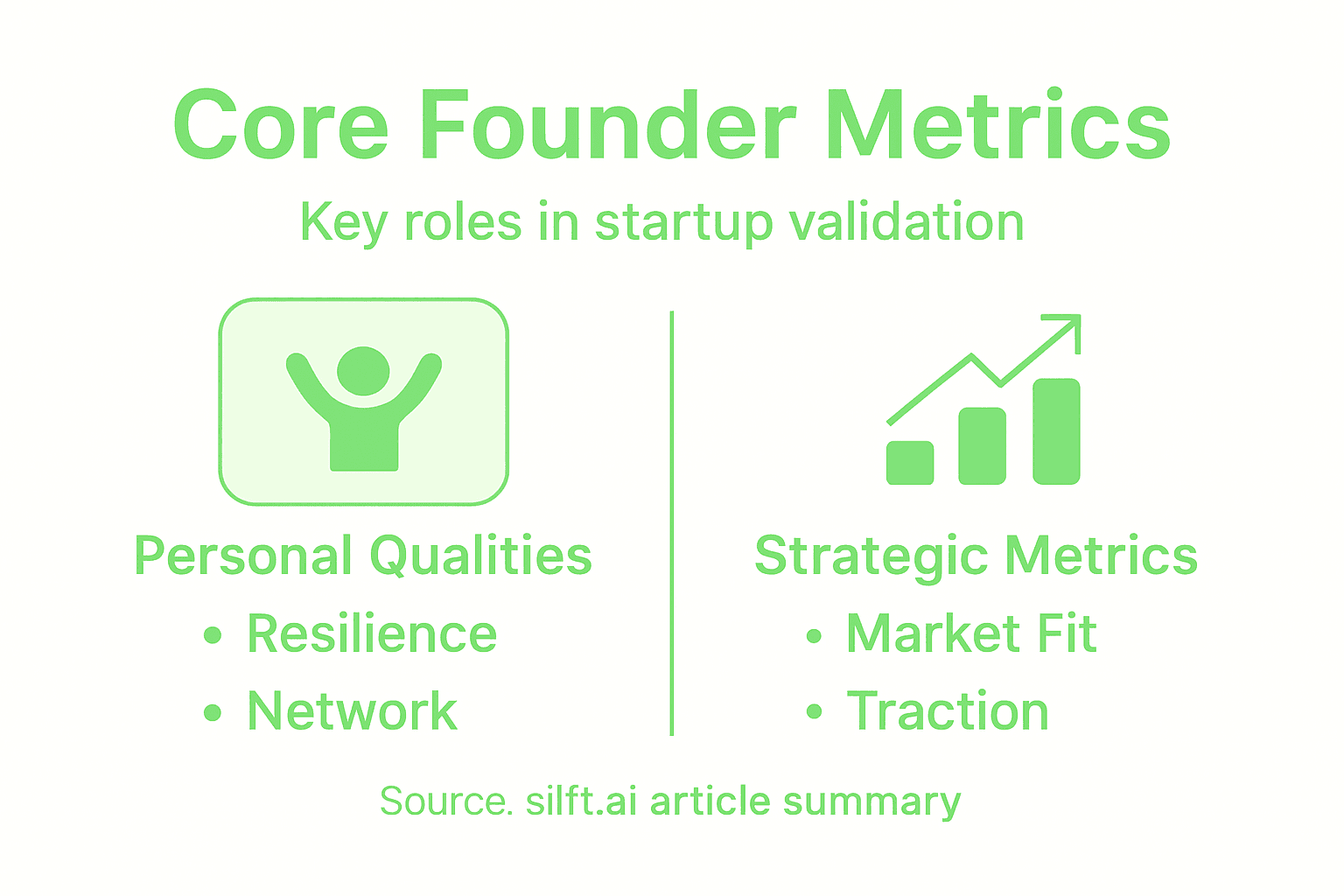
Here is a breakdown of how core founder metrics support different aspects of startup success:
Founder Metric | Strategic Role | Business Impact |
|---|---|---|
Personal Resilience | Navigating setbacks | Sustained progress during pivots |
Technical Expertise | Problem-solving acceleration | Higher product quality |
Network Strength | Expanding opportunity access | Faster partnership formation |
Prior Innovation History | Building credibility | Easier investor engagement |
Emotional Intelligence | Enhancing team collaboration | Improved company culture |
Pro Tip: Conduct a periodic self-audit of your founder metrics to identify growth opportunities and potential blind spots in your entrepreneurial journey.
Types of Metrics for Startup Validation
Startup validation requires a multifaceted approach to measuring potential success, encompassing various metric categories that provide comprehensive insights into a venture’s viability. Comprehensive validation metrics help founders systematically assess their business potential across different dimensions.
Founders typically leverage multiple metric types to build a holistic understanding of their startup’s trajectory. These metrics can be broadly categorized into several critical areas:
Product Engagement Metrics
User activation rates
Feature utilization
Time spent in application
Retention percentages
Customer Acquisition Metrics
Customer acquisition cost (CAC)
Conversion rates
Lead generation efficiency
Sales pipeline velocity
Financial Performance Metrics
Monthly recurring revenue
Burn rate
Gross margin
Cash runway
Research emphasizes the importance of using multiple research validation approaches to avoid over-relying on single indicators. This means founders should create a nuanced dashboard that tracks progress across different metric categories simultaneously.

The table below compares key metric categories for startup validation and their primary focus:
Metric Category | Focus Area | Example Value |
|---|---|---|
Product Engagement Metrics | User activity and adoption | Retention, activation rates |
Customer Acquisition Metrics | Growth efficiency | Cost per acquisition |
Financial Performance Metrics | Financial health | Revenue growth, burn rate |
Pro Tip: Develop a dynamic metrics tracking system that updates in real-time, allowing you to quickly pivot and adapt your startup strategy based on comprehensive performance insights.
Key Metrics for Product-Market Fit
Product-market fit represents the critical intersection where a startup’s solution perfectly addresses genuine market needs. Critical startup validation metrics help founders objectively measure their progress toward achieving this elusive alignment.
Founders must track several key performance indicators to understand their product’s market resonance:
Customer Engagement Metrics
Net Promoter Score (NPS)
User activation rates
Feature adoption percentage
User retention rates
Growth and Satisfaction Indicators
Customer lifetime value
Churn rate
Repeat purchase frequency
Customer satisfaction scores
Market Validation Signals
Unsolicited customer referrals
Organic user growth
Unprompted positive testimonials
Reduced customer acquisition costs
Successful founders understand that product-market fit is not a static achievement but a dynamic process of continuous validation and refinement. The most effective startups treat these metrics as living indicators, constantly adjusting their approach based on real-world user feedback and performance data.
A true product-market fit means your customers are not just buying your product, but becoming passionate advocates for your solution.
Pro Tip: Create a comprehensive dashboard that tracks these metrics in real-time, enabling rapid insights and quick strategic pivots based on actual market performance.
How to Use Metrics to De-Risk Growth
Successful founders understand that strategic growth requires more than intuition—it demands rigorous, data-driven risk management. Systematic metric evaluation techniques enable entrepreneurs to transform uncertainty into actionable intelligence.
Founders can effectively de-risk their growth trajectory by implementing a comprehensive metrics monitoring approach:
Early Warning Indicators
Customer acquisition cost trends
Conversion rate fluctuations
User engagement decline signals
Emerging competitive pressures
Growth Risk Mitigation Strategies
Continuous funnel performance analysis
Predictive churn modeling
Segmented user behavior tracking
Dynamic pricing optimization
Proactive Validation Techniques
Regular cohort performance reviews
Rapid experimental iterations
Cross-functional metric alignment
Scenario planning exercises
Research emphasizes the critical need to avoid single-metric dependency by developing a holistic, multidimensional assessment framework. This approach prevents misleading interpretations and supports more nuanced strategic decision-making.
Effective de-risking isn’t about eliminating uncertainty, but systematically understanding and managing potential challenges before they become critical.
Pro Tip: Implement a monthly metrics review process that goes beyond surface-level data, diving deep into interconnected performance indicators and potential growth constraints.
Common Mistakes When Tracking Metrics
Founders often stumble when tracking startup metrics, transforming potentially valuable data into misleading noise. Critical metric tracking pitfalls reveal systematic errors that can derail strategic decision-making and obscure true business performance.
The most prevalent mistakes founders make in metrics tracking include:
Metric Misuse Errors
Overemphasizing vanity metrics
Tracking too many disconnected indicators
Ignoring context and business stage
Failing to establish baseline comparisons
Data Interpretation Mistakes
Mistaking correlation for causation
Overlooking qualitative insights
Rigid adherence to numerical targets
Neglecting external market factors
Strategic Tracking Weaknesses
Inconsistent measurement periods
Lack of cross-functional metric alignment
Avoiding uncomfortable performance signals
Insufficient metric portfolio diversification
Startup metric tracking strategies emphasize the importance of focusing on actionable, stage-appropriate metrics that drive genuine strategic understanding.
Metrics are storytellers—not dictators. They should guide your decisions, not replace thoughtful leadership.
Pro Tip: Develop a lean, purposeful metrics dashboard that prioritizes 3-5 core indicators directly tied to your current business objectives and growth stage.
Unlock Success by Harnessing Founder Metrics with siift.ai
The article highlights the vital role that founder metrics play in validating startup ideas and de-risking your growth journey. Challenges such as tracking the right indicators, identifying blind spots, and aligning personal resilience and technical expertise with market needs are common hurdles founders face. siift.ai’s Intelligent Business Canvas directly addresses these pain points by guiding entrepreneurs through a personalized step-by-step process that transforms complex metrics into actionable insights.
With siift.ai you gain access to an intuitive AI-powered platform that helps you filter out biases, prioritize actions, and uncover blind spots in your business model. This means you can confidently measure your progress toward product-market fit while avoiding common pitfalls like metric overload or misleading vanity metrics. Start turning your ideas into viable businesses faster by leveraging siift.ai’s founder insights platform. Explore how our step-by-step ideation and validation process accelerates your startup success. Don’t wait to take control of your founder journey – visit siift.ai now to get started.
Frequently Asked Questions
What are founder metrics?
Founder metrics are critical predictive indicators that help entrepreneurs validate their startup potential by assessing individual characteristics and skills of the founder rather than focusing solely on traditional business metrics.
How can founder metrics impact startup success?
Founder metrics can significantly influence startup success by evaluating personal resilience, technical expertise, network strength, prior innovation history, and emotional intelligence, which often matter more than initial business plans.
What types of metrics should I track for startup validation?
For startup validation, it’s essential to track a combination of product engagement metrics, customer acquisition metrics, and financial performance metrics to gain a holistic understanding of your startup’s viability.
How can I effectively use metrics to minimize growth risks?
To minimize growth risks, implement a comprehensive metrics monitoring strategy that includes early warning indicators, proactive validation techniques, and regular cohort performance reviews to identify potential challenges before they escalate.