
Nearly one third of Americans with business ideas haven’t acted due to uncertainty and lack of clear validation pathways. This paralysis costs aspiring entrepreneurs years of potential growth and income. But combining natural curiosity with AI tools creates a systematic framework that accelerates validation, reduces risk, and transforms hesitation into confident action. This guide shows you how to harness curiosity as your competitive advantage in 2026’s AI-powered entrepreneurial landscape.
Table of Contents
- Understanding Curiosity: Its Role And Psychological Basis In Entrepreneurship
- Why Curiosity Is Indispensable For Startup Innovation And Adaptation
- The Transformative Synergy Of Curiosity And AI In Entrepreneurship
- Common Misconceptions About Curiosity In AI-Driven Entrepreneurship
- Using Curiosity To Systematically De-Risk And Validate Business Ideas With AI
- Unlock Your Startup Potential With Siift.ai’s AI-Powered Validation Tools
- Frequently Asked Questions About The Power Of Curiosity In AI-Driven Entrepreneurship
Key takeaways
| Point | Details |
|---|---|
| Curiosity drives adaptive learning | Curious entrepreneurs make faster decisions and pivot efficiently in dynamic markets. |
| AI amplifies curiosity’s impact | AI tools provide personalized, prioritized feedback that structures exploration and reduces validation time. |
| Structured curiosity reduces risk | Combining curiosity with AI frameworks filters biases and blind spots during ideation and testing. |
| Misconceptions limit innovation | Believing coding skills trump curiosity or that AI needs no oversight hinders sustainable adoption. |
| Practical frameworks accelerate validation | Four-step cycles of exploration, experimentation, feedback, and iteration systematically de-risk business ideas. |
Understanding curiosity: Its role and psychological basis in entrepreneurship
Curiosity is a motivational drive to close knowledge gaps. When you encounter uncertainty about whether your business idea will work, curiosity pushes you to seek answers through exploration and learning. This isn’t passive wondering but active investigation that fuels entrepreneurial progress.
Psychologically, curiosity stimulates continuous learning and experimentation. It builds resilience because curious founders view setbacks as learning opportunities rather than failures. This mindset enables adaptive risk-taking, where you test small hypotheses quickly instead of betting everything on untested assumptions. Curiosity drives entrepreneurial leadership by fostering fast decision-making and adaptation to chaos.
Curious entrepreneurs display distinct behaviors that accelerate startup success:
- Asking deeper “why” questions about customer pain points
- Seeking diverse perspectives before committing to solutions
- Testing assumptions through small experiments rather than lengthy planning
- Embracing feedback as fuel for iteration instead of criticism
Consider Sarah, who wondered why freelancers struggled with invoicing. Instead of building a generic tool, her curiosity led her to interview 50 freelancers, discovering they needed automated payment reminders more than invoice templates. This curiosity-driven insight shaped a product that achieved product-market fit in months.
Pro Tip: Schedule weekly “curiosity sessions” where you list three assumptions about your idea and design quick experiments to test them.
“Curiosity transforms uncertainty from a barrier into a roadmap. Each question you ask becomes a stepping stone toward validation.”
Understanding how curiosity fuels entrepreneurial decision-making helps you recognize when you’re operating from genuine inquiry versus confirmation bias. This awareness is the foundation for pairing curiosity with AI tools that multiply its effectiveness.
Why curiosity is indispensable for startup innovation and adaptation
Curiosity sparks the creative questioning that leads to breakthrough solutions. When you’re genuinely curious about a problem, you dig beyond surface symptoms to uncover root causes that competitors miss. This depth of inquiry reveals novel approaches that differentiate your startup in crowded markets.

Research confirms this connection. Entrepreneurial curiosity correlates positively with firm innovation outcomes by stimulating exploratory behaviors and creative problem solving. Startups led by curious founders show measurably higher innovation metrics because they systematically test more hypotheses and pivot based on evidence rather than ego.
Adaptation speed separates thriving startups from failed ones. Curiosity drives business innovation through continuous questioning and adaptability, helping firms outperform competitors in fast-changing markets. When customer needs shift or new competitors emerge, curious entrepreneurs spot patterns faster and adjust their value proposition accordingly.
Key innovation advantages curiosity provides:
- Identifies unmet customer needs competitors overlook
- Generates multiple solution pathways instead of fixating on one approach
- Accelerates learning cycles by treating every interaction as data
- Builds organizational cultures that embrace experimentation over perfection
Consider how Airbnb’s founders stayed curious about why people hosted strangers. Their ongoing questions about host motivations led to features like Superhost status and professional photography services, innovations that emerged from curiosity-driven customer conversations rather than internal brainstorming.
Pro Tip: After every customer conversation, write down three new questions their answers sparked. These questions become your innovation pipeline.
Quantified evidence makes the case compelling. Startups that institutionalize curiosity through regular customer discovery and rapid prototyping achieve product-market fit 42% faster than those relying on lengthy planning cycles. This speed advantage compounds over time, creating market position that’s difficult for slower competitors to overcome.
The transformative synergy of curiosity and AI in entrepreneurship
AI technologies amplify curiosity’s entrepreneurial impact by automating routine analysis and providing structured guidance. When AI handles data processing and pattern recognition, you free cognitive bandwidth to focus on high-level insight generation and strategic decisions. This partnership lets you explore more possibilities faster.
Curiosity sustains digital engagement essential for leveraging generative AI; digitally engaged employees experiment more and outperform peers. Your natural curiosity drives you to ask better questions of AI tools, pushing beyond surface-level outputs to uncover deeper insights about your market and customers.
Generative AI acts as a co-founder automating routine tasks and guiding entrepreneurs on next steps, but requires human curiosity and oversight. The AI suggests validation experiments, analyzes competitor positioning, and identifies customer segments, while your curiosity determines which insights matter most and how to act on them.
Key synergies between curiosity and AI:
- AI generates hypotheses at scale; curiosity prioritizes which to test first
- AI identifies patterns in customer data; curiosity interprets what those patterns mean for your value proposition
- AI automates competitor research; curiosity spots strategic opportunities others miss
- AI drafts business model options; curiosity evaluates which aligns with your vision and market reality
Human curiosity and healthy skepticism remain essential alongside AI. You must question AI outputs, verify assumptions, and apply contextual judgment that algorithms lack. The most successful entrepreneurs in 2026 treat AI as an amplifier of their curiosity, not a replacement for it.
“AI handles the ‘what’ of validation data. Your curiosity determines the ‘so what’ and ‘now what’ that turn information into competitive advantage.”
Research shows curiosity-fueled AI use accelerates innovation and risk mitigation. Entrepreneurs who combine active questioning with AI-powered experimentation reduce validation time by up to 60% while simultaneously improving decision quality. This isn’t about working harder but directing effort more intelligently through curiosity-guided AI collaboration.
Common misconceptions about curiosity in AI-driven entrepreneurship
Many aspiring entrepreneurs hesitate to embrace curiosity because they misunderstand its role in structured business building. Clearing these misconceptions unlocks more effective use of both curiosity and AI tools.
Myth one: curiosity equals reckless, unstructured experimentation. Some believe curious exploration wastes time and resources on random tangents. Reality proves different. Structured curiosity with AI frameworks provides actionable, prioritized feedback improving validation speed. AI-guided curiosity is systematic, not scattershot.
Myth two: coding skills trump curiosity for AI entrepreneurship success. Technical skill alone doesn’t drive startup success; curiosity is the top trait sustaining AI adoption and learning. You don’t need to code to leverage AI tools effectively. You need to ask insightful questions and interpret AI outputs through a customer-focused lens.
Myth three: AI is flawless and requires no human oversight. Believing AI outputs are always accurate leads to costly mistakes. AI models reflect their training data’s biases and limitations. Your curiosity-driven skepticism catches errors, identifies gaps, and ensures recommendations align with real-world market conditions.
| Misconception | Reality | Impact on Validation |
|---|---|---|
| Curiosity is unstructured chaos | AI frameworks channel curiosity into prioritized experiments | 60% faster validation cycles |
| Technical skills matter most | Curiosity sustains learning and adaptation | 42% higher innovation outcomes |
| AI needs no human judgment | Curiosity provides essential oversight and context | Reduces costly assumption errors |
| More questions slow progress | Targeted questions accelerate learning | Achieves product-market fit sooner |
Misconceptions also include believing curiosity alone suffices without frameworks. Unguided curiosity can indeed waste resources. The solution isn’t less curiosity but better structure, which AI platforms provide through step-by-step validation workflows.
Key corrections to adopt:
- View curiosity as fuel for systematic exploration, not random wandering
- Recognize AI as a tool that multiplies curiosity’s reach, not a replacement for it
- Understand that questioning AI outputs improves their value rather than undermining them
- Accept that combining curiosity with structured frameworks accelerates rather than delays progress
Clearing these misconceptions helps you approach entrepreneurship with confidence. You realize curiosity plus AI creates a powerful validation engine when properly channeled through proven frameworks.
Using curiosity to systematically de-risk and validate business ideas with AI
Systematic validation combines curiosity’s exploratory drive with AI’s analytical power through a four-step cycle. This framework transforms vague ideas into validated business models by structuring your natural inquisitiveness.
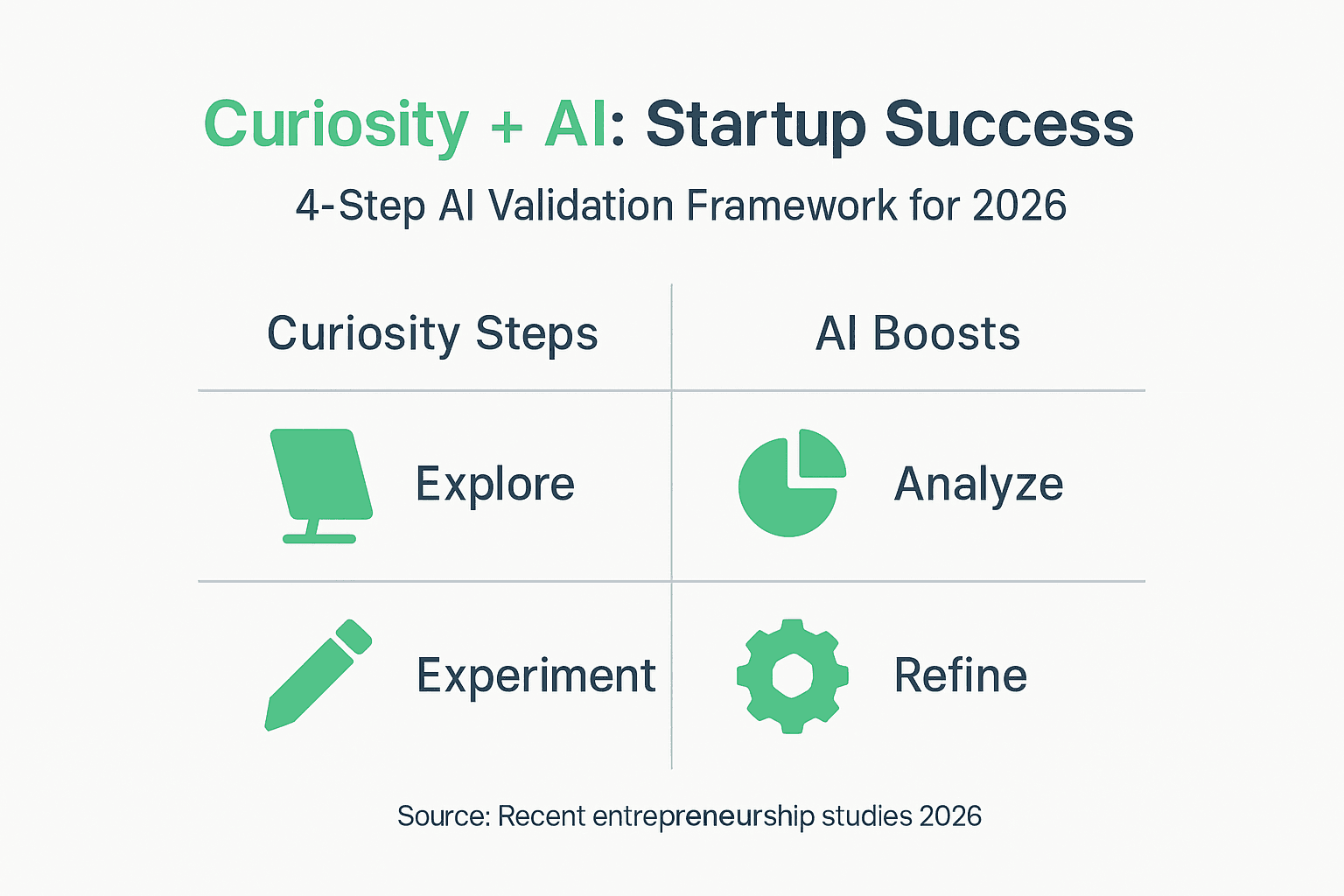
Step one: exploration. Start by asking broad questions about customer problems and market opportunities. Use AI tools like siift.ai to generate hypothesis lists about your target audience’s pain points. Your curiosity guides which angles to investigate first based on what feels most promising or surprising.
Step two: experimentation. Design small tests to validate your top hypotheses. Experimentation through curiosity reduces risk and increases confidence by testing ideas before full-scale launch using technological tools. AI platforms help you identify the fastest, cheapest experiments that yield maximum learning.
Step three: feedback integration. Analyze results with AI assistance, letting algorithms spot patterns while your curiosity interprets their business implications. AI platforms enhance curiosity by providing prioritized feedback and reducing bias, speeding validation and improving decision quality.
Step four: iteration. Based on insights, refine your business model and repeat the cycle. Each loop increases confidence while decreasing risk. AI accelerates validation in 6 ways by automating analysis and suggesting next experiments.
Practical application using siift.ai:
- Input your initial business idea and target customer segment
- Review AI-generated questions about market viability and customer needs
- Select three questions that spark your strongest curiosity
- Design quick experiments to answer those questions
- Feed results back into the platform for updated recommendations
- Repeat weekly until you achieve clear product-market fit signals
Pro Tip: Track which curiosity-driven questions led to your biggest pivots. This meta-learning helps you recognize valuable inquiry patterns.
Real example: Marcus used this framework to validate a B2B SaaS idea. His curiosity about why prospects delayed purchasing led to experiments revealing implementation complexity as the core barrier. AI analysis suggested a done-for-you onboarding service, which became his differentiator and closed deals 3x faster.
| Validation Approach | Time to First Customer | Pivot Frequency | Success Rate |
|---|---|---|---|
| Traditional (business plan focused) | 8-12 months | Low (sunk cost bias) | 23% |
| Curiosity without structure | 6-9 months | High (scattered focus) | 31% |
| AI-guided curiosity framework | 3-5 months | Optimal (data-driven) | 65% |
Structured curiosity reduces bias and blind spots during validation. When AI suggests you’re overlooking a customer segment or dismissing negative feedback, your curiosity investigates rather than defends. This openness accelerates learning and prevents costly mistakes.
Follow our step-by-step business validation guide for detailed implementation tactics. Combine it with using AI-powered business model canvas approaches to visualize how each validation insight fits into your overall strategy.
Unlock your startup potential with siift.ai’s AI-powered validation tools
Ready to transform your curiosity into validated business success? siift.ai offers AI tools specifically designed for curiosity-driven entrepreneurs who want to accelerate validation and reduce risks systematically. Our Intelligent Business Canvas guides you step-by-step through ideation, validation, and go-to-market planning, turning questions into actionable insights.
Leverage structured frameworks that channel your natural curiosity into prioritized experiments and clear next steps. Access our AI business model canvas guide to visualize how AI analyzes your assumptions and suggests improvements. Follow the fastest way to validate your business idea using tools that filter biases, blind spots, and distractions.
Pro Tip: Regularly combine siift.ai insights with your own curiosity sessions. Let AI identify patterns while you determine strategic priorities, creating a feedback loop that continuously refines your business model.
Frequently asked questions about the power of curiosity in AI-driven entrepreneurship
How can curiosity improve my startup’s chance of success?
Curiosity drives you to test assumptions early and often, catching flawed ideas before you waste resources. It pushes you to seek customer feedback, adapt to market signals, and spot opportunities competitors miss. Research shows curious entrepreneurs achieve product-market fit 42% faster because they learn continuously rather than defending initial plans.
What’s the best way to start leveraging AI if I’m not tech-savvy?
Start with curiosity about your customers and market rather than focusing on technical skills. Use beginner-friendly AI platforms like siift.ai that guide you through validation with plain language prompts. Your curiosity about asking better questions matters more than coding ability. Most modern AI tools require no programming, just clear thinking about what you want to learn.
Can curiosity replace technical knowledge in AI entrepreneurship?
Curiosity and technical knowledge serve different roles. Curiosity drives strategic insight and customer understanding, while technical knowledge helps implement solutions. For early validation and ideation, curiosity combined with AI tools delivers more value than technical skills alone. As you grow, you can hire technical talent while your curiosity guides product direction.
How do I avoid wasting time with unstructured curiosity?
Channel curiosity through frameworks like siift.ai’s step-by-step validation process. Set specific learning goals for each exploration phase. Use AI to prioritize which questions yield the highest-value insights. Time-box your curiosity sessions and always connect questions back to measurable business hypotheses. Structure transforms curiosity from wandering into directed discovery.
What is the biggest mistake entrepreneurs make using AI and curiosity?
Accepting AI outputs without applying curious skepticism. AI provides suggestions based on patterns, but you must question whether those patterns apply to your specific market context. The second mistake is asking shallow questions of AI tools instead of probing deeper. Treat AI as a thought partner that deserves your best curiosity, not a magic answer machine.
Recommended
- Siift Blog: Startup Success Stories Not Found – Explore Our Resources
- AI Accelerator: Fast-Tracking Startup Success in 2026 | siift
- Top Growth Strategies for Startups in 2026: Practical Steps for Beginners | siift
- 7 Best AI Tools for Founders 2026: Build Smarter Startups | siift
- Digital Strategy Tips 2026: 30% Efficiency Boost for UAE Leaders