
Most founders pour everything into building their startup, yet 75% of VC startups never exit profitably. That’s not a small risk. It’s a systemic blind spot. The founders who walk away with life-changing outcomes aren’t necessarily the ones with the best product. They’re the ones who treated their exit as a strategy, not an afterthought. This guide walks you through every major exit path available, how to prepare years in advance, and what buyers actually want when they come to the table. Whether you’re pre-seed or approaching Series B, the time to think about your exit is right now.
Table of Contents
- Understanding the main exit strategies
- Preparing for your ideal exit
- Executing an acquisition: What buyers want
- Navigating IPO, edge cases, and distressed exits
- Our take: Why early and realistic exit planning changes everything
- Ready to plan your startup’s next move?
- Frequently asked questions
Key Takeaways
| Point | Details |
|---|---|
| Start preparing early | Build your exit strategy and documentation at least 2-3 years in advance for maximum value. |
| Acquisition is fastest and most common | Most startups exit through acquisition, with strategic fit and clean financials being essential for success. |
| Align business metrics to exit type | Your growth, profitability, and systems should match your target exit—buyers, IPO, or edge cases. |
| Know alternative exit paths | Beyond acquisitions and IPOs, understand options like secondary sales, acqui-hires, and liquidation. |
| Avoid common mistakes | Neglecting early prep or misaligning incentives can cost founders millions in lost value. |
Understanding the main exit strategies
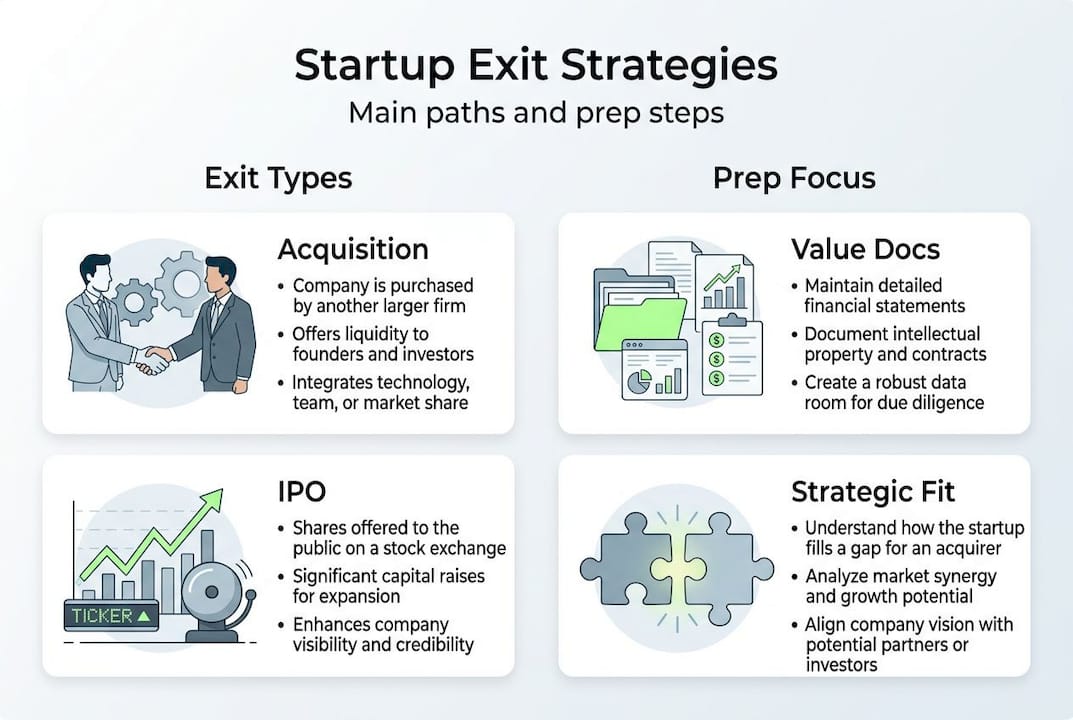
Before you can plan your exit, you need to know your options. Think of it like a map: you wouldn’t start a road trip without knowing the possible routes. Primary startup exit strategies include acquisition, IPO, mergers, secondary sales, management buyouts, and liquidation. Each one fits a different founder situation, business model, and investor expectation.
Here’s a quick comparison to orient you:
| Exit type | Best fit | Typical timeline | Equity outcome |
|---|---|---|---|
| Acquisition | Most startups | 3-12 months | High (3-10x revenue) |
| IPO | High-growth, $100M+ revenue | 12-24 months | Very high, but complex |
| Merger | Strategic alignment | 6-18 months | Variable |
| Secondary sale | Founder liquidity, early stage | 1-3 months | Partial |
| Management buyout | Operational teams | 6-12 months | Moderate |
| Liquidation | Distressed businesses | 1-6 months | Often zero |
Acquisition is by far the most traveled road. It accounts for 65 to 90% of all startup exits, and for good reason: it’s faster, more accessible, and doesn’t require the regulatory machinery of a public offering. Strategic acquirers, meaning larger companies buying for technology, talent, or market share, often pay significant premiums.
At the other end of the spectrum sits liquidation. When a startup winds down and sells its assets, returns are asset value only, often zero or negative for equity holders. It’s the exit nobody wants but many founders face without adequate planning.
Here’s a useful way to think about the middle ground:
- Secondary sales let founders cash out partial stakes without a full exit, useful when you need liquidity but believe in the company’s future
- Management buyouts work well when a strong internal team wants to take ownership and has access to financing
- Mergers create combined entities that can unlock new markets or eliminate competition
“The best exit strategy is the one you’ve designed before you needed it.” Founders who explore startup success stories consistently report that exit planning shaped their early decisions, from cap table structure to hiring choices.
Knowing your options is step one. Building toward the right one is where the real work begins.
Preparing for your ideal exit
With the landscape mapped, it’s time to build the foundation for a successful exit. Here’s the uncomfortable truth: 80% of businesses fail to sell without a plan. And founders who build transferable value two to three years before their intended exit see 50 to 100% higher proceeds. That’s not a marginal improvement. That’s the difference between a life-changing outcome and a disappointing one.
What does preparation actually look like? Follow these steps:
- Clean up your financials. Buyers want auditable, organized records. Messy books kill deals at the diligence stage faster than almost anything else.
- Develop your management layer. A business that runs only because of you is not a business a buyer wants. Build systems and a team that operates independently.
- Align your metrics to your exit type. Acquisition targets need strong revenue growth and customer retention. IPO candidates need a clear path to profitability. Know which metrics matter for your path.
- Optimize your cap table. Early planning shapes your cap table and funding decisions. Messy ownership structures with conflicting preferences can derail otherwise solid deals.
- Document everything. IP ownership, customer contracts, employment agreements, and vendor terms all need to be airtight.
Pro Tip: Transferable value is the single most powerful lever for increasing your exit multiple. If your startup’s value lives in your head or your relationships, buyers will discount it heavily. Systematize your knowledge, your processes, and your customer relationships into assets that survive your departure.
Common mistakes founders make include waiting until they receive an offer to start preparing, misaligning incentives between founders and investors, and underestimating how long diligence actually takes. Resources like tools for first-time founders and the AI founder guide can help you build these systems earlier and smarter.

Preparation isn’t glamorous. But it’s the work that separates founders who maximize their exit from those who leave millions on the table.
Executing an acquisition: What buyers want
Most founders aim for acquisition, so here’s what it takes to maximize your leverage. The acquisition timeline typically runs 3 to 12 months, from initial conversations to closing. Strategic buyers, those acquiring for technology, team, or market access, commonly pay 3 to 10x revenue. Financial buyers like private equity firms tend to pay less, focusing more on cash flow and operational efficiency.
Understanding what buyers scrutinize helps you build toward it:
| What buyers value | Why it matters |
|---|---|
| Proprietary technology | Defensible moat, reduces competition risk |
| Loyal customer base | Predictable revenue, lower churn |
| Strong team | Reduces integration risk |
| Clean financials | Speeds diligence, builds trust |
| Scalable systems | Signals growth potential post-acquisition |
Strategic fit is the variable most founders underestimate. A buyer doesn’t just want your product. They want to understand how your startup accelerates their roadmap, fills a gap in their portfolio, or neutralizes a competitive threat. That framing changes how you position yourself in early conversations.
Acquisition remains optimal for most startups because of its speed, prevalence, and lower barriers compared to an IPO. But optimal doesn’t mean automatic. You still need to do the work.
Here’s what to focus on:
- Build a pipeline of potential acquirers 18 to 24 months before you plan to sell
- Maintain warm relationships with strategic partners who could become buyers
- Track and present metrics in the format buyers in your sector expect
- Engage an M&A advisor or startup legal counsel early in the process
Pro Tip: Your first conversation with a potential acquirer is not a negotiation. It’s a relationship. Founders who approach getting early customers with the same discipline they apply to acquirer relationships consistently close better deals. The same principle applies to your launch business strategy: build with the end buyer in mind from day one.
For a deeper look at execution mechanics, the startup legal guide covers term sheets, reps and warranties, and post-close obligations in practical detail. And for founders still mapping their broader journey, step-by-step entrepreneurship resources can help connect early decisions to long-term exit outcomes.
Navigating IPO, edge cases, and distressed exits
For founders aiming bigger or facing unique situations, let’s break down alternative exit routes and critical pitfalls. The IPO is the headline exit that most founders dream about. But the reality is demanding. Traditional IPO prep takes 12 to 18 months, requires $100 million or more in annual revenue, and demands a credible path to profitability. That’s a high bar.
Alternate IPO tracks exist for founders who want public markets without the full traditional process:
- Direct listing: Existing shares go public immediately, providing liquidity without issuing new shares or raising fresh capital. Faster, but no new funding.
- SPAC (Special Purpose Acquisition Company): A blank-check company merges with your startup to take it public in 6 to 12 months. More flexible, but scrutiny has increased significantly since 2021.
- Traditional IPO: The gold standard, with full underwriting, roadshow, and institutional investor buy-in. Longest path, highest credibility.
Beyond these, edge cases are more common than most founders realize:
- Acqui-hires: The acquirer wants your team, not your product. Common at Series A and early Series B, especially in AI where talent is scarce
- Roll-ups: Private equity firms aggregate multiple small companies in a sector into a larger entity
- Asset-backed exits: IP-heavy distressed startups use Assignment for Benefit of Creditors (ABC) to sell core assets
- Reverse acqui-hires: In the current AI talent wars, larger companies are structuring deals specifically to absorb engineering and research teams
“Not every exit looks like a headline. Some of the most strategically sound exits happen quietly, through acqui-hires or asset sales that preserve team value and founder reputation.”
Distressed exits deserve honest attention. If your startup is running out of runway and acquisition isn’t materializing, liquidation may be the only path. The reality is stark: asset sales in distress return asset value only, and equity holders frequently receive nothing. The AI accelerator for exits and AI entrepreneur trends resources can help you identify pivot opportunities before you reach that point. Staying current on the 2026 AI outlook also matters, because market timing affects every exit path.
Our take: Why early and realistic exit planning changes everything
Here’s a perspective most founders never hear: the IPO fantasy is costing you money. Not because IPOs are bad, but because chasing that headline outcome leads founders to under-invest in the preparation that actually creates value across every exit type.
Acquisition is optimal for most startups because of speed, prevalence, and lower barriers. Yet we consistently see founders who are three years in, still haven’t mapped their cap table to an acquisition scenario, and are surprised when a buyer’s offer comes in well below expectations.
The founders who win are the ones who start exit thinking before their first major funding round. That’s not pessimism. It’s precision. When you know what a strategic buyer values, you build toward it. When you understand how metrics translate to multiples, you prioritize the right growth levers. When you explore startup success stories, the common thread isn’t luck. It’s intentional alignment between what was built and what the market rewarded.
Start now. Not when you get the first call from an acquirer.
Ready to plan your startup’s next move?
Exit planning isn’t a one-time event. It’s a discipline you build into your strategy from the beginning. At siift, we built the Intelligent Business Canvas specifically to help founders like you move from idea to validated strategy with clarity and speed. Whether you’re mapping your go-to-market, stress-testing your business model, or preparing the metrics that matter most to acquirers, siift guides you step by step. No guesswork. No generic advice. Just a systematic path toward the outcome you’re working toward. Explore startup exit solutions and see how the right platform can accelerate your founder journey from day one.
Frequently asked questions
What is the most common startup exit strategy?
Acquisition accounts for 65 to 90% of startup exits due to its speed, accessibility, and broad pool of strategic and financial buyers compared to alternatives like IPO.
How far in advance should I plan my startup exit?
Start at least 2 to 3 years before your intended exit. Founders who do this consistently see 50 to 100% higher proceeds by building transferable value into their operations and systems.
What are the requirements for a tech startup IPO?
A tech startup typically needs $100 million or more in annual revenue, a credible path to profitability, and 12 to 18 months of preparation time for a traditional public offering.
What happens if my startup faces liquidation?
Liquidation returns asset value only, and equity holders frequently receive zero or face negative returns, making it the least desirable exit outcome for founders and investors alike.
What expert strategies help ensure a successful exit?
Build transferable business value through strong systems and management, align your metrics to your exit type early, and treat exit planning as a core part of your founding strategy from day one.
Recommended
- Avoid common startup mistakes: 42% fail from no market need | siift
- Value Proposition Statement: Unlocking Startup Success | siift
- De-Risk My Startup Idea: Smarter Paths to Launch | siift
- Derisk Startup Strategy: Cut Failure Risk by 40% with Proven Steps | siift
- Cybersecurity Tips for Start-ups | Re-Solution Experts