
You feel busy but unproductive while building your business. Every day brings endless tasks, yet critical milestones slip further away. This guide offers proven productivity strategies tailored for entrepreneurs: goal-setting frameworks, distraction management, time-blocking techniques, AI-powered tools, and measurable improvements to accelerate your journey from idea to product-market fit.
Table of Contents
- Introduction To Productivity For Entrepreneurs
- Prerequisites: What You Need Before Improving Productivity
- Goal-Setting For Founders
- Time-Blocking And Focus Management
- Leveraging AI For Productivity Boosts
- Common Productivity Mistakes And How To Fix Them
- Measuring Productivity Outcomes And Success Metrics
- Boost Your Startup Productivity With Siift.ai
Key takeaways
| Point | Details |
|---|---|
| Structured goal-setting | SMART goals increase productivity by 25-30% by focusing efforts and reducing ambiguity. |
| Time-blocking eliminates distractions | Pomodoro Technique and notification management create sustained focus periods. |
| AI accelerates validation | AI tools reduce validation time from months to weeks with personalized feedback. |
| Avoid common mistakes | Multitasking reduces efficiency by 40-50%; overworking drops productivity 15-25%. |
| Track metrics for growth | Weekly productivity tracking links daily effort to business milestones. |
Introduction to productivity for entrepreneurs
Entrepreneurial productivity differs fundamentally from traditional workplace efficiency. Corporate employees optimize within established systems, but founders must validate ideas, wear multiple hats, and navigate undefined priorities simultaneously. Your productivity directly determines how quickly you reach product-market fit.
Side hustlers face unique challenges. You juggle a day job, personal commitments, and startup tasks with limited time. Traditional productivity advice assumes stable workflows and clear hierarchies. You need strategies that account for ambiguity, rapid pivots, and solo decision-making.
Effective entrepreneurial productivity encompasses three dimensions:
- Goal clarity: Knowing exactly what moves your business forward versus busy work
- Focus management: Protecting deep work time from constant interruptions and context switching
- Feedback loops: Quickly testing assumptions and iterating based on real market signals
Poor productivity creates costly delays. Every extra month spent building the wrong product or chasing the wrong customers increases burn rate and opportunity cost. Structured productivity strategies help you validate faster, pivot smarter, and launch with confidence.
Prerequisites: what you need before improving productivity
Before implementing productivity techniques, establish foundational elements that make improvements stick. Starting without these creates frustration and wasted effort.
You need clarity on your business direction. Whether you have a validated idea or exploring options, define what success looks like. Vague aspirations like “build something successful” provide no focus. Specific targets like “validate demand for this solution with 50 customer interviews” create measurable progress.
Basic time management infrastructure matters:
- Digital calendar for scheduling focused work blocks and meetings
- Task management system to capture ideas and track progress
- Note-taking tool for documenting customer insights and learnings
- Communication boundaries to protect focused work time
Understanding your distraction patterns enables targeted fixes. Track what interrupts you most: notifications, emails, social media, or internal task-switching. Honest assessment reveals where you lose the most productive time.
Pro Tip: Audit one typical workday before changing anything. Note every task, interruption, and time block. This baseline shows exactly where productivity leaks occur and which fixes deliver maximum impact.
Commitment to experimentation and adjustment separates successful productivity improvements from failed attempts. You will test techniques, measure results, and refine approaches. Productivity optimization is iterative, not a one-time fix.
Access to AI-based feedback tools accelerates validation and reduces guesswork. Modern platforms provide personalized insights that traditional methods cannot match, helping you prioritize high-impact activities over busy work.
Goal-setting for founders
Clear goals transform vague ambitions into actionable plans. The SMART framework provides structure specifically valuable for entrepreneurs managing uncertainty.
SMART goals are:
- Specific: Define exactly what you will accomplish, not general aspirations
- Measurable: Include concrete metrics to track progress objectively
- Achievable: Set challenging but realistic targets given your resources
- Relevant: Align directly with your path to product-market fit
- Time-bound: Establish deadlines that create urgency without causing burnout
Entrepreneurial goal examples include launching an MVP in three months, completing 30 customer discovery interviews in four weeks, or achieving 100 email signups before building features. Each goal provides clear direction and measurable outcomes.
Setting specific, measurable goals increases productivity by 25-30% by focusing efforts and reducing task ambiguity. Founders without clear goals waste time on activities that feel productive but don’t advance their business.
Align goals with validation milestones rather than arbitrary metrics. Early-stage founders should prioritize learning goals over vanity metrics. “Understand why customers currently solve this problem” beats “get 1,000 Instagram followers” for actual business progress.
“Goals that lack specificity lead to diffused effort and diminished results. Entrepreneurs who define measurable targets consistently outperform those who rely on general intentions.”
Break large goals into weekly sub-goals. If your three-month goal is launching an MVP, weekly targets might include finalizing feature scope, completing user flow designs, or building the core functionality. Weekly goals create momentum and reveal when you are off track quickly.

Review and adjust goals monthly. Market feedback may invalidate assumptions, requiring pivots. Rigid adherence to outdated goals wastes resources. Regular reviews keep goals relevant as you learn. Check the idea validation guide for frameworks that inform goal adjustments.
Time-blocking and focus management
Structured work time multiplies output by protecting focus from constant interruptions. Time-blocking assigns specific activities to defined periods, eliminating decision fatigue about what to work on next.
The Pomodoro Technique delivers sustained focus through 25-minute work blocks followed by five-minute breaks. After four cycles, take a longer 15-30 minute break. This rhythm maintains mental sharpness while preventing burnout. Entrepreneurs juggling multiple roles benefit from the forced breaks that prevent cognitive overload.
Customize time blocks for different startup tasks:
- Deep work blocks (90-120 minutes): Complex problem-solving, product development, strategic planning
- Communication blocks (30-60 minutes): Email responses, quick calls, team coordination
- Learning blocks (45-60 minutes): Customer interviews, market research, skill development
- Administrative blocks (30-45 minutes): Bookkeeping, scheduling, routine maintenance tasks
Digital distractions sabotage focus. Turn off all non-essential notifications during work blocks. Email, social media, and messaging apps create constant interruption cycles that fragment attention. Batch-process communications during designated blocks instead of responding reactively throughout the day.
Pro Tip: Use website blockers during deep work sessions to eliminate unconscious browsing. Apps like Freedom or Cold Turkey prevent access to distracting sites, removing temptation completely during critical focus periods.
Single-tasking beats multitasking every time. Your brain cannot effectively focus on multiple complex tasks simultaneously. Context-switching between activities wastes cognitive resources and increases errors. Complete one task fully before starting another.
Manage interruptions by setting boundaries. Communicate your focus schedule to family, roommates, or team members. Use visual signals like closed doors or do-not-disturb signs. Schedule office hours when others can interrupt you, protecting other time completely.
Weekly schedule example for side hustlers:
- Monday/Wednesday evenings (7-9pm): Deep work on product development
- Tuesday/Thursday mornings (6-7am): Customer research and interviews
- Saturday morning (9am-12pm): Strategic planning and goal review
- Sunday afternoon (2-4pm): Learning new skills and exploring best AI tools for founders 2026
Consistency matters more than volume. Two focused hours daily beats eight scattered hours weekly. Protect your scheduled blocks ruthlessly to build sustainable momentum.
Leveraging AI for productivity boosts
AI tools fundamentally accelerate entrepreneurial productivity by providing personalized insights, detecting blindspots, and prioritizing high-impact activities. Traditional validation methods require months of trial and error. Modern AI platforms compress this timeline to weeks.
AI reduces validation time by analyzing your business idea against market data, identifying overlooked risks, and suggesting targeted experiments. Instead of guessing which assumptions to test first, AI ranks them by impact and feasibility. This guidance prevents wasted effort on low-value activities.
AI identifies blindspots you cannot see alone. Confirmation bias leads founders to seek information supporting their beliefs while ignoring contradictory signals. AI provides objective analysis, highlighting weak assumptions and market mismatches before you invest significant resources.
| Traditional Methods | AI-Powered Platforms |
|---|---|
| Manual market research taking weeks | Automated competitive analysis in hours |
| Generic business advice from books | Personalized feedback on your specific idea |
| Trial and error with high failure rates | Data-driven recommendations reducing risk |
| Unclear prioritization of next steps | Ranked action items by impact |
| Delayed feedback loops | Real-time insights and adjustments |
AI features that enhance productivity include:
- Intelligent business canvas tools that guide systematic validation
- Risk detection algorithms identifying potential failures early
- Prioritization engines ranking tasks by strategic importance
- Personalized learning paths addressing your specific knowledge gaps
- Automated progress tracking linking activities to business milestones
Choose AI tools designed specifically for founders rather than general productivity apps. Generic tools lack context about startup challenges and validation processes. Specialized platforms like those covered in AI tools for first-time founders understand entrepreneurial workflows and provide relevant guidance.
Integrate AI into your daily routine gradually. Start with one tool addressing your biggest bottleneck, whether that is idea validation, customer research, or go-to-market planning. Master that tool before adding others to avoid overwhelming yourself with new systems.
AI excels at pattern recognition across vast datasets. It can spot market trends, customer pain points, and competitive gaps faster than manual analysis. This speed advantage compounds over time, letting you iterate and improve while competitors still research. Explore AI for business idea validation to understand validation applications specifically.
Common productivity mistakes and how to fix them
Entrepreneurs repeatedly fall into predictable traps that devastate productivity. Recognizing and correcting these mistakes immediately improves output and prevents burnout.
Multitasking reduces efficiency by 40-50%, leading to higher error rates and longer task completion times. Your brain cannot effectively process multiple complex tasks simultaneously. Context switching wastes cognitive resources. Each switch requires mental recalibration, fragmenting focus and reducing quality.
Fix: Implement strict single-tasking during work blocks. Complete one activity fully before starting another. If new tasks arise, capture them in your system for later rather than switching immediately.
Failing to delegate non-core tasks wastes your limited time on low-value activities. As a founder, your unique contribution involves strategic decisions, customer relationships, and product vision. Administrative tasks, basic design work, or routine operations can often be delegated or automated.
Fix: Identify tasks others can do 80% as well as you. Delegate or automate those activities. Focus your personal time on the 20% of work only you can do effectively.
Ignoring burnout signs decreases long-term productivity and health. Early warning signs include persistent fatigue, irritability, declining work quality, and loss of motivation. Pushing through burnout makes everything worse.
Fix: Schedule mandatory breaks and recovery time. Take at least one full day off weekly. Build sustainable work rhythms rather than heroic sprints.
“Sustainable productivity beats intense bursts followed by burnout. Founders who maintain steady momentum consistently outperform those who oscillate between extremes.”
Overworking beyond 50 hours per week leads to significant productivity decline, with performance dropping by 15-25%. Exhaustion impairs judgment, creativity, and execution. More hours do not equal more output beyond a threshold.
Fix: Set weekly hour limits and stick to them. If you cannot accomplish goals within reasonable hours, the problem is prioritization or efficiency, not insufficient time. Track actual productive hours rather than total time spent.
Common fixes summarized:
- Replace multitasking with focused single-task blocks
- Delegate or automate non-core activities immediately
- Recognize burnout early and adjust workload proactively
- Limit weekly work hours to maintain peak performance
- Schedule breaks and recovery time as non-negotiable appointments
Measuring productivity outcomes and success metrics
Tracking productivity quantifies improvements and reveals what works. Vague feelings about being more productive lack actionable data. Specific metrics link daily activities to business progress.
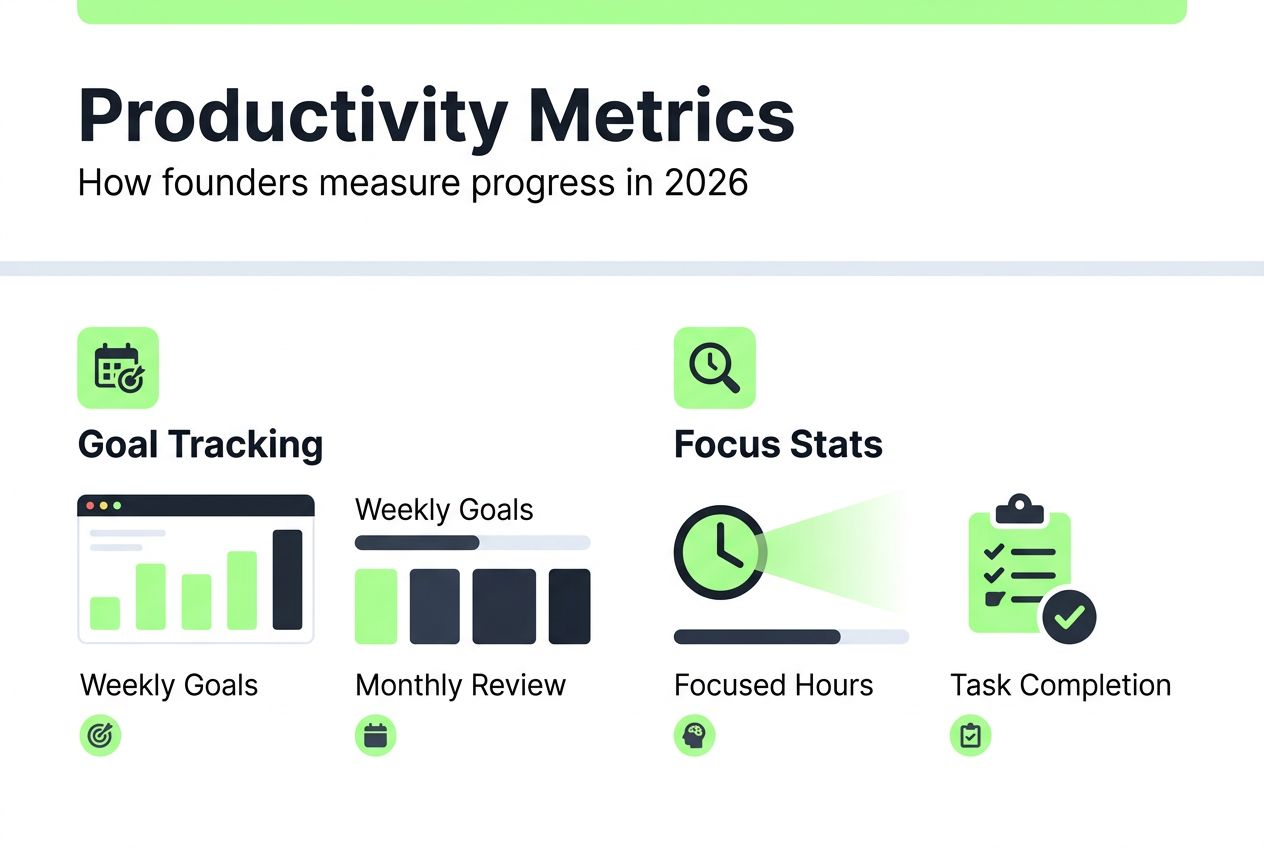
Weekly productivity tracking creates accountability. Set aside 30 minutes every Sunday to review the past week and plan the next. Document what you accomplished, where you got stuck, and what you learned. This reflection surfaces patterns invisible in daily work.
Key metrics to measure:
- Focused work hours: Track time spent in deep work versus distracted browsing or meetings
- Distraction frequency: Count interruptions per work block to measure improvement over time
- Validation speed: Monitor how quickly you complete customer interviews, experiments, or MVP iterations
- Goal completion rate: Percentage of weekly goals achieved on schedule
- Energy levels: Subjective 1-10 rating of mental clarity and motivation
| Metric | Week 1 Baseline | Week 4 Target | Week 8 Goal |
|---|---|---|---|
| Focused hours/week | 12 | 18 | 24 |
| Distractions/day | 15 | 8 | 5 |
| Customer interviews | 2 | 5 | 8 |
| Goal completion | 60% | 75% | 90% |
| Energy rating | 5/10 | 7/10 | 8/10 |
Interpret metrics to identify trends. If focused hours increase but goal completion stagnates, you may be working on wrong priorities. If distraction frequency drops but energy declines, you might need better breaks. Metrics reveal disconnects between effort and results.
Prioritization scores align daily activities with business objectives. Rate each task on two dimensions: impact on reaching product-market fit and urgency. Focus on high-impact activities regardless of urgency. Low-impact urgent tasks are traps that feel productive but advance nothing.
Milestone progress improvements demonstrate productivity gains:
- Validation cycle reduced from 8 weeks to 3 weeks through focused customer research
- MVP launch accelerated by 6 weeks using AI-powered prioritization
- Customer acquisition cost decreased 40% by eliminating low-impact marketing experiments
- Product iteration speed doubled through systematic feedback collection
Adjust strategies based on data. If time-blocking does not improve focus after four weeks, try different block lengths or times of day. If AI tools do not accelerate validation, reassess which tools you are using and how. Continuous experimentation guided by metrics drives sustained improvement.
Boost your startup productivity with siift.ai
Ready to accelerate your journey from idea to launch? siift.ai provides AI-driven feedback tailored specifically for entrepreneurs and side hustlers. The intelligent business canvas guides you systematically through ideation, validation, and go-to-market strategies.
siift.ai reduces validation time by providing personalized insights that identify blindspots, filter biases, and prioritize high-impact actions. The platform integrates goal-setting, task prioritization, and progress tracking in one unified system designed for founders. Stop guessing what to work on next. Let AI recommend your most important activities based on where you are in your founder’s journey.
FAQ
How can I reduce digital distractions as an aspiring entrepreneur?
Turn off unnecessary notifications and schedule dedicated times for email and social media rather than checking constantly. Use website blockers during work blocks to prevent unconscious browsing. Establish clear boundaries for device usage during focused work sessions.
What is the best way to set goals for a new business idea?
Use the SMART framework to create specific, measurable, achievable, relevant, and time-bound goals that guide progress. Align goals directly with validation milestones rather than vanity metrics. Break large goals into weekly sub-goals to maintain momentum and catch problems early.
How does AI help speed up startup productivity?
AI provides personalized feedback on your specific idea, identifies unseen risks, and recommends prioritized actions based on market data. It reduces time spent on guesswork by analyzing your assumptions against proven patterns. This accelerates decision-making and validation cycles significantly.
What are common mistakes that reduce productivity and how can I avoid them?
Avoid multitasking by focusing on single tasks during work blocks. Delegate low-impact activities that others can handle adequately. Set work hour limits below 50 hours per week to prevent the 15-25% productivity decline from overwork. Recognize burnout signs early and adjust your workload immediately.