
Starting a business can feel overwhelming when doubt and uncertainty cloud every decision. Many aspiring entrepreneurs struggle to translate ideas into viable businesses because they lack structured mindset development and validation processes. This guide presents an AI-powered, step-by-step approach to cultivate your entrepreneurial mindset effectively, helping you systematically increase your startup success chances while reducing common failure risks.
Table of Contents
- Prerequisites And What You Need Before Starting
- Understanding The Entrepreneurial Mindset
- Step-By-Step Mindset Development Process
- Leveraging AI Tools For Entrepreneurial Mindset Development
- Common Mistakes And Failure Points In Mindset Development
- Expected Results And Measurable Outcomes
- Summary And Next Steps
- Discover Siift.Ai – Your Partner In Entrepreneurial Mindset Growth
- Frequently Asked Questions
Key takeaways
| Point | Details |
|---|---|
| Mindset development impact | Entrepreneurial mindset development boosts startup survival by 30% through structured training programs. |
| AI efficiency gains | AI tools reduce decision-making time by 40% and lower operational costs by 15%. |
| Validation importance | Ignoring validation increases failure risk by 50%, making early testing critical. |
| Common pitfalls | Overconfidence and ignoring feedback account for 45% and 38% of early failures respectively. |
| Development timeline | Structured mindset development takes 3 to 6 months with measurable results. |
Prerequisites and what you need before starting
Before diving into mindset-building steps, ensure you have foundational prerequisites in place to maximize your success. These elements create the right conditions for effective entrepreneurial mindset development with AI assistance.
Basic business literacy or equivalent foundational knowledge is necessary to understand concepts and apply learnings effectively. You don’t need an MBA, but familiarity with business fundamentals helps you grasp validation frameworks and market analysis principles.
Access to mentors or an entrepreneurial community accelerates growth through feedback and support. Connecting with experienced founders provides real-world insights that complement AI-driven guidance. Consider joining startup meetups or online founder communities.
Familiarity and openness to using AI-driven tools is important for leveraging modern entrepreneurial resources. If you’re new to AI platforms, spend time exploring how they work before committing to building entrepreneurial mindset steps systematically.
Being ready to commit 3 to 6 months to consistent practice ensures meaningful mindset development. This isn’t a weekend project. Real transformation requires dedicated weekly sessions where you actively challenge assumptions and test hypotheses.
Pro Tip: Start small by setting aside focused weekly sessions for mindset exercises linked with AI platform tools. Block two hours every week specifically for ideation, validation reviews, and reflecting on feedback.
Understanding the entrepreneurial mindset
The entrepreneurial mindset includes resilience, adaptability, opportunity recognition, and data-driven decision-making. These traits aren’t innate. They develop through deliberate practice and structured learning experiences that challenge your assumptions.
Having this mindset improves your startup’s chances significantly. Research shows that structured entrepreneurial mindset training can boost your startup’s survival and success rates substantially compared to lacking organized development approaches.
Structured entrepreneurial mindset training can boost your startup’s chances by nearly a third.
AI tools provide continuous, personalized feedback that accelerates mindset evolution and highlights blind spots you might miss on your own. Traditional mentorship is valuable, but AI platforms offer 24/7 availability and unbiased analysis of your business assumptions.
A strong mindset helps founders pivot quickly and persist through challenges that would derail less prepared entrepreneurs. When market conditions shift or customer feedback contradicts your assumptions, adaptability becomes your greatest asset.
The ai tools for entrepreneurs guide explains how modern platforms support mindset development through systematic feedback loops. These tools analyze your responses, identify patterns in your thinking, and suggest adjustments to improve decision quality.
Key mindset components include:
- Resilience to bounce back from setbacks without losing momentum
- Adaptability to pivot strategies based on market feedback
- Opportunity recognition to spot viable business ideas others miss
- Data-driven thinking to replace gut instincts with validated insights
- Continuous learning orientation to evolve as markets change
Now that you understand what the entrepreneurial mindset is and why it matters, let’s walk through the precise steps to develop it systematically.
Step-by-step mindset development process
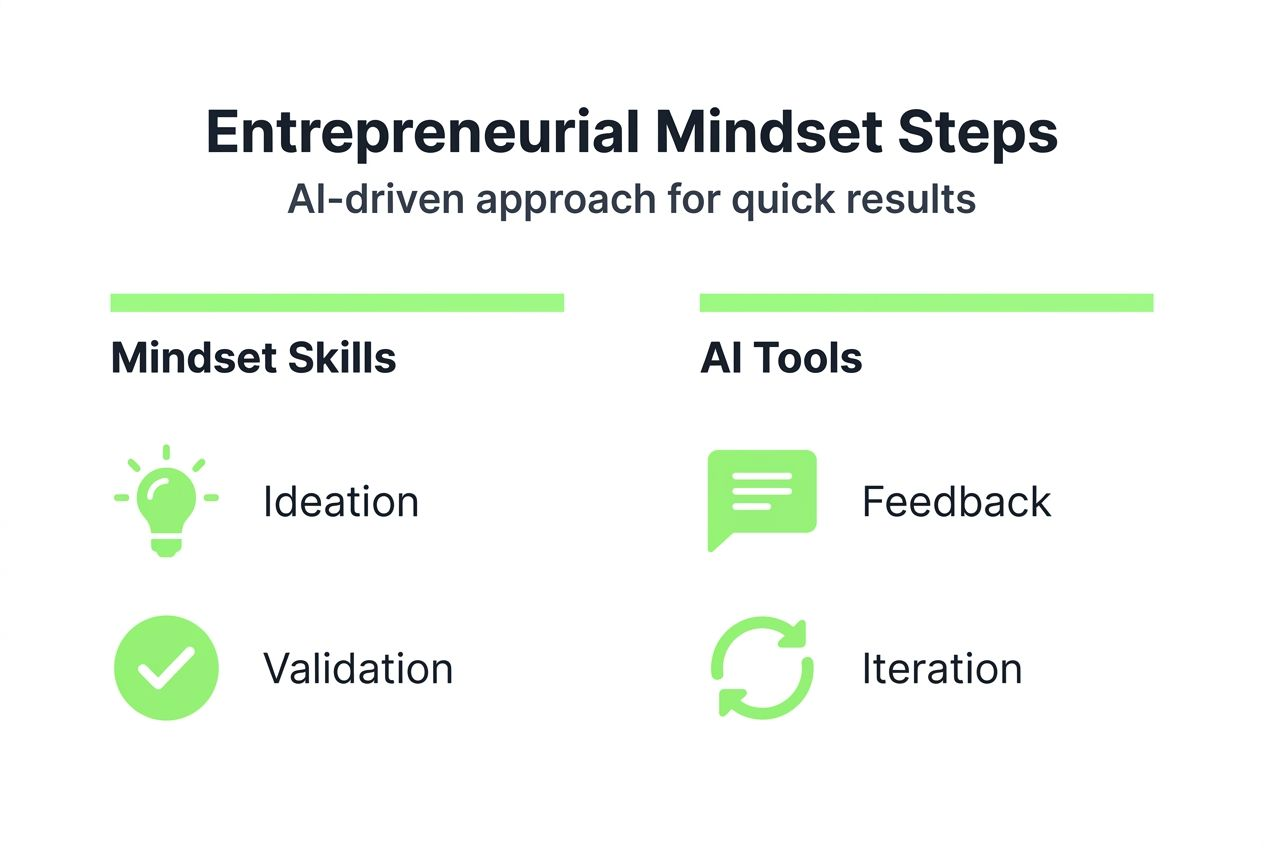
Developing an entrepreneurial mindset requires a structured approach that moves from ideation through validation to execution. This framework ensures you build each skill progressively while AI tools provide guidance and feedback.
Step 1: Ideate using AI to surface unbiased business ideas
Start by generating multiple business concepts without self-censorship. AI platforms help you explore opportunities beyond your immediate experience, reducing confirmation bias. Input your interests, skills, and market observations to receive diverse idea suggestions.
Step 2: Rigorously validate assumptions early
Every business idea rests on assumptions about customers, problems, and solutions. The validating business idea process emphasizes testing these assumptions before investing significant resources. Ignoring early validation steps increases startup failure risk by 50%.
Step 3: Rapidly iterate business models
Use AI-generated insights to refine your business model based on validation feedback. This iterative process helps you adjust value propositions, revenue streams, and customer segments systematically rather than guessing what might work.

Step 4: Build go-to-market strategies
Develop market entry plans with AI-assisted risk assessment and competitive analysis. Understanding how to reach early adopters and scale customer acquisition separates successful launches from failed attempts.
Step 5: Engage in continuous learning
Adopt an adaptable mindset that welcomes pivots informed by real-world data. Markets change, customer preferences evolve, and competitors emerge. Your ability to learn and adjust determines long-term viability.
| Step | Purpose | Key Activities | Expected Outcomes |
|---|---|---|---|
| Ideate | Generate diverse opportunities | AI-assisted brainstorming, market scanning | 10-15 viable business concepts |
| Validate | Test critical assumptions | Customer interviews, MVP testing | 50% risk reduction through early feedback |
| Iterate | Refine business model | Pivot based on data, adjust positioning | Stronger product-market fit indicators |
| Go-to-market | Plan market entry | Channel strategy, competitive analysis | Clear customer acquisition roadmap |
| Learn | Adapt continuously | Feedback loops, performance tracking | Sustained competitive advantage |
Pro Tip: Document assumptions clearly and revisit them frequently to improve learning speed. Create a simple spreadsheet tracking each assumption, the test you’ll run, and the results.
With this stepwise framework from mindset development steps guide, you can execute your mindset development methodically, avoiding common pitfalls that derail unprepared founders.
Leveraging AI tools for entrepreneurial mindset development
AI platforms fundamentally change how quickly and effectively you can develop entrepreneurial capabilities. These tools provide advantages traditional training methods can’t match in speed, personalization, and objectivity.
AI accelerates ideation and validation by providing data-driven, unbiased insights that challenge your assumptions. Instead of relying solely on personal experience or limited mentor availability, you get instant feedback on business hypotheses.
Personalized AI feedback uncovers blind spots often missed by founders themselves. We all have cognitive biases that distort our judgment. AI systems analyze your responses objectively, flagging inconsistencies and highlighting risks you might overlook.
AI tools reduce decision-making time by 40% while lowering costs by up to 15% compared to traditional consulting or training programs. This efficiency gain means you can test more ideas in less time with fewer resources.
Founders who integrate AI tools report higher confidence and adaptability when facing business challenges. The continuous feedback loop creates a learning environment that builds resilience through repeated practice.
| Aspect | Traditional Training | AI-Driven Platforms |
|---|---|---|
| Feedback speed | Days to weeks | Instant |
| Availability | Limited by mentor schedules | 24/7 access |
| Personalization | Generic frameworks | Customized to your situation |
| Cost | $5,000-$20,000+ for programs | $50-$500/month |
| Bias detection | Depends on mentor awareness | Systematic analysis |
| Scalability | One-on-one constraints | Unlimited users |
Key AI benefits for mindset development:
- Speed: Get immediate feedback instead of waiting for scheduled mentor meetings
- Accuracy: Data-driven insights reduce subjective judgment errors
- Cost savings: Affordable monthly subscriptions versus expensive training programs
- Personalized support: Tailored guidance based on your specific business context
- Continuous improvement: Regular check-ins that track progress over time
The ai tools for first-time founders resource explores specific platforms designed for entrepreneurs at different stages. Understanding AI’s critical role reveals why integrating these tools is essential for modern entrepreneurial success.
Common mistakes and failure points in mindset development
Even with structured approaches, aspiring entrepreneurs frequently stumble over predictable pitfalls. Recognizing these common failure points helps you adopt proactive habits that keep your mindset development on track.
Overconfidence affects about 45% of founders and can impair judgment leading to costly errors. Believing you understand your market without validation causes you to skip essential research steps. This hubris often stems from domain expertise that creates blind spots about customer needs.
Ignoring or resisting feedback contributes to 38% of early startup failures. When customers or mentors share concerns, defensiveness blocks learning. Your ego protects your idea instead of improving it based on market reality.
Skipping validation phases increases failure risk by 50%. Rushing to build products before confirming demand wastes time and money on solutions nobody wants. Consistent feedback loops prevent these expensive setbacks.
Lack of structured feedback systems is linked to 35% of development setbacks and missed market needs. Without organized processes for gathering and analyzing input, you can’t identify patterns or make informed pivots.
Pro Tip: Establish accountability partners or mentors to enforce feedback acceptance and challenge biases. Meet weekly with someone who will honestly critique your assumptions and hold you accountable for validation work.
Common mistakes with corrections:
- Overconfidence: Challenge every assumption with evidence; treat opinions as hypotheses requiring testing
- Feedback resistance: Create specific questions for customers; listen more than you talk in interviews
- Skipping validation: Set minimum validation thresholds before building; commit to testing with real users
- Unstructured feedback: Use templates for customer interviews; maintain organized records of all input
- Isolation: Join founder communities; share progress regularly to get external perspectives
The startup mistakes to avoid guide details additional pitfalls specific to first-time founders and how to sidestep them effectively.
Expected results and measurable outcomes
Setting realistic expectations for timelines, success metrics, and measurable outcomes helps you monitor progress and stay motivated along your entrepreneurial journey. Understanding what success looks like at each stage prevents discouragement.
Mindset development typically requires 3 to 6 months of consistent, structured effort. This timeframe assumes weekly practice sessions where you actively work on ideation, validation, or iteration activities. Shorter periods rarely produce lasting change.
You can expect measurable startup viability improvements of about 30% after completing a mindset program. This doesn’t guarantee success, but it significantly shifts odds in your favor compared to launching without structured preparation.
AI-supported entrepreneurs report a 25% boost in confidence and faster adaptability to challenges. This psychological shift matters because entrepreneurship tests your resolve repeatedly. Confidence helps you persist through inevitable setbacks.
| Milestone | Timeline | Success Indicators |
|---|---|---|
| Initial ideation | Weeks 1-4 | Generated 10+ business concepts; identified 3-5 promising opportunities |
| Assumption mapping | Weeks 5-8 | Documented critical assumptions; designed validation tests |
| Early validation | Weeks 9-16 | Conducted 20+ customer interviews; gathered quantitative data |
| Model iteration | Weeks 17-20 | Pivoted based on feedback; refined value proposition |
| Go-to-market planning | Weeks 21-24 | Created customer acquisition strategy; identified initial channels |
| Measurable progress | Month 6+ | 30% viability improvement; increased confidence in decisions |
Qualitative and quantitative progress markers:
- Reduced anxiety when making business decisions
- Increased willingness to test assumptions rather than defend them
- Faster identification of flawed hypotheses before investing resources
- Growing network of mentors and peers providing feedback
- Clear documentation of learnings and pivots over time
Setting realistic goals helps maintain motivation and track development effectively. Celebrate small wins like completing your first customer interview or identifying a flawed assumption before building. The entrepreneurial mindset development timeline provides detailed benchmarks for each development phase.
Summary and next steps
Structured entrepreneurial mindset training reduces risk systematically by replacing guesswork with validated learning. The framework outlined here provides a clear path from ideation through validation to market entry.
AI tools like siift.ai provide vital support during ideation, validation, and iteration by offering personalized feedback that uncovers blind spots. These platforms democratize access to high-quality guidance previously available only through expensive consultants or executive programs.
Consistent application leads to higher success rates and measurable progress within 3 to 6 months. The key is treating mindset development as a skill requiring deliberate practice, not a one-time workshop.
With the full picture clear, here’s how to begin applying these methods immediately for your entrepreneurial success:
- Review prerequisites: Assess your current business literacy and identify knowledge gaps to address
- Start AI-powered ideation: Use platforms to generate and evaluate multiple business concepts
- Schedule validation steps: Block time weekly for customer interviews and market research
- Engage mentorship: Find experienced founders willing to provide honest feedback on your progress
- Document learnings: Create systems for tracking assumptions, tests, and results systematically
Begin your journey by exploring the entrepreneurial mindset steps in detail and considering how siift.ai platform can accelerate your development process.
Discover siift.ai – your partner in entrepreneurial mindset growth
Ready to take your entrepreneurial mindset to the next level? The siift.ai platform offers AI-powered tools designed specifically to guide early-stage founders through ideation, validation, and go-to-market planning systematically.
The platform personalizes feedback based on your unique business context, accelerating learning while reducing failure risks and costs. Instead of generic advice, you receive tailored insights that address your specific assumptions and market conditions.
Using siift.ai aligns perfectly with the mindset development framework outlined in this article, delivering measurable success through structured processes. The Intelligent Business Canvas filters out biases, blind spots, and distractions that derail unprepared founders.
Explore ai tools for first-time founders to understand how the platform works, then begin your transformation journey. The entrepreneurial mindset steps guide provides additional context for maximizing platform benefits.
Frequently asked questions
How long does it typically take to develop an entrepreneurial mindset?
Mindset development usually requires 3 to 6 months of consistent, structured practice with weekly sessions dedicated to ideation, validation, and reflection. Shorter timelines rarely produce lasting behavioral changes. The exact duration depends on your starting point and commitment level.
What AI tools are best for early-stage entrepreneurs?
Platforms like siift.ai that offer step-by-step guidance through ideation, validation, and go-to-market planning work best for beginners. Look for tools providing personalized feedback rather than generic templates. The ideal platform should challenge your assumptions and highlight blind spots systematically.
How can I stay motivated during mindset development?
Set small, achievable milestones like completing your first customer interview or documenting ten business assumptions. Celebrate these wins to maintain momentum. Join founder communities for accountability and regular progress sharing.
What are the most common mindset mistakes to avoid?
Overconfidence and feedback resistance are the biggest pitfalls, affecting 45% and 38% of founders respectively. Combat these by treating every assumption as a hypothesis requiring testing and actively seeking criticism rather than validation. Establish accountability partners who will challenge your thinking honestly.
Can mindset development really reduce startup failure risk?
Yes, structured entrepreneurial mindset training reduces failure risk significantly. Research shows that early validation alone lowers failure probability by 50%, while comprehensive mindset programs improve overall startup survival rates by approximately 30%. These gains come from replacing guesswork with validated learning.
Recommended
- 7 Smart Ways to Use AI as an Entrepreneur for Business Growth | siift
- Step-by-Step Guide to AI Entrepreneurship Success with siift.ai
- Power of curiosity in 2026: Boost startup success 42% faster | siift
- 7 Best AI Tools for Founders 2026: Build Smarter Startups | siift
- Embracing the Future: CCS Introduces AI-Focused Events for Audit Professionals in 2025