
TL;DR:
- Confidence, or self-efficacy, significantly increases startup survival, income, and innovation.
- Building entrepreneurial confidence requires deliberate preparation, repetition, and real-world practice.
- Confidence is a system constructed through continuous actions, feedback, and small wins over time.
Starting a business when you feel underprepared is one of the most disorienting experiences a first-time founder faces. That nagging voice asking “who am I to do this?” is nearly universal, yet most advice skips right past it. The gap is real: 40% of Gen Z feel overwhelmed when starting a business, even though 41% believe young people are best positioned to build one. The good news is that confidence isn’t a personality trait you’re either born with or without. It’s a skill set you can deliberately build, and this guide gives you the research-backed, step-by-step roadmap to do exactly that.
Table of Contents
- Why confidence matters for entrepreneurs
- Prep work: Laying the foundation for confidence
- Step-by-step: Building real-world confidence
- Common barriers and how to overcome them
- Validating your progress: Measuring confidence gains
- A fresh take: Why confidence is a system, not a trait
- Next steps: Grow your confidence with powerful tools
- Frequently asked questions
Key Takeaways
| Point | Details |
|---|---|
| Confidence predicts success | Higher entrepreneurial self-confidence leads to better survival, more innovation, and higher income. |
| Preparation matters | Deliberate learning, story crafting, and professionalism build a solid foundation for self-belief. |
| Practice builds conviction | Regularly pitching your ideas and integrating feedback help sharpen clarity and confidence. |
| Barriers can be overcome | Impostor syndrome and overwhelm are common but conquerable with focused actions and micro-expertise. |
| Confidence is trainable | Self-efficacy grows step by step, and anyone can strengthen it with the right approach. |
Why confidence matters for entrepreneurs
With the challenge clear, let’s explore why confidence doesn’t just feel good. It directly impacts entrepreneurial results in ways that show up on your balance sheet and your survival odds.
Researchers call it self-efficacy: your belief in your ability to execute specific tasks and achieve meaningful outcomes. It’s not arrogance. It’s not bravado. It’s a calm, earned conviction that you can figure things out when they get hard. And it turns out, that conviction is one of the strongest predictors of whether your startup will still exist in three years.
A study of 1,405 German founders found that generalized self-efficacy increases startup survival probability by 3 percentage points per standard deviation, boosts income, and drives higher rates of innovation. That’s not a soft benefit. That’s a measurable, economically significant edge. Founders with stronger self-efficacy were more likely to take calculated risks, iterate faster, and push through the inevitable valleys every new business goes through.
| Confidence level | Startup survival impact | Innovation rate | Income effect |
|---|---|---|---|
| Low self-efficacy | Baseline | Lower | Baseline |
| Average self-efficacy | +1.5pp over baseline | Moderate | +4% per SD |
| High self-efficacy | +3pp over baseline | Significantly higher | +8% per SD |
There’s also an important nuance worth understanding early: generalized confidence is different from domain-specific confidence. Generalized self-efficacy is your overall belief in your ability to handle challenges. Domain-specific confidence is your belief in a particular skill, like pitching, coding, or selling. Both matter, but they develop differently. Our startup validation guide digs into how domain-specific confidence grows through direct market testing.
“Self-efficacy is not about thinking you’ll never fail. It’s about believing you can recover, adapt, and still reach your goals even when the path shifts.” — Adapted from self-efficacy research frameworks
The practical benefits of high entrepreneurial confidence are worth naming directly:
- Clearer decision-making: You act on evidence rather than freezing under uncertainty.
- Greater innovation: You’re more willing to experiment because you believe in your capacity to handle the results.
- Stronger resilience: Setbacks become data points, not verdicts on your worth.
- Better stakeholder relationships: Investors, partners, and customers respond to founders who project earned conviction.
- Faster pivots: You move from “what went wrong?” to “what do we try next?” with less emotional drag.
Prep work: Laying the foundation for confidence
Now that we know why confidence is essential, it’s time to build a solid foundation through focused prep work. The single most underrated confidence builder isn’t affirmations or vision boards. It’s preparation. Thorough, deliberate, structured preparation.

Boosting your knowledge before meetings and pitches is one of the most consistently cited strategies for overcoming early-stage founder anxiety. When you know your market, your numbers, and your customer deeply, you walk into any room with something to stand on. That’s not fake confidence. That’s earned certainty.
To help you figure out which learning method fits your current stage, here’s a quick comparison:
| Learning method | Pros | Cons | Best for |
|---|---|---|---|
| Online courses (Coursera, Maven) | Structured, self-paced, affordable | Can feel theoretical without application | Complete beginners building foundational knowledge |
| Mentor or coach sessions | Personalized, high signal, builds network | Harder to access, can be costly | Founders who have a concept and need reality-checks |
| Learn by doing (beta launches, MVPs) | Real feedback, fast iteration | Risk of overwhelm without prior framework | Founders ready to test with low-stakes prototypes |
Practical steps to lay your foundation right now:
- Enroll in one focused course on your business’s core domain, whether that’s marketing, finance, or product development. Just one, not five.
- Set up a minimal but professional digital presence. A clean website and a crisp email signature signal legitimacy, to prospects and to yourself.
- Craft your founder story. Know why you’re building this, for whom, and what problem you’re solving. Practice saying it out loud until it feels natural.
- Research your three closest competitors thoroughly. Understanding the landscape gives you vocabulary and conviction in any conversation.
- Build your entrepreneurial mindset from the inside out. Mindset and prep aren’t opposites. They reinforce each other.
Pro Tip: Focus on mastering one core skill or domain at a time. The temptation to learn everything at once is real, but it scatters your attention and slows your progress. Pick the skill most critical to your next milestone, go deep on it, then move to the next.
Step-by-step: Building real-world confidence
With the groundwork in place, here’s how to move from preparation into confident action. Knowledge without repetition stays fragile. You need to put it into practice in real-world conditions, and you need to do it more than once.
Practicing your pitch and founder story repeatedly is not a cliché. It’s how clarity and conviction actually develop. Every time you say your idea out loud to a real person, you refine it. You learn what lands and what confuses people. You hear your own uncertainty and gradually replace it with earned authority.
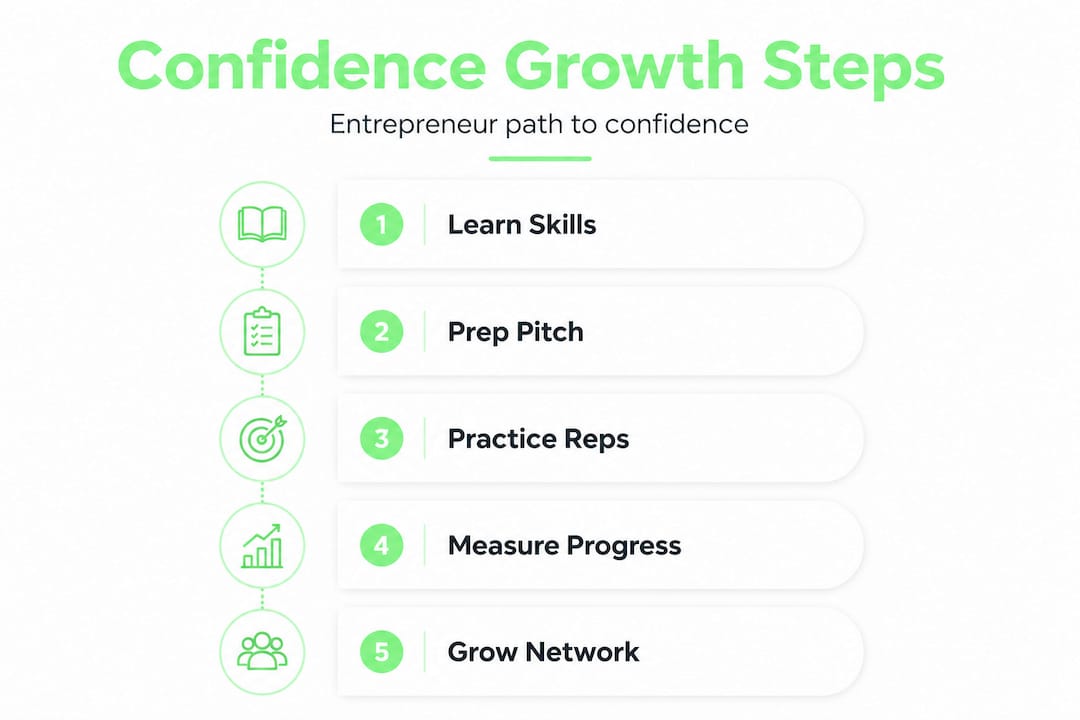
Here’s a sequenced approach that works:
- Identify the problem you’re solving. Write it down in one clear sentence. If you can’t do this yet, start here and don’t move on until you can.
- Write your founder story. Why you, why now, why this problem? Authenticity builds trust, with audiences and with yourself.
- Practice pitching to a trusted ally. A mentor, a fellow founder, or even a supportive friend. Get feedback on clarity, not just encouragement.
- Pitch to a neutral or unfamiliar audience. Strangers give you the unfiltered reactions that matter most. Join a startup meetup, apply to a pitch event, or post in an online founder community.
- Gather feedback systematically and integrate it. Don’t just collect opinions. Notice patterns. Two people saying the same confusing thing is a signal, not a coincidence.
- Repeat the full cycle at least monthly. Confidence compounds through iteration, not through a single great performance.
“Confidence grows not from certainty, but from the repeated experience of facing uncertainty and moving forward anyway.”
You can also deepen your preparation by reading our pitching ideas guide, which covers how to structure your pitch for different types of audiences, including investors, early customers, and potential collaborators.
Pro Tip: Practice with both allies and neutral audiences. Allies give you safe reps and emotional support. Neutral audiences give you honest signal. You need both to build confidence that holds up under real pressure.
Common barriers and how to overcome them
All progress comes with setbacks. Here’s how to navigate the most common traps that can undermine a budding founder’s confidence before they even get started.
The most frequently cited barrier is impostor syndrome: the persistent feeling that you’re not qualified, that you’ll be exposed as a fraud, that everyone else knows things you don’t. It’s especially acute among young founders facing funding gaps and lacking established networks. The antidote isn’t waiting until you feel ready. It’s building micro-expertise that you can point to and say, “I know this specific thing deeply.”
Other common barriers include:
- Overwhelm: Too many decisions, too many options, too little clarity on what matters most right now.
- Funding anxiety: Fear that without money, nothing is possible. This creates paralysis before any evidence of failure exists.
- Comparison traps: Measuring your early chapter against someone else’s later chapter, especially on social media where only wins get posted.
- Lack of a trusted network: Going it alone amplifies every doubt and eliminates the reality-checks that come from community.
Proven solutions that actually move the needle:
- Build micro-expertise in one specific task or domain. Become the person who really understands your customer’s biggest pain point, or your market’s pricing dynamics. Depth beats breadth at this stage.
- Seek out honest mentor feedback from people who have built businesses before. Not cheerleaders. Honest coaches.
- Limit comparison to others by tracking your own trajectory week over week. Are you clearer than you were 30 days ago? That’s the only metric that matters in early stages.
- Use structured tools to identify your startup blindspots before they become expensive mistakes. Blindspots are confidence killers precisely because they’re invisible until they blow up.
Pro Tip: Break your goals into the smallest achievable action you can take in the next 48 hours. Big goals feel overwhelming. Small wins build momentum, and momentum is what transforms hesitant founders into decisive ones.
Validating your progress: Measuring confidence gains
Once you’re putting these strategies into practice, it’s time to measure real progress and reinforce your gains. Confidence without feedback loops is just hope. You need a system.
The research is clear: self-efficacy is trainable through entrepreneurship education, and its effects are strongest when tied to real survival and innovation outcomes. That means the feedback loops you set up need to connect to business results, not just how you feel on a given morning.
| Confidence-building activity | Business outcome indicator | Timeline to see signal |
|---|---|---|
| Regular pitch practice | Higher clarity in investor conversations | 4 to 6 weeks |
| Consistent mentor feedback sessions | Faster pivots and better decisions | 6 to 8 weeks |
| Structured competitor research | Stronger positioning statements | 2 to 4 weeks |
| Customer interview practice | More actionable product feedback | 2 to 4 weeks |
| Weekly reflection and journaling | Improved resilience and reduced anxiety | Ongoing |
Use this self-check routine monthly to keep your growth visible and honest:
- Rate your conviction on key tasks. On a scale from 1 to 10, how confident are you pitching, handling objections, and explaining your business model? Track this number over time.
- Seek outside validation. Ask a mentor or peer: “Where do you see me growing? Where do you still see hesitation?” Outside eyes catch what self-assessment misses.
- Record and reflect on meaningful growth. Keep a founder journal. Document what scared you three months ago that feels manageable today. That evidence is more motivating than any motivational quote.
For a more structured pathway from these milestones to launch, explore our startup launch steps resource.
A fresh take: Why confidence is a system, not a trait
Understanding how to measure progress brings us to a deeper question. What is confidence, really, and how should you think about growing it?
Here’s the honest truth most guides won’t say: confidence is not a trait you discover. It’s a system you construct. Every pitch rep, every mentor session, every uncomfortable feedback conversation, every pivot you survive, adds another brick to that system. Treat it like infrastructure, not inspiration.
The myth is that confident founders were always confident. That their boldness is just who they are. But what you don’t see is the hundreds of quiet repetitions that preceded every seemingly effortless pitch. The late-night self-doubt they processed in journals, peer groups, and coaching sessions. Confidence looks innate from the outside because the system that built it is invisible.
Think of it like a training regimen. You don’t walk into a gym once and expect to lift heavy. You build capacity through progressive overload, recovery, and consistent practice over time. Entrepreneurial confidence works the same way. Each small act of courage, telling your idea to a stranger, asking for honest feedback, making the first cold outreach, is a rep that makes the next one easier.
The other thing worth saying directly: failing safely is a feature, not a bug. The goal isn’t to avoid all setbacks. It’s to create conditions where setbacks generate learning rather than shutdown. Low-stakes experiments, honest feedback, quick reflection cycles. Getting startup traction isn’t about one massive bet. It’s about hundreds of smaller bets that compound into a pattern of momentum.
Stop asking yourself “am I confident enough to start?” Start asking yourself “what’s the smallest action I can take today to build one more rep?” That reframe changes everything.
Next steps: Grow your confidence with powerful tools
Now that you have a blueprint for building confidence, take advantage of modern tools and networks to accelerate your growth journey. Reading about confidence is the beginning. Acting on it is the whole game.
At siift.ai, we built a platform specifically for founders who are serious about turning ideas into validated, fundable businesses. siift’s New Business OS guides you step-by-step through ideation, validation, and go-to-market strategy using Agentic AI that filters out the biases, blindspots, and noise that erode confidence and slow momentum. Rather than relying on generic tools that give you broad answers, siift gives you a structured path tailored to your specific idea and market. It’s like having a sharp, experienced co-founder in your corner every step of the way. If you’re ready to move from anxious to action-ready, start your founder journey with siift today.
Frequently asked questions
What is the fastest way to build confidence as a new entrepreneur?
Focus on small wins first: practice pitching regularly to trusted mentors and neutral audiences, and let the clarity from repetition build your conviction naturally.
Can confidence really affect my business’s survival?
Absolutely. Higher self-efficacy can increase startup survival by around 3 percentage points per standard deviation, while also improving income and innovation outcomes.
How do I overcome impostor syndrome as a first-time founder?
Build deep expertise in one focused area and seek honest feedback from mentors; targeted preparation is the most effective counter to impostor syndrome.
Is confidence an innate trait or can it be developed?
It can absolutely be developed. Self-efficacy is trainable through entrepreneurship education, deliberate practice, and structured feedback, and its effects grow stronger over time.
Recommended
- Business Communication Skills for Aspiring Entrepreneurs 2025 | siift
- Reflections on 10+ years as a Founder: Advice for New and Young Entrepreneurs | siift
- How to Find Mentors: A Guide for Aspiring Entrepreneurs | siift
- Building Entrepreneurial Mindset: Steps for Beginners in 2025 | siift
- De juiste verzekeringen kiezen als startende ondernemer - Zakelijkeverzekering