
Every founder knows that starting a business means navigating uncertainty at every turn. From unexpected market shifts to rapid changes in technology, risk is built into the DNA of every entrepreneurial venture. Ignoring common pitfalls can turn small missteps into major setbacks, but learning how to define and manage risk puts you in control. This guide helps you recognize where challenges come from and how to address them head-on to keep your vision on track.
Table of Contents
- Defining Business Risk and Common Pitfalls
- Identifying and Prioritizing High-Impact Assumptions
- Validating Problem and Willingness to Pay First
- Sequencing Risks by Market, Solution, Execution
- Running Fast, Cheap Experiments Without Scaling
- Overcoming Founder Bias, Blindspots, and Distractions
Key Takeaways
| Point | Details |
|---|---|
| Understanding Business Risk | Recognizing various types of risks, such as financial and operational, is crucial for entrepreneurs in navigating uncertainty. |
| Prioritizing Assumptions | Focus on high-impact assumptions by evaluating their probability, potential impact, and validation speed to effectively manage risks. |
| Implementing Lean Experiments | Conduct structured, cost-effective experiments to validate business hypotheses without extensive financial commitment. |
| Combating Founder Bias | Address cognitive biases by seeking diverse perspectives and establishing external accountability to enhance strategic decision-making. |
Defining Business Risk and Common Pitfalls
Business risk represents the potential for unexpected outcomes that could impact a company’s financial health, operational effectiveness, or strategic objectives. Understanding modern business risk involves recognizing that uncertainty is inherent in every entrepreneurial journey, not just a theoretical concept.
Risk manifests in multiple dimensions for founders, including:
- Financial Risk: Potential loss of capital or inability to generate revenue
- Operational Risk: Challenges in executing business processes effectively
- Market Risk: Changes in customer demand, competitive landscape, or economic conditions
- Technological Risk: Disruption from emerging technologies or rapid industry shifts
- Regulatory Risk: Potential legal or compliance challenges
Founders often encounter common pitfalls that amplify business risk. These include:
Here’s a comparison of common business risk types and strategic ways to mitigate them:
| Risk Type | Typical Impact | Example Mitigation Action |
|---|---|---|
| Financial Risk | Reduced cash or resources | Diversify revenue streams |
| Operational Risk | Inefficient operations | Streamline internal processes |
| Market Risk | Fluctuating customer demand | Expand into new market segments |
| Technological Risk | Outdated products/services | Invest in ongoing R&D |
| Regulatory Risk | Legal or compliance issues | Consult regulatory experts |
- Overestimating market demand
- Underestimating required capital
- Neglecting comprehensive market research
- Failing to adapt to changing conditions
- Inadequate risk management strategies
Business risk is not about eliminating uncertainty, but strategically navigating potential challenges with informed decision-making.
The most successful entrepreneurs approach risk not as a barrier, but as a calculated element of their strategic planning. Integrating holistic risk management means continuously identifying potential threats, assessing their probability, and developing proactive mitigation strategies.
Pro tip: Develop a systematic risk assessment framework that you review quarterly, treating risk management as an ongoing strategic process rather than a one-time exercise.
Identifying and Prioritizing High-Impact Assumptions
Successful founders understand that not all business assumptions are created equal. Identifying critical research assumptions requires a strategic approach that systematically evaluates potential risks and their potential impact on business outcomes.
When prioritizing high-impact assumptions, entrepreneurs should focus on key evaluation criteria:
- Probability of Occurrence: How likely is the assumption to materialize?
- Potential Impact: What is the magnitude of consequences if the assumption proves incorrect?
- Cost of Mitigation: How expensive or complex would it be to address potential risks?
- Speed of Validation: How quickly can you test and verify the assumption?
- Interdependence: How might this assumption affect other critical business hypotheses?
Founders can apply a structured approach to prioritizing assumptions:
- Create a comprehensive list of all business assumptions
- Score each assumption based on impact and probability
- Categorize assumptions into high, medium, and low-priority tiers
- Develop targeted validation strategies for top-priority assumptions
- Continuously monitor and reassess assumptions as the business evolves
Not all risks are equal - focus your energy on assumptions that could fundamentally derail your business strategy.
Systematic barrier evaluation techniques suggest using a scoring matrix that helps entrepreneurs objectively rank their assumptions. This approach transforms risk assessment from a subjective exercise into a data-driven decision-making process.

Pro tip: Create a living document that tracks your key assumptions, updating it quarterly with new insights and validation results to maintain a dynamic risk management strategy.
Validating Problem and Willingness to Pay First
Validating the problem and customers’ willingness to pay represents the most critical early-stage risk mitigation strategy for entrepreneurs. Economic perspectives on willingness to pay reveal that understanding customer motivation goes far beyond simple price point analysis.
Founders must systematically validate their core business assumptions through multiple validation techniques:
- Problem Interviews: Deeply understand customer pain points
- Solution Prototyping: Create minimal viable product concepts
- Price Sensitivity Testing: Explore different pricing scenarios
- Comparative Market Analysis: Benchmark against existing solutions
- Customer Feedback Loops: Continuously iterate based on insights
Effective validation requires a structured approach to measuring customer interest:
- Define your specific customer segment
- Develop precise hypotheses about their problems
- Design targeted research methods
- Collect quantitative and qualitative data
- Analyze results objectively
Real validation means being willing to hear that your initial idea might not work - and being ready to pivot.
Customer willingness to pay research demonstrates that entrepreneurs must move beyond assumptions and gather empirical evidence about market demand. This means creating experiments that reveal genuine customer intentions, not just theoretical interest.
Pro tip: Build a validation framework that treats every assumption as a hypothesis to be rigorously tested, not a fact to be defended.
Sequencing Risks by Market, Solution, Execution
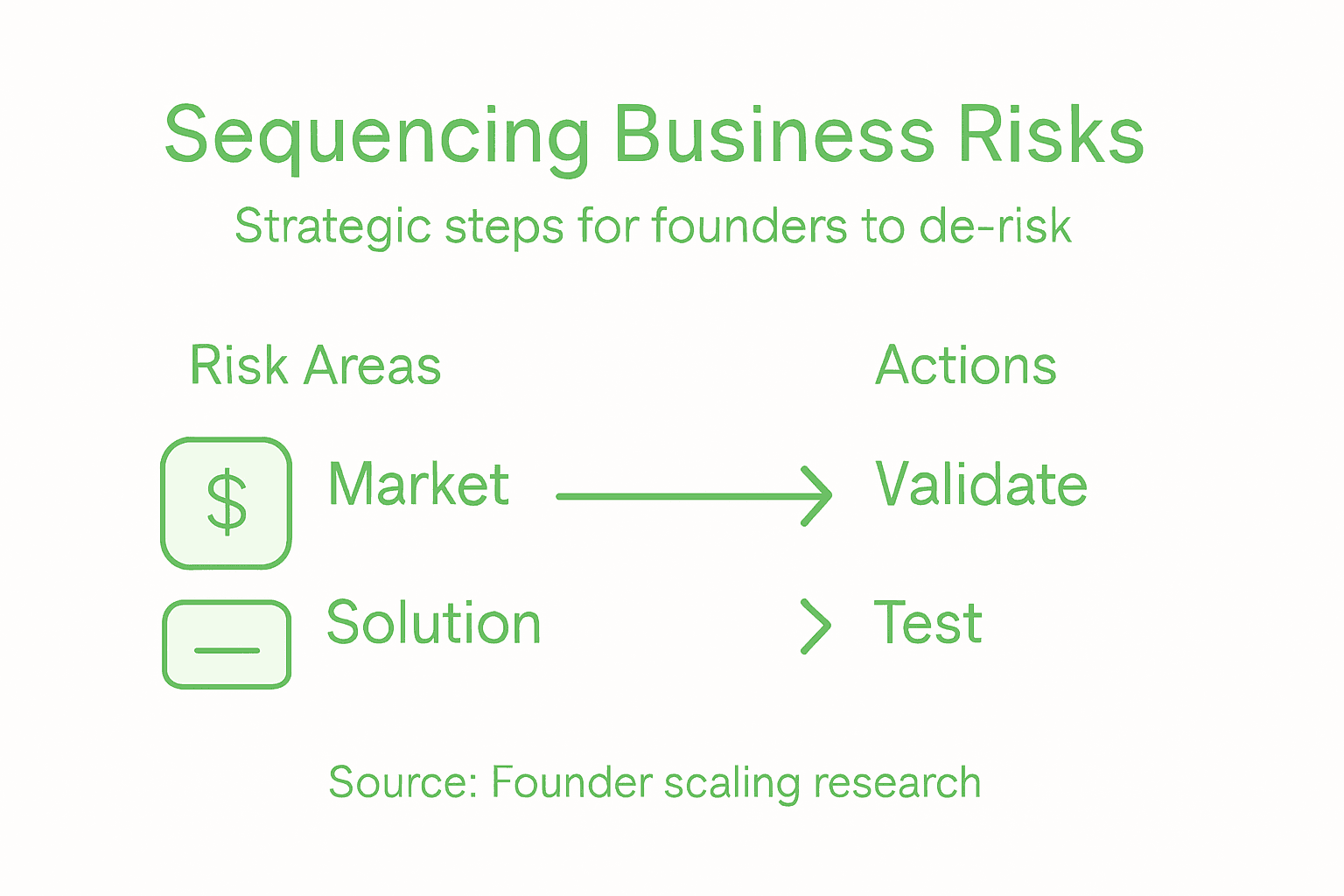
Successful founders understand that business risk isn’t a monolithic challenge, but a strategic sequence of interconnected hurdles. Strategic risk management approaches reveal a critical hierarchy in addressing entrepreneurial uncertainty.
The recommended risk sequencing follows a strategic progression:
- Market Risk: Validate customer problem and demand
- Solution Risk: Design viable product addressing market needs
- Execution Risk: Build capabilities to deliver solution effectively
- Scaling Risk: Expand operations with validated market understanding
- Sustainability Risk: Ensure long-term business model viability
Founders should approach risk mitigation through a deliberate, staged process:
- Deeply understand target market dynamics
- Prototype minimum viable solutions
- Test solution effectiveness with real customers
- Build repeatable execution capabilities
- Gradually expand market presence
Risk sequencing isn’t linear - it’s an iterative dance of continuous learning and adaptation.
Startup scaling research demonstrates that premature scaling dramatically increases failure probability. Entrepreneurs must resist the temptation to accelerate before thoroughly validating each risk stage.
Pro tip: Create a risk tracking dashboard that allows you to monitor and update your assumptions across market, solution, and execution dimensions as you progress.
Running Fast, Cheap Experiments Without Scaling
Entrepreneurs must master the art of lean experimentation - running targeted tests that reveal critical insights without massive financial investment. Online controlled experiment techniques provide sophisticated yet cost-effective methods for validating business hypotheses rapidly.
Effective experimental approaches include:
- Landing Page Tests: Create minimal product pages to gauge market interest
- Social Media Surveys: Rapidly collect customer feedback
- Prototype Simulations: Build low-fidelity mockups
- Concierge MVP: Manually deliver proposed solution
- Shadow Testing: Simulate product experience without full infrastructure
Founders should follow a structured experimental framework:
- Define precise hypothesis
- Design minimal test mechanism
- Establish clear success/failure criteria
- Execute quickly and objectively
- Document and interpret results
Cheap experiments aren’t about cutting corners - they’re about maximizing learning while minimizing risk.
Efficient test-time scaling methods demonstrate that strategic experimentation can provide robust insights without requiring substantial resources. The key is designing experiments that are both scientifically rigorous and financially prudent.
Below is a summary of experimental methods founders can use before scaling:
| Experiment Type | Typical Timescale | Learning Outcome |
|---|---|---|
| Landing Page Test | 1-2 weeks | Gauges real market interest |
| Social Media Survey | 2-7 days | Validates customer preferences |
| Prototype Simulation | 1 week | Assesses usability, concept fit |
| Concierge MVP | 1 month | Direct feedback on solution |
| Shadow Testing | 2 weeks | Observes behavior in real time |
Pro tip: Allocate a small, fixed experimental budget each month and treat each test as a learning investment rather than a potential failure.
Overcoming Founder Bias, Blindspots, and Distractions
Founders often become their own worst enemies through unconscious cognitive traps that limit strategic thinking. Articulating underlying business assumptions represents the first critical step in overcoming potentially destructive mental patterns.
Common founder bias categories include:
- Confirmation Bias: Seeking information that validates preexisting beliefs
- Sunk Cost Fallacy: Continuing investments despite clear evidence of failure
- Optimism Bias: Underestimating challenges and overestimating capabilities
- Survivorship Bias: Focusing only on successful outcomes while ignoring failures
- Dunning-Kruger Effect: Overestimating personal competence in complex domains
Founders can combat these biases through systematic approaches:
- Create external accountability mechanisms
- Seek diverse perspectives regularly
- Implement structured decision-making frameworks
- Practice radical self-awareness
- Develop robust feedback loops
Recognizing your blindspots isn’t weakness - it’s the ultimate entrepreneurial strength.
Assumption-based planning techniques provide sophisticated methods for maintaining objectivity and challenging internal narratives that might compromise strategic clarity.
Pro tip: Establish a personal board of advisors with zero financial stake in your venture who are committed to challenging your perspectives.
Accelerate Your Path to De-Risking Your Business with siift.ai
The article highlights critical challenges founders face such as overcoming blindspots, prioritizing high-impact assumptions, and validating customer willingness to pay. If you are navigating common pitfalls like confirmation bias, market uncertainty, or the pressure to scale prematurely, finding a systematic, personalized approach can transform uncertainty into opportunity. Using concepts like problem validation and risk sequencing requires more than intuition — it demands clear insights and guided actions.
siift.ai’s Intelligent Business Canvas offers exactly that. This top founder’s insights platform guides you step-by-step through ideation, validation, and go-to-market strategies with AI-powered personalized feedback that cuts through distractions and cognitive traps. By leveraging siift.ai, you gain real-time, prioritized next steps that help you validate assumptions, run fast, affordable experiments, and focus on the riskiest areas first. Start de-risking your business now to accelerate your journey to product-market fit with confidence. Discover how at Intelligent Business Canvas and unlock your startup’s full potential today.
Frequently Asked Questions
What are the main types of business risk founders should be aware of?
The main types of business risk include financial risk, operational risk, market risk, technological risk, and regulatory risk. Each type can significantly impact a company’s performance and future growth.
How can founders effectively validate their business assumptions?
Founders can validate business assumptions through techniques such as problem interviews, prototype testing, price sensitivity testing, market analysis, and gathering customer feedback. These methods help ensure that the business meets real customer needs and willingness to pay.
What steps can founders take to sequence their business risks?
Founders should address business risks in a strategic progression: start with market risk, validate the problem, design viable solutions, ensure effective execution, and finally, assess sustainability risks for long-term viability.
How can founders minimize the impact of cognitive biases on their decision-making?
Founders can minimize cognitive biases by creating external accountability mechanisms, seeking diverse perspectives, implementing structured decision-making frameworks, practicing self-awareness, and developing robust feedback loops to challenge their assumptions.