
Most American founders underestimate just how fast early-stage risks can derail a new business. Launching a startup is more than an exciting idea—it means navigating uncertainty that can wipe out even the best concepts within months. With over 50 percent of American startups failing before their fifth year, understanding and managing risk becomes a matter of financial survival. This guide breaks down the critical types of startup risk and shows you exactly how smart founders stay one step ahead.
Table of Contents
- Defining Startup Risk for New Founders
- Major Types of Startup Risk Explained
- Financial Impacts and Hidden Costs
- How to Systematically De-Risk Your Startup
- Common Pitfalls and How to Avoid Them
Key Takeaways
| Point | Details |
|---|---|
| Understand Startup Risks | Entrepreneurs must identify and categorize risks such as financial, market, operational, and human capital to enhance survival probabilities. |
| Develop Proactive Mitigation Plans | Successful founders create strategies that include continuous reassessment of business models and financial discipline to navigate risks effectively. |
| Emphasize Financial Management | Addressing hidden costs and utilizing dynamic funding strategies can significantly reduce financial risk during critical early stages. |
| Learn and Adapt Continuously | Founders should treat their startups as dynamic entities, constantly monitoring for vulnerabilities and ready to pivot in response to market changes. |
Defining Startup Risk for New Founders
Startup risk represents the probability and potential negative impact of factors that could derail a new business venture before it becomes sustainable. For entrepreneurs, understanding these risks isn’t just academic - it’s a survival strategy.
Research analyzing startup survival reveals critical insights. In a comprehensive study of 1,123 newly founded firms in Bavaria, researchers discovered that initial risk factors like market targeting, founder experience, and financial structure dramatically influence a startup’s likelihood of success survival dynamics of new ventures. These foundational elements can make or break an entrepreneurial journey.
Startup risks typically fall into several key categories:
- Financial Risk: Limited capital, unpredictable revenue streams
- Market Risk: Unvalidated product-market fit, competitive landscape
- Operational Risk: Inefficient processes, scaling challenges
- Human Capital Risk: Skill gaps, team dynamics, leadership inexperience
Most critically, startups face heightened vulnerability during their initial years. fundraising and valuation conflicts can expose entrepreneurs to significant potential fraud or misalignment with investor expectations. Understanding these risks allows founders to build protective strategies and increase their probability of sustainable growth.
Beyond identifying risks, successful founders develop proactive mitigation plans. This means continuously reassessing your business model, maintaining financial discipline, staying adaptable, and building robust networks of support and expertise. Your ability to anticipate and navigate risks will often determine whether your startup becomes a statistic or a success story.
Major Types of Startup Risk Explained
Startup risks are complex and multifaceted, challenging entrepreneurs across different dimensions of their business ecosystem. Understanding these risks isn’t just about avoiding pitfalls - it’s about strategic navigation and resilient planning.
Research examining startup environments reveals nuanced risk categories. International expansion risks for born global startups demonstrate that entrepreneurs must consider social, environmental, economic, and institutional factors beyond traditional financial metrics. These complex risk layers require sophisticated strategic thinking.
Specifically, startup risks can be categorized into several critical domains:
- Financial Risks
- Capital constraints
- Funding volatility
- Cash flow management
- Market Risks
- Competitive landscape shifts
- Customer acquisition challenges
- Product-market misalignment
- Operational Risks
- Scalability limitations
- Process inefficiencies
- Technology infrastructure gaps
A comprehensive study analyzing startup risk factors across multiple sectors highlighted that human capital and organizational dynamics play equally significant roles in determining startup success. This means founders must not only manage external challenges but also cultivate internal resilience.

Ultimately, risk management isn’t about elimination - it’s about intelligent mitigation. Successful entrepreneurs develop adaptive strategies, maintain financial discipline, build robust networks, and remain consistently prepared to pivot when necessary. Your startup’s survival depends not on avoiding risks entirely, but on developing the strategic agility to navigate them effectively.
Financial Impacts and Hidden Costs
Financial risk represents more than just balance sheet numbers - it’s the complex web of monetary challenges that can silently undermine a startup’s potential. Entrepreneurs often underestimate the intricate financial landscape they’re navigating, which can transform promising ventures into cautionary tales.
Comprehensive analysis of startup financial challenges reveals that cash flow mismanagement and inadequate funding strategies are primary culprits behind early-stage business failures. These hidden financial pitfalls extend far beyond simple budgeting, requiring sophisticated financial intelligence and proactive planning.
Startup founders must anticipate several critical financial hidden costs:
- Infrastructure Expenses
- Technology setup and maintenance
- Software licensing
- Cloud storage and computing costs
- Talent Acquisition
- Recruitment fees
- Training and onboarding
- Competitive salary structures
- Compliance and Legal
- Regulatory documentation
- Insurance requirements
- Initial legal consultations
Interestingly, portfolio financing strategies demonstrate that dynamic financial approaches can significantly mitigate risk. By intelligently balancing equity and debt based on a startup’s unique characteristics, entrepreneurs can create more resilient financial frameworks.
Successful financial management isn’t about avoiding expenses - it’s about strategic investment. Smart founders allocate resources with precision, maintain financial flexibility, and continuously reassess their monetary strategies. Your ability to understand and navigate these financial nuances will determine whether your startup survives its critical early stages or becomes another statistic in the unforgiving world of entrepreneurship.
How to Systematically De-Risk Your Startup
De-risking isn’t about eliminating every potential challenge - it’s about building strategic resilience and adaptive capabilities that transform uncertainty into opportunity. Successful founders don’t fear risk; they understand, anticipate, and systematically mitigate it.
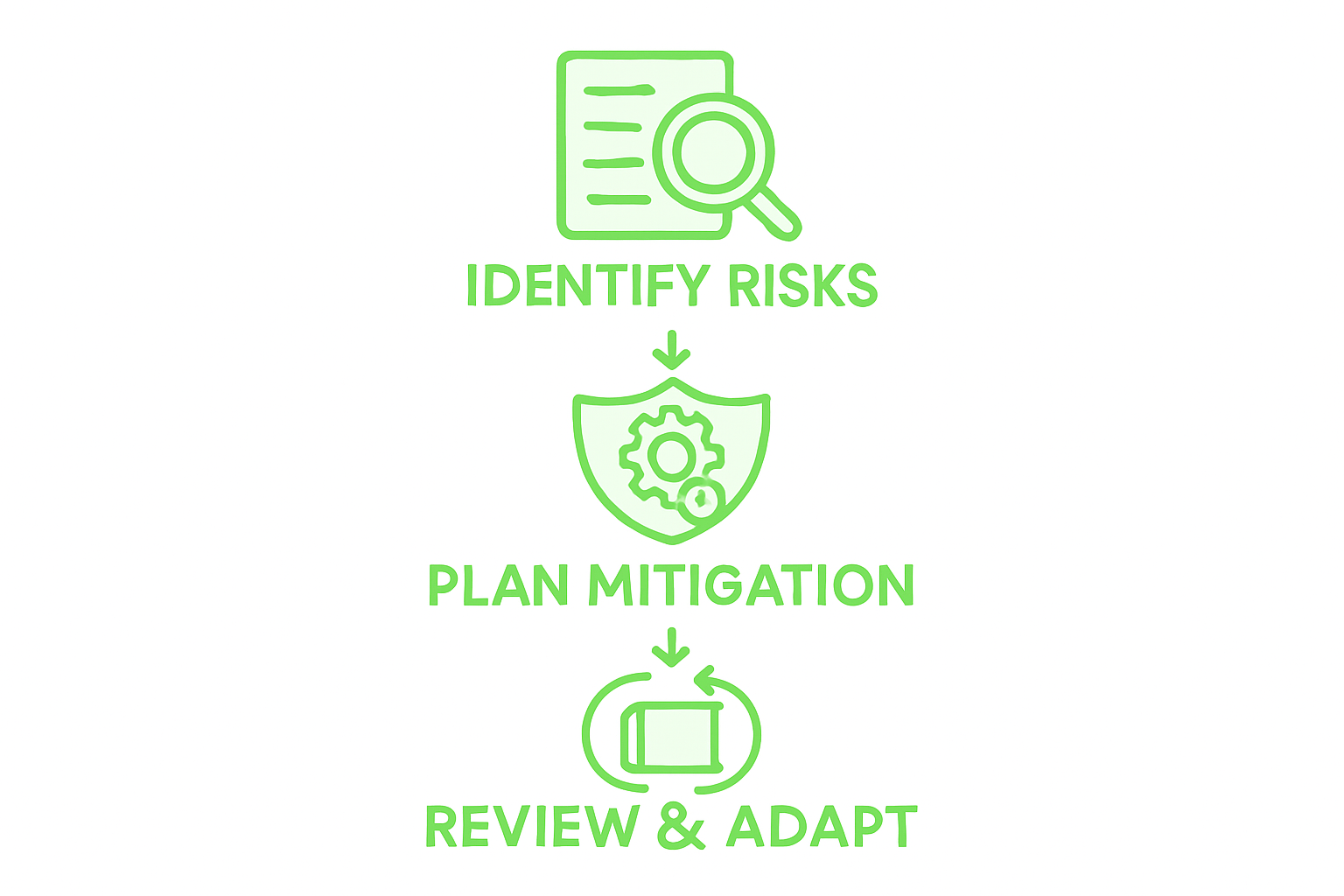
Software startup development tactics reveal that aligning engineering practices with entrepreneurial strategies is crucial for reducing organizational vulnerability. This means creating flexible frameworks that can rapidly respond to emerging challenges and market dynamics.
Key systematic de-risking strategies include:
- Market Validation
- Continuous customer feedback
- Rapid prototyping
- Minimum viable product testing
- Financial Planning
- Conservative cash flow projections
- Multiple funding contingencies
- Lean operational models
- Operational Flexibility
- Modular business architecture
- Cross-functional skill development
- Scalable technology infrastructure
Research examining startup pivot strategies demonstrates that recognizing potential transformation points can be a critical risk management technique. Successful entrepreneurs don’t just resist change - they proactively design adaptability into their core business model.
Ultimately, de-risking is a continuous process of learning, adjusting, and evolving. Smart founders treat their startup like a living organism - constantly monitoring, testing, and recalibrating. Your ability to systematically identify potential vulnerabilities and develop responsive strategies will determine whether your venture becomes another statistical failure or a resilient, innovative success story.
Common Pitfalls and How to Avoid Them
Startup failure isn’t random - it’s often the result of predictable and preventable mistakes that accumulate over time. Understanding these potential traps is the first step in creating a resilient entrepreneurial strategy that can withstand early-stage challenges.
Core competency deficit models reveal that startups frequently stumble due to fundamental skill gaps and resource limitations. These systemic weaknesses can transform promising ideas into cautionary tales if not proactively addressed.
The most critical startup pitfalls include:
- Strategic Missteps
- Unclear value proposition
- Weak market research
- Ineffective competitive analysis
- Operational Vulnerabilities
- Poor financial management
- Insufficient team alignment
- Rigid business models
- Leadership Challenges
- Ego-driven decision making
- Lack of adaptability
- Inadequate communication
Research examining founder personality dynamics highlights how individual traits significantly impact startup success. Self-awareness becomes a critical tool, allowing entrepreneurs to recognize and mitigate their inherent biases and limitations.
Avoiding these pitfalls requires more than technical skill - it demands emotional intelligence, strategic thinking, and a willingness to continuously learn and pivot. Successful founders don’t just build businesses; they cultivate adaptive ecosystems that can absorb shocks, learn from failures, and transform challenges into opportunities for growth and innovation.
De-Risk Your Startup Journey With Confidence and Clarity
Starting a new venture means facing complex risks that can affect your success at every turn. From financial threats and market uncertainties to operational challenges and leadership pitfalls this article highlights how understanding and managing these startup risks is essential. If you want to avoid common traps like cash flow mismanagement or strategic missteps you need a modern strategy platform that guides you step-by-step to build resilience and adaptability.
Discover how siift.ai Intelligent Business Canvas empowers founders with personalized feedback new insights and prioritized actions to systematically de-risk your founder journey. Our intuitive AI app helps you validate ideas test assumptions and design agile business models without biases blind spots or pressure. Don’t wait until risks take control. Start transforming uncertainty into opportunity with siift.ai today and ensure your startup’s survival and success.
Frequently Asked Questions
What are the main types of startup risk?
Startup risks can be categorized into financial risks, market risks, operational risks, and human capital risks. Each type presents unique challenges that entrepreneurs need to navigate for success.
How can I mitigate financial risks in my startup?
To mitigate financial risks, establish conservative cash flow projections, seek multiple funding sources, and adopt lean operational models. Additionally, strategic financial planning is essential for sustainability.
What strategies can I use for market validation?
Effective market validation strategies include gathering continuous customer feedback, conducting rapid prototyping, and testing minimum viable products to ensure alignment with market demands.
How can I avoid common startup pitfalls?
Avoid common pitfalls by clearly defining your value proposition, conducting thorough market research, ensuring team alignment, and fostering effective communication within your leadership team.
Recommended
- blog | siift | What Is Business Risk? A Simple Guide for New Entrepreneurs 2025
- blog | siift | Understanding Founder Mode: Your Guide to Entrepreneurship
- blog | siift | Bootstrapping Strategies: Guide for First-Time Founders
- blog | siift | Startup Success Stories: Real Paths to Business Wins 2025
- Why Do Startups Fail at AI Automation and How to Avoid It?