
TL;DR:
- Most founders overlook that strategic planning can be done simply using SWOT analysis with a pen and paper.
- SWOT helps entrepreneurs identify internal strengths and weaknesses alongside external opportunities and threats to make balanced decisions.
Most founders assume strategic planning is something reserved for corner offices, boardrooms, and consultants charging $400 an hour. That assumption is costing them. The truth is, some of the most powerful strategic decisions get made with a single sheet of paper and four clearly labeled boxes. SWOT analysis is that tool, and it has helped entrepreneurs at every stage clarify their thinking, spot hidden risks, and move forward with confidence rather than guesswork. In this guide, we’ll break down exactly how it works and how you can use it right now to validate your business idea.
Table of Contents
- What is SWOT analysis?
- How to conduct a SWOT analysis step by step
- Real examples: Common SWOT factors for startups and small businesses
- Going beyond basics: Advanced SWOT best practices
- Our take: Why most SWOT analyses fail (and how to make yours work)
- How siift.ai helps you turn SWOT insights into startup success
- Frequently asked questions
Key Takeaways
| Point | Details |
|---|---|
| Simple framework, big impact | SWOT analysis helps entrepreneurs quickly map out strengths, weaknesses, opportunities, and threats for clear strategic decisions. |
| Follow a structured process | Using defined steps and diverse input makes your SWOT analysis more accurate and actionable. |
| Move beyond listing | Turn your SWOT insights into action plans by prioritizing, assigning ownership, and setting deadlines. |
| Common pitfalls exist | Beware of bias and generic lists—ground your analysis in real data for best results. |
What is SWOT analysis?
SWOT analysis is not a buzzword. It is a structured thinking framework that forces you to be honest about where your business stands, inside and out. According to a widely used strategic planning framework, SWOT identifies an organization’s Strengths (internal advantages), Weaknesses (internal limitations), Opportunities (external chances), and Threats (external risks). That framework has been helping businesses clarify strategy since the 1960s, when Albert Humphrey developed it at the Stanford Research Institute using data gathered from more than 500 Fortune 500 companies.
The framework divides your thinking into two clean categories. Internal factors (Strengths and Weaknesses) are things you control: your skills, your resources, your processes. External factors (Opportunities and Threats) are things happening in the market around you that you need to respond to. For a first-time founder, that distinction alone is a revelation.
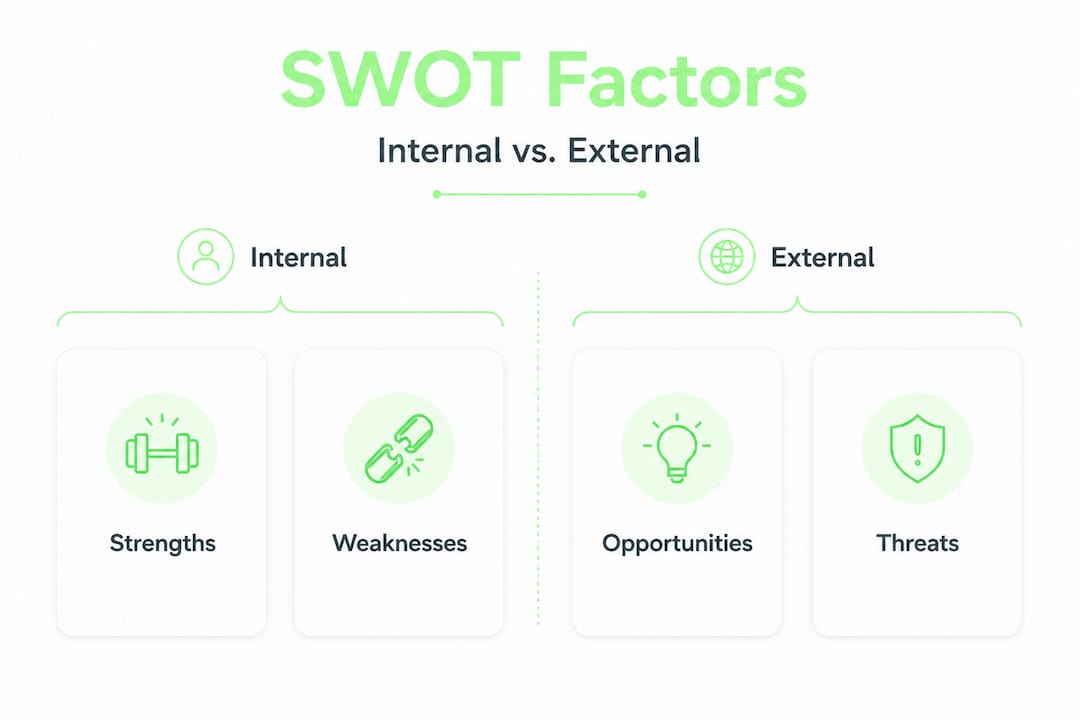
Here is a simple breakdown:
| Factor | Category | Questions to ask |
|---|---|---|
| Strengths | Internal | What do we do better than others? |
| Weaknesses | Internal | Where do we fall short or lack resources? |
| Opportunities | External | What trends or gaps can we capitalize on? |
| Threats | External | What risks could hurt us from outside? |
Why does this matter so much for entrepreneurs? Because when you are building something new, your brain is wired to be optimistic. You see the upside clearly and tend to discount the risks. SWOT forces balance. It gives equal weight to what can go wrong as to what can go right, which is exactly the kind of clear-eyed thinking that separates founders who survive from those who flame out after six months.
You can find a detailed walkthrough of how to apply this in practice in our business SWOT analysis guide, which goes deeper into each quadrant with startup-specific context.
“The goal of a SWOT analysis is not just to list facts, but to develop strategies by understanding how internal and external factors interact with each other.”
That insight is what makes SWOT more than just a brainstorming exercise. It is the beginning of real strategy.
How to conduct a SWOT analysis step by step
With the basic concept and components clear, here is how you can put SWOT to work for your business in simple steps. The biggest mistake founders make is treating this as a solo thinking exercise done in twenty minutes. Real SWOT analysis takes deliberate effort, honest input, and a process you can repeat as your business evolves.
Here is a proven six-step process, adapted from MindTools’ guidance on how to conduct a structured SWOT:
-
Define your objective clearly. Before anything else, know what decision you are trying to inform. Are you validating a new product idea? Evaluating whether to enter a new market? The sharper your objective, the more focused your analysis.
-
Assemble a diverse group of perspectives. Even if you are a solopreneur, bring in a mentor, advisor, or trusted peer. Diverse input dramatically reduces the blind spots that come from knowing your own idea too well.
-
Brainstorm each quadrant using guiding questions. For Strengths, ask: what unique advantages do we have? For Weaknesses: what do customers or potential investors criticize? For Opportunities: what trends or gaps exist in the market? For Threats: what could a competitor do to hurt us?
-
Organize inputs into a 2x2 matrix. Visually laying out the four quadrants side by side helps you see patterns and connections that are invisible in a bulleted list.
-
Analyze how the quadrants interact. This is the strategic gold. Which Strengths position you to capture which Opportunities? Which Weaknesses leave you exposed to which Threats? These interactions are where your action priorities come from.
-
Prioritize by impact and assign action plans. Not every item on your list deserves equal energy. Rank items by business impact and urgency, then assign a specific action, an owner, and a deadline to each top priority.
Research consistently shows that structured planning processes increase the probability of business success. A Harvard Business Review study found that entrepreneurs who write out formal plans are 16% more likely to achieve viability than those who do not. SWOT is one of the best starting points for that planning.
Pro Tip: Before your SWOT session, run a quick external scan. Look at competitor reviews on Google, scan industry news, and check two or three customer forums or Reddit communities where your target audience hangs out. This external data grounds your analysis in real-world signals rather than internal assumptions.
When you are ready to move beyond the framework and start testing your business idea in the market, that SWOT becomes your strategic roadmap. Pair it with structured validating business ideas methods and you have a genuinely powerful foundation.
Real examples: Common SWOT factors for startups and small businesses
Now, let us ground this framework in the real world by walking through examples that fit entrepreneurs and local businesses. Abstract frameworks only become useful when you can see yourself in them.
Consider a food delivery startup run by a husband-and-wife team in a mid-size city. Their SWOT might look very different from a solo SaaS founder, but the structure works equally well for both. Here is a comparison table that shows how specific SWOT factors might look across two common startup scenarios:

| Quadrant | Local food business | SaaS startup |
|---|---|---|
| Strengths | Deep community ties, local brand loyalty, unique recipes | Technical founder, low overhead, scalable product |
| Weaknesses | Limited marketing budget, no online ordering system | No industry network, unknown brand, long sales cycle |
| Opportunities | Growing food delivery apps, underserved neighborhood cuisine | Remote work trend, growing SMB software adoption |
| Threats | National chains entering local market, food cost inflation | Established players like Hubspot or Salesforce, churn risk |
For the external quadrants, common opportunities for small businesses include rising demand driven by market trends (like digital delivery platforms), local population growth, competitors closing or pulling back, and partnership opportunities with complementary businesses. Threats often include new well-funded competitors entering your space, rising input costs, economic uncertainty affecting consumer spending, and regulatory changes that increase compliance burden.
Key factors to consider in each quadrant when you are brainstorming:
- Strengths: Founder expertise, proprietary process or technology, existing customer relationships, cost advantages, speed of execution
- Weaknesses: Cash flow constraints, skill gaps in the team, lack of brand recognition, operational inefficiencies, over-reliance on one customer or channel
- Opportunities: Emerging technology you can adopt early, underserved customer segments, geographic expansion, shifting consumer behavior, government grants or incentives
- Threats: New entrants with more capital, supply chain fragility, platform dependency (like relying entirely on Facebook for reach), economic downturns
Understanding whether you are building a startup vs small business also shapes which factors matter most. A startup optimizing for rapid scale has very different threat profiles than a lifestyle business building sustainable local revenue.
Pro Tip: Do not copy these examples directly. The value of SWOT comes from specificity. Generic lists produce generic strategy. Ask yourself: “Is this actually true for us, right now, given our specific situation?” If you cannot defend every item with evidence or direct experience, cut it.
Going beyond basics: Advanced SWOT best practices
You understand the basics. Here is how to extract even more value from SWOT for better, bias-free decision-making. Most entrepreneurs stop at the list. The ones who build durable businesses go further.
The most powerful next step is converting your SWOT into a TOWS matrix. While SWOT identifies, TOWS strategizes. The TOWS approach takes the four quadrants and generates four strategy types:
-
SO strategies (Strengths + Opportunities): How do you use what you are already good at to capture the best external opportunities available right now?
-
WO strategies (Weaknesses + Opportunities): How do you address your internal gaps specifically to take advantage of opportunities you would otherwise miss?
-
ST strategies (Strengths + Threats): How do you deploy your existing advantages as a shield against the most credible external threats?
-
WT strategies (Weaknesses + Threats): What defensive actions prevent your biggest weaknesses from being exploited by external threats?
This is not a theoretical exercise. It is a direct bridge between honest self-assessment and real strategic choices. Each cell of the TOWS matrix should produce at least one concrete action your team can take.
To make your SWOT genuinely reliable, follow these validation steps:
- Pressure-test every “Strength” claim. Ask: would a skeptical investor or customer agree with this? If not, it may be a wish, not a reality.
- For Opportunities and Threats, source actual data. Industry reports, Google Trends, competitor pricing pages, and customer interviews are all legitimate sources.
- For each top priority item, assign a specific owner and a 30, 60, or 90-day deadline.
- Review and update your SWOT quarterly. The market changes. Your analysis should too.
“A SWOT analysis without action items is just a therapy session. You have acknowledged the truth, but nothing changes unless you do something with it.”
The link between SWOT and startup risk management is direct. Every Threat and Weakness you identify is a risk that needs a mitigation plan. Advanced founders treat those quadrants as their risk register, not just a brainstorming artifact.
Our take: Why most SWOT analyses fail (and how to make yours work)
We have worked with hundreds of founders at various stages, and here is something we see constantly: entrepreneurs treat SWOT as a checkbox. They fill in the four boxes during a Saturday morning brainstorm, feel productive, and file it away. Months later, they hit exactly the obstacle their Threats quadrant predicted. The analysis was right. They just never acted on it.
The core failure is not intellectual. It is behavioral. Most SWOT analyses fail because of what MindTools identifies as internal bias: teams fill the Strengths box with things they hope are true rather than things they can prove. The fix is deceptively simple. Start your analysis from the outside in. Run a PESTLE scan (Political, Economic, Social, Technological, Legal, Environmental) or a quick competitor analysis before you touch the internal quadrants. External data grounds your internal self-assessment in reality.
The second failure is what we call “list syndrome.” Founders create beautifully balanced, twenty-item SWOT lists that are so broad they are functionally useless. Strategic paralysis disguised as thoroughness. Our advice: limit yourself to the top three to five items in each quadrant and tie each one to a named next action. If an item on your list does not connect to something your business will actually do differently, delete it.
There is also an important mindset shift worth calling out. Your Weaknesses and Threats are not signs of a bad idea. They are information. The goal is not to produce a SWOT that looks reassuring. It is to produce a SWOT that is accurate enough to make better decisions. Founders who execute on that principle consistently build better growth strategies for startups because they are working from a clear-eyed picture of reality rather than a flattering one.
SWOT is powerful precisely because it is humble. It reminds you that every business has vulnerabilities, and the founders who acknowledge theirs early are the ones who address them before they become fatal.
How siift.ai helps you turn SWOT insights into startup success
Having learned the ins and outs of SWOT analysis, here is how you can put these insights into action with help from siift.ai. Building a SWOT is a great start, but translating it into a validated, actionable business strategy is where most founders stall without structured support. The siift.ai platform is built specifically for this moment in your founder journey. It guides you step by step through ideation, validation, and go-to-market strategy, helping you filter out bias, blind spots, and uncertainty that can derail even the most promising idea. Instead of navigating a generic AI tool that gives generic answers, siift gives you a systematic, agentic experience designed to accelerate your path to Product-Market-Fit. Whether you are running your first SWOT or building on an existing strategy, siift helps you move from insight to action, faster and with more confidence.
Frequently asked questions
Who invented SWOT analysis and why?
SWOT analysis was developed at Stanford Research Institute in the 1960s and 1970s by Albert Humphrey, who used structured data from over 500 major companies to help organizations clarify strategy and align leadership around shared priorities.
How is SWOT analysis different from a business plan?
SWOT analysis is a focused self-assessment tool that fits on a single page and helps you identify strategic priorities, while a business plan is a detailed document that covers financials, operational plans, market research, and long-term goals.
Should SWOT analysis come before or after idea validation?
SWOT works best when used early, ideally before you invest heavily in building or marketing, because the process of brainstorming each quadrant forces you to surface risks and assumptions you need to test through validation.
What is a common mistake to avoid when creating a SWOT analysis?
The most damaging mistake is letting internal bias fill your Strengths column with wishful thinking. Assign owners and deadlines to your top priorities and start with external data before assessing internal factors.
Can solopreneurs use SWOT analysis or is it just for teams?
Solopreneurs can absolutely run effective SWOT analyses by seeking honest input from mentors, advisors, or even candid customer conversations. What matters is the quality and honesty of the inputs, not the size of the team producing them.