
Most American startups face failure within the first five years, a sobering reality for founders everywhere. For Millennial entrepreneurs and recent graduates, understanding risk isn’t just smart—it’s crucial for survival. With the rise of AI-driven insights, you can finally uncover hidden threats and set smarter goals. Learn how to build a resilient strategy and turn uncertainty into clear, actionable steps that give your business an edge right from the beginning.
Table of Contents
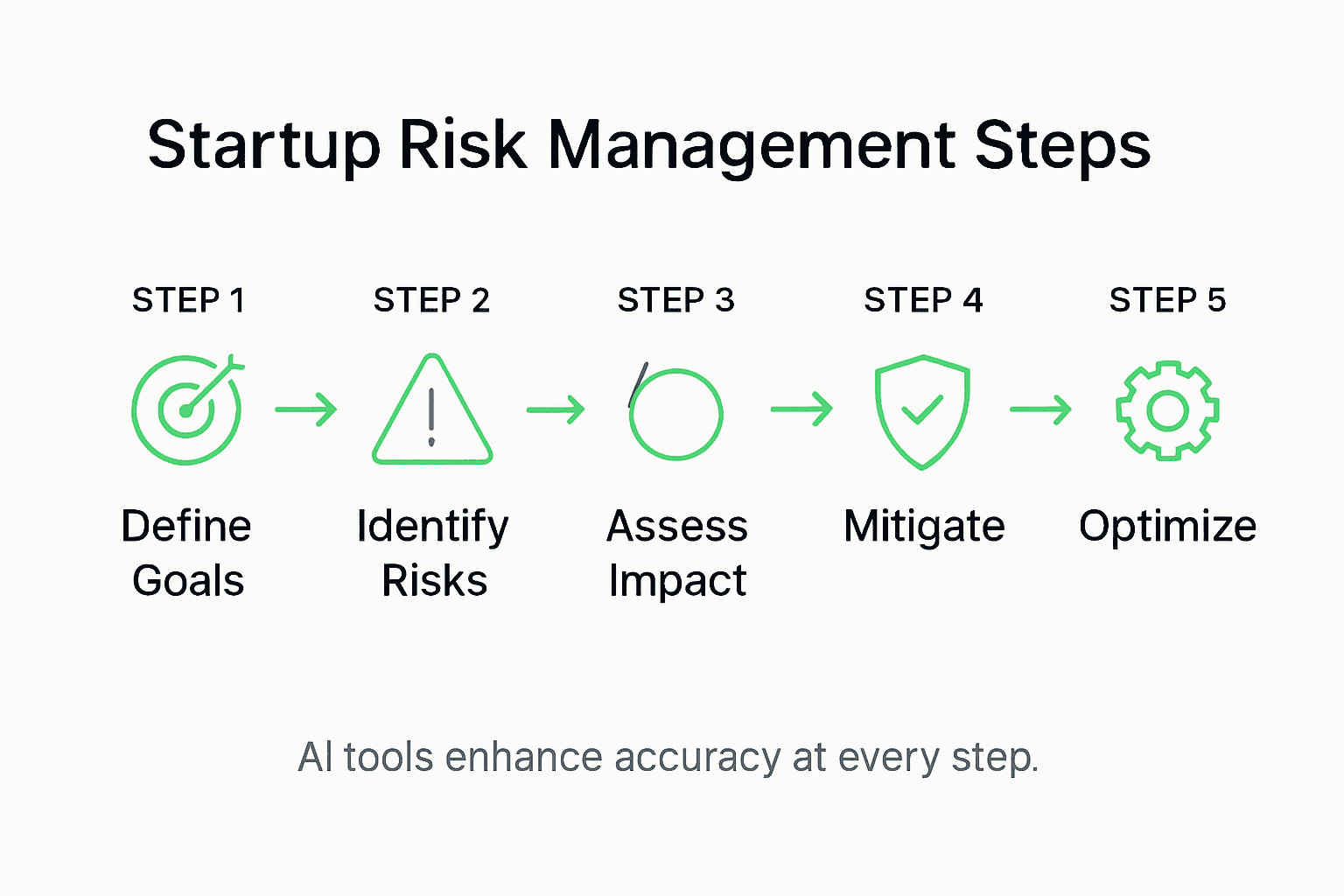
- Step 1: Define Venture Goals And Key Risk Factors
- Step 2: Leverage AI To Identify Critical Startup Risks
- Step 3: Prioritize And Assess Risk Impact Using AI Tools
- Step 4: Develop Actionable Plans To Mitigate Identified Risks
- Step 5: Verify Risk Reduction And Optimize Your Strategy
Quick Summary
| Key Insight | Explanation |
|---|---|
| 1. Define clear venture goals | Establish specific, measurable goals across financial, market, and product development areas to guide your startup’s growth. |
| 2. Utilize AI for risk identification | Implement AI tools to analyze complex data and generate proactive risk assessments, improving strategic decision-making. |
| 3. Prioritize risks with AI tools | Use sophisticated AI frameworks to evaluate and rank risks accurately, ensuring proper focus on significant threats. |
| 4. Create adaptable mitigation plans | Develop flexible strategies for each identified risk, with contingency scenarios and trigger points to enhance responsiveness. |
| 5. Continuously verify and optimize strategies | Regularly audit and recalibrate risk mitigation strategies to ensure they remain effective and aligned with market changes. |
Step 1: Define venture goals and key risk factors
Successful startup founders understand that crystal clear goals and strategic risk assessment are the foundation of sustainable business growth. This critical first step involves creating a comprehensive roadmap that transforms your entrepreneurial vision into actionable, measurable objectives.
Begin by articulating specific, quantifiable goals across multiple dimensions. Financial targets matter most, but equally important are market positioning, customer acquisition metrics, and product development milestones. Understanding how startups systematically categorize risk factors reveals that ventures must balance ambitious objectives with pragmatic risk management strategies. Your goals should encompass short term (3 months), medium term (12 months), and long term (36 months) horizons, ensuring a dynamic yet structured approach to business evolution.
Identify potential risks by conducting thorough market research and competitive analysis. Academic research highlights the importance of validating product market fit through rigorous testing while maintaining organizational flexibility. Common risk categories include financial constraints, market volatility, technological disruptions, regulatory changes, and potential talent acquisition challenges. Quantify these risks by assessing their potential impact and probability, creating a nuanced risk matrix that guides strategic decision making.
Pro tip: Create a living document that tracks your venture goals and risks, updating it quarterly to reflect new insights and changing market conditions.
Step 2: Leverage AI to identify critical startup risks
AI technology represents a groundbreaking approach to understanding and mitigating startup risks with unprecedented precision and depth. By integrating advanced machine learning algorithms and data analytics, founders can transform risk management from a reactive process into a proactive strategic advantage.

Advanced AI risk detection techniques enable startups to analyze complex data patterns that traditional methods might overlook. These AI systems can process massive volumes of market data, customer interactions, financial trends, and competitive intelligence to generate nuanced risk assessments. Practical implementation involves selecting AI tools that specialize in predictive analytics and can synthesize information from multiple sources. Look for platforms that offer real time risk monitoring, predictive modeling, and scenario simulation capabilities.
Implementing AI risk identification requires a systematic approach. Begin by integrating AI tools that can scan industry databases, track market sentiment, analyze financial reports, and monitor regulatory changes. Focus on AI solutions that provide contextual insights rather than generic alerts. These systems should help you understand not just potential risks, but their probable impact, likelihood, and potential mitigation strategies. By transforming raw data into actionable intelligence, AI empowers founders to make more informed strategic decisions.
Pro tip: Regularly calibrate your AI risk assessment tools by cross referencing their predictions with actual market developments and adjusting their learning parameters.
Here’s a summary of common startup risk categories and how AI tools can address them:
| Risk Category | Typical Challenge | How AI Tools Help |
|---|---|---|
| Financial | Cash flow fluctuations | Real-time data forecasting |
| Market Volatility | Changing consumer demand | Market sentiment analysis |
| Technological | System or stack failures | Automated anomaly detection |
| Regulatory | New compliance requirements | Policy change monitoring |
| Talent Acquisition | Recruiting skilled employees | Resume screening algorithms |
Step 3: Prioritize and assess risk impact using AI tools
Transforming risk management from a guessing game into a precise strategic exercise requires sophisticated AI powered prioritization techniques. By leveraging advanced algorithmic approaches, startup founders can systematically evaluate and rank potential risks with unprecedented accuracy.
AI enabled risk assessment frameworks provide startups with dynamic tools to analyze risks across multiple dimensions. These intelligent systems combine quantitative data points like financial projections, market volatility indicators, and operational metrics with qualitative insights such as competitive landscape analysis and emerging industry trends. The goal is not just identifying risks but understanding their potential cascading effects and relative urgency.
Implement a structured approach by selecting AI tools that offer comprehensive risk scoring mechanisms. Focus on platforms that can generate multidimensional risk matrices, which visualize potential impacts through color coded heat maps and probability distribution graphs. Such visualization helps founders quickly distinguish between manageable risks and critical threats that demand immediate intervention. Pay special attention to AI systems that can simulate different scenarios, allowing you to test potential mitigation strategies before real world implementation.
Pro tip: Create a weekly ritual of reviewing and recalibrating your AI risk assessment models to ensure they remain responsive to the most current market dynamics.
Compare strategic approaches to risk prioritization using AI-powered frameworks:
| Approach | Key Benefit | Limitation | Best Use Case |
|---|---|---|---|
| Manual Assessment | Contextual human insight | Prone to bias, slow | Small startups, less data |
| AI Risk Scoring | Quantitative accuracy | Dependent on data quality | Growth-stage, data-rich firms |
| Scenario Simulation | Tests mitigation strategies | Requires advanced setup | High-risk industries |
Step 4: Develop actionable plans to mitigate identified risks
Transforming risk insights into concrete mitigation strategies requires a systematic and dynamic approach that goes beyond theoretical planning. Your goal is to create flexible roadmaps that can adapt quickly as your startup encounters unexpected challenges.
Effective risk mitigation planning demands more than just identifying potential threats. You must develop nuanced strategies that integrate risk response directly into your startup’s core operational framework. This means creating multiple contingency scenarios for each significant risk, complete with specific trigger points that activate predetermined response protocols. Think of these plans as living documents that evolve alongside your business, with clear accountability assigned for monitoring and executing risk mitigation actions.
Designing robust mitigation strategies requires a multifaceted approach. Start by prioritizing risks based on their potential impact and probability, then develop targeted interventions for each category. Financial risks might require building cash reserves or securing flexible credit lines. Technological risks could involve diversifying technology stacks or establishing robust backup systems. Market risks may demand rapid product pivoting capabilities or diversified customer acquisition strategies. The key is building adaptive resilience into every aspect of your startup ecosystem.
Pro tip: Schedule quarterly risk strategy review sessions where your entire team reassesses and updates mitigation plans, ensuring continuous alignment with changing business dynamics.
Step 5: Verify risk reduction and optimize your strategy
Successful risk management is not a one time exercise but an ongoing process of continuous evaluation and strategic refinement. As your startup evolves, your risk mitigation strategies must adapt with equal agility and precision.
Rigorous risk management verification methods are essential for ensuring the effectiveness of your mitigation strategies. This involves establishing clear performance metrics, conducting periodic risk audits, and creating robust feedback loops within your organizational framework. Track both quantitative indicators like financial performance and qualitative signals such as team resilience and market perception. Develop a comprehensive dashboard that provides real time insights into your risk landscape, allowing you to make data driven decisions quickly and confidently.
Standardized risk management frameworks recommend implementing a systematic approach to strategy optimization. This means regularly reviewing your risk indicators, comparing actual outcomes against predicted scenarios, and proactively adjusting your strategies. Pay special attention to emerging market trends, technological shifts, and competitive dynamics that could introduce new risks or render existing mitigation plans obsolete. Your goal is to build an adaptive risk management system that transforms potential threats into strategic opportunities.
Pro tip: Create a dedicated risk management journal where you document lessons learned, track strategy evolution, and capture insights that can inform future decision making.
Master Startup Risks with AI Powered Strategy Guidance
Navigating startup risk management requires clear goals, precise risk assessment, and agile mitigation. This article highlights critical challenges such as quantifying risks, leveraging AI for real time insights, and prioritizing threats before they become obstacles. Founders often struggle with bias free decision making and maintaining dynamic plans that evolve with fast changing market conditions. The key pain points include transforming complex risk data into actionable strategies and continuously optimizing those strategies to maintain business resilience.
siift.ai Intelligent Business Canvas is designed to solve these exact problems. Our AI platform guides founders step by step through ideation, validation, and go to market strategies while delivering personalized feedback to identify hidden risk blindspots early. You can build a living risk assessment with prioritized next steps that adapt as you progress. Don’t let uncertainty slow you down or blindside your venture. Discover how siift.ai turns risk management into your competitive advantage.
Want to stay ahead of the curve with AI powered risk detection and mitigation? Experience the future of founder strategy on the siift.ai landing page and start transforming the way you manage startup risks today.
Frequently Asked Questions
How can I define clear venture goals for my startup?
To define clear venture goals, articulate specific and measurable objectives across financial, market, customer, and product development dimensions. Create short-term (3 months), medium-term (12 months), and long-term (36 months) goals and review them regularly to ensure alignment with your vision.
What are common risk categories that startups face?
Common risk categories include financial constraints, market volatility, technological disruptions, regulatory changes, and challenges in talent acquisition. Identify these risks through thorough market research and create a risk matrix to assess their potential impact and probability.
How can AI help in identifying risks for my startup?
AI can help by analyzing large volumes of data for patterns that reveal potential risks, utilizing predictive analytics for more accurate assessments. Integrate AI tools that provide real-time monitoring and scenario simulations to gain insights into those risks’ probable impacts and mitigation strategies.
What steps should I take to prioritize and assess risk impact using AI?
To prioritize risks, select AI tools that provide multidimensional risk scoring and visualization methods such as heat maps. Regularly review and recalibrate your risk assessment models to reflect current market dynamics, ensuring that you focus on the most critical risks that demand immediate attention.
How can I develop actionable plans for risk mitigation?
Create flexible roadmaps for mitigating risks by developing contingency scenarios for each significant threat, specifying trigger points for response. Prioritize these risks based on impact and probability, and establish procedures for monitoring and executing these plans to ensure adaptability in your startup environment.
What processes should I implement to verify risk reduction strategies?
Implement a continuous evaluation process by establishing clear performance metrics and conducting regular risk audits. Create a dashboard to monitor real-time insights into your risk landscape and adjust strategies proactively based on actual outcomes compared to predictions.