

TL;DR:
- An MVP is the simplest functional product used to test core value propositions with real users, enabling validated learning. It differs from prototypes and proof of concept by measuring actual customer behavior and willingness to pay, focusing only on features necessary for testing hypotheses. Founders succeed by treating MVPs as experiments, quickly iterating based on behavioral data, and defining clear success criteria beforehand.
A minimum viable product (MVP) is the simplest functional version of a product that lets you test your core value proposition with real users before committing serious time or money. Eric Ries, author of The Lean Startup, defined the MVP as the version that maximizes validated learning about customers with the least effort. That framing is everything. Your MVP is not a rough draft of your final product. It is a deliberate experiment designed to answer one question: does this idea create real value for real people? Dropbox, Airbnb, and Zappos all used MVPs to confirm demand before building anything substantial. You can too.
What is an MVP and why does it matter for founders?
An MVP, which stands for minimum viable product, is the simplest version of a product that validates your idea and gathers feedback efficiently. The word “viable” carries the weight here. Viable means the product must actually deliver enough value that users can meaningfully react to it. Strip it down too far and you learn nothing. Build it up too much and you waste months on assumptions that may be wrong.
The minimum viable product definition centers on validated learning, not on shipping features. You are not trying to impress anyone. You are trying to find out whether your core assumption about user value holds up under real conditions. That distinction separates founders who move fast and learn from those who spend a year building something nobody wants.
Startups like Airbnb launched with a basic website and photos of their own apartment to test whether strangers would pay to stay in someone else’s home. Zappos founder Nick Swinmurn photographed shoes from local stores and listed them online before owning a single unit of inventory. Both are textbook examples of MVP in action. The product was minimal. The learning was maximum.
How does an MVP differ from a prototype or proof of concept?
This is one of the most common points of confusion for first-time founders, and mixing these up leads to real strategic errors. NN/g clarifies that an MVP tests customer value with real users, a prototype tests design and functionality, and a proof of concept tests technical feasibility. Each serves a different purpose at a different stage.
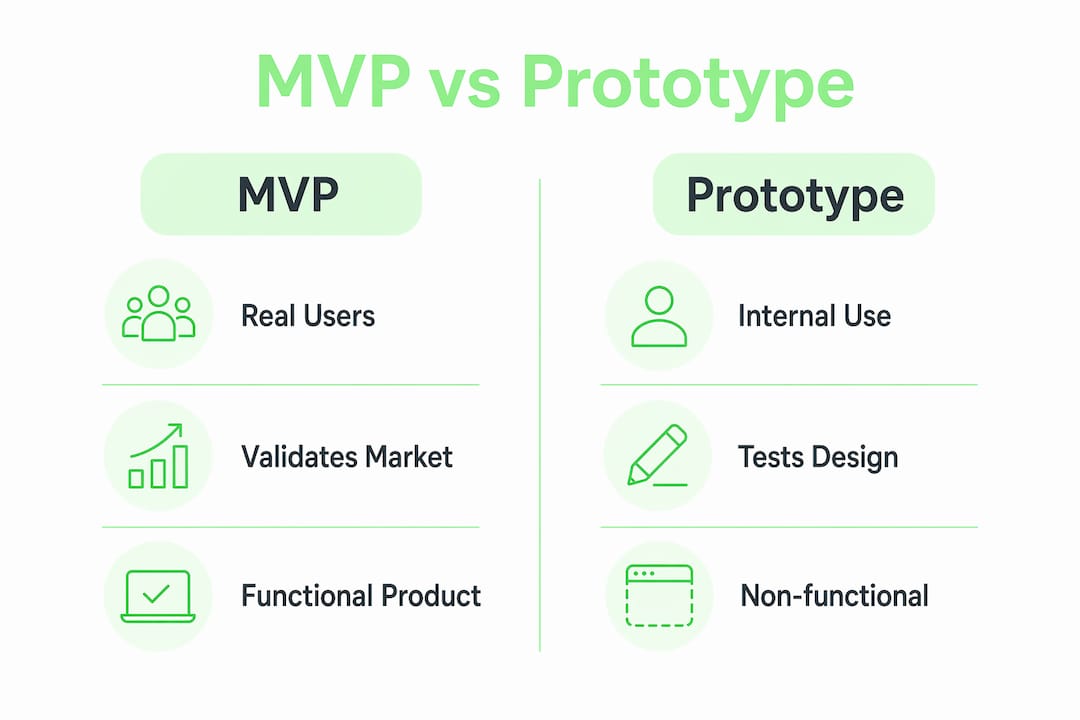
Here is a direct comparison:
| Concept | Goal | Users | Output |
|---|---|---|---|
| Proof of concept | Test technical feasibility | Internal team | Yes/no on technical viability |
| Prototype | Test design and usability | Small test group | Design feedback and UX data |
| MVP | Test market value with real users | Target customers | Behavioral data on willingness to use or pay |
The critical difference is who interacts with it and what you measure. A prototype might never leave your design team. A proof of concept might live in a developer’s sandbox. An MVP goes in front of actual customers and measures real behavior, not opinions.
Common pitfalls from confusing these three:
- Building a polished prototype and calling it an MVP, then wondering why you got no real market signal
- Running a proof of concept and assuming technical success means market success
- Treating MVP feedback as design critique rather than a signal about core value
- Skipping the MVP entirely and jumping straight to a full product build
The MVP concept explained simply: it is the earliest version of your product that real customers can use and that you can learn from. Everything else is preparation.
What are the essential features and scope of an effective MVP?
The hardest part of building an MVP is deciding what to leave out. Most founders build too much. NN/g advises that MVPs should be built around falsifiable hypotheses with clear evaluation metrics. That means before you write a single line of code or design a single screen, you need a written hypothesis.
A strong MVP hypothesis looks like this: “We believe that [target user] will [take this action] because [core value]. We will know this is true when we see [measurable outcome].” This structure forces you to define success before you build, which is the only way to know whether your MVP actually taught you anything.
When scoping your MVP features, ask yourself one question for each candidate feature: does removing this feature prevent me from testing my core hypothesis? If the answer is no, cut it. Your MVP scope should include only the features that are directly tied to your primary validation question.
Pro Tip: Write your measurement plan before you build your MVP. Define what “success” looks like in numbers. Without this, you will rationalize any result as a win and learn nothing.
A few practical principles for MVP scope:
- Focus on your riskiest assumption first, not your easiest feature to build
- Prioritize your value proposition over technical elegance
- Plan your iteration cycle from day one. What will you change if users do not respond?
- Set a time limit. An MVP that takes 12 months to ship is not an MVP
Aligning MVP scope tightly to hypotheses about user value optimizes both your testing and your resource use. That is not just good practice. It is the difference between learning fast and burning cash slowly.
What are practical ways to develop and test your MVP?
Here is something that surprises most first-time founders: your MVP does not have to be software. MVPs can take diverse forms, from paper mockups to manual concierge services, as long as they enable real user testing and learning. The form follows the hypothesis, not the other way around.
Some of the most effective MVP formats used by real startups:
- Landing page MVP. Build a single page describing your product and add a signup or pre-order button. Measure click-through rates to gauge genuine interest before building anything.
- Concierge MVP. Manually deliver the service your product would automate. Dropbox-style video MVPs and concierge models let you test demand with zero engineering.
- Wizard of Oz MVP. The user thinks they are interacting with a real product. Behind the scenes, humans are doing the work. This tests whether users value the outcome before you automate it.
- Smoke test. Run paid ads to a landing page for a product that does not yet exist. Conversion rates tell you whether the market wants what you are describing.
- Single-feature app. Build only the one feature that represents your core value proposition. Instagram launched as a photo-sharing app with filters. Nothing more.
Pro Tip: Watch what users do, not just what they say. Behavioral data about actual usage is far more reliable than survey responses or interviews. If users say they love it but never come back, that is your real answer.
The goal of every MVP test is speed to learning. Launching quickly to test core assumptions before investing heavily is the primary benefit of the MVP approach. Every week you spend building before testing is a week of learning you are giving up.
For founders who want a structured path through this process, resources like Siift’s step-by-step validation guide walk you through hypothesis building and feedback collection in a systematic way.
What common mistakes do founders make with MVPs?
The MVP concept is simple in theory and surprisingly easy to get wrong in practice. Multiple sources highlight that overbuilding, ignoring learning goals, and insufficient iteration after feedback are the most common founder pitfalls.
The most damaging mistakes, and how to avoid them:
- Building a mini version 1.0 instead of an experiment. The Agile Alliance warns that teams often create a reduced-scale full product rather than a test, which limits their ability to pivot or abandon based on learning. An MVP is not a small product. It is a question with a measurable answer.
- Skipping the hypothesis. If you do not define what you are testing, you cannot interpret the results. Every MVP needs a written assumption it is designed to validate or invalidate.
- Treating user opinions as gospel. Users will tell you they love your idea. Watch their behavior instead. Do they come back? Do they pay? Do they refer others?
- Failing to iterate after feedback. Collecting feedback and not acting on it is the most expensive mistake in startups. The MVP loop is: build, measure, learn, repeat.
- Confusing MVP with a marketing launch. Your MVP is not your brand debut. It is a private experiment. Treat it accordingly and resist the urge to polish it for optics.
Pro Tip: Set a “kill criteria” before you launch your MVP. Define the specific result that would tell you to stop and pivot. This removes ego from the decision and makes pivoting feel like wisdom rather than failure.
The MVP as a learning experiment, not a stripped-down launch product, is the mental model that separates founders who iterate to success from those who stubbornly build toward a cliff.
Key takeaways
An MVP is a structured learning experiment, not a product shortcut. Its value lies entirely in the quality of the hypothesis it tests and the behavioral data it generates.
| Point | Details |
|---|---|
| MVP definition | The simplest functional product version designed to validate core user value with real customers. |
| MVP vs. prototype | Prototypes test design; MVPs test market value through actual user behavior and willingness to pay. |
| Scope discipline | Include only features that directly test your riskiest assumption. Cut everything else. |
| Behavioral data wins | Observe what users do, not what they say. Actions are the only reliable signal. |
| Iterate or stop | Define success criteria before launch so you can pivot or persevere based on evidence, not hope. |
Why the MVP mindset is the most underrated founder skill
I have worked with hundreds of founders, and the pattern is consistent: the ones who struggle longest are the ones who treat their MVP like a product launch. They obsess over design, add features “just in case,” and delay shipping until it feels ready. By the time they get real feedback, they have invested so much that pivoting feels like failure.
The founders who move fastest treat their MVP like a science experiment. They write the hypothesis first. They define what a failed test looks like. They ship ugly, learn fast, and iterate without attachment. That mindset is genuinely rare, and it is worth more than any technical skill.
What has changed in 2026 is the speed at which you can now run these experiments. AI tools have compressed the time between idea and testable MVP from months to days. A founder who understands the MVP concept and uses the right tools can now run three validation cycles in the time it used to take to build one. That is a real shift in the odds for early-stage founders.
The uncomfortable truth is that most MVPs should fail. That is the point. A failed MVP is not a failed startup. It is a cheap lesson that redirects you toward something that actually works. The founders who win are not the ones with the best first idea. They are the ones who learn the fastest.
— Samim
How Siift helps you build and validate your MVP faster
Siift is built specifically for founders who want to move from idea to validated MVP without the guesswork. The platform guides you step by step through hypothesis building, MVP scoping, and validation workflows so you are always testing the right assumption at the right time. Rather than starting with a blank page or a generic AI chat, Siift gives you a structured founder operating system that filters out bias, blindspots, and wasted effort. If you are serious about launching your startup idea with a clear validation strategy, Siift is where that work gets done. Try it and see how much faster you can get to your first real signal.
FAQ
What does MVP stand for in startups?
MVP stands for minimum viable product. It is the simplest version of a product that allows founders to test their core value proposition with real users and gather feedback for decision-making.
How is an MVP different from a prototype?
A prototype tests design and usability, typically with a small internal group. An MVP tests whether real customers find genuine value in your product, generating behavioral data rather than design feedback.
What are some well-known examples of MVP?
Airbnb tested demand by listing their own apartment online before building a platform. Zappos validated shoe e-commerce by photographing store inventory before holding any stock. Both are classic MVP examples of testing assumptions before building at scale.
How do you know if your MVP is working?
Define measurable success criteria before you launch. Track behavioral signals like return visits, sign-ups, or purchases rather than relying on user surveys. If users act on the value you offer, your hypothesis is confirmed.
Do you need to write code to build an MVP?
No. MVPs can take the form of landing pages, manual services, explainer videos, or paper mockups. The format should match your hypothesis, not your technical comfort zone.