

TL;DR:
- Digital transformation is a continuous, organization-wide process that reimagines business models, processes, and customer experiences beyond mere technology adoption. Success relies on cultural shifts, strategic focus, and ongoing adaptation, not just implementing new tools. Building organizational capacity for change ensures lasting benefits like efficiency, agility, and market competitiveness.
Most organizations think they’re transforming. They buy new software, move files to the cloud, and launch a mobile app. Then they wonder why nothing meaningfully changed. Understanding what is digital transformation means confronting an uncomfortable truth: technology is the least important part. The real work is cultural, operational, and strategic. This guide breaks down the actual definition, the components that drive it, how to implement it effectively, and why the organizations that get it right treat it as a capability rather than a project.
Key takeaways
| Point | Details |
|---|---|
| More than technology adoption | Digital transformation reimagines entire business models, not just tools or workflows. |
| Culture drives outcomes | Lasting change requires shifting mindsets, skills, and organizational behavior alongside technology. |
| Continuous capability, not a project | Transformation never finishes. Organizations must build ongoing adaptability into their operating model. |
| Structure reduces failure risk | Frameworks like the 4D method help align initiatives with real business goals from day one. |
| Benefits compound over time | Efficiency, agility, and customer experience gains accelerate as transformation matures. |
What digital transformation really means
Let’s get the terminology straight, because most of the confusion starts here. Three terms get used interchangeably when they describe fundamentally different things.

Digitization is converting analog information into a digital format. Scanning paper invoices into PDFs is digitization. Nothing about how your business operates changes. Digitalization takes that a step further by using digital data to improve or automate existing processes. Replacing a paper approval workflow with an automated digital one is digitalization. It’s more useful, but the underlying business logic stays the same.
Digital transformation is categorically different. It’s an organization-wide process of adopting digital technology to rethink how you create value, serve customers, and compete in your market. You’re not improving the old way of doing things. You’re questioning whether the old way should exist at all.
| Term | What changes | Example |
|---|---|---|
| Digitization | Format | Scanning physical documents to PDFs |
| Digitalization | Process | Automating invoice approvals digitally |
| Digital transformation | Business model and culture | Shifting from product sales to subscription-based services |
The distinction matters because transformation reimagines business models and the experiences built around them. A retailer that digitizes its catalog has done something useful. A retailer that uses real-time demand data to personalize pricing, inventory, and delivery at scale has transformed. One is operational housekeeping. The other reshapes competitive position.
This is why the digital transformation meaning is best understood as a strategic orientation, not a technical initiative. It answers the question: “How do we use technology to become a fundamentally better, faster, and more customer-centered organization?”
The four pillars of transformation
Digital transformation touches every corner of an organization. Not in theory. In practice. Here are the four areas where the real work gets done.
People and culture. This is where most transformations stall. Technology is the easy part. Getting a 500-person company to think and work differently is the hard part. That means investing in digital literacy, rewiring incentive structures, and creating psychological safety for experimentation. Without this, every new tool just layers complexity on top of resistance.
Processes. Transformation demands new workflows, not just faster versions of old ones. Cross-functional teams replacing siloed departments, continuous feedback loops replacing annual reviews, real-time data replacing quarterly reports. Process redesign is where efficiency gains actually live.
Technology. Cloud infrastructure, AI, automation, and advanced data analytics are the engines. They enable everything else. But technology without the right processes and people to use it is expensive furniture. The tools matter far less than the decisions made about why and how to adopt them.
Customer experience. The entire point of transformation is reimagining value delivery for the people you serve. Every technology decision should connect back to how it changes what customers feel, receive, or accomplish when they interact with you.
- Shift from reactive to predictive customer service using AI and behavioral data
- Redesign internal processes around customer outcomes, not departmental convenience
- Build feedback mechanisms that let customer signals influence product and service decisions continuously
Pro Tip: Before adopting any new technology, ask one question: “Which specific customer outcome or operational friction does this address?” If you can’t answer it in one sentence, the tool is premature.
Why transformation never finishes
Here’s a framing that separates organizations that succeed from those that plateau. Digital transformation is a continuous capability, not a destination. There is no ribbon-cutting. There is no finish line.
Markets shift. Customer expectations evolve. New technologies emerge. The organizations that outperform over time are the ones that build the capacity to adapt continuously, not the ones that execute a single transformation program and call it done. Think of it less like a renovation project and more like physical fitness. You don’t “finish” getting fit. You build habits that keep you capable.
This has real structural implications. It means:
- Leadership must model transformation behaviors. When executives publicly champion experimentation and hold themselves accountable to learning, it signals to the entire organization that this is the operating mode, not a phase.
- Governance should evolve alongside technology. Executive involvement and multi-stakeholder governance are directly correlated with transformation speed and sustainability. Static governance models break under dynamic conditions.
- Employee engagement is non-negotiable. People who feel excluded from transformation decisions become its biggest obstacles. Inclusion in process design, not just training, drives adoption.
- Continuous monitoring is built in, not bolted on. Ongoing evaluation and iterative change management helps organizations catch failing assumptions before they become expensive failures.
Pro Tip: Build a quarterly transformation review cadence that isn’t about project status. Ask instead: “What has changed in our market, our customer behavior, or our technology options that should change our priorities?” That question keeps the organization adaptive rather than complacent.
The organizations that treat transformation as an IT rollout consistently underperform. Treating it as an isolated project instead of an integrated, ongoing business change is one of the most cited reasons transformations fail.
How to implement digital transformation
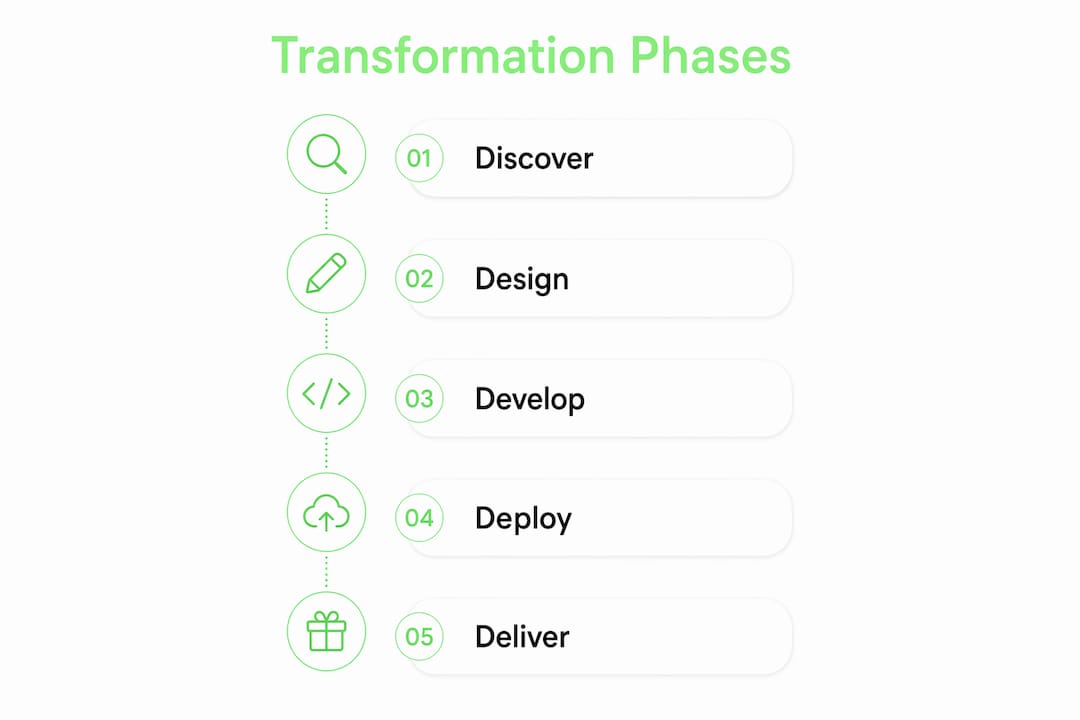
The practical question: where do you actually start? The 4D Framework from APMG International offers one of the clearest structured approaches available, and it maps well to how successful organizations actually operate.
| Phase | Name | What happens |
|---|---|---|
| 1 | Discover | Assess current state, map existing processes, identify pain points and opportunities |
| 2 | Define | Set vision, align stakeholders, define measurable goals and success criteria |
| 3 | Develop | Build, pilot, and iterate on solutions before full-scale deployment |
| 4 | Deliver | Execute, monitor outcomes, and continuously refine based on real data |
The Discover phase is where most organizations underinvest. A structured baseline assessment surfaces hidden dependencies and operational assumptions that will derail later phases if left unexamined. Understanding your baseline early is one of the highest-leverage moves you can make before committing resources.
Here’s a practical sequence for getting started:
- Audit your current state honestly. Map processes, technology stack, data quality, and capability gaps. Be brutal. Optimistic baselines produce unrealistic plans.
- Define the transformation vision in business terms. “We will reduce customer onboarding time from 14 days to 3 by automating identity verification and document processing.” That’s a transformation goal. “Adopt AI” is not.
- Prioritize by impact and feasibility. Not every process needs transformation simultaneously. Start where the return is clear and the organizational resistance is manageable.
- Pilot before scaling. Test assumptions in a controlled environment. Data-driven decision making at every stage reduces the cost of being wrong.
- Build in evaluation loops. Assign ownership, set review cadences, and create feedback channels that surface real adoption data. What looks like success in reporting often masks friction on the ground.
The most common mistake? Skipping straight from vision to execution without validating assumptions in between. Great digital transformation strategies are built on evidence, not enthusiasm.
The real benefits of getting it right
When transformation is done with discipline, the benefits of digital transformation compound in ways that are hard for competitors to replicate quickly.
- Operational efficiency. Deloitte research shows that financial institutions pursuing digital transformation see measurable gains in operational efficiency and business economics, often within 18 to 24 months of sustained effort.
- Customer experience. Personalization at scale, faster service resolution, and proactive communication all become achievable. These aren’t perks. They’re competitive table stakes in markets where customers have abundant alternatives.
- Speed to market. Organizations that have transformed their development and deployment processes can test and ship new offerings in days, not quarters. That agility compounds into significant market position over time.
- Talent. People want to work on things that matter with tools that work. Capability building across people and the right business model strategy attract and retain the individuals who accelerate everything else.
None of this happens from buying software. It happens from building the organizational capacity to use technology purposefully, continuously, and in service of a clear vision.
My honest take on why most transformations miss the mark
I’ve spent years watching organizations pour significant resources into digital transformation initiatives. And the pattern is almost embarrassingly consistent. The ones that struggle conflate change with transformation. They launch digital channels, deploy automation tools, and rebrand their IT department. Then they measure success by the technology deployed rather than the outcomes produced.
What actually works is far less glamorous than the vendor roadshows suggest. It’s about aligning people, processes, and technology toward a shared purpose. That means leadership doing the unglamorous work of changing incentive structures. It means middle managers being retrained as coaches rather than gatekeepers. It means accepting that transformation will surface uncomfortable truths about how the organization currently functions.
The technology is almost never the bottleneck. I’ve seen organizations with sophisticated AI deployments fail because nobody changed who was allowed to make decisions with the insights. And I’ve seen organizations with relatively simple digital tools dramatically outperform peers because their culture embraced experimentation and accountability together.
The real competitive advantage isn’t digital. It’s adaptive. Build that, and the technology becomes a force multiplier. Skip it, and every digital investment becomes a very expensive decoration.
— Samim
Ready to build your transformation strategy?
If this article shifted how you think about digital change in your organization, the next step is translating that clarity into a concrete strategy. That’s exactly what Siift is built for. Siift’s Agentic AI platform guides founders and business leaders through validated, step-by-step strategy development from idea through execution. Whether you’re mapping a new business model or figuring out where to start your transformation, Siift helps you cut through the noise and build a validated strategy grounded in real business logic. No generic playbooks. No guesswork. Just a smarter path forward.
FAQ
What is digital transformation in simple terms?
Digital transformation is the process of using digital technology to fundamentally change how an organization creates value, operates, and serves customers. It goes well beyond adopting new tools to include cultural, operational, and strategic change.
How is digital transformation different from digitization?
Digitization converts analog information to digital formats, while digital transformation reimagines entire business models and customer experiences using digital capabilities. One updates the medium; the other changes the model.
How do you implement digital transformation successfully?
Successful implementation starts with an honest baseline assessment, followed by a clear business-outcome vision, phased execution, and continuous evaluation loops. Structured frameworks like the 4D method help reduce risk and keep initiatives aligned to real goals.
Why do so many digital transformation efforts fail?
Most failures trace back to treating transformation as a technology project rather than an integrated change in culture, processes, and decision-making. Without executive commitment and broad organizational engagement, even the best tools produce minimal impact.
What are the most important benefits of digital transformation?
The primary benefits include improved operational efficiency, stronger customer experiences, faster time to market, and a workforce better equipped to compete. These gains are most pronounced when transformation is treated as an ongoing capability rather than a one-time initiative.