
Starting a side business in the age of AI feels overwhelming for many american professionals, especially without a background in entrepreneurship. A bold shift is happening—data-driven entrepreneurs are now outperforming traditional founders by turning massive information streams into smart decisions. This matters because relying on intuition alone cannot compete with the competitive edge that data science and analytics provide. You will discover how adopting a data-driven mindset leads to smarter strategies, lower risk, and real growth that fits the modern business world.
Table of Contents
- Defining Data-Driven Entrepreneurship Today
- Core Processes And Required Mindsets
- Real-World Examples And Key Applications
- Mistakes To Avoid In Data-Led Startups
- Comparing Data-Led Vs. Traditional Entrepreneurship
Key Takeaways
| Point | Details |
|---|---|
| Data-Driven Decision Making | Entrepreneurs are shifting from intuition-based decisions to data-backed strategies that minimize risks and enhance innovation. |
| Importance of Skill Development | Founders must acquire data analysis skills to effectively translate raw data into meaningful business insights. |
| Continuous Learning Mindset | A growth-oriented perspective is essential for navigating uncertainty and leveraging data as a strategic asset. |
| Proactive Monitoring of Methods | Regular audits of data collection and analysis techniques can improve decision-making processes in data-led startups. |
Defining Data-Driven Entrepreneurship Today
Data-driven entrepreneurship represents a fundamental shift in how modern founders approach business creation and innovation. At its core, this approach leverages advanced data analytics, artificial intelligence, and computational techniques to transform raw information into strategic insights that drive meaningful business decisions. Computational social science is revolutionizing how entrepreneurs identify and validate market opportunities, enabling a more systematic and evidence-based approach to launching and scaling ventures.
Unlike traditional entrepreneurship models that often rely on intuition and limited market research, data-driven entrepreneurship empowers founders to make decisions grounded in empirical evidence. Entrepreneurs now have unprecedented access to large-scale technological and social data that can help forecast competition, simulate business models, and dramatically reduce the risks associated with new venture creation. This approach goes beyond simple data collection - it involves sophisticated analysis of complex datasets to uncover hidden patterns, consumer behaviors, and potential market disruptions.
The academic literature increasingly recognizes data-driven entrepreneurship as a critical paradigm for innovation in the digital age. By integrating data science principles with entrepreneurial strategies, founders can create more robust, adaptable business models that respond dynamically to changing market conditions. Key capabilities include leveraging big data for market validation, using machine learning to predict consumer trends, and developing digital experimentations that test business hypotheses with unprecedented speed and accuracy.
Here is a summary of the core capabilities and impacts of data-driven entrepreneurship:
| Capability | Description | Business Impact |
|---|---|---|
| Big Data Market Validation | Use large datasets to confirm market demand | Reduces launch risk |
| Predictive Analytics | Anticipate consumer needs and trends | Informs product development |
| Machine Learning | Uncover patterns in customer behavior | Enables targeted marketing |
| Digital Experimentation | Rapidly test business hypotheses | Speeds up innovation cycles |
Pro tip: Start building your data-driven entrepreneurship toolkit by learning basic data analysis skills through online courses and practicing with free datasets to understand how insights can transform your business strategy.
Core Processes and Required Mindsets
Data-driven entrepreneurship demands a systematic approach to transforming raw information into actionable business strategies. Successful entrepreneurs must develop robust data acquisition and analytics capabilities that enable precise decision-making across all business functions. This requires more than technical skills - it necessitates a fundamental shift in thinking about how data can drive innovation and competitive advantage.
The core processes of data-driven entrepreneurship involve several critical components. Strategic data collection becomes paramount, requiring founders to systematically gather information from diverse sources like customer interactions, market trends, and competitive intelligence. Entrepreneurs must develop sophisticated filtering mechanisms to distinguish between noise and meaningful signals, transforming vast amounts of raw data into clear, actionable insights that can guide business strategy. Advanced technologies like machine learning and predictive analytics play a crucial role in helping founders interpret complex datasets and make informed predictions about market behavior.

Beyond technical capabilities, developing the right entrepreneurial mindset is equally important. Sustainable data-driven entrepreneurship demands continuous learning, adaptability, and a proactive approach to technological innovation_for_Innovation_and_Success_2023.pdf). Successful founders must cultivate a growth-oriented perspective that views data not just as a tool, but as a strategic asset capable of uncovering hidden opportunities. This mindset includes being comfortable with uncertainty, willing to experiment, and capable of quickly pivoting strategies based on emerging insights. Key attributes include intellectual curiosity, statistical thinking, and the ability to translate complex data narratives into compelling business strategies.
Pro tip: Develop your data literacy by practicing with free online datasets, learning basic statistical analysis, and consistently challenging your own assumptions through empirical evidence.
Real-World Examples and Key Applications
Entrepreneurial experimentation through data-driven methodologies has transformed how innovative startups approach problem-solving and market entry. Modern entrepreneurs are leveraging sophisticated data collection and analysis techniques to validate business concepts, reduce risk, and identify unique market opportunities that traditional approaches might overlook. These real-world applications demonstrate how data can serve as a powerful strategic tool for transforming innovative ideas into sustainable business models.
In practice, data-driven entrepreneurship manifests across multiple industries through targeted strategies. Technological startups frequently use predictive analytics to forecast market trends, while e-commerce platforms employ machine learning algorithms to personalize customer experiences and optimize pricing strategies. Healthcare technology firms utilize complex data modeling to develop breakthrough diagnostic tools, and fintech companies leverage advanced statistical analysis to assess credit risks and develop innovative financial products. These examples illustrate how data-driven approaches enable entrepreneurs to make more informed decisions, minimize uncertainty, and create value in increasingly competitive global markets.
Human capital data and analytics play a crucial role in startup environment analyses, allowing founders to optimize team effectiveness and performance measurement. Successful entrepreneurs now use sophisticated data tools to assess team dynamics, identify skill gaps, and develop targeted recruitment and training strategies. By treating human capital as a measurable and improvable asset, data-driven founders can build more resilient, adaptive organizations that can quickly respond to changing market conditions and technological disruptions.
Pro tip: Create a personal data portfolio documenting your key business experiments, tracking both successful and unsuccessful outcomes to build a comprehensive learning repository that informs future strategic decisions.
Mistakes to Avoid in Data-Led Startups
Entrepreneurs must be vigilant about common data-driven startup pitfalls_for_Innovation_and_Success_2023.pdf) that can derail even the most promising ventures. Small and medium enterprises frequently stumble by underestimating the complexity of implementing data-driven strategies, often assuming that simply collecting data guarantees success. In reality, transforming raw information into meaningful business insights requires sophisticated technical skills, strategic thinking, and a nuanced understanding of data’s potential and limitations.
One of the most critical errors emerging entrepreneurs make involves misinterpreting experimental data. Startups frequently conduct experiments that fail to generate meaningful learning outcomes due to poor experimental design or biased data interpretation. This can lead to false conclusions that misdirect business strategy, wasting valuable resources and time. Successful data-driven entrepreneurs must develop rigorous methodologies for designing experiments, collecting information, and critically analyzing results without allowing personal biases to skew their understanding.
Technical infrastructure and data governance represent another significant area of potential failure for data-led startups. Many young companies lack robust IT systems, comprehensive data policies, and the technical expertise required to manage complex datasets effectively. Weak infrastructure can lead to data security vulnerabilities, inefficient information processing, and missed opportunities for extracting strategic insights. Entrepreneurs must invest in building scalable, secure data management systems and continuously upgrade their technical capabilities to remain competitive in a rapidly evolving digital landscape.
Pro tip: Establish a regular data audit process that critically examines your experimental methods, data collection techniques, and interpretation strategies to systematically improve your startup’s data-driven decision making.
Comparing Data-Led vs. Traditional Entrepreneurship
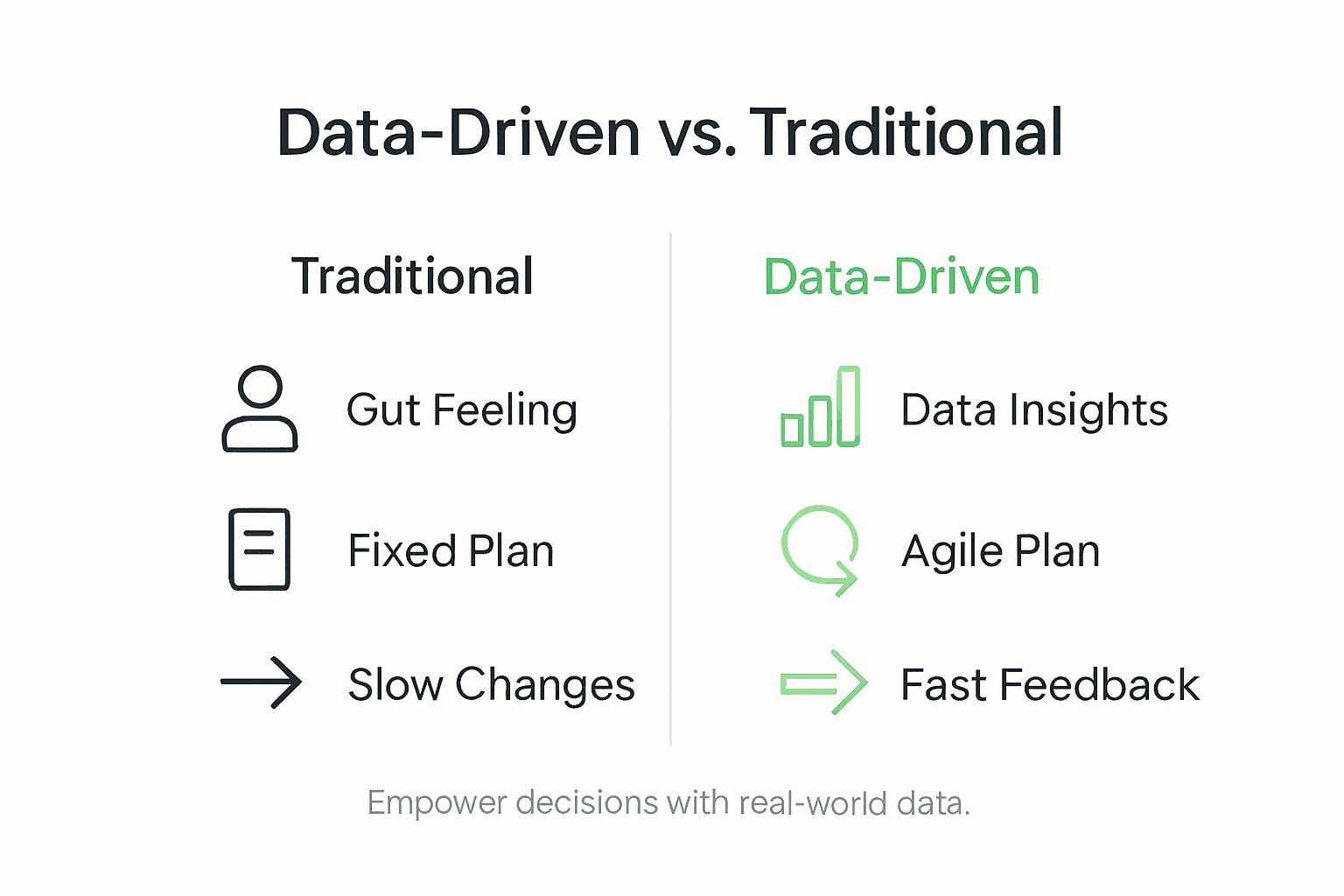
Entrepreneurship has undergone a fundamental transformation with the emergence of data-driven methodologies, shifting from intuition-based decision making to a more systematic, evidence-driven approach. Traditional entrepreneurs historically relied on personal experience, industry connections, and gut instincts to navigate business challenges. In contrast, modern data-led entrepreneurs leverage sophisticated analytical tools, machine learning algorithms, and comprehensive datasets to make more precise, predictive business decisions.
The core difference between traditional and data-driven entrepreneurship lies in their fundamental approach to opportunity recognition and innovation. Traditional entrepreneurship operates on a linear model of market understanding, where founders develop ideas based on limited market research and personal observations. Data-led entrepreneurship, by comparison, utilizes technology and digital insights to rapidly sense market dynamics and accelerate product development, creating a more dynamic and responsive business model. This approach allows entrepreneurs to validate concepts faster, minimize risks, and adapt strategies with unprecedented agility.
Key distinctions emerge across multiple dimensions of business strategy. Traditional entrepreneurs typically develop business plans through sequential stages of research and intuition, while data-driven founders continuously iterate their strategies using real-time insights. Technology and data analytics enable more granular market segmentation, predictive modeling of consumer behavior, and rapid prototyping of business concepts. This represents a profound shift from linear, experience-based decision making to a more complex, interconnected approach that values empirical evidence and computational analysis over purely human judgment.
This table contrasts data-driven with traditional entrepreneurship across key business strategy dimensions:
| Dimension | Traditional Model | Data-Driven Model |
|---|---|---|
| Decision Basis | Intuition and experience | Evidence from data and analytics |
| Market Research | Limited and manual | Automated, real-time insights |
| Product Development | Sequential, slow | Continuous, rapid iterations |
| Risk Management | Ad hoc, reactive | Proactive, predictive modeling |
Pro tip: Develop a hybrid approach by combining your entrepreneurial intuition with data-driven insights, creating a more robust and adaptable business strategy.
Unlock the Power of Data-Driven Entrepreneurship with siift.ai
The article highlights key challenges faced by modern founders such as making sense of complex data, validating market opportunities, and reducing risks in their entrepreneurial journey. If you want to overcome these hurdles and harness the full potential of data-driven methodologies like predictive analytics and digital experimentation, siift.ai Intelligent Business Canvas is your essential partner. Our intuitive AI app guides you step-by-step through ideation, validation, and go-to-market strategies offering personalized feedback, fresh insights, and prioritized actions to avoid blindspots and biases.
Take control and transform your ideas into impactful, viable businesses today. Visit siift.ai to experience a modern founder’s strategy platform built precisely for entrepreneurs committed to evidence-based growth. Don’t wait to innovate smarter and faster. Start now with siift.ai Intelligent Business Canvas and redefine your entrepreneurial future.
Frequently Asked Questions
What is data-driven entrepreneurship?
Data-driven entrepreneurship is an approach that utilizes advanced data analytics, artificial intelligence, and computational techniques to convert raw information into strategic insights, guiding business decisions and innovation.
How does data-driven entrepreneurship differ from traditional entrepreneurship?
Data-driven entrepreneurship relies on empirical evidence from data analysis for decision-making, while traditional entrepreneurship often depends on intuition and limited market research.
What are some key capabilities of data-driven entrepreneurship?
Key capabilities include big data market validation, predictive analytics, machine learning for customer behavior, and digital experimentation to rapidly test business hypotheses.
What mistakes should entrepreneurs avoid when implementing data-driven strategies?
Entrepreneurs should be cautious of misinterpreting experimental data, underestimating the complexity of data management, and lacking robust IT infrastructure, as these can lead to misguided business decisions.