
Over eighty percent of new American startups now depend on data insights to guide key business moves. This shift shows how being data-driven is more than just a buzzword for today’s entrepreneurs. As competition rises and markets become unpredictable, understanding what sets a data-driven American business founder apart can be the difference between success and stalling out. Discover why today’s most successful leaders are turning complex information into powerful strategies and measurable growth.
Table of Contents
- Defining A Data-Driven Entrepreneur Today
- Types Of Data And How They Are Used
- Strategies For Leveraging Data In Startups
- Essential Skills And Tools For Founders
- Common Pitfalls And How To Avoid Them
Key Takeaways
| Point | Details |
|---|---|
| Data-Driven Decision Making | Modern entrepreneurs leverage data analysis to inform decisions, ensuring choices are backed by empirical evidence rather than intuition. |
| Diverse Data Types | Understanding various data types, such as numerical, categorical, and geospatial, allows entrepreneurs to tailor their strategies effectively. |
| Essential Skills | Founders must develop analytical thinking, financial literacy, and technological adaptability to navigate the complex business landscape successfully. |
| Avoiding Common Pitfalls | Entrepreneurs should be cautious of biases and ensure that they integrate qualitative insights with statistical data to enhance decision-making. |
Defining a Data-Driven Entrepreneur Today
In the modern business landscape, a data-driven entrepreneur represents a strategic innovator who transforms raw information into actionable insights. Unlike traditional business leaders relying solely on intuition, these professionals leverage advanced data analysis technologies to guide organizational decisions with precision and clarity.
The core philosophy of a data-driven entrepreneur centers on making strategic choices grounded in empirical evidence rather than gut feelings. By interpreting complex datasets, these professionals can customize their approach, combining data and creativity to personalize messaging and target audiences with unprecedented accuracy.
Key characteristics of a modern data-driven entrepreneur include:
- Comfort with advanced analytical tools and technologies
- Ability to interpret complex statistical information
- Willingness to challenge existing assumptions through data
- Commitment to continuous learning and skill adaptation
- Transparent decision-making processes backed by verifiable metrics
Successful data-driven entrepreneurs recognize that information is not just a tool but a strategic asset. They view data as a dynamic resource that can reveal hidden market opportunities, predict consumer behaviors, and guide product development strategies. Understanding solopreneur versus traditional entrepreneurial models becomes easier when you approach business challenges with a systematic, data-informed perspective.
Types of Data and How They Are Used
Entrepreneurs today navigate a complex landscape of data types, each offering unique insights for strategic decision-making. Data is broadly classified into fundamental categories that range from qualitative to quantitative, providing nuanced perspectives on business performance and market dynamics. Understanding these variations allows entrepreneurs to select the most appropriate analytical approaches for their specific business challenges.
The spectrum of data types includes multiple formats that require specialized processing techniques. Entrepreneurs can leverage different data categories such as:
- Numerical data: Precise measurements and statistical indicators
- Categorical data: Grouped information describing characteristics
- Textual data: Insights from written communication and documentation
- Time-series data: Tracking performance and trends over specific periods
- Geospatial data: Location-based insights for market expansion
Successful data-driven entrepreneurs recognize that each data type serves a unique purpose. Numerical data might reveal financial trends, while categorical data can help segment customer profiles. Entrepreneur personality traits often determine how effectively these diverse data types are interpreted and transformed into actionable business strategies.

Strategies for Leveraging Data in Startups
Data-driven strategies have become the cornerstone of successful startup innovation. Implementing a comprehensive data-driven approach enables startups to obtain relevant and reliable information about their business strategies, offering unprecedented insights into organizational performance and market potential.
Startups can effectively leverage data through strategic approaches:
- Customer Insights: Analyzing behavioral and demographic data
- Market Segmentation: Identifying precise target audience characteristics
- Performance Tracking: Monitoring key performance indicators (KPIs)
- Predictive Analytics: Forecasting potential business trends
- Resource Optimization: Allocating resources with mathematical precision
Combining data and creativity allows startups to personalize messaging, ensuring communication reaches the right audience at the optimal moment. This approach transforms raw information into actionable business intelligence. By developing strategic growth frameworks for emerging businesses, entrepreneurs can systematically decode complex market dynamics and make informed decisions that drive sustainable competitive advantage.
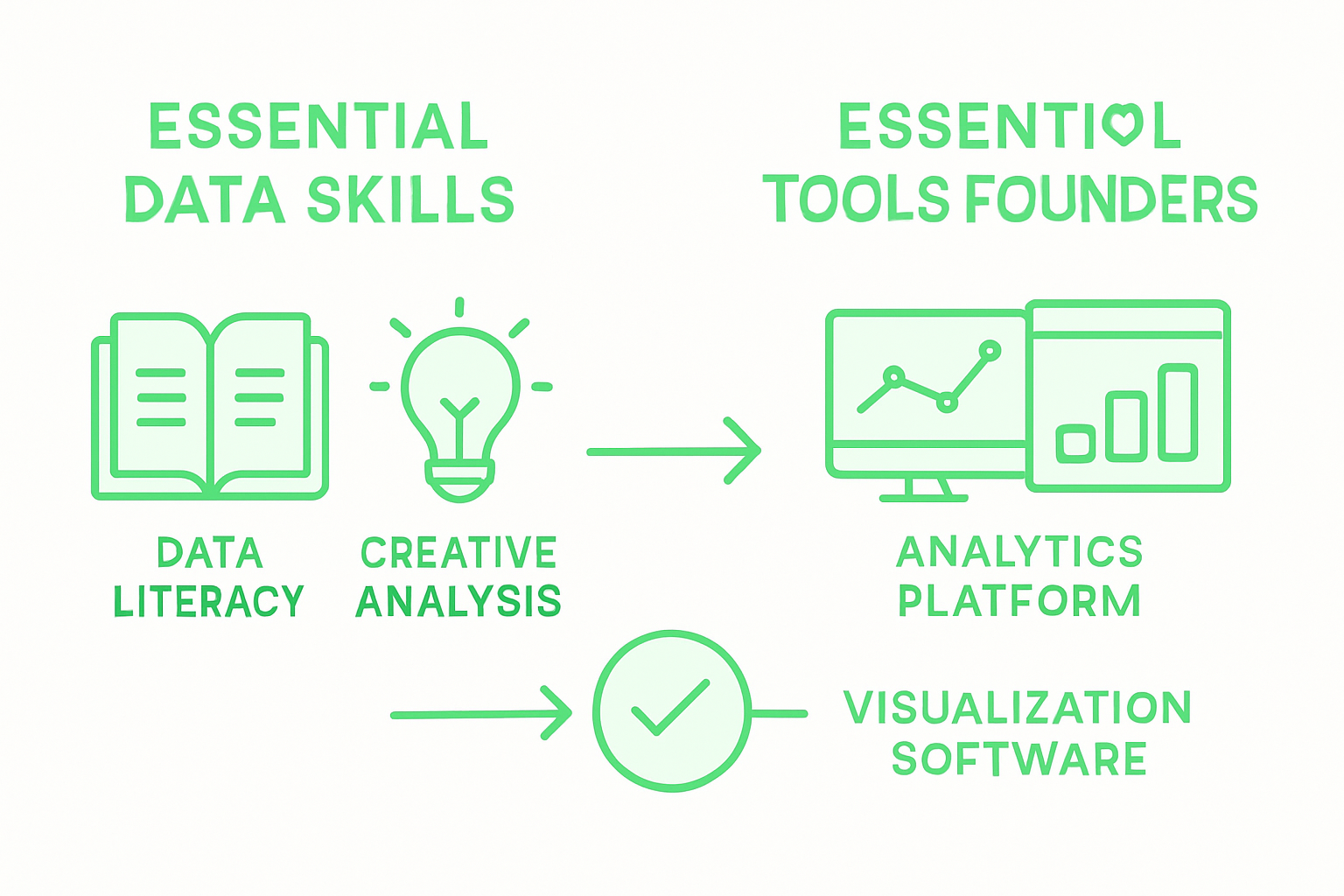
Essential Skills and Tools for Founders
Successful founders must develop a robust toolkit of skills and technologies to navigate the complex entrepreneurial landscape. Founders should cultivate advanced data analysis technologies to guide organizational decisions, ensuring strategies emerge from empirical insights rather than mere intuition.
Key skills for modern entrepreneurs include:
- Analytical Thinking: Interpreting complex data sets
- Strategic Communication: Translating insights into actionable plans
- Technological Adaptability: Mastering emerging digital tools
- Financial Literacy: Understanding economic performance metrics
- Creative Problem-Solving: Generating innovative solutions from data
Entrepreneurs must learn to interpret data creatively, customizing messaging and audience targeting, which requires a nuanced blend of technical skill and human intuition. By developing critical entrepreneurial habits and mindsets, founders can transform raw information into strategic competitive advantages that drive sustainable business growth.
Common Pitfalls and How to Avoid Them
Data-driven entrepreneurship requires strategic navigation through potential obstacles that can derail startup success. A critical pitfall is relying exclusively on intuition without implementing comprehensive data analysis approaches, which can lead to misguided strategic decisions and missed opportunities.
Common entrepreneurial data challenges include:
- Confirmation Bias: Selecting data that supports preexisting beliefs
- Overreliance on Historical Data: Assuming past trends predict future performance
- Data Silos: Failing to integrate information across different business domains
- Misinterpreting Correlation: Confusing coincidental patterns with causal relationships
- Neglecting Qualitative Insights: Reducing complex human experiences to numeric metrics
Entrepreneurs must learn to combine data interpretation with creative messaging strategies, ensuring that statistical insights are transformed into meaningful, personalized communication. By understanding critical entrepreneurial habits that prevent strategic missteps, founders can develop robust frameworks for mitigating risks and maximizing data-driven decision-making.
Empower Your Data-Driven Entrepreneurial Journey with siift.ai
The article highlights the challenge entrepreneurs face in turning complex data insights into clear, actionable strategies. You know that relying solely on intuition can lead to costly mistakes while ignoring key data types might obscure valuable business opportunities. To succeed, you need to master analytical thinking, combine creativity with data, and avoid common pitfalls like confirmation bias and data silos. These are exactly the pain points that modern founders confront every day.
siift.ai Intelligent Business Canvas is designed to tackle these challenges head-on. This intuitive AI platform guides you step-by-step through ideation, validation, and go-to-market strategies, offering personalized feedback and prioritized actions to help you avoid blindspots and make data-driven decisions confidently. Transform your startup approach by leveraging advanced frameworks that combine data insights with creativity and strategic communication. Discover how to turn raw information into sustainable business growth with no pressure or gatekeepers.
Ready to master the art of data-driven entrepreneurship and build a viable business with clarity and confidence Get started today by exploring the siift.ai Intelligent Business Canvas and make your ideas actionable with AI-powered guidance. Don’t wait to unlock strategic growth — visit https://siift.ai and take control of your founder’s journey now.
Frequently Asked Questions
What is a data-driven entrepreneur?
A data-driven entrepreneur is a business professional who uses data analysis and empirical evidence to make strategic decisions, rather than relying solely on intuition.
What are the key characteristics of a successful data-driven entrepreneur?
Successful data-driven entrepreneurs typically exhibit comfort with analytical tools, a willingness to challenge assumptions, and a commitment to continuous learning and skill adaptation.
How can startups leverage data for decision-making?
Startups can leverage data by analyzing customer insights, segmenting markets, tracking performance indicators, using predictive analytics, and optimizing resource allocation based on data insights.
What are common pitfalls in data-driven entrepreneurship?
Common pitfalls include confirmation bias, overreliance on historical data, data silos, misinterpreting correlation, and neglecting qualitative insights that go beyond numeric metrics.
Recommended
- blog | siift | Building Entrepreneurial Mindset: Steps for Beginners in 2025
- blog | siift | Understanding What is Entrepreneurship: A Complete Guide
- blog | siift | 10 Essential Habits of Successful Entrepreneurs Explained
- blog | siift | How to Find Business Ideas in 2025: Proven Steps for Students and New Grads
- Customer Insights Analytics Guide: Unlocking Value in 2025 - ApusNest Blog | ApusNest