

Did you know that over 65 percent of self-made millionaires have at least three sources of passive income? Many people are looking for ways to earn money with less hands-on effort so they can have more freedom and flexibility. Understanding passive income streams gives you tools to build wealth without constant daily hustle, revealing practical methods for generating steady earnings while you focus on what matters most.
Key Takeaways
| Point | Details |
|---|---|
| Understanding Passive Income | Passive income requires minimal ongoing effort and can provide financial security by generating money independently of continuous labor. |
| Diverse Income Streams | Developing multiple passive income streams enhances financial resilience, like cultivating various income sources that generate wealth over time. |
| Risks and Tax Implications | Passive income is subject to varied tax treatments and requires proactive management of compliance, documentation, and investment risks. |
| Continuous Improvement | Success in passive income generation demands continuous adaptation and learning, ensuring strategies remain relevant and effective in changing markets. |
Table of Contents
- Understanding Passive Income Streams Fully
- Key Types Of Passive Income Opportunities
- How Passive Income Streams Generate Earnings
- Costs, Risks, And Tax Implications Explained
- Common Pitfalls And How To Succeed
Understanding Passive Income Streams Fully
Passive income isn’t just a buzzword or a get-rich-quick fantasy. Passive income represents a strategic approach to generating money that works while you sleep, travel, or focus on other priorities. According to Wikipedia, it’s income requiring minimal ongoing effort to earn and maintain.
At its core, passive income includes several powerful earning mechanisms:
- Dividends from stock investments
- Rental property income
- Interest from savings or bonds
- Royalties from creative works
- Digital product sales
- Affiliate marketing revenues
What makes passive income so compelling is its potential to create financial breathing room. Unlike traditional employment where you trade hours for dollars, passive income streams generate money independent of your direct, continuous labor. According to economic research, this type of unearned income can include profits from assets you own without materially participating in their day-to-day operations.
The real magic happens when you strategically develop multiple passive income streams. This approach doesn’t just supplement your primary income - it builds a robust financial safety net. By diversifying your passive income sources, you’re essentially creating multiple small financial engines that collectively drive your wealth generation. Think of it like planting several money trees that gradually grow and produce fruit, requiring minimal maintenance but delivering consistent returns.
Key Types of Passive Income Opportunities
The digital era has dramatically expanded passive income possibilities beyond traditional investment models. Digital content creation now offers entrepreneurs unprecedented opportunities to generate income with minimal ongoing effort. According to research from UMA Technology, modern passive income streams encompass innovative approaches like e-commerce automation, print-on-demand services, and intellectual property royalties.
Here are some exciting passive income opportunities:
Here’s a comparison of key passive income opportunities:
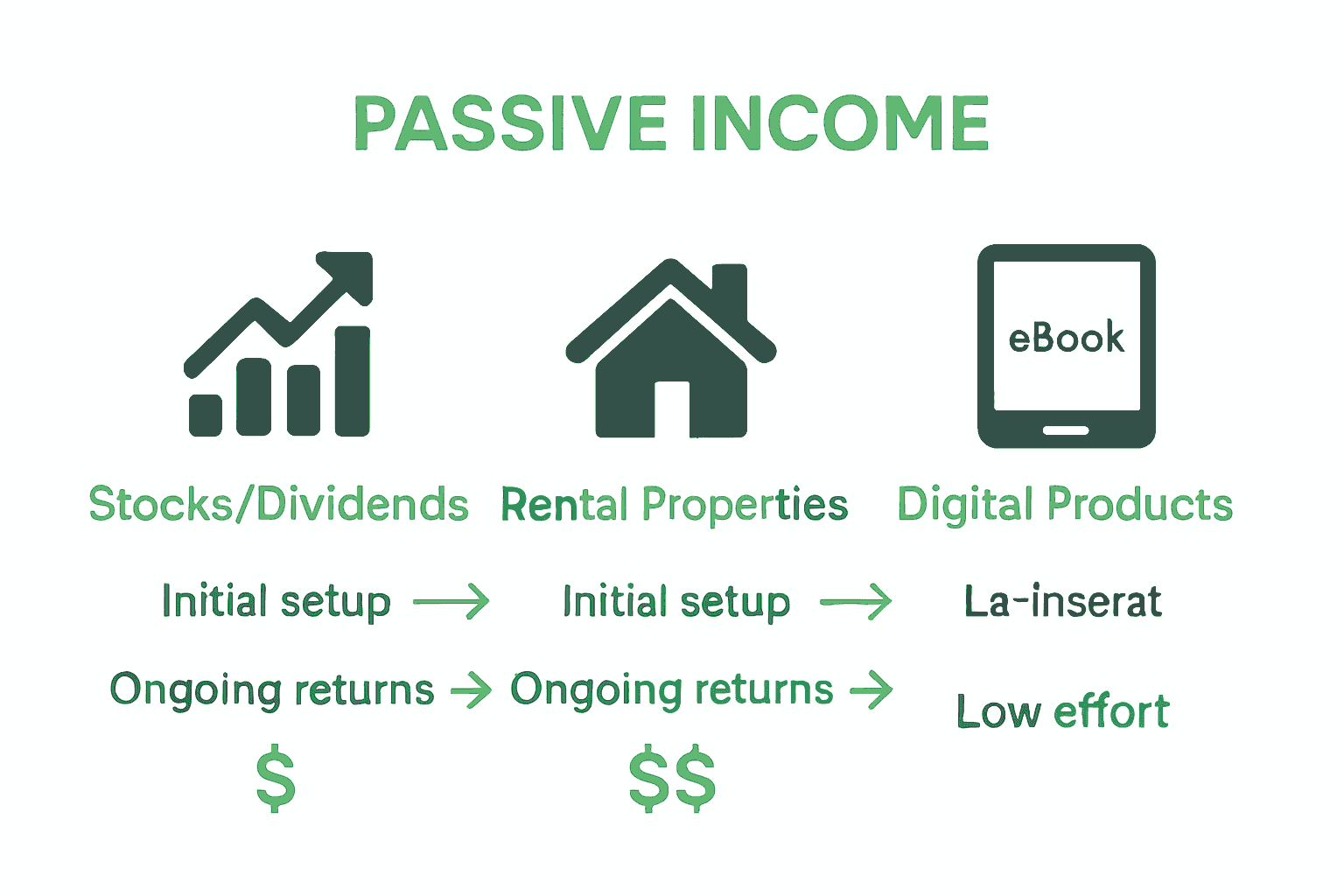
| Passive Income Type | Typical Setup Effort | Ongoing Involvement |
|---|---|---|
| Dividend Investing | Moderate | Minimal |
| Rental Properties | High | Low to Moderate |
| Digital Product Sales | High | Minimal |
| Affiliate Marketing | Moderate | Minimal |
| E-commerce Automation | High | Minimal |
| Crypto Staking | Low to Moderate | Minimal |
| Real Estate Crowdfunding | Low | Minimal |
| Print-on-Demand | Moderate | Minimal |
- E-commerce Automation: Setting up dropshipping stores that operate with minimal daily management
- Print-on-Demand: Creating designs for merchandise sold through automated platforms
- Crypto Staking: Earning returns by holding and validating cryptocurrency transactions
- Digital Product Sales: Selling online courses, ebooks, and software
- Robo-Advisor Investments: Automated investment platforms managing portfolios
- Real Estate Crowdfunding: Investing in property developments without direct property management
The most successful passive income strategies leverage technology to minimize personal time investment. Intellectual property royalties represent a particularly compelling opportunity, allowing creators to monetize their knowledge and creativity through digital platforms. By systematically developing multiple income streams, entrepreneurs can build a resilient financial ecosystem that generates revenue independently of their direct daily labor.

Key to success is selecting passive income opportunities that align with your skills, interests, and available resources. Start small, learn continuously, and gradually diversify your income streams to create a robust financial portfolio that grows with minimal ongoing intervention.
How Passive Income Streams Generate Earnings
Passive income generation is less mysterious than most people imagine - it’s fundamentally about creating systems that generate money with minimal ongoing effort. According to Bitpanda, this typically involves strategically investing in assets that continuously produce returns without requiring constant personal management.
The primary mechanisms of passive income generation include:
- Investment Returns: Earning dividends from stocks, ETFs, or bonds
- Rental Income: Generating revenue from property without direct daily management
- Digital Product Sales: Creating content or software sold repeatedly
- Affiliate Marketing: Earning commissions from product recommendations
- Royalty Streams: Generating income from intellectual property
As Wikipedia explains, the key characteristic of passive income is that it comes from activities where you do not materially participate. This means your initial effort creates a revenue-generating asset that continues producing income with minimal additional work. For instance, writing an ebook once can result in ongoing sales, or investing in dividend-paying stocks can provide regular income without managing daily operations.
Successful passive income requires upfront investment - whether that’s financial capital, time, creativity, or expertise. The magic happens when you design income streams that compound over time, transforming your initial effort into a consistent revenue generator. Think of it like planting a financial seed that grows independently, requiring only occasional nurturing to continue producing results.
Costs, Risks, and Tax Implications Explained
Passive income isn’t just about generating money - it’s also about understanding the complex financial landscape that comes with it. According to Wikipedia, passive income is typically taxable, with different income types potentially subjected to varied tax treatments. Learn more about business risks in our comprehensive guide.
Key financial considerations for passive income include:
- Tax Variability: Different income streams are taxed differently
- Reporting Requirements: Mandatory documentation for various income sources
- Compliance Costs: Potential expenses for legal and accounting support
- Investment Risks: Potential capital loss or reduced returns
- Regulatory Changes: Shifting tax laws and investment regulations
Research from the GSM Growth Agency emphasizes that ignoring tax and legal implications is a critical mistake for passive income entrepreneurs. Proactive tax planning involves understanding how different passive income sources - like dividends, rental income, or royalties - are treated under local tax laws. This means maintaining accurate records, understanding potential deductions, and potentially consulting with tax professionals.
Successful passive income generation requires a holistic approach that balances potential earnings with comprehensive risk management. While the allure of ‘hands-off’ income is strong, smart investors recognize that some ongoing attention and strategic planning are essential to protecting and growing their passive revenue streams.
Common Pitfalls and How to Succeed
Building passive income isn’t a get-rich-quick scheme - it’s a strategic journey requiring careful planning and realistic expectations. According to research from UMA Technology, entrepreneurs often stumble by underestimating the initial effort required to establish sustainable passive income streams. Learn more about startup challenges in our in-depth guide.
Common passive income pitfalls include:
- Unrealistic Expectations: Believing income will be instant and effortless
- Poor Market Research: Selecting niches without understanding demand
- Lack of Automation: Failing to create scalable systems
- Single Platform Dependence: Not diversifying income sources
- Neglecting Continuous Learning: Refusing to adapt and improve strategies
Research highlights that successful passive income requires more than just initial setup. Continuous adaptation is crucial - this means regularly reviewing your income streams, understanding market shifts, and being willing to pivot or upgrade your approaches. Reinvestment is key: instead of viewing passive income as pure profit, treat it as a mechanism for further growth and development.
The most successful passive income entrepreneurs approach their streams like mini-businesses. They invest time in understanding their markets, create robust systems that can operate with minimal intervention, and maintain a learning mindset. Remember, passive income is less about finding a magic formula and more about building intelligent, adaptable financial ecosystems that generate returns with progressively less personal effort.
Ready to Turn Passive Income Ideas into Lasting Financial Growth?
Building real passive income streams is an exciting step, but without the right systems, the journey can quickly feel overwhelming. Many entrepreneurs struggle with knowing where to start, how to avoid common pitfalls, or simply how to move from ideas to real, sustainable income. The challenges highlighted in the article—like managing risk, staying motivated, and building scalable systems—are real roadblocks if you try to go it alone.
siift offers a smarter way to turn your passive income dreams into reality. Get personalized guidance on:
- Spotting the most successful passive income streams for your unique strengths
- Prioritizing the steps that actually move the needle
- Avoiding costly mistakes with proactive support
You deserve more than vague advice and empty promises. Let siift be your founder’s compass, providing you with intuitive feedback, ongoing insights, and clear next steps tailored precisely to your ambitions. Ready to move from planning to earning? Start building your passive income journey with siift now and unlock your financial future today.
Frequently Asked Questions
What is passive income and how does it work?
Passive income is money earned with minimal ongoing effort after the initial setup. It typically includes earnings from investments, rental properties, royalties, and digital products, where you do not materially participate in daily operations.
What are the main types of passive income streams?
The main types of passive income streams include dividends from stocks, rental income from properties, royalties from creative works, digital product sales, affiliate marketing, and income from automated e-commerce activities.
What are the risks associated with passive income?
Passive income can carry various risks, including market volatility, regulatory changes, potential capital loss, and taxation implications. It requires careful planning and an understanding of the financial landscape to manage these risks effectively.
What are common mistakes to avoid when building passive income?
Common mistakes include having unrealistic expectations about income generation, neglecting market research, failing to automate systems, relying on a single income source, and not prioritizing continuous learning and adaptation to market shifts.
Recommended
- blog | siift | Work From Home Tips for Future Entrepreneurs and Solopreneurs
- blog | siift | Choosing a Business Structure: A Simple Guide for New Founders
- blog | siift | 7 Innovative Business Ideas for Students to Start Now
- blog | siift | When to Register a Business: A 2025 Guide for Side Hustlers and New Founders
- Blogging Tips for 2025: Proven Strategies for Growth
- 3 Fast Ways To Build A Profitable Author Opt-In List - DigitalMarketingAuthors.com