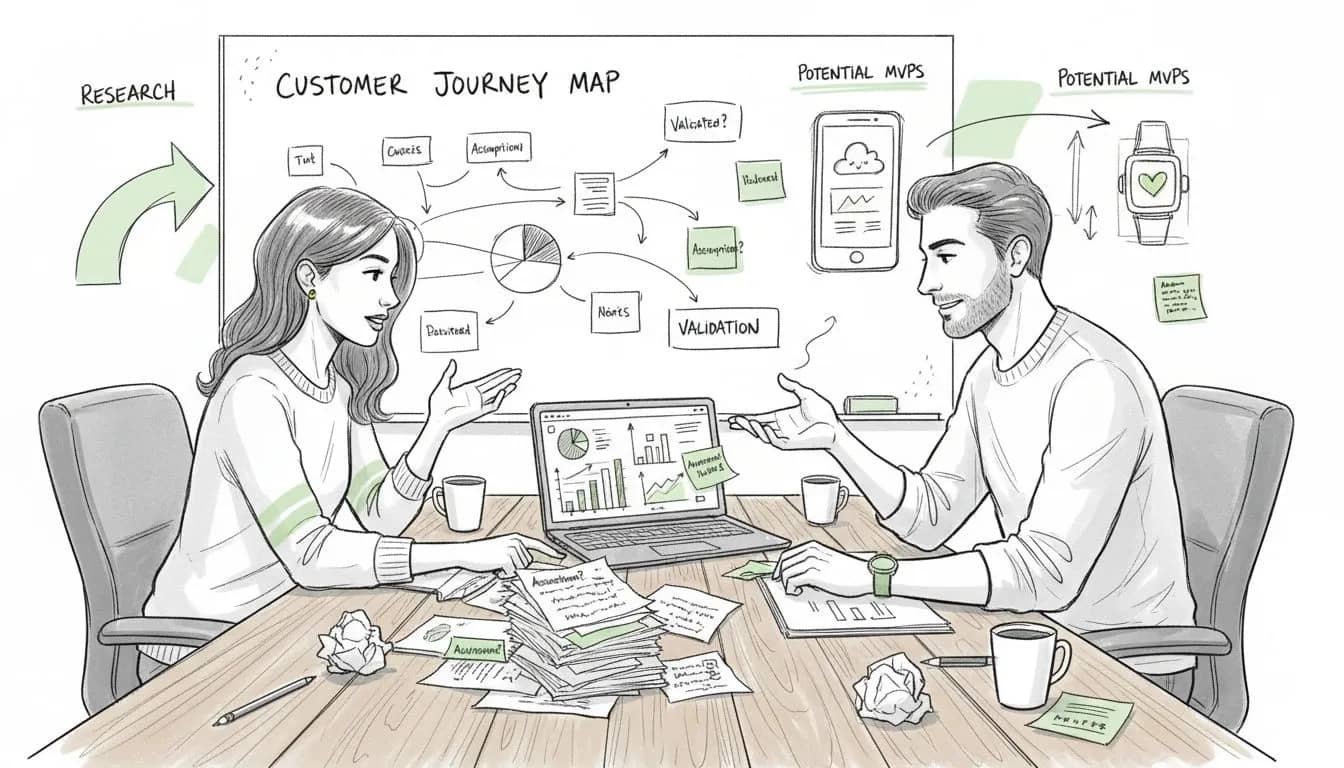
More than half of startups fail because they build products nobody actually wants. That’s why customer validation sits at the heart of smart business development. By testing assumptions with real people before sinking time and money, founders swap wild guesses for insights that deliver results. This practical guide shows you how customer validation works, why it matters, and the proven steps that turn ideas into products customers are eager to buy.
Table of Contents
- Defining Customer Validation And Its Purpose
- Core Steps In The Customer Validation Process
- Customer Validation Methods And Best Practices
- Common Pitfalls And How To Avoid Them
- Real-World Examples And Next Steps
Key Takeaways
| Point | Details |
|---|---|
| Purpose of Customer Validation | It bridges business ideas to actual products, testing assumptions about the market and potential customers. |
| Core Steps | Includes problem definition, target market research, hypothesis development, customer interviews, and feedback cycles to ensure product-market fit. |
| Methods and Best Practices | Utilizes surveys, interviews, prototyping, and behavioral tracking to gather actionable insights for informed product decisions. |
| Common Pitfalls | Avoid cognitive biases and data collection failures by maintaining intellectual humility and treating validation as a learning journey. |
Defining Customer Validation And Its Purpose
Customer validation is the critical bridge between having a business idea and creating a product people actually want to buy. At its core, customer validation is a systematic process designed to test fundamental assumptions about your target market, potential customers, and proposed solution before investing significant resources.
According to ProductPlan, customer validation is a “critical phase in product development that tests assumptions about customer problems, target markets, and product solutions.” This definition highlights the process’s primary goal: reducing risk by gathering real-world evidence about market needs and potential product fit.
The purpose of customer validation goes far beyond simple market research. It’s about transforming assumptions into actionable insights. Entrepreneurs and product developers use this process to answer crucial questions like: Who are my ideal customers? What specific problems do they experience? How valuable is my proposed solution? By systematically investigating these questions, founders can make data-driven decisions that dramatically increase their chances of success.

Customer validation typically involves several key activities:
- Conducting targeted customer interviews
- Developing and testing minimum viable products (MVPs)
- Gathering quantitative and qualitative feedback
- Iterating product design based on actual user responses
Unlike early-stage customer discovery, which focuses on broadly understanding potential markets, WisdomLib notes that customer validation “focuses on achieving product-market fit by ensuring that a developed product effectively meets the needs and demands of the target market.” This nuanced approach transforms theoretical potential into practical, marketable solutions.
The ultimate goal? Minimizing the risk of building something nobody wants while maximizing your opportunity to create a product that truly resonates with your target audience. Smart founders treat customer validation not as an optional step, but as a mandatory journey toward sustainable business success.
Core Steps In The Customer Validation Process
Customer validation isn’t a one-size-fits-all checklist but a strategic journey of understanding your market’s genuine needs. Strategic customer validation involves a structured approach that transforms uncertain assumptions into concrete, actionable insights about your potential product’s market potential.
According to Nulab, the customer validation process fundamentally “involves gathering and organizing feedback, analyzing the data to identify patterns, and iterating the product based on insights to ensure it meets customer needs.” This comprehensive approach requires methodical execution across several critical stages.
The core steps in the customer validation process typically include:
- Problem Definition
- Clearly articulate the specific customer problem you’re solving
- Verify that the problem is significant and widespread
- Target Market Research
- Identify and segment your ideal customer demographics
- Understand their pain points, behaviors, and preferences
- Hypothesis Development
- Formulate testable hypotheses about your product’s value proposition
- Define specific, measurable criteria for validation
- Customer Discovery Interviews
- Conduct structured interviews with potential users
- Ask open-ended questions to uncover deep insights
- Avoid leading questions that might skew responses
- Prototype and Feedback Cycle
- Develop a minimum viable product (MVP)
- Gather qualitative and quantitative user feedback
- Iterate rapidly based on user responses
As CS Princeton research highlights, the ultimate goal of customer validation is to “build a repeatable sales roadmap by successfully selling the product to early customers” and proving that a specific market segment will respond positively to your solution.
Successful customer validation requires patience, intellectual honesty, and a willingness to pivot.
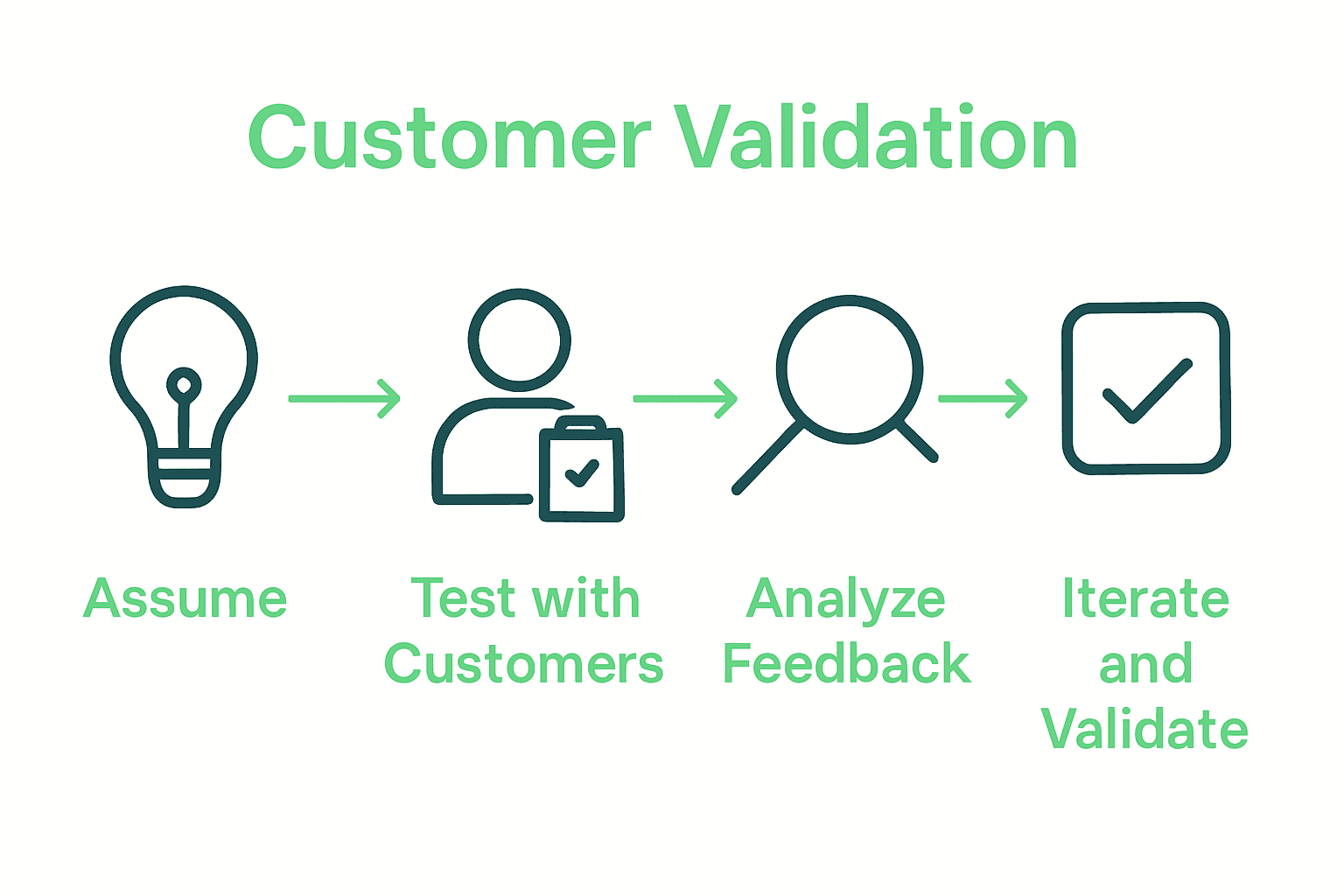 It’s not about confirming what you want to hear, but discovering the genuine market truth. Smart founders embrace this process as a critical filtering mechanism that separates promising ideas from potential market failures.
Customer Validation Methods And Best Practices
Customer validation isn’t just a checklist. It’s an art and science of understanding your market’s deepest needs through strategic, systematic approaches. Effective validation methods transform gut feelings into data-driven insights that can make or break a startup’s success.
According to ProductPlan, product managers leverage customer validation to “inform product decisions by validating problems, solutions, and pain points, focusing on the market, the problem being solved, and the product itself.” This nuanced approach requires multiple complementary techniques.
Key validation methods include:
Survey and Interview Techniques
- Conduct structured customer interviews
- Use open-ended and probing questions
- Record and analyze conversation patterns
- Seek depth over quantity of responses
Prototype and MVP Testing
- Create low-fidelity prototypes
- Test with small, representative user groups
- Gather both qualitative and quantitative feedback
- Iterate rapidly based on user insights
Analytics and Behavioral Tracking
- Implement user behavior tracking
- Monitor engagement metrics
- Analyze conversion and drop-off points
- Use heatmaps and user flow analysis
Best practices for customer validation demand intellectual honesty and systematic rigor. Link Springer research emphasizes that validation “involves testing assumptions through generating and evaluating information, supporting the development of a product that solves a chosen problem, and ensuring the startup’s path to product/market fit.”
Successful founders approach customer validation as a continuous learning process. They remain open to pivoting, embrace uncomfortable feedback, and view each interaction as an opportunity to refine their understanding. The goal isn’t just to validate an idea, but to deeply comprehend the underlying market dynamics that will ultimately determine your product’s success.
Common Pitfalls And How To Avoid Them
Customer validation is a minefield of potential mistakes that can derail even the most promising startup ideas. Entrepreneurial landmines lurk at every turn, waiting to explode your carefully constructed business hypothesis and drain your limited resources.
According to Nulab, one of the most critical pitfalls is “inadequate data organization and analysis, leading to misinterpretation of customer feedback.” Smart founders must systematically gather, organize, and analyze data to identify meaningful patterns and actionable insights.
Common validation pitfalls include:
Cognitive Bias Traps
- Confirmation bias: Seeking only feedback that validates preexisting beliefs
- Survivorship bias: Overlooking potential failure scenarios
- Sampling bias: Interviewing only friends or people who seem supportive
Data Collection Failures
- Leading questions that suggest desired answers
- Insufficient sample size
- Lack of demographic diversity in research participants
- Inconsistent interview methodologies
Interpretation Mistakes
- Overreacting to single data points
- Ignoring contradictory evidence
- Failing to distinguish between anecdotal feedback and statistically significant insights
CS Princeton research highlights another critical pitfall: “failing to establish a repeatable sales process.” This means founders must develop a sales roadmap field-tested by successfully selling to early customers, ensuring a proven and scalable approach.
The key to avoiding these pitfalls is maintaining intellectual humility. Treat customer validation as a learning journey, not a confirmation quest. Embrace uncomfortable feedback, remain objectively curious, and view each potential mistake as an opportunity to refine your understanding of the market’s true needs.
Real-World Examples And Next Steps
Customer validation transforms abstract concepts into tangible business strategies through real-world application and continuous learning. The journey from idea to validated business concept is rarely linear, but always illuminating for founders willing to embrace uncertainty and systematic exploration.
Link Springer research emphasizes that validation is “a continuous and iterative process, remaining important throughout a startup’s lifecycle, from problem exploration and solution development to business modeling and growth hacking.” This perspective highlights validation as an ongoing strategic approach, not a one-time event.
Real-World Validation Success Stories:
Tech Startup Example
- Dropbox created a simple explainer video before building the full product
- Validated massive market demand through user sign-ups
- Used minimal investment to test core value proposition
E-commerce Validation
- Airbnb founders physically visited hosts to understand pain points
- Photographed apartments to improve listing attractiveness
- Iteratively refined platform based on direct user feedback
Service Industry Innovation
JRSSEM showcases an Indonesian startup that validated its concept by “offering online stall rental facilities, addressing community complaints, and ensuring convenience and security for both stall providers and tenants.”
Next steps for founders involve maintaining strategic momentum:
- Document every customer interaction
- Create systematic feedback collection mechanisms
- Develop adaptable prototype strategies
- Remain emotionally detached from initial hypotheses
Successful validation isn’t about proving yourself right. It’s about discovering what truly matters to your potential customers. Treat each insight as a stepping stone, each conversation as an opportunity to refine your understanding of market dynamics.
Unlock the Power of Customer Validation with AI-Driven Guidance
The article highlights the challenge many founders face when trying to turn assumptions into real market success. Customer validation involves detecting genuine customer needs, avoiding common pitfalls such as bias and misinterpretation, and iterating quickly based on authentic feedback. Many entrepreneurs struggle with organizing insights and building a repeatable sales approach that proves product-market fit. If you want to navigate these complexities with confidence, using strategic tools that remove guesswork is crucial.
siift.ai Intelligent Business Canvas is designed precisely for founders who want to master the customer validation process step-by-step. Our AI-powered platform offers personalized feedback, fresh insights, and prioritized actions to help you avoid cognitive traps and build a strong go-to-market strategy. The app guides you through problem definition, hypothesis development, MVP testing, and feedback cycles with no biases or pressure. Discover how to transform your ideas into validated, viable products by visiting siift.ai today. Take control of your founder journey now and ensure your business builds what customers truly want.
Frequently Asked Questions
What is customer validation?
Customer validation is a systematic process that tests assumptions about your target market, potential customers, and proposed solutions. Its goal is to gather evidence of market needs and potential product fit before significant investment.
Why is customer validation important for startups?
Customer validation is crucial for startups because it helps minimize the risk of building products that do not meet market needs. By testing and iterating based on user feedback, founders can increase their chances of creating successful products.
What are the core steps involved in the customer validation process?
The core steps include defining the problem, conducting target market research, developing hypotheses, conducting customer discovery interviews, and employing a prototype and feedback cycle to gather user insights.
What common pitfalls should be avoided during customer validation?
Common pitfalls include cognitive bias traps, leading questions in surveys, inadequate data collection, and misinterpreting customer feedback. Maintaining intellectual humility and treating validation as a learning journey can help avoid these issues.
Recommended
- blog | siift | What Is Business Validation? A Simple Guide for New Founders
- blog | siift | How to Validate Idea in 2025: A Simple Guide for New Founders
- blog | siift | Master Business Idea Validation: Steps to Success in 2025
- blog | siift | Understanding Lean Startup Methodology for New Entrepreneurs
- Customer Engagement — The Missing Piece in Investor Conversations
- Top Ways to Boost Fan Loyalty for Creators - FanSpicy