
TL;DR:
- A business startup aims for rapid growth and market disruption through innovation and scalability.
- It is distinguished from small businesses by its need for external funding, high uncertainty, and a repeatable business model.
A business startup is defined as a young company built to create an innovative product or service with the explicit goal of rapid growth and market disruption. That definition matters more than most aspiring founders realize. Understanding it correctly shapes every decision you make, from how you structure your company to how you pitch investors. The term “startup” gets thrown around loosely, but the industry standard meaning is specific: a company designed to scale fast, not just one that opened recently. If you’re a millennial or college student trying to figure out whether your idea qualifies, this guide gives you the foundational knowledge to answer that question honestly.
What does “define business startup” actually mean?
A startup is not just any new business. The business startup definition centers on three things: innovation, scalability, and speed. A startup builds something new or applies an existing idea in a way that disrupts a market, then pursues rapid growth rather than steady local revenue.
Startups are young, innovative companies designed for rapid scalability and market disruption, relying often on external capital. That reliance on venture capital or angel investment is a defining trait, not an optional feature. A neighborhood bakery is a new business. A tech platform that automates bakery supply chains across 50 cities is a startup.
Business Finland categorizes startups as SMEs less than 5 years old with high-growth goals. That age threshold is a useful benchmark. It signals that the startup label is temporary by design. You either grow into a scaled company or you pivot, get acquired, or wind down.
What are the core characteristics of a business startup?
The business startup meaning becomes clearest when you look at what separates startups from every other type of new company. These traits are not aspirational. They are operational requirements.
- Scalability. A startup’s business model must work at 10x its current size without proportionally increasing costs. Software is the classic example. You write the code once and sell it to a million users.
- Innovation or disruption. The product or service either creates a new market or reshapes an existing one. Uber did not invent transportation. It disrupted how transportation gets dispatched and paid for.
- Repeatable business model. Startups require a repeatable and scalable business model distinct from small business models focused on local market stability. Repeatability means the same sales process works in Austin, Atlanta, and Amsterdam.
- High uncertainty and risk. Startups operate in unproven territory. The product may not find buyers. The market may not exist yet. This is not a bug. It is the nature of the work.
- External funding. Most startups cannot self-fund their growth. Angel investors and venture capital funds fill that gap in exchange for equity.
- Technology as a core driver. Most modern startups use technology to deliver their product, reach customers, or reduce costs at scale.
Pro Tip: If your business idea cannot realistically serve 10,000 customers with the same team and infrastructure you’d use for 100, rethink whether you’re building a startup or a small business. Both are valid. Only one of them needs VC money.
What are the steps to start a business startup?
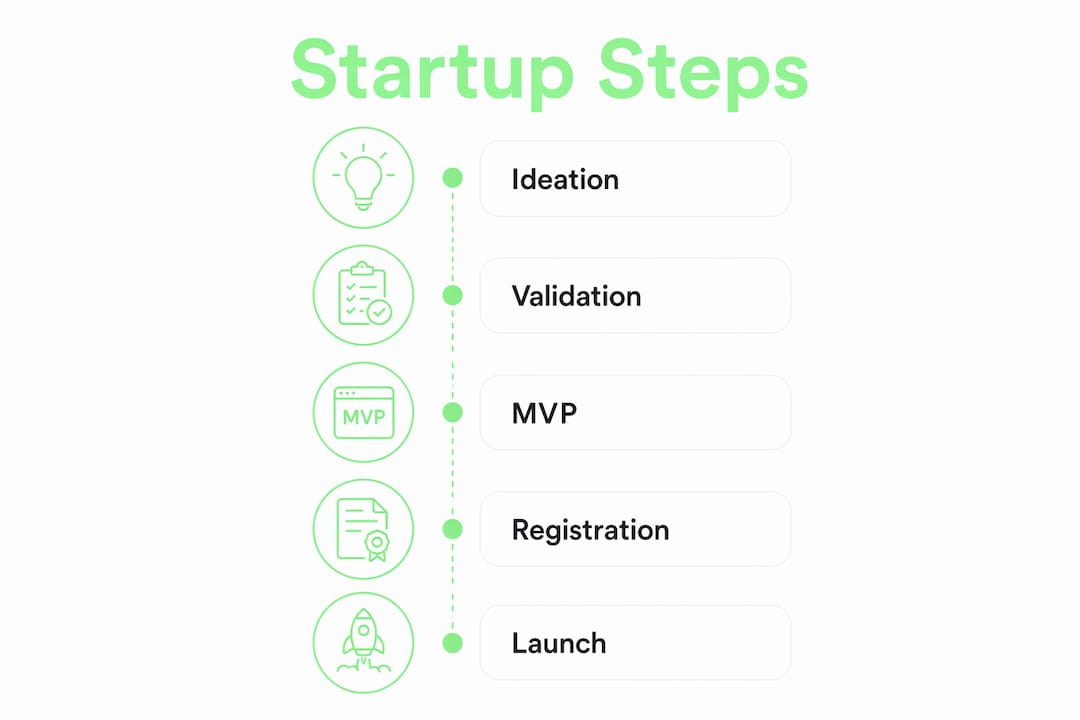
The business startup process follows a validated sequence. Skipping steps does not save time. It creates expensive problems later.
- Validate market demand. Failing to validate market demand is the most common reason startups fail. Talk to real potential customers before writing a single line of code or spending a dollar on production.
- Build a Minimum Viable Product (MVP). An MVP is the simplest version of your product that lets you test your core assumption. Learn more about building your MVP before you over-engineer anything.
- Choose a legal structure. Most startups incorporate as an LLC or C-Corporation. The IRS and US Chamber of Commerce recommend thorough legal setup as a foundational step to reduce operational friction. A C-Corp is typically required if you plan to raise venture capital.
- Register your business and obtain an EIN. An Employer Identification Number (EIN) is your business’s tax ID. You need it to open a bank account, hire employees, and file taxes.
- Protect your intellectual property. File for trademarks, patents, or copyrights early. Founders who address IP and legal structure early experience fewer setbacks and grow more sustainably.
- Open a dedicated business bank account. Mixing personal and business finances is one of the most common and costly early mistakes.
- Build a funding strategy. Understand your burn rate before you approach investors. Funding should come after MVP development and demonstrated market traction, not before.
| Startup stage | Key milestone | Common mistake |
|---|---|---|
| Ideation | Identify a real problem worth solving | Falling in love with the solution, not the problem |
| Validation | Prove demand with real customer feedback | Skipping validation and building in isolation |
| MVP | Launch a testable version of the product | Over-building before testing |
| Legal setup | Register entity, get EIN, protect IP | Delaying structure until problems arise |
| Funding | Approach investors with traction data | Pitching ideas without evidence of demand |
Pro Tip: Treat market research as an ongoing activity, not a one-time checkbox. The market research basics that matter most are the ones you do after your first 50 customer conversations, not before.
How do startups differ from small businesses?
This is where most aspiring founders get confused. Most millennials and college entrepreneurs confuse any new business with a startup, overlooking distinct operational and funding differences. The confusion is understandable. Both involve starting something from scratch. But the goals, strategies, and funding approaches are fundamentally different.
A small business is built for sustainable, profitable operations in a defined market. A startup is built to grow as fast as possible, often at the expense of short-term profitability. A local accounting firm wants steady clients and predictable revenue. A fintech startup wants to process payroll for every small business in the country.
| Factor | Startup | Small business |
|---|---|---|
| Primary goal | Rapid scale and market disruption | Stable, profitable local operations |
| Funding source | Venture capital, angel investors, grants | Personal savings, bank loans, revenue |
| Age threshold | Typically under 5 years | No standard threshold |
| Risk tolerance | High, designed to pivot or fail fast | Low, focused on steady growth |
| Business model | Repeatable and scalable across markets | Often location or service specific |
The most dangerous mistake a founder can make is applying startup strategies to a small business, or vice versa. Chasing VC funding for a business that will never scale beyond a regional market wastes time and dilutes your ownership for no reason. Conversely, running a genuinely scalable tech product like a lifestyle business starves it of the capital it needs to grow. Know which one you are building. The startup vs. small business distinction is not just semantic. It determines your entire playbook.
Key practical considerations before you launch
Understanding business startups at a conceptual level is one thing. Executing correctly is another. These are the areas where new founders most often get burned.
- Validate before you build. Validated demand separates mere business ideas from viable startups. A great idea with no paying customers is a hobby, not a startup.
- Understand burn rate from day one. Burn rate is how much cash your company spends each month before it becomes profitable. Running out of cash is the most mechanical way a startup dies.
- Know what funding actually costs. Founders must manage burn rate carefully and understand that funding is a trade-off for equity, not free money. Every dollar of VC you take reduces your ownership percentage.
- Protect your IP early. Read up on intellectual property basics before you launch publicly. A competitor can copy an unprotected idea faster than you think.
- Embrace the pivot. Startups are designed to fail fast and iterate. Your first version of the product will almost certainly not be your best. Build systems that let you change direction without losing momentum.
- Avoid the most common blind spots. The startup blind spots that sink founders most often are not dramatic failures. They are quiet assumptions that never got tested.
Pro Tip: Separate your business and personal finances from the very first dollar. Open a business checking account before you make your first sale. This protects you legally and makes tax time dramatically less painful.
Key takeaways
A business startup is defined by its intent to scale rapidly through innovation, not simply by being new or small.
| Point | Details |
|---|---|
| Startup definition | A startup is a young company built for rapid growth and market disruption, not just any new business. |
| Core traits | Scalability, innovation, repeatable business model, high risk, and external funding define a true startup. |
| Validate first | Market demand must be proven before building a product or approaching investors. |
| Startup vs. small business | Startups chase scale; small businesses pursue stable, local revenue. These require different strategies and funding. |
| Legal foundations | Register your entity, get an EIN, protect your IP, and separate your finances before you launch. |
What I’ve learned about founders who get the definition wrong
I’ve watched a lot of aspiring founders stumble not because their ideas were bad, but because they misidentified what they were building. They called themselves a startup, chased angel investors, and burned through savings trying to scale something that was actually a perfectly good small business. The label matters because it shapes your entire strategy.
Here’s the uncomfortable truth: not every new business is a startup, and that is completely fine. A profitable, growing small business is a genuine achievement. The problem comes when you apply startup logic to a business that does not need it. You end up over-funded, over-extended, and under-focused.
For millennials and college founders especially, the pressure to call everything a “startup” is real. It sounds more exciting. It attracts attention. But clarity beats hype every time. Know what you are building. Define your growth model honestly. Then choose the strategy that actually fits. The founders who get this right early move faster, waste less, and build with more confidence than those who figure it out after two years of chasing the wrong playbook.
— Samim
How Siift helps founders build from a solid foundation
Getting the definition right is step one. Building on it is where most founders need real support. Siift is an agentic AI platform built specifically for entrepreneurs who want to move from idea to validated strategy without the guesswork. It guides you through ideation, validation, and go-to-market planning in a structured, step-by-step way that generic AI tools simply do not offer. Whether you are figuring out your MVP, stress-testing your business model, or preparing to approach your first investors, Siift’s New Business OS gives you the clarity and confidence to move forward. If you are serious about building a real startup, start with the right foundation.
FAQ
What is the business startup definition?
A business startup is a young company designed to create an innovative product or service with the goal of rapid growth and scalability. It differs from a small business by its focus on disruption and external funding rather than stable local operations.
How long is a company considered a startup?
Many government agencies and industry bodies use a 5-year threshold. Business Finland, for example, categorizes startups as SMEs under 5 years old with high-growth goals.
What are the first steps to start a business startup?
The first steps are validating market demand, building a Minimum Viable Product, choosing a legal structure, registering the business, and obtaining an EIN. Legal setup and IP protection should happen before public launch.
Do all startups need venture capital?
No. Many startups bootstrap early using personal savings or revenue. Venture capital becomes relevant only after you have demonstrated traction, and it always comes at the cost of equity.
What is the biggest mistake new startup founders make?
Seeking funding before validating market demand is the most common and costly mistake. Traction evidence, not just a great idea, is what investors actually want to see.