

Nearly 90% of startups shut their doors within a decade, yet most founders believe failure is all about running out of cash or picking the wrong market. The truth is more complicated. Many ventures stumble on hidden challenges like leadership gaps and poor adaptability, not just money troubles. Understanding what truly causes startups to fail—and debunking common myths—opens the door to smarter decisions and stronger strategies for lasting success.
Table of Contents
- Defining Startup Failure And Common Misconceptions
- Key Root Causes Of Startup Failure
- Types Of Startup Failure Risks
- Real-World Examples And Industry Benchmarks
- Proven Strategies For Preventing Failure
Key Takeaways
| Point | Details |
|---|---|
| Complexity of Startup Failure | Startup failure arises from a multifaceted ecosystem of challenges rather than a single event, requiring entrepreneurs to view it as a learning journey. |
| Root Causes of Failure | Key issues include managerial incompetence, financial mismanagement, and market misalignment that create a cascading effect on startups. |
| Types of Startup Risks | Startups face financial, market, operational, and strategic risks that must be managed through adaptive strategies to enhance resilience. |
| Prevention Strategies | Success hinges on implementing proactive strategies like prototype validation, strategic alignment, and robust risk management to mitigate potential failures. |
Defining Startup Failure and Common Misconceptions
Startup failure isn’t a simple binary outcome but a complex ecosystem of interconnected challenges that transform entrepreneurial dreams into hard-learned lessons. According to research from BSL Lausanne, failure often emerges from a multifaceted landscape of problems rather than a single catastrophic event.
Contrary to popular belief, startup failure isn’t just about running out of money or experiencing market rejection. As insights from IJISRT reveal, the roots of failure run deeper than surface-level financial metrics. Key misconceptions include:
- Believing failure is exclusively tied to external market conditions
- Assuming sufficient funding guarantees success
- Thinking technical expertise automatically translates to business acumen
- Overlooking the critical importance of adaptable leadership
The reality is that startup failure represents a nuanced learning journey. Entrepreneurs who understand failure as a structured process of iteration and growth, rather than a terminal endpoint, are more likely to pivot successfully. Market adaptability, leadership resilience, and continuous learning emerge as fundamental differentiators between startups that survive and those that dissolve. By reframing failure as feedback rather than defeat, founders can transform seemingly catastrophic setbacks into strategic roadmaps for future success.
Key Root Causes of Startup Failure
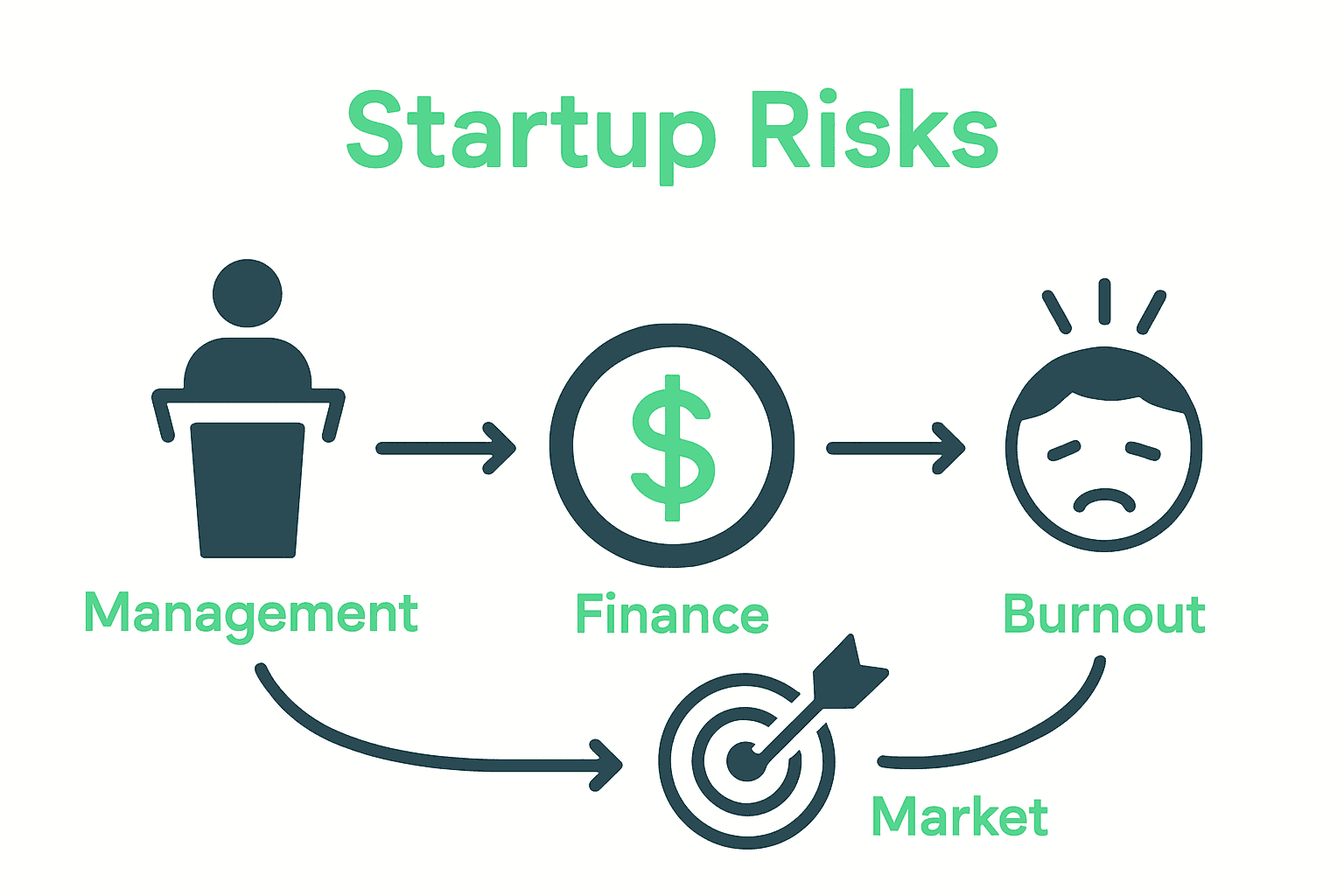
Startup failure is rarely a sudden event but a complex interplay of strategic, operational, and personal challenges that gradually erode a venture’s potential. According to research from MDPI, the root causes of startup failure are multifaceted, extending far beyond simplistic financial narratives.
The landscape of startup challenges can be categorized into several critical root causes:
- Managerial Incompetence: Founders often lack the strategic decision-making skills required to navigate complex business environments
- Financial Mismanagement: Inadequate working capital planning and inefficient resource allocation
- Competitive Pressures: Inability to differentiate or respond effectively to market dynamics
- Overexpansion: Premature scaling before establishing a sustainable business model
- Entrepreneurial Stress: Psychological and operational burnout that undermines strategic thinking
Research indicates that these root causes are interconnected, creating a cascading effect that can rapidly destabilize even promising ventures.
IMAGE:descriptive_key_1] [MDPI emphasizes that understanding these systemic challenges is crucial for developing resilient entrepreneurial strategies. Sustainable entrepreneurship demands not just passion and innovation, but a holistic approach that anticipates and mitigates these fundamental risk factors. Successful founders recognize that navigating these challenges requires continuous learning, adaptive leadership, and a willingness to pivot when initial strategies prove ineffective.
Types of Startup Failure Risks
Startup failure risks are not monolithic but a complex web of interconnected challenges that can silently undermine even the most promising ventures. According to research from Preprints, the startup landscape is treacherous, with nearly 90% of new businesses collapsing within their first decade, predominantly due to preventable financial missteps.
The primary types of startup failure risks can be categorized into several critical domains:
- Financial Risks
- Cash flow instability
- Capital misallocation
- Inadequate funding reserves
- Market Risks
- Misaligned product-market fit
- Incorrect customer segment targeting
- Inability to pivot or adapt
- Operational Risks
- Inefficient business processes
- Scalability challenges
- Poor team management
- Strategic Risks
- Lack of clear vision
- Competitive landscape misunderstanding
- Premature or delayed scaling
Research from arXiv highlights a fascinating insight: failure is not a terminal point but a potential learning trajectory. Successful entrepreneurs understand that risk management is not about eliminating risks entirely, but developing adaptive strategies that transform potential failures into opportunities for growth and innovation. By anticipating these risks and maintaining strategic flexibility, founders can dramatically improve their startup’s resilience and long-term survival prospects.
Real-World Examples and Industry Benchmarks
The startup world is littered with cautionary tales that offer profound insights into failure mechanisms. According to research from e-Research, notorious startup collapses like Quibi, Theranos, and Juicero epitomize how seemingly promising ventures can rapidly unravel due to fundamental strategic miscalculations.
Key industry failure benchmarks reveal startling patterns:
- Survival Rate: Approximately 90% of startups fail within their first decade
- Critical Period: First two years are the most vulnerable
- Primary Failure Triggers:
- Lack of genuine market demand
- Poor product-market alignment
- Unsustainable cash flow management
- Inability to establish consumer trust
Research from JETIR underscores a critical insight: failure is not just about what goes wrong, but about understanding systemic vulnerabilities that predetermine a startup’s trajectory. These real-world examples demonstrate that entrepreneurial success demands more than innovative ideas—it requires rigorous market validation, adaptive strategy, and an uncompromising commitment to solving genuine customer problems. The most successful founders learn to transform these potential failure points into opportunities for pivoting, redesigning, and ultimately creating more resilient business models.
Proven Strategies for Preventing Failure
Startup survival demands more than passionate ideas—it requires a systematic approach to navigating complex entrepreneurial challenges. Research from arXiv reveals that software startups, in particular, face unique hurdles in product development and strategic execution that can be systematically mitigated through proactive strategies.
Key prevention strategies for startup resilience include:
- Prototype Validation
- Rapid, iterative product development
- Continuous user feedback loops
- Minimum viable product (MVP) testing
- Strategic Alignment
- Clear problem/solution mapping
- Consistent managerial execution
- Adaptive business model
- Learning Infrastructure
- Prioritize experimental learning
- Create flexible decision frameworks
- Embrace data-driven insights
- Risk Management
- Comprehensive market research
- Financial scenario planning
- Agile resource allocation
According to arXiv, the most critical prevention mechanism is developing an entrepreneurial learning process that transforms potential failure points into strategic opportunities. Successful founders don’t just avoid risks—they systematically understand, anticipate, and convert challenges into competitive advantages. This approach requires continuous learning, ruthless self-reflection, and a willingness to pivot swiftly when initial assumptions prove incorrect.
Turn Startup Failure Risks Into Your Greatest Strengths
Facing startup failure is more common than you think. This article clearly highlights pain points like managerial struggles, financial pitfalls, and market misalignment that drain passion and momentum from founders. You deserve a smarter, clearer way to navigate these challenges and build resilience while staying true to your vision.
At siift.ai, our Intelligent Business Canvas helps you take control with personalized feedback and prioritized actions that address the real reasons startups fail. From rapid validation and strategic alignment to adaptive learning, this AI-driven platform guides you step-by-step through the founder’s journey without guesswork or unnecessary risks. Don’t wait until challenges become setbacks. Start de-risking your startup today and turn failure into a strategic advantage with siift.ai.
Explore how Intelligent Business Canvas can transform uncertainty into clarity and give you the confidence you need to succeed.
Frequently Asked Questions
What are the common reasons startups fail?
Startup failure often stems from a mix of challenges such as managerial incompetence, financial mismanagement, competitive pressures, overexpansion, and entrepreneurial stress.
How can startup founders prevent their ventures from failing?
Founders can mitigate failure risks by implementing strategies such as prototype validation, strategic alignment, establishing a learning infrastructure, and effective risk management through thorough market research and adaptive resource allocation.
What role does market adaptability play in a startup’s success?
Market adaptability is crucial for startups as it allows founders to pivot and respond effectively to changing market demands, ensuring that their product or service remains relevant and meets customer needs.
How does understanding startup failure contribute to future success?
Recognizing failure as a structured learning process enables entrepreneurs to identify systemic vulnerabilities, learn from mistakes, and develop more resilient business models, transforming setbacks into opportunities for growth.