
Many aspiring entrepreneurs believe market research is too complex, expensive, or time-consuming for early-stage startups. This misconception stops countless innovative ideas from reaching their potential. The truth is that basic market research is accessible, affordable, and essential for validating your business concept and making informed decisions. This guide breaks down market research fundamentals specifically for novice founders and AI-native innovators, showing you how to gather meaningful insights without breaking the bank. You’ll learn practical methods to understand your customers, test your assumptions, and build a foundation for sustainable growth in 2026.
Table of Contents
- What Is Market Research And Why Does It Matter?
- Core Methods For Conducting Effective Market Research
- Analyzing And Applying Research Findings To Grow Your Business
- Testing And Validating Your Business Idea With Minimal Risk
- Learn More And Get Support With Market Research At Siift
- FAQ
Key takeaways
| Point | Details |
|---|---|
| Validation foundation | Market research validates your business idea and reveals actual customer needs before you invest heavily |
| Dual approach | Combining primary and secondary research methods yields the most comprehensive and actionable insights |
| AI acceleration | Leverage AI tools to streamline research processes and analyze data patterns more effectively |
| Trend awareness | Understanding market trends helps you anticipate changes and seize emerging opportunities |
| Early testing | Testing ideas early with affordable methods reduces risk and informs product-market fit strategies |
What is market research and why does it matter?
Market research is crucial for technology startups to understand market needs and reduce risk. At its core, market research means systematically collecting and analyzing information about your customers, competitors, and industry trends. This process transforms guesswork into evidence-based decision making.
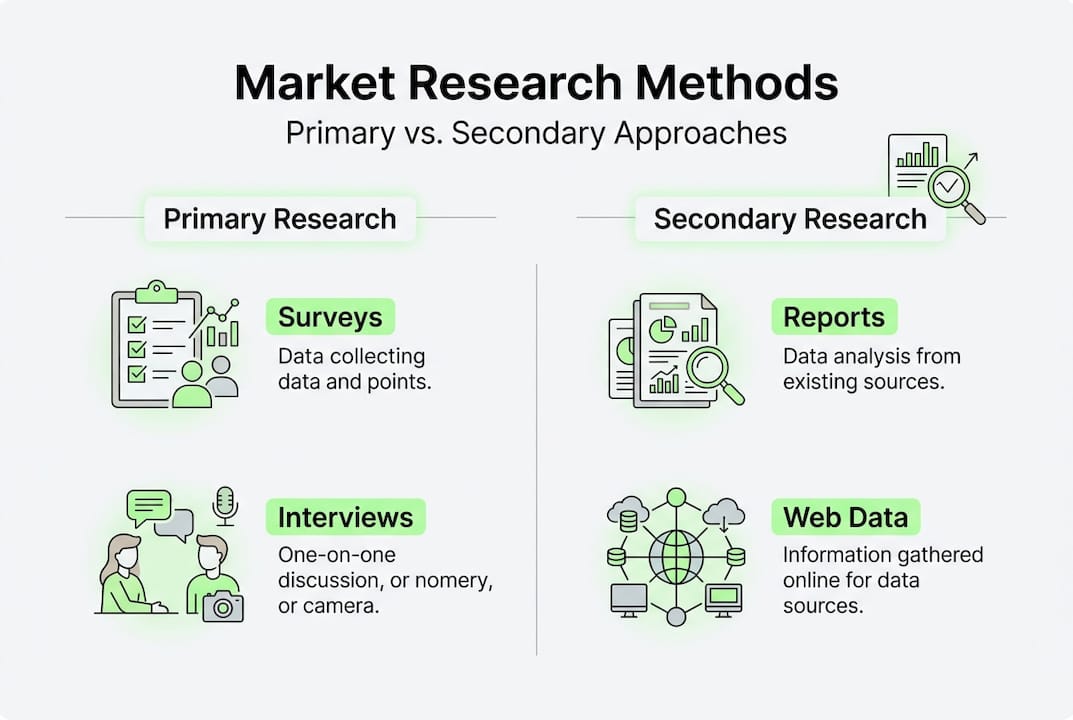
You can approach research through two main pathways. Primary research involves gathering fresh data directly from your target audience through surveys, interviews, or observations. Secondary research analyzes existing information like industry reports, competitor websites, government databases, or academic studies. Think of primary research as creating your own map, while secondary research uses maps others have already drawn.
Why should you invest time in market research? The answer is simple: it prevents expensive mistakes. Launching a product nobody wants wastes months of effort and capital. Research helps you validate assumptions, identify genuine customer pain points, and spot gaps competitors have missed. It guides product development, pricing strategies, and marketing messages based on real data rather than hunches.
Market research plays a vital role in achieving product-market fit, that sweet spot where your offering perfectly addresses a proven demand. Without research, you’re essentially gambling. With it, you’re making calculated bets backed by evidence. This market research guide for beginners provides deeper context for founders just starting out.
Here’s what effective market research accomplishes:
- Validates whether your target audience actually experiences the problem you’re solving
- Reveals how customers currently address this problem and what frustrates them
- Identifies pricing expectations and willingness to pay
- Uncovers competitive advantages you can leverage
- Highlights market size and growth potential
Technology has democratized market research in remarkable ways. AI-powered tools now automate tasks that once required expensive consultants or months of manual work. Small startups can access the same caliber of insights that Fortune 500 companies use, leveling the playing field for innovative founders.
“The goal is to turn data into information, and information into insight.” This transformation from raw numbers to strategic clarity defines successful market research.
Core methods for conducting effective market research
Understanding research methods empowers you to choose the right approach for your specific needs and budget. Combining primary and secondary research leads to deeper insights than relying on just one approach.
Primary research techniques put you in direct contact with potential customers. Surveys let you gather quantitative data from hundreds of respondents quickly and affordably using tools like Google Forms or Typeform. Interviews provide rich qualitative insights through one-on-one conversations that reveal motivations, frustrations, and decision-making processes. Focus groups bring together small groups to discuss your concept, generating dynamic feedback through participant interaction. For a physical product, observation studies show how people actually use similar items in real environments.

Secondary research taps into existing knowledge bases. Industry reports from firms like Gartner or IBISWorld provide market size data, growth projections, and competitive landscapes. Competitor analysis examines rival websites, pricing, customer reviews, and marketing strategies to identify opportunities. Government databases offer demographic information, economic indicators, and regulatory trends. Academic journals contain peer-reviewed studies on consumer behavior and market dynamics.
AI tools help accelerate and improve accuracy of product-market fit research. Modern platforms can analyze thousands of customer reviews in minutes, identify sentiment patterns, and surface unexpected insights human researchers might miss. They automate survey distribution, clean messy data, and generate visualizations that make trends obvious.
Here’s how to plan and execute basic market research efficiently:
- Define your research objectives clearly before collecting any data
- Identify your target audience with specific demographic and psychographic criteria
- Choose methods that match your budget, timeline, and information needs
- Create research instruments like survey questions or interview guides
- Recruit participants through social media, email lists, or research platforms
- Collect data systematically while maintaining consistency across all interactions
- Analyze findings to identify patterns, outliers, and actionable insights
- Document conclusions and translate them into strategic decisions
| Method | Cost | Speed | Insight Depth | Best For |
|---|---|---|---|---|
| Online surveys | Low | Fast | Moderate | Quantifying preferences and behaviors |
| Customer interviews | Low to moderate | Moderate | High | Understanding motivations and pain points |
| Focus groups | Moderate | Moderate | High | Testing concepts and gathering reactions |
| Industry reports | Moderate to high | Fast | Moderate | Market sizing and trend analysis |
| Competitor analysis | Low | Fast | Moderate | Identifying market gaps and positioning |
| AI analysis tools | Low to moderate | Very fast | Moderate to high | Processing large datasets quickly |
Pro Tip: When crafting surveys, avoid leading questions that push respondents toward specific answers. Instead of asking “Don’t you think this feature would be useful?”, try “How would you rate the importance of this feature on a scale of 1 to 10?” Neutral phrasing yields honest, actionable responses.
Explore testing your startup idea and discover how AI tools for market research can transform your validation process.
Analyzing and applying research findings to grow your business
Collecting data means nothing without proper analysis and application. The real value emerges when you transform raw information into strategic decisions that drive growth.
Interpreting qualitative data from interviews or open-ended survey responses requires identifying recurring themes. Read through responses multiple times, coding common phrases or sentiments. If twelve out of fifteen interviewees mention frustration with current solutions being “too complicated,” you’ve discovered a key pain point to address. Quantitative data from surveys or analytics demands statistical thinking. Look for significant patterns, not random noise. A 60% preference for Feature A over Feature B suggests real demand, while a 51% to 49% split might reflect chance.
Customer pain points and market gaps reveal themselves through careful analysis. Pain points are problems people actively experience and would pay to solve. Market gaps are needs that existing solutions inadequately address. When research shows customers jury-rigging workarounds or expressing dissatisfaction with all available options, you’ve found a gap worth exploring.
| Decision Approach | Basis | Speed | Risk Level | Scalability |
|---|---|---|---|---|
| Intuitive | Gut feeling and experience | Very fast | High | Limited |
| Data-driven | Research and evidence | Moderate | Low | High |
Research findings should directly inform multiple business dimensions:
- Marketing messaging that speaks to actual customer language and priorities
- Pricing strategies aligned with perceived value and willingness to pay
- Product features prioritized by real user needs rather than assumptions
- Distribution channels where your target audience actually shops or browses
- Competitive positioning that highlights your unique advantages
Pro Tip: Guard against confirmation bias by actively seeking data that contradicts your assumptions. If you believe customers want Feature X, specifically look for evidence suggesting they don’t. Challenging your own hypotheses leads to more accurate conclusions.
Understanding market trends is essential to anticipate changes and succeed in dynamic markets. Trends indicate where industries are heading, helping you time your launch strategically. Entering a growing market offers more opportunity than fighting for scraps in a declining one. Spotting trends early lets you position as an innovator rather than a follower.
Anticipating trends influences critical timing decisions. If research reveals increasing regulatory pressure on your industry, you might accelerate launch to establish presence before compliance costs rise. If adoption of enabling technology is still nascent, you might delay until infrastructure matures. Strategic timing based on trend analysis can mean the difference between being too early, perfectly positioned, or frustratingly late.
Learn more about identifying market trends and building a comprehensive go to market strategy guide to maximize your competitive advantage.
Testing and validating your business idea with minimal risk
Research provides direction, but testing transforms hypotheses into validated learning. Running affordable, low-risk experiments lets you refine your startup idea before major investments.
Testing ideas early reduces risk and improves product-market fit by revealing what actually resonates with customers. Several methods let you validate assumptions without building the full product.
Landing pages test demand by describing your solution and measuring interest through email signups or pre-orders. Create a simple page explaining your value proposition, drive traffic through social media or ads, and track conversion rates. A 5% conversion rate might signal genuine interest, while 0.5% suggests weak demand or unclear messaging.
Minimum viable products (MVPs) deliver core functionality to early adopters who provide feedback. An MVP isn’t a prototype; it’s the simplest version that solves the main problem. Build only essential features, launch to a small audience, and iterate based on real usage patterns.
Crowdfunding campaigns on platforms like Kickstarter validate both demand and pricing. If people commit money before you build anything, you’ve proven willingness to pay. Campaign performance also tests your marketing message and identifies your most compelling features.
Pilot programs let you test with a limited group before full launch. Offer your solution to ten customers, support them closely, and gather detailed feedback. Their experiences reveal operational challenges and improvement opportunities.
Here’s how to design and execute validation tests effectively:
- Identify your riskiest assumptions that could sink your business if wrong
- Design specific tests that directly validate or invalidate each assumption
- Define success metrics before running tests to avoid moving goalposts
- Run tests with real target customers, not friends or family
- Collect both quantitative data and qualitative feedback
- Analyze results objectively without rationalizing negative signals
- Iterate your concept based on learning and retest
- Know when to pivot or persevere based on evidence
Common testing pitfalls drain resources without generating insights:
- Over-testing minor details while ignoring fundamental assumptions
- Ignoring negative feedback that contradicts your vision
- Testing with the wrong audience who won’t actually buy
- Waiting for perfect conditions instead of learning from imperfect tests
- Confusing vanity metrics like page views with validation metrics like purchases
Iterative testing creates a learning loop that progressively reduces waste. Each experiment teaches you something, letting you adjust before the next round. This approach improves product-market fit systematically rather than hoping you guessed right initially.
Know when to pivot based on test results. If multiple experiments show weak demand for your core concept despite different approaches, consider pivoting to a related problem or audience. If tests validate the problem but not your solution, pivot your approach while keeping the target customer. If everything tests poorly, sometimes the wisest decision is stopping before investing more. Explore smart startup testing methods for detailed validation frameworks.
Learn more and get support with market research at siift
Mastering market research basics positions you to validate and grow your startup confidently. Siift simplifies this journey with AI-powered tools designed specifically for entrepreneurs navigating the path from idea to product-market fit. Our platform guides you through systematic research, validation, and go-to-market planning, filtering out biases and uncertainty that derail many startups. Whether you’re just starting or refining your approach, Siift’s Intelligent Business Canvas accelerates your founder’s journey with step-by-step support. Explore our comprehensive resources and dive deeper with our market research beginner guide to transform your startup idea into a validated, scalable business.
FAQ
What is the difference between primary and secondary market research?
Primary research involves collecting new, original data directly from your target audience through methods like surveys, interviews, or observations. Secondary research analyzes existing information that others have already gathered, such as industry reports, competitor analysis, or government statistics. Primary research answers your specific questions but takes more time and effort, while secondary research is faster and cheaper but may not address your exact needs. Most effective research strategies combine both approaches to gain comprehensive insights.
How can AI tools make market research easier for startups?
AI tools help accelerate and improve accuracy of product-market fit research by automating time-consuming tasks like data collection, cleaning, and analysis. They can process thousands of customer reviews, social media mentions, or survey responses in minutes, identifying patterns and sentiment that would take humans weeks to uncover. AI platforms also reduce costs by eliminating the need for expensive consultants or large research teams. This democratization lets resource-constrained startups access enterprise-level insights and compete more effectively against established players.
What are simple ways to test a business idea without spending a lot?
Testing ideas early with low-cost methods reduces risk and improves success rates significantly. Create a landing page describing your solution and measure how many visitors sign up for updates or pre-order, which costs only the price of a domain and basic hosting. Build a minimum viable product with just core features to gather real usage feedback before investing in full development. Use social media polls or free survey tools to validate demand and preferences among your target audience. These approaches provide genuine validation signals without requiring substantial capital investment.
How much market research should I do before launching?
Balance thoroughness with speed by focusing research on your riskiest assumptions rather than trying to answer every possible question. Conduct enough research to validate that a real problem exists, that your target customers experience it, and that they’d pay for your solution. This typically requires 15 to 30 customer interviews, a survey with 100+ responses, and analysis of 3 to 5 direct competitors. Avoid analysis paralysis by setting a research deadline, then launching your MVP to gather real-world data. Remember that some questions only get answered through actual market interaction, not pre-launch research.